Redox Signaling Mechanisms: How Cysteine Modification Controls Cellular Function and Disease Pathways
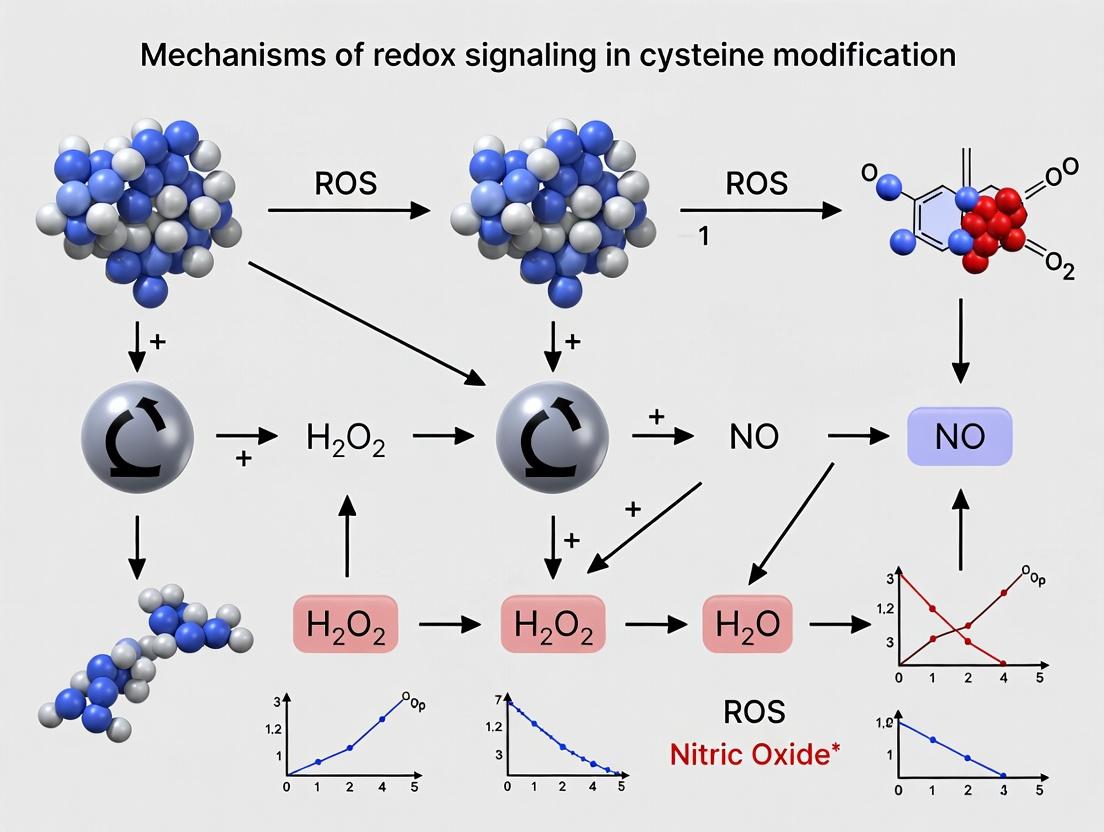
This article provides a comprehensive analysis of redox signaling mediated by post-translational cysteine modification, tailored for researchers and drug development professionals.
Redox Signaling Mechanisms: How Cysteine Modification Controls Cellular Function and Disease Pathways
Abstract
This article provides a comprehensive analysis of redox signaling mediated by post-translational cysteine modification, tailored for researchers and drug development professionals. It explores the fundamental chemical mechanisms and reactive oxygen species involved, details current methodologies for detection and experimental application, addresses common challenges in redox biology research, and compares key signaling hubs and their validation across physiological and pathological contexts. The synthesis offers a roadmap for leveraging redox signaling in therapeutic development.
The Chemical Language of Cells: Foundational Principles of Cysteine Redox Signaling
Within the broader thesis on Mechanisms of redox signaling in cysteine modification research, it is imperative to precisely define redox signaling as a distinct, regulated biological process. This paper distinguishes it from the stochastic damage associated with oxidative stress. Redox signaling involves the specific, reversible post-translational modification of cysteine residues in proteins, primarily through reactions with reactive oxygen/nitrogen species (ROS/RNS) like H₂O₂, peroxynitrite, or oxidized glutathione. These modifications, including sulfenylation (-SOH), disulfide formation (-SS-), S-glutathionylation (-SSG), and S-nitrosylation (-SNO), function as molecular switches to modulate protein function, localization, and interactions, thereby regulating critical cellular pathways in metabolism, immune response, and gene expression. Oxidative stress, in contrast, represents a state where antioxidant defenses are overwhelmed, leading to irreversible oxidative damage (e.g., carbonylation, irreversible sulfinic/sulfonic acid formation) and cell death.
Core Molecular Mechanisms and Cysteine Modification
Key Cysteine Redox Modifications
The reactivity of cysteine is governed by its microenvironment. A low pKa thiolate anion (Cys-S⁻) is highly nucleophilic and prone to redox modification.
Primary Reversible Modifications:
- Sulfenylation (Cys-SOH): The initial reaction of a thiolate with H₂O₂.
- Disulfide Bond Formation (Cys-SS-Cys): Intramolecular or intermolecular, often via sulfenylate intermediate.
- S-Glutathionylation (Cys-SSG): Mixed disulfide with glutathione (GSH).
- S-Nitrosylation (Cys-SNO): Reaction with nitric oxide (NO) derivatives.
Quantitative Landscape of Redox Potentials
Table 1: Standard Redox Potentials and Cellular Concentrations of Key Redox Couples
| Redox Couple | Approximate E'° (mV, pH 7.0) | Typical Cellular Concentration (Resting State) | Significance in Signaling |
|---|---|---|---|
| GSH/GSSG | -240 | [GSH]: 1-10 mM; [GSSG]: 1-100 µM (Ratio: 30:1 to 100:1) | Central redox buffer; defines cellular redox environment. |
| Trx-(SH)₂/Trx-S₂ | -270 to -290 | Low µM range | Key protein disulfide reductase; directly regulates signaling proteins (e.g., ASK1, NF-κB). |
| H₂O₂/H₂O | +1,320 | ~1-100 nM (transiently higher) | Primary signaling ROS; oxidizes specific target cysteines. |
| Cysteine/Cystine | -250 to -200 | [Cys]: ~20-200 µM; [Cystine]: ~20-100 µM | Extracellular redox buffer; influences receptor activity. |
Experimental Protocols for Cysteine Redox Signaling Research
Protocol: Detection of Protein S-Sulfenylation using Dimedone-based Probes
Objective: To selectively label and detect sulfenylated proteins/cysteine residues. Principle: Cyclic 1,3-diones (e.g., dimedone) selectively react with sulfenic acid (-SOH) forming a stable thioether adduct.
Materials & Procedure:
- Cell Treatment & Lysis: Treat cells with a redox stimulus (e.g., precise bolus of H₂O₂, 10-500 µM, 1-10 min). Rapidly lyse in modified RIPA buffer containing 20-50 mM of the alkylating agent N-ethylmaleimide (NEM) to block free thiols and arrest further redox changes.
- Sulfenic Acid Labeling: Incubate clarified lysate with a biotin-conjugated dimedone probe (e.g., DYn-2, 100 µM, 1 hr, room temp, in the dark).
- Capture and Analysis: Precipitate proteins. Affinity-purify biotinylated proteins using streptavidin beads. Wash stringently.
- Detection:
- Western Blot: Elute proteins and analyze by SDS-PAGE/WB with streptavidin-HRP or specific antibodies.
- Mass Spectrometry: On-bead tryptic digest for LC-MS/MS identification of modified sites.
Protocol: Assessing Thiol Redox State via Maleimide Alkylation Shift Assay
Objective: To evaluate the oxidation state (free vs. oxidized) of specific protein cysteines. Principle: Sequential alkylation with differently sized maleimide reagents (e.g., NEM vs. Polyethylene glycol-maleimide (PEG-maleimide)) causes a gel shift proportional to the number of reduced cysteines.
Materials & Procedure:
- Free Thiol Blockade (In Vivo/In Situ): Lyse cells directly in buffer with excess NEM (e.g., 50 mM) to covalently tag all reduced cysteines.
- Reduction of Oxidized Thiols: Treat an aliquot of the NEM-blocked lysate with a strong reducing agent (e.g., DTT, 10-50 mM, 30 min).
- Labeling of Newly Reduced Thiols: Alkylate the reduced cysteines with a larger maleimide (e.g., PEG-maleimide 5kDa, 2 mM).
- Detection: Run samples (non-reduced vs. DTT/PEG-treated) on non-reducing SDS-PAGE. A characteristic upward gel shift indicates the protein contained cysteines that were oxidized (and thus not blocked by initial NEM) in the cell.
Visualization of Key Pathways
Nrf2-Keap1 Redox Signaling Pathway
Diagram Title: Nrf2 Activation via Keap1 Cysteine Oxidation
Experimental Workflow for Redox Cysteine Proteomics
Diagram Title: Workflow for Redox Proteomics using Biotin Switch
The Scientist's Toolkit: Research Reagent Solutions
Table 2: Essential Reagents for Cysteine Redox Signaling Research
| Reagent Category | Specific Example(s) | Function & Critical Note |
|---|---|---|
| Thiol Alkylators | N-ethylmaleimide (NEM), Iodoacetamide (IAM) | Irreversibly blocks free thiols (-SH) to "snapshot" the redox state. NEM is membrane-permeable for in situ quenching. Must be used in excess and fresh. |
| Reducing Agents | Dithiothreitol (DTT), Tris(2-carboxyethyl)phosphine (TCEP) | Reduces reversible oxidations (disulfides, sulfenic acids). TCEP is stronger, more stable, and does not react with maleimides. |
| Specific ROS Donors | Hydrogen Peroxide (H₂O₂), Tert-butyl hydroperoxide (tBHP), MitoParaquat | Deliver controlled, dose-dependent ROS signals. Select donors based on subcellular targeting (e.g., MitoParaquat generates mitochondrial O₂⁻). |
| Sulfenic Acid Probes | Dimedone, DYn-2 (biotin-dimedone), DAz-2 (azide-dimedone) | Chemoselective probes for labeling sulfenic acid modifications (-SOH). Enable detection via biotin enrichment or click chemistry. |
| Biotin-Switch Reagents | Methyl Methanethiosulfonate (MMTS), Biotin-HPDP, PEG-maleimide | Core reagents for the biotin-switch technique (BST) to detect S-nitrosylation or total reversible oxidation. |
| Glutathione Probes | Biotinylated glutathione ethyl ester (BioGEE) | Cell-permeable probe to monitor protein S-glutathionylation dynamically. |
| Antioxidant Enzymes | PEG-Catalase, PEG-Superoxide Dismutase | Scavenge specific ROS extracellularly to confirm signaling mediation. PEGylation prolongs activity. |
| Redox Biosensors | roGFP2-Orp1, HyPer | Genetically encoded fluorescent sensors for live-cell imaging of H₂O₂ dynamics or glutathione redox potential (Eh). |
Within the broader thesis on mechanisms of redox signaling, the targeted modification of cysteine residues stands as a central paradigm. Cysteine thiols (-SH) are uniquely redox-active, undergoing reversible post-translational modifications that regulate protein function, localization, and interactions. Hydrogen peroxide (H₂O₂), nitric oxide (NO), and reactive nitrogen species (RNS) are key endogenous reactive molecules that drive these modifications, transitioning from their historical perception as purely damaging oxidants to essential signaling agents. This whitepaper provides an in-depth technical guide to their generation, specific cysteine modifications, downstream consequences, and experimental interrogation.
H₂O₂ as a Signaling Agent
Generation and Specificity
H₂O₂ is primarily generated enzymatically via NADPH oxidases (NOX family) and as a byproduct of mitochondrial respiration. Its signaling specificity is achieved through localized production, kinetic barriers, and the presence of sensor proteins with reactive, low-pKa cysteine thiolates.
Primary Cysteine Modifications
The primary modification is the oxidation of a cysteine thiolate (-S⁻) to sulfenic acid (-SOH). This rapid and reversible modification can lead to further states:
- Disulfide formation (-S-S-): With a proximal cysteine.
- S-glutathionylation (-SSG): With glutathione.
- Irreversible overoxidation: To sulfinic (-SO₂H) or sulfonic (-SO₃H) acids under high/ sustained flux.
Key Signaling Pathways
H₂O₂ signaling is crucial in growth factor receptor signaling (e.g., EGFR, PDGFR), apoptosis regulation (via phosphatases like PTEN), and innate immune responses (NF-κB pathway).
Table 1: Quantitative Parameters of H₂O₂ Signaling
| Parameter | Typical Physiological Range | Key Measurement Method |
|---|---|---|
| Intracellular Concentration | 1-100 nM (basal); up to ~1 µM (signaling) | Genetically encoded probes (e.g., HyPer) |
| Rate of Production (NOX2) | ~0.5-1.0 nmol/min/10^6 cells | Amplex Red/Horseradish Peroxidase assay |
| 2-Cys Peroxiredoxin Oxidation Rate Constant | ~10^7 - 10^8 M⁻¹s⁻¹ | Stopped-flow spectroscopy |
| Half-life in Cell | ~1 ms | Computational modeling & direct measurement |
Nitric Oxide (NO) and Reactive Nitrogen Species (RNS)
Generation and Classification
NO is synthesized by nitric oxide synthases (NOS: neuronal nNOS, inducible iNOS, endothelial eNOS). RNS arise from the diffusion-limited reaction between NO and superoxide (O₂⁻), forming peroxynitrite (ONOO⁻), a potent oxidant and nitrating agent.
Primary Cysteine Modifications
NO and RNS induce distinct, often competing, modifications:
- S-nitrosylation (SNO): Addition of a nitroso group to a thiol, forming S-nitrosothiol (-SNO). A primary mechanism for NO-based signaling.
- S-glutathionylation: Promoted by ONOO⁻ or via SNO-derived intermediates.
- Sulfenic acid formation: Directly by ONOO⁻.
- Tyrosine nitration: By ONOO⁻, forming 3-nitrotyrosine (not a cysteine modification but a key RNS footprint).
Key Signaling Pathways
SNO signaling regulates critical processes including vasodilation (sGC activation), mitochondrial respiration (complex I inhibition), and stress response (HIF-1α stabilization, NF-κB regulation).
Table 2: Quantitative Parameters of NO/RNS Signaling
| Parameter | Typical Physiological Range | Key Measurement Method |
|---|---|---|
| NO Concentration (paracrine) | Low nM to ~1 µM (peak) | Electrochemical sensors, DA-FM DA probe |
| ONOO⁻ Generation Rate | ~50-100 µM/s at sites of inflammation | Boronate-based probes (e.g., coumarin-7-boronate) |
| GSNO-R (Enzyme degrading SNOs) Km | ~100 µM for GSNO | Enzyme kinetics |
| S-Nitrosylation Rate Constant (for model thiols) | ~10³ M⁻¹s⁻¹ (direct NO reaction) | Competition kinetics, chemiluminescence |
Experimental Protocols for Detection and Quantification
Protocol: Detection of Protein S-Nitrosylation (Biotin-Switch Technique)
Principle: Selective reduction of S-NO bonds, followed by labeling of nascent thiols with a biotinylated agent.
- Cell Lysis & Blocking: Lyse cells in HEN buffer (250 mM HEPES-NaOH pH 7.7, 1 mM EDTA, 0.1 mM neocuproine) with 2.5% SDS. Add methyl methanethiosulfonate (MMTS) to 20 mM to block free thiols. Incubate at 50°C for 20 min with frequent vortexing.
- Acetone Precipitation: Remove excess MMTS by adding 2 volumes of pre-chilled acetone, incubating at -20°C for 20 min, and centrifuging at 2000 x g for 10 min. Wash pellet twice with 70% acetone.
- Reduction of S-NO Bonds: Resuspend pellet in HEN buffer with 1% SDS. Add sodium ascorbate (fresh, 20 mM final) to selectively reduce S-NO bonds to free thiols. Incubate at room temperature for 1 hour. Control: Omit ascorbate.
- Biotinylation: Add biotin-HPDP (N-[6-(biotinamido)hexyl]-3'-(2'-pyridyldithio)propionamide) from a 4 mM stock in DMSO to a final concentration of 0.4 mM. Incubate at room temperature for 1 hour.
- Pull-down & Analysis: Remove excess biotin-HPDP by acetone precipitation. Resuspend pellet in neutralization buffer. Incubate with streptavidin-agarose beads for 1 hour. Wash beads extensively, elute proteins with Laemmli buffer containing β-mercaptoethanol, and analyze by western blot.
Protocol: Quantifying Intracellular H₂O₂ with Genetically Encoded Probes (e.g., HyPer)
Principle: HyPer is a circularly permuted YFP fused to the H₂O₂-sensitive domain of OxyR. Oxidation causes a ratiometric fluorescence change.
- Transfection: Transfect cells with a plasmid encoding HyPer (targeted to a specific compartment if using HyPer-3, e.g., mito-HyPer).
- Live-Cell Imaging: 24-48h post-transfection, transfer cells to a perfusion chamber in phenol-free imaging medium. Use a live-cell imaging capable microscope with a 40x/63x oil objective.
- Ratiometric Measurement: Excite sequentially at 420 nm and 500 nm using a monochromator or appropriate filter sets. Collect emission at 516 nm. Calculate the ratio (F500/F420) for each cell over time.
- Calibration: At the end of the experiment, perfuse with 100 µM H₂O₂ to obtain Rmax, followed by 10 mM DTT to obtain Rmin. Calculate [H₂O₂] using the formula: [H₂O₂] = Kd * ((R - Rmin)/(Rmax - R)), where HyPer's Kd ≈ 140 nM.
The Scientist's Toolkit: Research Reagent Solutions
Table 3: Essential Reagents for Redox Signaling Research
| Reagent/Category | Example Products | Primary Function in Research |
|---|---|---|
| ROS/RNS Donors | DEA-NONOate (NO), SIN-1 (ONOO⁻), t-BOOH (organic peroxide) | Provide controlled, chemical generation of specific species for in vitro or cellular stimulation studies. |
| Fluorescent Probes | CM-H2DCFDA (general oxidative stress), DAF-FM DA (NO), MitoSOX (mito O₂⁻) | Detect and semi-quantify reactive species in live or fixed cells via flow cytometry or microscopy. |
| Genetically Encoded Sensors | HyPer (H₂O₂), roGFP (Glutathione redox potential), SNO-Flash (S-nitrosylation) | Enable specific, compartmentalized, ratiometric measurement of redox species/events in live cells. |
| Scavengers & Inhibitors | PEG-Catalase (H₂O₂), FeTPPS (ONOO⁻), L-NAME (NOS), VAS2870 (NOX) | Pharmacologically manipulate endogenous levels of reactive species to establish causality. |
| Thiol-blocking Agents | Iodoacetamide (IAM), N-ethylmaleimide (NEM), Methyl Methanethiosulfonate (MMTS) | Alkylate free thiols to "snapshot" the redox state or prevent artifacts during sample preparation. |
| Selective Reducing Agents | Sodium Ascorbate (reduces S-NO), Arsenite (reduces sulfenic acid), DTT/TCEP (general disulfide reduction) | Selectively reverse specific cysteine modifications for identification (e.g., biotin-switch) or functional assays. |
| Antibodies for PTMs | Anti-3-nitrotyrosine, Anti-S-glutathione, Anti-sulfenic acid (DCP-Rho/Dimedone based) | Detect specific oxidative post-translational modifications in proteins via immuno blotting or microscopy. |
Visualization of Pathways and Workflows
Within the broader thesis on Mechanisms of Redox Signaling in Cysteine Modification Research, the unique chemical properties of cysteine residues establish them as central sentinels in cellular redox homeostasis. This whitepaper provides an in-depth technical analysis of cysteine thiol reactivity, focusing on the pivotal role of pKa modulation in dictating sensor function. The nucleophilic thiolate anion (S⁻), not the protonated thiol (SH), is the reactive species in most redox modifications. The local protein microenvironment exerts profound control over the cysteine thiol's acid dissociation constant (pKa), shifting it from a typical value of ~8.5 to values as low as 3-4 in specialized sensor proteins, thereby "tuning" its reactivity and specificity toward oxidants like hydrogen peroxide (H₂O₂).
Core Principles of Thiol Reactivity and pKa Modulation
The reactivity of a cysteine thiol is governed by the equilibrium:
R–SH ⇌ R–S⁻ + H⁺
The fraction of thiolate anion present at physiological pH (7.4) is determined by its pKa via the Henderson-Hasselbalch equation. A lowered pKa results in a significantly higher proportion of the reactive thiolate, enhancing sensitivity to oxidation. Key mechanisms of pKa modulation include:
- Electrostatic Effects: Positively charged residues (e.g., Arg, Lys, protonated His) or dipole moments from alpha-helices stabilize the negative charge of the thiolate, lowering the pKa.
- Hydrogen Bonding: Networks of hydrogen bond donors (backbone amides, Ser, Thr, Tyr) pre-organize to stabilize the thiolate.
- Local Dielectric/Solvent Accessibility: Burial of the cysteine in a low-dielectric (hydrophobic) or structured polar environment can destabilize the neutral thiol, favoring deprotonation.
Table 1: pKa Modulation in Characterized Redox Sensor Proteins
| Protein | Cysteine Residue | Measured pKa | Modulation Mechanism | Primary Oxidant |
|---|---|---|---|---|
| Human Peroxiredoxin 2 (Prdx2) | Cys51 (peroxidatic) | ~5.3 | Stabilization by Arg128, Thr44, and helix dipole. | H₂O₂, Organic Peroxides |
| Bacillus subtilis OhrR | Cys15 | ~4.6 | Arg18 salt bridge and hydrogen bonding network. | Organic Peroxides, HOCl |
| Salmonella Typhimurium AhpC | Cys46 (peroxidatic) | ~5.8 | Arg133, helix dipole, and buried hydrophobic environment. | H₂O₂, Peroxynitrite |
| Human GAPDH | Cys152 | ~6.3 | Proximity to catalytic His179 and NAD⁺ cofactor. | H₂O₂, Nitric Oxide |
| Human KEAP1 | Cys151 | ~5.5 | Positively charged microenvironment (Lys, Arg). | Electrophiles, 15d-PGJ₂ |
Experimental Methodologies for Characterizing Redox Sensor Cysteines
Determination of Cysteine pKa
Protocol: Kinetic-based pKa Determination using DTNB (Ellman's Reagent)
- Reagent Preparation: Prepare a series of 0.1 M buffers covering pH 4.0 to 9.5 (e.g., Acetate, MES, MOPS, HEPES, CHES). Prepare stock solutions of 10 mM DTNB in assay buffer (e.g., 0.1 M sodium phosphate, 1 mM EDTA, pH 7.0) and 100 mM DTT (positive control).
- Protein Preparation: Buffer-exchange the purified protein of interest into a low-thiol buffer (e.g., 50 mM HEPES, 100 mM NaCl, pH 7.4) using a desalting column to remove reducing agents. Determine concentration spectrophotometrically.
- Assay Procedure: a. In a 96-well plate, mix 98 μL of each pH buffer with 2 μL of protein (final concentration 1-10 μM). b. Initiate the reaction by adding 10 μL of 2 mM DTNB (final concentration 0.2 mM). c. Immediately monitor the increase in absorbance at 412 nm (ε = 14,150 M⁻¹cm⁻¹ for TNB²⁻) for 5-10 minutes. d. Perform control reactions with buffer alone and with fully reduced protein (pre-treated with excess DTT and desalted).
- Data Analysis: Calculate the initial reaction rate (v₀) for each pH. Plot v₀ (or log v₀) vs. pH. Fit the data to a sigmoidal curve or the Henderson-Hasselbalbalch equation to determine the apparent pKa.
Quantifying Thiol Reactivity and Oxidation Kinetics
Protocol: Stopped-Flow Kinetics for H₂O₂ Reaction
- Instrument Setup: Equip a stopped-flow spectrophotometer with a photomultiplier tube or diode array detector. Thermostat the system to 25°C.
- Sample Preparation: Reduce and desalt protein as in 3.1. Prepare anaerobic stocks of H₂O₂ in the same buffer, standardized by A₂₄₀ (ε = 43.6 M⁻¹cm⁻¹).
- Reaction Monitoring: a. Load one syringe with protein (10-50 μM final after mixing). b. Load the second syringe with H₂O₂ (typically 10- to 1000-fold molar excess). c. Rapidly mix equal volumes and observe. d. For direct thiolate monitoring, record decay at 240 nm (S⁻ to sulfenic acid) or use a coupled assay with excess dimedone followed by detection.
- Data Analysis: Fit the resulting time-course absorbance traces to a single or double exponential function. Plot observed rate constants (kobs) against [H₂O₂] to determine the apparent second-order rate constant (kapp).
Table 2: Second-Order Rate Constants for Cysteine Oxidation by H₂O₂
| Protein / Peptide | Cysteine Context | k_app (M⁻¹s⁻¹) at pH 7.4, 25°C | Method |
|---|---|---|---|
| Glutathione (GSH) | Free thiol in solution | ~0.9 - 3.0 | Stopped-Flow, Competition |
| Human Prdx2 | Cys51 (pKa ~5.3) | 1.4 x 10⁷ | Stopped-Flow (A₂₄₀ decay) |
| S. typhimurium AhpC | Cys46 (pKa ~5.8) | 2.5 x 10⁷ | Stopped-Flow (Coupled NADH oxidation) |
| PTP1B | Cys215 (Active site) | ~20 - 50 | Competition with GSH/Chloroacetate |
| Low-pKa Model Peptide | CXXC in α-helix | ~1.5 x 10⁴ | Iodine Competition Assay |
Visualization of Pathways and Workflows
Redox Sensor Activation Pathway
pKa Determination via DTNB Kinetic Assay
The Scientist's Toolkit: Key Research Reagents & Materials
Table 3: Essential Reagents for Cysteine Redox Sensor Research
| Reagent / Material | Function & Application | Key Considerations |
|---|---|---|
| Dithiothreitol (DTT) / Tris(2-carboxyethyl)phosphine (TCEP) | Chemical reduction of disulfides and sulfenic acids. Maintains thiols in reduced state for experiments. | TCEP is more stable, metal-free, and effective at a wider pH range than DTT. |
| 5,5'-Dithio-bis-(2-nitrobenzoic acid) (DTNB, Ellman's Reagent) | Colorimetric quantitation of free thiols. Forms yellow TNB²⁻ anion (A₄₁₂). Used in pKa determination assays. | Reaction is pH-dependent (works best >pH 7.0). High concentrations can denature some proteins. |
| Dimedone (5,5-Dimethyl-1,3-cyclohexanedione) | Electrophilic probe that specifically and irreversibly tags sulfenic acid (SOH) intermediates. Used in immunoblotting and activity assays. | Forms a stable thioether adduct. Can be derivatized with biotin or fluorescent tags for detection. |
| Iodoacetamide (IAM) & N-Ethylmaleimide (NEM) | Alkylating agents that irreversibly block free thiols. Used to "cap" or "trap" reduced cysteines, quench reactions, or prevent artifactual oxidation. | Use in excess under denaturing conditions for complete blocking. IAM is more specific than NEM but slower. |
| H₂O₂ Stocks (e.g., Pierce Quantitative Peroxide Assay Kits) | Primary physiological oxidant used in in vitro reactivity studies. Requires precise, fresh quantification. | Commercial stabilized solutions or enzyme-based kits (e.g., Horseradish Peroxidase/Amplex Red) provide accurate concentration control. |
| Mass Spectrometry-Compatible Alkylating Agents (e.g., Iodoacetamide-d₃, NEM-d₅) | Isotopically labeled thiol-blocking agents for quantitative redox proteomics via ICAT or similar methods. | Allows pairwise comparison of reduced vs. oxidized thiol states from different samples by mass shift. |
| Recombinant Human Peroxiredoxins (e.g., Prdx1, Prdx2) | Benchmark proteins with well-characterized low-pKa cysteines. Essential positive controls for kinetic and pKa assays. | Available from commercial suppliers or purified from E. coli expression systems. |
Abstract: Within the framework of redox signaling research, reversible cysteine modifications serve as crucial molecular switches, transducing oxidative and nitrosative signals into functional cellular responses. This whitepaper provides a technical dissection of four major thiol-based modifications—S-nitrosylation (SNO), S-glutathionylation (SSG), sulfenic acid formation (SOH), and disulfide bond formation (S-S)—detailing their chemical genesis, regulatory roles, and experimental interrogation. The integration of quantitative data, standardized protocols, and visualization tools aims to equip researchers with a comprehensive resource for advancing mechanistic studies and therapeutic targeting in redox biology.
The thiol group (-SH) of cysteine residues is uniquely susceptible to post-translational modifications (PTMs) by reactive oxygen and nitrogen species (ROS/RNS). These modifications are not merely markers of oxidative stress but are integral components of sophisticated signaling cascades regulating apoptosis, metabolism, inflammation, and gene expression. The specificity and outcome of signaling are dictated by the type of modification, its subcellular localization, and its reversibility. This guide delineates the core mechanisms, cross-talk, and methodologies central to studying these pivotal redox events.
Chemical Mechanisms and Biological Roles
S-Nitrosylation (SNO)
S-nitrosylation involves the covalent addition of a nitric oxide (NO) group to a cysteine thiol, forming an S-nitrosothiol (R-SNO). It is primarily mediated by NO synthases (NOS) and transnitrosylation reactions from donor molecules like S-nitrosoglutathione (GSNO).
- Key Regulators: GSNO reductase (GSNOR) denitrosylates proteins via GSNO.
- Signaling Role: Modulates activity of caspases, transcription factors (e.g., NF-κB), and ion channels (e.g., NMDAR).
S-Glutathionylation (SSG)
This entails the formation of a mixed disulfide between a protein cysteine thiol and the tripeptide glutathione (GSH). It occurs via thiol-disulfide exchange with oxidized glutathione (GSSG) or via reactions with sulfenic acid or nitrosothiol intermediates.
- Key Regulators: Glutaredoxin (Grx) catalyzes reversible deglutathionylation.
- Signaling Role: Protects cysteines from irreversible oxidation; regulates metabolism (e.g., GAPDH), apoptosis, and cytoskeletal dynamics.
Sulfenation (Sulfenic Acid Formation, SOH)
Sulfenic acid formation is the direct, reversible two-electron oxidation of a cysteine thiol by H₂O₂ or other peroxides. It is a pivotal intermediate state, preceding further oxidation to sulfinic/sulfonic acids or progression to SSG or disulfides.
- Key Regulators: Reaction kinetics are controlled by local pKa and solvent accessibility.
- Signaling Role: Serves as a rapid sensor for H₂O₂ in growth factor and stress signaling (e.g., regulation of PTP1B, ASK1).
Disulfide Formation (S-S)
Disulfide bonds are covalent links between the thiol groups of two cysteines, either within a protein (intramolecular) or between proteins (intermolecular). Formation is typically catalyzed by oxidoreductases of the thioredoxin (Trx) and protein disulfide isomerase (PDI) families.
- Key Regulators: Thioredoxin (Trx) and glutaredoxin (Grx) systems reduce disulfides.
- Signaling Role: Stabilizes protein structure; regulates enzyme activity and protein-protein interactions in the endoplasmic reticulum and during oxidative stress.
Quantitative Comparison of Modification Properties
Table 1: Comparative Analysis of Major Cysteine Modifications
| Property | S-Nitrosylation | S-Glutathionylation | Sulfenation | Disulfide Formation |
|---|---|---|---|---|
| Chemical Formula | R-S-N=O | R-S-SG | R-S-OH | R₁-S-S-R₂ |
| Primary Inducer | NO, RNS | Oxidized GSH, ROS/RNS | H₂O₂, Organic Peroxides | Oxidizing Environment |
| Key Detoxification Enzyme | GSNO Reductase | Glutaredoxin (Grx) | Specific reductants (e.g., Srx)¹ | Thioredoxin (Trx), Grx |
| Typical Reversibility | Highly Reversible | Highly Reversible | Reversible (transient) | Reversible |
| Approx. Cellular Half-life² | Seconds-Minutes | Minutes | Milliseconds-Seconds | Minutes-Hours |
| Common Detection Method | Biotin Switch | Anti-GSH Immunoblot | Dimedone Probes | Non-reducing SDS-PAGE |
| Example Target Protein | Caspase-3 | GAPDH | PTP1B | PDIs in ER |
¹Sulfiredoxin (Srx) reduces cysteine sulfinic acid (SO₂H), not sulfenic acid directly. Sulfenation is typically reversed via reaction with thiols. ²Half-lives are highly context-dependent and vary by protein, cell type, and redox environment.
Experimental Protocols for Detection and Validation
Protocol: SNO Site Identification via Biotin Switch Technique (BST)
Principle: Free thiols are blocked, SNO groups are selectively reduced to thiols, which are then labeled with a biotinylated agent for enrichment and detection.
- Blocking: Lyse cells in HEN buffer (HEPES, EDTA, Neocuproine) with 2.5% SDS and 20 mM methyl methanethiosulfonate (MMTS) at 50°C for 30 min to block free thiols.
- Acetone Precipitation: Remove excess MMTS by acetone precipitation.
- Reduction/Labeling: Resuspend pellet in HEN buffer with 1 mM ascorbate (to reduce SNO) and 0.4 mM biotin-HPDP. Incubate for 1 hour at 25°C.
- Pull-down & Analysis: Precipitate proteins, resuspend in neutralization buffer, and incubate with NeutrAvidin beads. Wash beads, elute with sample buffer containing β-mercaptoethanol, and analyze by immunoblot or mass spectrometry.
Protocol: Detection of Protein S-Glutathionylation
Principle: Use of anti-glutathione antibodies or selective reduction of mixed disulfides.
- Cell Lysis & Blocking: Lyse cells in the presence of 50-100 mM N-ethylmaleimide (NEM) to alkylate free thiols and prevent artifacts.
- Immunoprecipitation/Western Blot: Immunoprecipitate the protein of interest under non-reducing conditions. Separate by non-reducing SDS-PAGE and immunoblot using a monoclonal anti-GSH antibody.
- Alternative: Selective Reduction: Treat lysates with specific reductants like glutaredoxin (Grx) system (Grx1, GSH, NADPH) to reduce SSG bonds, comparing treated vs. untreated samples on non-reducing gels.
Protocol: Chemoselective Probing of Sulfenic Acids
Principle: Use of nucleophilic, cell-permeable probes like dimedone derivatives that covalently tag sulfenic acids.
- In-situ Labeling: Treat live cells with stimuli (e.g., H₂O₂) in the presence of a sulfenic acid probe (e.g., DYn-2 or BTD at 50-100 µM) for 5-30 min.
- Cell Lysis & Click Chemistry: Lyse cells. If using an alkyne-functionalized probe (e.g., DYn-2), perform copper-catalyzed azide-alkyne cycloaddition (CuAAC) with a biotin-azide or fluorescent-azide tag.
- Enrichment/Detection: Enrich biotinylated proteins with streptavidin beads for proteomics, or detect labeled proteins via fluorescent scanning or anti-biotin immunoblot.
Visualization of Signaling Pathways and Workflows
Diagram 1: Redox modification network and reversibility.
Diagram 2: Biotin switch technique (BST) workflow.
The Scientist's Toolkit: Key Research Reagents
Table 2: Essential Reagents for Studying Cysteine Redox Modifications
| Reagent Name | Category | Function & Application |
|---|---|---|
| N-Ethylmaleimide (NEM) | Thiol Alkylator | Irreversibly blocks free thiols to prevent post-lysis oxidation artifacts. |
| Methyl Methanethiosulfonate (MMTS) | Thiol Blocking Agent | Reversible thiol blocker used specifically in the Biotin Switch Technique. |
| Biotin-HPDP | Affinity Label | Thiol-reactive, cleavable biotinylation agent for labeling ascorbate-reduced SNO sites. |
| Dimedone (DYn-2, BTD) | Chemoselective Probe | Cell-permeable probes that covalently and specifically tag sulfenic acid (SOH) residues. |
| S-Nitrosoglutathione (GSNO) | NO Donor | Chemical tool to induce protein S-nitrosylation in cellular and biochemical assays. |
| Recombinant Glutaredoxin (Grx1) | Reductase Enzyme | Catalyzes the specific reduction of S-glutathionylated proteins. |
| Anti-Glutathione Antibody | Detection Tool | Monoclonal antibody for direct immunodetection of protein-SSG adducts by Western blot. |
| Auranofin | Inhibitor | Selective inhibitor of Thioredoxin Reductase (TrxR), disrupting the thioredoxin system. |
Within the framework of a thesis on Mechanisms of redox signaling in cysteine modification research, understanding the principal redox buffering systems is fundamental. Cellular redox homeostasis is meticulously regulated by two central, interlinked thiol-based systems: the glutathione (GSH) and thioredoxin (Trx) systems. These systems are not merely protective antioxidants but are integral to the dynamic, post-translational modification of cysteine residues—a primary mechanism of redox signaling. This whitepaper provides an in-depth technical guide to their structures, functions, quantitative dynamics, and experimental interrogation.
Core Systems: Biochemical Architecture and Function
The Glutathione System
Glutathione (γ-L-glutamyl-L-cysteinylglycine) exists predominantly in its reduced (GSH) form, serving as the major low-molecular-weight thiol redox buffer. The system is maintained by the enzyme glutathione reductase (GR), which uses NADPH to recycle oxidized glutathione (GSSG).
Primary Functions:
- Maintenance of the cellular reduction potential (E~h~).
- Direct reduction of reactive oxygen species (ROS) and electrophiles.
- Protein glutathionylation (P-SSG), a reversible post-translational modification regulating protein function.
- Regeneration of ascorbate (Vitamin C).
The Thioredoxin System
The thioredoxin system comprises thioredoxin (Trx), a small dithiol-disulfide oxidoreductase, and thioredoxin reductase (TrxR), which uses NADPH to reduce oxidized Trx.
Primary Functions:
- Reduction of protein disulfides and sulfenic acids (-SOH).
- Regulation of transcription factors (e.g., NF-κB, AP-1, p53).
- Electron donation to essential enzymes (e.g., ribonucleotide reductase, peroxiredoxins).
- Control of apoptosis via interaction with ASK1.
The interplay between these systems is critical for signal specificity. Generally, the Trx system has a more negative redox potential and is involved in specific regulatory protein interactions, while GSH acts as a broader buffer and detoxifier.
Quantitative Dynamics and Redox Potentials
Quantitative measurements of pool sizes, ratios, and redox potentials are essential for defining the cellular redox state. The following table summarizes key parameters in mammalian cells.
Table 1: Quantitative Parameters of Glutathione and Thioredoxin Systems in Mammalian Cells
| Parameter | Glutathione System | Thioredoxin-1 System | Measurement Method | Typical Value (Mammalian Cell, e.g., Hepatocyte) |
|---|---|---|---|---|
| Total Pool | [GSH] + 2[GSSG] | [Trx-(SH)~2~] + [Trx-S~2~] | HPLC, DTNB/Elman's assay | 1-10 mM (GSx) |
| Redox Potential (E~h~) | E~h~(GSSG/2GSH) | E~h~(Trx-S~2~/Trx-(SH)~2~) | Nernst equation calculation | -260 to -200 mV (Cytosol) |
| Reduced/Oxidized Ratio | [GSH]^2^/[GSSG] | [Trx-(SH)~2~]/[Trx-S~2~] | HPLC, redox Western blot | >100:1 (Healthy state) |
| System Turnover | Dependent on GR, NADPH, & oxidative load | Dependent on TrxR, NADPH, & oxidative load | Enzyme activity assays | Minutes to hours |
| Compartmentalization | Cytosol, mitochondria, nucleus, ER | Cytosol (Trx1), mitochondria (Trx2), nucleus | Fractionation + specific assays | Mitochondrial [GSH] ~1-5 mM |
Key Methodologies for Experimental Analysis
Protocol: Measurement of Glutathione Redox State via HPLC
This protocol quantifies GSH and GSSG to calculate the redox potential (E~h~).
- Cell Lysis: Rapidly lyse 1x10^6^ cells in 100 µL of ice-cold 5% (w/v) meta-phosphoric acid containing 1 mM diethylenetriaminepentaacetic acid (DTPA) to acidify and prevent auto-oxidation.
- Derivatization: Centrifuge at 13,000 x g for 10 min at 4°C. Collect supernatant. For total glutathione, react 50 µL supernatant with 5 µL of 10 mM dithiothreitol (DTT) for 30 min at room temperature to reduce GSSG. For GSSG-specific measurement, first derivatize GSH in a separate aliquot by adding 2-vinylpyridine (2% final v/v) and incubating for 60 min at room temperature.
- Chromatography: Inject samples onto a reversed-phase C18 column. Use a mobile phase of 0.1% trifluoroacetic acid in water (solvent A) and methanol (solvent B) with a gradient from 0% to 30% B over 15 min.
- Detection & Quantification: Detect derivatives by UV absorbance at 215 nm or fluorescence (post-column derivatization with o-phthalaldehyde). Quantify using standard curves of GSH and GSSG.
- Calculation: Use the Nernst equation: E~h~ = E~0~ + (RT/nF) ln([GSSG]/[GSH]^2^). E~0~ for GSH is -240 mV at pH 7.0.
Protocol: Assessment of Thioredoxin Reductase Activity
A continuous spectrophotometric assay monitoring NADPH oxidation.
- Sample Preparation: Lyse cells in non-reducing buffer (e.g., 50 mM Tris-HCl pH 7.5, 1 mM EDTA). Clear lysate by centrifugation.
- Reaction Setup: In a cuvette, mix:
- 100 mM potassium phosphate buffer (pH 7.0)
- 10 mM EDTA
- 0.24 mM NADPH
- 5 mM human Thioredoxin-1 (as substrate)
- Cell lysate (10-50 µg protein)
- Measurement: Initiate reaction by adding 20 mM DTNB [5,5'-dithiobis-(2-nitrobenzoic acid)] to a final concentration of 0.4 mM. DTNB is reduced by Trx, which is regenerated by TrxR consuming NADPH.
- Kinetics: Monitor the increase in absorbance at 412 nm (formation of 2-nitro-5-thiobenzoate, TNB^-^) for 3-5 minutes at 30°C. The rate is proportional to TrxR activity. Calculate activity using the extinction coefficient of TNB^-^ (ε~412~ = 13,600 M^-1^cm^-1^).
Protocol: Detection of Protein S-Glutathionylation (Redox Western Blot)
Identifies specific proteins modified by glutathione.
- Cell Treatment & Lysis: Treat cells under experimental conditions. Lyse immediately in alkylation buffer (50 mM Tris-HCl pH 7.5, 150 mM NaCl, 1% NP-40, 0.5% sodium deoxycholate) containing 50 mM N-ethylmaleimide (NEM) to alkylate free thiols and block post-lysis artifacts. Incubate 15 min on ice.
- Protein Clean-up: Remove excess NEM by passing lysate through a desalting column or acetone precipitation.
- Reduction of Glutathionylated Thiols: Resuspend protein pellet. Treat one aliquot with 20 mM DTT (reduces P-SSG bonds) and a control aliquot with buffer only for 30 min.
- Labeling of Newly Freed Thiols: Alkylate the newly exposed thiols (from reduced P-SSG) with 10 mM biotin-HPDP (N-[6-(biotinamido)hexyl]-3'-(2'-pyridyldithio)propionamide) for 1 hour. This introduces a biotin tag.
- Detection: Resolve proteins by SDS-PAGE under non-reducing conditions. Transfer to membrane and probe with streptavidin-HRP to detect biotinylated (previously glutathionylated) proteins. Re-probe with specific antibodies to identify proteins of interest.
Visualizing Pathways and Workflows
Diagram 1: Core Redox Buffering & Cysteine Modification Pathways (Max 760px)
Diagram 2: Workflow for Glutathione Redox State Analysis (Max 760px)
The Scientist's Toolkit: Essential Research Reagents
Table 2: Key Reagent Solutions for Redox Buffering System Research
| Reagent / Material | Primary Function | Key Consideration |
|---|---|---|
| N-Ethylmaleimide (NEM) | Alkylating agent for blocking free thiols during cell lysis. Prevents post-lysis oxidation/reduction artifacts. | Must be used fresh and in excess. Removed prior to downstream labeling steps. |
| Iodoacetamide (IAM) | Alternative alkylating agent for thiol blocking. Used in proteomic workflows (e.g., ICAT, iodoTMT). | Alkylates at a slightly higher pH than NEM. Can be light-sensitive. |
| Biotin-HPDP / Biotin-IAM | Thiol-reactive biotinylation reagents. Used to label and purify reversibly oxidized cysteine residues (e.g., after reduction of disulfides). | HPDP is cleavable by reducing agents; IAM is irreversible. |
| Meta-Phosphoric Acid (MPA) | Strong acid used in glutathione extraction. Precipitates proteins and stabilizes GSH/GSSG. | Must be handled with care. Supernatant must be neutralized before HPLC. |
| 2-Vinylpyridine (2-VP) | Derivatizing agent that specifically conjugates to GSH, allowing selective measurement of GSSG in a sample. | Must be used in a fume hood. Requires careful optimization of concentration and incubation time. |
| Recombinant Human Thioredoxin-1 | Substrate for the thioredoxin reductase (TrxR) activity assay. Provides specificity over other NADPH-oxidizing enzymes. | Ensure it is fully oxidized (or reduced) as required by the specific assay protocol. |
| Auranofin | Specific, potent inhibitor of Thioredoxin Reductase (TrxR). Used to probe Trx system function in vitro and in cellulo. | Highly toxic. Effective at low nanomolar concentrations. |
| Buthionine Sulfoximine (BSO) | Specific, irreversible inhibitor of γ-glutamylcysteine synthetase, the rate-limiting enzyme in GSH synthesis. Depletes cellular GSH pools. | Requires prolonged treatment (12-24h) for full depletion. |
| Anti-Glutathione Antibody | For detection of protein S-glutathionylation (P-SSG) via immunoblotting or immunofluorescence. | Specificity can vary. Must be validated with reduction/competition controls. |
Redox signaling, a fundamental regulatory mechanism in cellular physiology, operates through the reversible post-translational modification of specific cysteine residues on target proteins. The core thesis framing this discussion posits that the biological outcome of redox signaling is not merely a function of the chemical modification itself (e.g., S-glutathionylation, S-nitrosylation, disulfide formation) but is critically determined by the precise spatial and temporal context in which it occurs. The inherent reactivity of the thiol group in cysteine makes it a potent sensor for reactive oxygen/nitrogen species (ROS/RNS). Without stringent compartmentalization, such signaling would devolve into indiscriminate oxidative damage.
This technical guide elucidates how the subcellular localization of ROS/RNS generators, antioxidant systems, and target proteins creates microdomains of redox potential, thereby conferring exquisite signal precision. We explore the experimental paradigms and quantitative data that define this paradigm, providing a roadmap for researchers and drug development professionals aiming to target redox pathways with specificity.
Foundational Principles: Compartmentalization of Redox Machinery
Redox signaling fidelity is established by the asymmetric distribution of pro-oxidant and antioxidant systems. Key organelles maintain distinct redox environments, quantified by the glutathione (GSH/GSSG) and thioredoxin (Trx-(SH)₂/Trx-S₂) redox couples.
Table 1: Compartment-Specific Redox Potentials and Major Systems
| Cellular Compartment | Approximate GSH/GSSG Redox Potential (Eh, mV) | Major ROS/RNS Sources | Primary Antioxidant Systems |
|---|---|---|---|
| Mitochondrial Matrix | -280 to -320 | Complex I, III; p66Shc | Glutathione/Glutaredoxin, Thioredoxin-2, Peroxiredoxin-3 |
| Endoplasmic Reticulum | -150 to -185 (Oxidizing) | Ero1, GPx7/8 | Protein Disulfide Isomerase (PDI), Glutathione |
| Cytosol/Nucleus | -260 to -280 | NOX enzymes, NOS uncoupling | Glutathione/Glutaredoxin, Thioredoxin-1, Peroxiredoxin-1/2 |
| Extracellular / Peroxisomes | -80 to -150 (Oxidizing) | NOX4, Xanthine Oxidase, Metabolic Oxidases | Extracellular GPx, Catalase (Peroxisomes) |
The Kinetic Dimension: Temporal Dynamics of Modification
Signal precision requires not only where, but when. The lifetime of a modifying species (e.g., H₂O₂ vs. ONOO⁻) and the catalytic turnover of peroxidase enzymes (e.g., Peroxiredoxins) create transient windows for target cysteine modification. Real-time monitoring reveals that H₂O₂ fluxes can induce localized, subsecond oxidation events that are rapidly reversed.
Experimental Methodologies for Spatiotemporal Analysis
Protocol: Live-Cell Imaging of Subcellular H₂O₂ Dynamics using roGFP2-Orp1
Objective: To visualize real-time, compartment-specific H₂O₂ changes. Principle: The yeast oxidant receptor peroxidase 1 (Orp1) rapidly reacts with H₂O₂, transferring the oxidative equivalent to the roGFP2 sensor, causing a ratiometric fluorescence shift.
Procedure:
- Transfection: Transfect cells with plasmids encoding roGFP2-Orp1 targeted to specific organelles (e.g., mito-roGFP2-Orp1, cyto-roGFP2-Orp1). Use appropriate transfection reagents (e.g., Lipofectamine 3000).
- Imaging Setup: Use a confocal or widefield fluorescence microscope with capabilities for ratiometric imaging. Configure excitation filters at 400-410 nm and 480-490 nm, and an emission filter at 510-530 nm.
- Calibration: After imaging, perfuse cells sequentially with:
- Reducing Solution: 10 mM DTT in PBS for 15 min (Rmin).
- Oxidizing Solution: 100 µM H₂O₂ + 10 µM antimycin A (for mitochondria) in PBS for 15 min (Rmax).
- Data Analysis: Calculate the normalized oxidation degree: (R - Rmin) / (Rmax - Rmin), where R is the 400/490 nm excitation ratio at each time point.
Table 2: Key Reagents for roGFP2-Orp1 Imaging
| Reagent | Function | Example Product / Cat. # |
|---|---|---|
| Mito-roGFP2-Orp1 Plasmid | Sensor targeted to mitochondrial matrix | Addgene #64999 |
| Cytoplasmic-roGFP2-Orp1 | Sensor for cytosolic H₂O₂ | Addgene #64998 |
| Lipofectamine 3000 | Transfection reagent for plasmid delivery | Thermo Fisher L3000015 |
| Dithiothreitol (DTT) | Strong reductant for sensor calibration | Sigma-Aldrich D0632 |
| Antimycin A | Mitochondrial complex III inhibitor, promotes mtROS | Sigma-Aldrich A8674 |
Protocol: Residue-Specific Identification of S-Nitrosylation via Triarylphosphine-based Enrichment (SNOTRAP)
Objective: To capture and identify proteins undergoing S-nitrosylation in a spatially resolved manner after a specific stimulus. Principle: S-nitrosothiols (SNOs) are selectively labeled and biotinylated via a phosphine-based reaction, enabling affinity purification and mass spectrometry.
Procedure:
- Stimulation & Quenching: Treat cells (e.g., in a 10 cm dish) with a precise, timed nitric oxide donor (e.g., GSNO, 100 µM, 5 min). Rapidly lyse in HEN buffer (250 mM HEPES, 1 mM EDTA, 0.1 mM Neocuproine, pH 7.7) with 2.5% SDS and 20 mM N-ethylmaleimide (NEM) to block free thiols.
- SNO Capture: Add the triarylphosphine reagent (e.g., MTSEA-biotin-PEO-Phosphine, 0.5 mM) and incubate in the dark at 50°C for 2 hours. This reduces SNOs, concurrently biotinylating the nascent thiol.
- Enrichment: Remove excess biotin reagent via acetone precipitation. Resuspend the pellet and incubate with streptavidin-agarose beads overnight at 4°C.
- Elution & Analysis: Wash beads stringently, elute proteins with Laemmli buffer containing 50 mM DTT, and analyze by western blot or process for LC-MS/MS identification.
Case Study: Mitochondrial vs. Cytosolic H₂O₂ Signaling
Activation of different growth factor receptors illustrates spatial specificity. EGF stimulation primarily activates plasma membrane NOX, generating a cytosolic H₂O₂ pulse that oxidizes phosphatases like PTP1B, sustaining ERK signaling. In contrast, PDGF stimulation recruits NOX to early endosomes and also activates mitochondrial complex I, producing a distinct mitochondrial H₂O₂ signal that modifies targets like the apoptosis regulator ASK1. The differential outcomes—proliferation vs. metabolic adaptation—are driven by this subcellular localization of the oxidant source.
Diagram 1: Spatially Distinct H₂O₂ Signaling Pathways
Title: Localized H₂O₂ Signals from Different Organelles Drive Distinct Outcomes
The Scientist's Toolkit: Essential Research Reagent Solutions
Table 3: Key Research Reagents for Studying Redox Specificity
| Category & Item | Function in Research | Example & Notes |
|---|---|---|
| Genetically Encoded Sensors | ||
| roGFP2-Orp1 | Live-cell, ratiometric H₂O₂ sensing. | Targeted to cytosol, mitochondria, ER. Requires ratiometric imaging. |
| HyPer | H₂O₂-specific sensor based on OxyR. | Multiple versions with different sensitivity and pH stability. |
| GRX1-roGFP2 | Sensor for glutathione redox potential (EGSH). | Reports on the major cellular redox buffer system. |
| Chemical Probes & Donors | ||
| MitoPY1 | Mitochondria-targeted H₂O₂-activated fluorescent probe. | Useful for flow cytometry and imaging. |
| AP39 (Mitochondria-targeted H₂S donor) | Delivers H₂S to mitochondria to modulate local redox. | Highlights crosstalk between redox-active species. |
| DEA-NONOate | Nitric oxide donor with defined half-life (~16 min). | Allows precise temporal control of NO/RNS flux. |
| Inhibitors & Modulators | ||
| VAS2870 / GKT137831 | Pharmacological inhibitors of NADPH Oxidase (NOX). | Used to dissect NOX-derived vs. mitochondrial ROS signals. |
| MitoTEMPO | Mitochondria-targeted SOD mimetic and antioxidant. | Selectively scavenges mitochondrial superoxide/H₂O₂. |
| Auranofin | Thioredoxin Reductase inhibitor. | Disrupts the Trx antioxidant system, shifting redox potential. |
| MS & Proteomics Reagents | ||
| Iodoacetyl Tandem Mass Tag (iodoTMT) | Isobaric tags for multiplexed quantification of reversible cysteine oxidation. | Enables high-throughput, quantitative redox proteomics. |
| N-ethylmaleimide (NEM) | Thiol-blocking alkylating agent. | Used to "freeze" the native redox state during lysis. |
| Streptavidin Magnetic Beads | For enrichment of biotinylated proteins (e.g., after SNO capture). | Enable stringent washing for clean MS samples. |
Visualization of an Integrated Experimental Workflow
Diagram 2: Workflow for Spatial Redox Proteomics
Title: Workflow to Map Redox Modifications with Subcellular Resolution
The spatiotemporal specificity of redox signaling is not an ancillary detail but the central mechanism ensuring precision. Disruption of this specificity—through global antioxidant supplementation or non-selective inhibitors—often fails clinically. The future lies in precision redox pharmacology: developing organelle-targeted antioxidants (e.g., MitoQ), inhibitors of specific ROS generators (e.g., NOX isoform inhibitors), and stabilizers of beneficial redox modifications. For drug developers, this necessitates tools that assess drug effects on redox networks with subcellular resolution, moving beyond bulk measurements to understand how a candidate compound modulates the redox topology of the cell. This framework, rooted in the spatial and temporal specificity of cysteine modification, provides the necessary roadmap for the next generation of redox-based therapeutics.
Tools of the Trade: Methodologies for Detecting and Manipulating Cysteine Redox States
Redox signaling, mediated primarily through the reversible post-translational modification of cysteine thiols, is a fundamental regulatory mechanism in cellular physiology and pathology. Mapping the "redoxome"—the comprehensive set of proteins and specific cysteine residues sensitive to redox modification—is critical for understanding these signaling networks. Mass spectrometry (MS) has emerged as the cornerstone technology for redox proteomics, enabling system-wide identification, quantification, and functional characterization of redox modifications. This whitepaper, framed within the broader thesis on Mechanisms of redox signaling in cysteine modification research, provides an in-depth technical guide to contemporary MS-based strategies for redoxome mapping.
Core Principles of Redox Proteomics
Cysteine residues can undergo a variety of reversible oxidative modifications, including S-nitrosylation (SNO), S-glutathionylation (SSG), sulfenylation (SOH), and disulfide formation. MS-based mapping strategies hinge on three core principles:
- Preservation: Stabilizing labile redox modifications during cell lysis and sample processing.
- Enrichment: Selective isolation of modified peptides/proteins from complex mixtures.
- Identification & Quantification: Accurate MS detection and relative or absolute measurement of modification extent.
Key MS-Based Strategies and Protocols
Direct Detection and Label-Free Quantification
This approach involves tryptic digestion of proteins under conditions that preserve modifications, followed by LC-MS/MS analysis. Modified peptides are identified by database searching for mass shifts corresponding to specific modifications (e.g., +305.07 Da for SSG).
Protocol:
- Cell Lysis: Use alkylation-free, acidic lysis buffer (e.g., 100 mM Tris, 1% SDS, pH 4.5) with rapid quenching to preserve modifications.
- Digestion: Perform S-Trap or FASP digestion to remove detergents. Trypsin digest at pH ~6-7.
- LC-MS/MS: Analyze on a high-resolution tandem mass spectrometer (e.g., Q-Exactive, timsTOF) coupled to nano-LC.
- Data Analysis: Search data with engines like MaxQuant or Proteome Discoverer, specifying variable modifications (Cys SNO, SSG, etc.). Quantification is based on precursor ion intensity.
Biotin-Switch and Related Cysteine-Reactive Tandem Mass Tag (cysTMT) Techniques
These are indirect enrichment strategies. The biotin-switch technique (BST) involves blocking free thiols, reducing a specific modification (e.g., SNO), and labeling the newly revealed thiols with a biotin tag for enrichment.
Protocol (Biotin-Switch for S-Nitrosylation):
- Block Free Thiols: Lyse cells in HEN buffer (250 mM HEPES, 1 mM EDTA, 0.1 mM neocuproine, pH 7.7) with 2.5% SDS and 20 mM methyl methanethiosulfonate (MMTS) at 50°C for 30 min.
- Reduce SNO to Thiol: Precipitate proteins. Resuspend and treat with 1 mM ascorbate to selectively reduce SNO groups.
- Label with Biotin: React with 1 mM N-[6-(biotinamido)hexyl]-3'-(2'-pyridyldithio)propionamide (biotin-HPDP) at 25°C for 1 hr.
- Enrich and Analyze: Capture biotinylated proteins on streptavidin beads, wash, elute, and analyze by gel electrophoresis or MS.
cysTMT Protocol: A multiplexed variant uses isobaric mass tags (e.g., 6-plex TMT) for labeling cysteines after reduction of oxidized species, enabling simultaneous quantification of redox changes across multiple conditions.
OxICAT and Related Isotope-Coded Affinity Tag Methods
Oxidized Cysteine Isotope-Coded Affinity Tag (OxICAT) allows precise quantification of the redox state of individual cysteines. It differentially labels reduced and oxidized thiols with light (¹²C) and heavy (¹³C) ICAT reagents.
Protocol:
- Differential Alkylation: Lyse under non-reducing conditions. First, label reduced thiols with the light ICAT reagent (cleavable).
- Reduce: Treat with tris(2-carboxyethyl)phosphine (TCEP) to reduce oxidized thiols.
- Second Labeling: Label the newly reduced thiols with the heavy (¹³C) ICAT reagent.
- Proteolysis & Affinity Purification: Digest with trypsin, purify ICAT-labeled peptides using the biotin/avidin system.
- LC-MS/MS Analysis: The ratio of heavy/light peptide pairs provides the percentage of oxidation for each cysteine site.
Activity-Based Protein Profiling (ABPP) for Reactive Cysteines
ABPP uses chemical probes that covalently bind to reactive, often functionally critical, cysteines in their native state.
Protocol:
- Probe Labeling: Treat live cells or native lysates with an alkynylated or tagged cysteine-reactive probe (e.g., iodoacetamide-alkyne).
- Click Chemistry: After labeling, conjugate an azide-biotin or azide-fluorophore reporter via copper-catalyzed azide-alkyne cycloaddition (CuAAC).
- Detection/Enrichment: Visualize via in-gel fluorescence or enrich biotinylated proteins for MS identification.
Table 1: Comparison of Key MS-Based Redox Proteomic Strategies
| Strategy | Key Principle | Quantification Method | Typical Coverage (Cysteine Sites) | Primary Applications |
|---|---|---|---|---|
| Direct Detection | MS identification of mass shifts | Label-free, intensity-based | 1,000 - 5,000 | Discovery, untargeted profiling of various PTMs. |
| Biotin-Switch Technique (BST) | Indirect chemoselective enrichment | Label-free or SILAC | ~100 - 500 (per experiment) | Mapping specific modifications (e.g., S-nitrosylation). |
| cysTMT | Isobaric tagging of reduced thiols | Multiplexed (e.g., 6-plex TMT) | 1,000 - 4,000 | High-throughput comparison of redox states across conditions. |
| OxICAT | Differential isotopic labeling | Heavy/Light ratio (ICAT) | ~200 - 1,000 | Precise quantification of redox potential (% oxidation). |
| ABPP | Activity-based covalent probing | Label-free or SILAC | ~100 - 1,000 | Profiling functionally reactive cysteines, inhibitor screening. |
Table 2: Common Cysteine Redox Modifications and Mass Shifts
| Modification | Chemical Formula | Monoisotopic Mass Shift (Da) | Reversibility | Key Detection Method |
|---|---|---|---|---|
| S-Nitrosylation (SNO) | R-S-N=O | +28.9902 (NO) | Yes | BST, Direct Detection |
| S-Glutathionylation (SSG) | R-S-S-G | +305.0682 | Yes | BST, Direct Detection |
| Sulfenylation (SOH) | R-S-OH | +15.9949 | Yes | Dimedone-based probes |
| Disulfide Bond | R-S-S-R' | -2.0156 (per cysteine)* | Yes | Non-reducing DIGE, MS |
| Sulfinic Acid (SO₂H) | R-SO₂H | +31.9898 | Irreversible | Direct Detection |
*Mass shift relative to free thiols; involves loss of two H atoms.
The Scientist's Toolkit: Research Reagent Solutions
Table 3: Essential Materials for Redoxome Mapping Experiments
| Item | Function | Example Product/Catalog # |
|---|---|---|
| Methyl Methanethiosulfonate (MMTS) | Thiol-blocking agent for free cysteines. | Sigma-Aldrich, 64306 |
| Triarylphosphine (e.g., TCEP) | Metal-free reducing agent for specific reduction of disulfides/S-nitrosothiols. | Thermo Fisher, 77720 |
| Biotin-HPDP | Thiol-reactive, cleavable biotinylation reagent for BST. | Cayman Chemical, 10010 |
| Iodoacetyl Tandem Mass Tag (cysTMT) | Isobaric mass tags for multiplexed quantification of redox cysteine states. | Thermo Fisher, 90406 |
| Alkynylated Iodoacetamide (IA-alkyne) | Activity-based probe for profiling reactive cysteines via CuAAC. | Click Chemistry Tools, 1046 |
| Azide-PEG₃-Biotin | Reporter for click chemistry conjugation to alkynylated probes. | Sigma-Aldrich, 762024 |
| Streptavidin Magnetic Beads | High-affinity capture of biotinylated peptides/proteins for enrichment. | Pierce, 88816 |
| Acid-cleavable Isotope-Coded Affinity Tag (ICAT) | Reagents for OxICAT (light: ¹²C, heavy: ¹³C). | Abcam (discontinued, custom synthesis often required) |
| Dimedone-based Probes (e.g., DYn-2) | Chemoselective probes for labeling sulfenic acids (SOH). | Cayman Chemical, 14996 |
Visualization of Workflows and Pathways
Title: Core MS Workflows for Redoxome Mapping
Title: Redox Signaling & MS Mapping Nexus
Within the broader thesis on Mechanisms of redox signaling in cysteine modification research, the detection and characterization of reversible cysteine oxidative modifications are paramount. Among these, S-sulfenylation (S-OH) is a critical post-translational modification (PTM) that serves as a nexus in redox signaling, regulating protein function in response to reactive oxygen species (H₂O₂). This technical guide details two cornerstone methodologies for studying this PTM: dimedone-based chemical probes and the biotin-switch technique (BST). These tools are essential for trapping, enriching, and identifying labile sulfenic acids, thereby decoding redox signaling networks.
Core Chemical Probes: Dimedone and Its Analogues
Dimedone (5,5-dimethyl-1,3-cyclohexanedione) is a classical 1,3-dicarbonyl compound that selectively and covalently reacts with sulfenic acids to form a stable thioether adduct. Its selectivity stems from its unique nucleophilicity, which favors the electrophilic sulfur of sulfenic acid over other oxidized thiol species.
Evolution of Dimedone Analogues
To enhance utility in complex biological systems, dimedone has been functionalized with reporter tags. Key analogues include:
- DAz-1 & DAz-2: Incorporate an azide moiety for subsequent bioorthogonal tagging via CuAAC (click chemistry) with alkyne-bearing reporters (biotin, fluorophores).
- DyN-2: An alkyne-functionalized probe for inverse click chemistry with azide reporters.
- DCP-Bio1 & DCP-Rho1: Directly conjugated to biotin or rhodamine, enabling one-step detection.
Quantitative Data on Reactivity and Utility
The table below summarizes key characteristics of prominent dimedone-based probes.
Table 1: Characteristics of Selected Dimedone-Based Chemical Probes
| Probe Name | Core Structure | Functional Tag | Detection Method | Key Advantage | Reported 2nd-Order Rate Constant (M⁻¹s⁻¹) with Model Sulfenic Acid |
|---|---|---|---|---|---|
| Dimedone | 1,3-cyclohexanedione | None | Antibody (anti-dimedone) | Gold standard for specificity | ~1-3 |
| DAz-2 | 1,3-cyclohexanedione | Azide | Click to alkyne-biotin/fluorophore | Cell-permeable, versatile tagging | ~0.5-1.5 |
| DCP-Bio1 | 1,3-cyclohexanedione | Biotin | Streptavidin-HRP/beads | Direct pull-down; no click step | ~0.8-2 |
| Cyanoacetamide-Based | Cyanoacetamide | Variable (e.g., alkyne) | Click chemistry | Faster kinetics (~10-100x dimedone) | ~50-200 |
The Biotin-Switch Technique for Sulfenic Acid Detection
The biotin-switch technique (BST) for sulfenic acids is a multistep chemical proteomics method to convert this transient modification into a stable, affinity-tagged derivative.
Detailed Experimental Protocol
Protocol: Biotin-Switch Technique for S-Sulfenylation
I. Cell Lysis and Probe Labeling
- Harvest & Lyse: Treat cells under experimental conditions (e.g., H₂O₂ stimulation). Rapidly lyse in BST Lysis Buffer (50 mM Tris-HCl pH 7.5, 150 mM NaCl, 1% NP-40, 0.1% SDS, 1 mM EDTA) supplemented with 10-100 µM dimedone-azide probe (e.g., DAz-2) and a cocktail of protease and phosphatase inhibitors. Include alkylating agents (10-20 mM iodoacetamide, IAM) to block free thiols and prevent disulfide formation.
- Incubate: Sonicate briefly and incubate at room temperature for 1-2 hours or at 4°C overnight with gentle rotation to allow probe reaction with sulfenic acids.
- Desalt: Remove excess probe by protein precipitation (e.g., methanol/chloroform) or centrifugal desalting columns.
II. Bioorthogonal Conjugation (Click Chemistry)
- Prepare Click Reaction: Resuspend or buffer-exchange protein into PBS (pH ~7.2). For each 100 µL reaction, add:
- Alkyne-Biotin (from 10 mM stock in DMSO) to final 100 µM.
- Tris[(1-benzyl-1H-1,2,3-triazol-4-yl)methyl]amine (TBTA) (from 10 mM stock in DMSO:t-butanol 1:4) to final 100 µM.
- CuSO₄ (from 50 mM stock in H₂O) to final 1 mM.
- Freshly prepared Sodium Ascorbate (from 100 mM stock in H₂O) to final 5 mM.
- React: Incubate at room temperature for 1-2 hours with gentle mixing.
- Quench & Cleanup: Add EDTA to 10 mM to chelate copper. Precipitate or desalt proteins to remove reagents.
III. Affinity Enrichment and Analysis
- Streptavidin Capture: Incubate protein sample with pre-washed streptavidin-agarose beads for 2-3 hours at 4°C.
- Wash: Wash beads stringently: 2x with PBS + 0.1% SDS, 1x with 4 M Urea in PBS, 1x with PBS.
- Elution/On-Bead Digestion: Elute proteins with Laemmli buffer containing 10 mM DTT (reduces biotin-thioether linkage) for Western blot analysis. Alternatively, perform on-bead tryptic digestion for mass spectrometry (MS) identification.
Critical Controls
- Negative Control: Pre-treat samples with a strong reducing agent (e.g., 10 mM DTT) before probe addition to reduce sulfenic acids.
- Competition Control: Co-incubate with excess untagged dimedone (e.g., 10 mM) to block specific labeling.
- Background Control: Omit the click chemistry step to assess non-specific streptavidin binding.
Visualization of Pathways and Workflows
Diagram 1: Redox Signaling & Sulfenic Acid Fate (100 chars)
Diagram 2: Biotin-Switch Technique Workflow (90 chars)
The Scientist's Toolkit: Essential Research Reagents
Table 2: Key Reagent Solutions for Sulfenic Acid Profiling
| Reagent / Material | Function & Role in Experiment | Example Product / Specification |
|---|---|---|
| Dimedone-Azide Probe (DAz-2) | Cell-permeable chemical probe that selectively reacts with protein sulfenic acids, introducing an azide handle for click chemistry. | CAS 925705-46-0; ≥95% purity (HPLC), stock in DMSO. |
| Alkyne-PEG₃-Biotin | The reporting molecule for click chemistry. The alkyne reacts with the azide on DAz-2, appending biotin for affinity capture. | CAS 899308-64-6; spacer arm improves accessibility. |
| Click Chemistry Catalyst (TBTA) | A stabilizing ligand for Cu(I), crucial for efficient copper-catalyzed azide-alkyne cycloaddition (CuAAC). | Soluble complex prepared in DMSO:t-butanol. |
| Copper(II) Sulfate & Sodium Ascorbate | Source of catalytic copper ions and the reducing agent to generate the active Cu(I) species for click chemistry. | Molecular biology grade, freshly prepared ascorbate. |
| Iodoacetamide (IAM) | Alkylating agent used during lysis to irreversibly block free thiols (-SH), preventing post-lysis oxidation and artifact formation. | >99% purity, prepare fresh in lysis buffer. |
| High-Capacity Streptavidin Beads | Solid-phase support for affinity purification of biotinylated proteins. High capacity reduces non-specific binding. | Agarose or magnetic beads, >5 mg biotin-binding capacity/mL. |
| Anti-Dimedone Antibody | Primary antibody for direct detection of dimedone-modified proteins via Western blot, bypassing click chemistry. | Rabbit monoclonal/polyclonal, validated for immunoblot. |
| Mass Spectrometry-Compatible Lysis Buffer | Buffer for protein extraction that maintains solubility without interfering with downstream MS analysis (e.g., avoids SDS). | 50 mM Tris, 150 mM NaCl, 1% NP-40, pH 7.5. |
Within the broader study of redox signaling mechanisms and cysteine modification, genetically encoded biosensors provide indispensable tools for dynamic, compartment-specific measurement of cellular redox states. This technical guide focuses on two principal sensor families: reduction-oxidation sensitive Green Fluorescent Proteins (roGFPs) for glutathione redox potential (EGSH) and the HyPer family for hydrogen peroxide (H2O2). These tools enable real-time, non-invasive quantification of redox dynamics, linking cysteine-based post-translational modifications to specific physiological and pathological signaling events.
Redox signaling involves the specific, reversible oxidation of cysteine thiols on target proteins, modulating function in response to metabolic and reactive oxygen species (ROS) fluxes. Key mediators include H2O2 and the glutathione (GSH/GSSG) redox couple. Dysregulation is implicated in cancer, neurodegeneration, and metabolic diseases. Traditional biochemical assays lack spatial and temporal resolution and are destructive. Genetically encoded sensors overcome these limitations by enabling live-cell imaging of redox dynamics within defined subcellular compartments.
Core Principles and Molecular Design
roGFP Sensors
roGFPs are engineered variants of GFP containing two surface-exposed cysteine residues that form a disulfide bond upon oxidation. This conformational change alters the protonation state of the chromophore, shifting its excitation spectrum. Ratometric measurement of excitation at 400 nm (disulfide-bond sensitive) and 480 nm (reference), with emission at 510 nm, provides a quantitative, internally referenced readout insensitive to sensor concentration, photobleaching, or variable illumination.
HyPer Sensors
HyPer is a circularly permuted yellow fluorescent protein (cpYFP) inserted into the regulatory domain of the bacterial H2O2-sensing protein, OxyR. Upon H2O2-mediated oxidation of specific OxyR cysteines, a conformational change alters cpYFP chromophore environment, changing its excitation spectrum. Dual-excitation ratiometric measurement (Ex490/Ex420, Em516) specifically reports H2O2 dynamics.
Quantitative Performance Data
Table 1: Key Characteristics of Representative roGFP and HyPer Sensors
| Sensor Name | Redox Couple / Target | Dynamic Range (Rmax/Rmin) | Midpoint Potential (E0') or KD | Response Time (t1/2) | Key Applications |
|---|---|---|---|---|---|
| roGFP1 | GSH/GSSG | ~5.0 | -291 mV | < 1 min | Cytosolic/nuclear EGSH |
| roGFP2 | GSH/GSSG | ~6.0 | -280 mV | < 1 min | General use; most stable |
| roGFP1-R12 | GSH/GSSG | ~3.5 | -229 mV | < 1 min | Oxidizing environments (ER) |
| Grx1-roGFP2 | GSH/GSSG (via Grx) | ~6.0 | Reports EGSH | ~seconds | Fast equilibration with GSH pool |
| HyPer | H2O2 | ~4.0-8.0 | KD ~140 µM | < 10 sec | Cytosolic/nuclear H2O2 |
| HyPer-3 | H2O2 | ~10.0 | KD ~370 µM | < 10 sec | Higher sensitivity variant |
| SypHer | pH (H2O2 insensitive) | ~4.0 | pH control | N/A | Control for pH artifacts |
Table 2: Comparison of roGFP and HyPer Core Properties
| Property | roGFP (e.g., roGFP2) | HyPer (e.g., HyPer-3) |
|---|---|---|
| Primary Signal | Glutathione redox potential (EGSH) | Hydrogen peroxide (H2O2) concentration |
| Specificity | Broad cellular oxidants (via glutathione) | Highly specific for H2O2 |
| Reversibility | Fully reversible (via glutaredoxin/GR) | Fully reversible (via cellular reductants) |
| pH Sensitivity | Moderate (requires control, e.g., pHRed) | High (requires SypHer control) |
| Best Use | Steady-state redox poise, metabolic stress | Acute signaling bursts, receptor-mediated ROS |
Experimental Protocols
Protocol: Live-Cell Ratiometric Imaging of roGFP2
Objective: To measure the glutathione redox potential (EGSH) in the cytosol of adherent HeLa cells. Materials: See "Scientist's Toolkit" below. Procedure:
- Cell Culture & Transfection: Plate HeLa cells on glass-bottom dishes. At 50-70% confluence, transfect with a plasmid expressing cytosolic roGFP2 (e.g., pLPCX-cyt-roGFP2) using a suitable reagent (e.g., Lipofectamine 3000). Incubate for 24-48h.
- Imaging Setup: Use a confocal or widefield fluorescence microscope equipped with a 405 nm and a 488 nm laser line, and a bandpass emission filter (500-540 nm). Maintain cells at 37°C and 5% CO2.
- Calibration (In-situ):
- Acquire ratiometric images (I405/I488) of cells in basal medium.
- Treat cells with 10 mM DTT (reducing agent) in imaging buffer for 5-10 min. Acquire images to obtain the fully reduced ratio (Rred).
- Wash and treat cells with 1-5 mM Diamide (oxidizing agent) for 5-10 min. Acquire images to obtain the fully oxidized ratio (Rox).
- Data Analysis:
- Calculate the degree of oxidation (OxD): OxD = (R - Rred) / (Rox - Rred).
- Convert OxD to EGSH using the Nernst equation: EGSH = E0' - (RT/nF) * ln(OxD/(1-OxD)), where E0' for roGFP2 is -280 mV, R is gas constant, T is temperature, n=2, F is Faraday's constant.
- Report EGSH in millivolts (mV).
Protocol: Measuring H2O2 Bursts with HyPer
Objective: To detect epidermal growth factor (EGF)-induced H2O2 production. Materials: See "Scientist's Toolkit" below. Procedure:
- Cell Culture & Sensor Expression: Stably express cytosolic HyPer in A431 epidermoid carcinoma cells using lentiviral transduction and selection.
- Serum Starvation: Prior to experiment, starve cells in serum-free medium for 4-6 hours to reduce basal activity.
- Imaging: Use a microscope with 420 nm and 490 nm excitation, and 516 nm emission detection. Acquire a 2-minute baseline.
- Stimulation: Add EGF (final 100 ng/mL) directly to the dish during continuous imaging. Acquire images every 10 seconds for 20 minutes.
- Control for pH: In parallel, perform identical experiments in cells expressing the pH-sensitive control sensor SypHer.
- Data Analysis:
- Calculate the ratiometric trace (I490/I420) over time for both HyPer and SypHer.
- Subtract any SypHer ratio change (pH artifact) from the HyPer ratio change to obtain the specific H2O2 signal.
- Express data as ΔR/R0, where R0 is the basal ratio.
Signaling Pathway & Experimental Workflow Visualizations
Diagram Title: roGFP and HyPer in Redox Signaling Pathways
Diagram Title: roGFP/HyPer Experimental Workflow
The Scientist's Toolkit: Essential Research Reagents & Materials
Table 3: Key Reagents for roGFP and HyPer Experiments
| Reagent/Material | Function/Purpose | Example/Catalog Consideration |
|---|---|---|
| Sensor Plasmids | Source of genetically encoded sensor DNA. | Addgene: pLPCX-cyt-roGFP2 (#64985); pHyPer-cytot (#42131). |
| Cell Transfection Reagent | Introduces plasmid DNA into mammalian cells. | Lipofectamine 3000, polyethylenimine (PEI), or electroporation systems. |
| Lentiviral Packaging System | For creating stable cell lines expressing the sensor. | psPAX2, pMD2.G plasmids with 2nd/3rd generation systems. |
| Dithiothreitol (DTT) | Strong reducing agent for in-situ calibration of roGFP (Rred) and HyPer reversal. | High-purity, prepare fresh 1M stock in water, use at 10-20 mM final. |
| Diamide | Thiol-oxidizing agent for in-situ calibration of roGFP (Rox). | Prepare fresh 100-500 mM stock in DMSO, use at 1-5 mM final. |
| Hydrogen Peroxide (H2O2) | Oxidant for HyPer calibration and positive controls. | Use high-grade 30% solution, dilute fresh in buffer, calibrate concentration. |
| Epidermal Growth Factor (EGF) | Model stimulus to induce receptor-mediated H2O2 production (Nox activation). | Recombinant human EGF, reconstitute as per manufacturer. |
| Glass-Bottom Culture Dishes | Optimal optical clarity for high-resolution live-cell imaging. | MatTek dishes or ibidi µ-Slides. |
| Phenol-Red Free Imaging Medium | Minimizes autofluorescence during live-cell experiments. | Leibovitz's L-15 medium or HBSS with HEPES. |
| Specific Inhibitors | Control experiments to validate signal specificity. | Catalase (H2O2 scavenger), PEG-Catalase (cell-permeable), BCNU (glutathione reductase inhibitor for roGFP). |
| pH Control Sensor (e.g., SypHer, pHRed) | Critical for HyPer to control for pH-induced fluorescence changes. | Must be expressed and imaged in parallel with HyPer. |
Activity-Based Protein Profiling for Redox-Sensitive Enzymes
This whitepaper details the application of Activity-Based Protein Profiling (ABPP) in the study of redox-sensitive enzymes, a critical methodology within the broader thesis investigating Mechanisms of Redox Signaling in Cysteine Modification Research. Cellular redox signaling is primarily mediated through the reversible post-translational modification of reactive cysteine thiols within enzyme active sites and allosteric regulatory domains. These modifications, including S-sulfenylation (-SOH), S-nitrosylation (-SNO), and disulfide bond formation, dynamically regulate protein function. ABPP provides a direct, functional readout of these redox-mediated changes by employing chemical probes that covalently label active, often redox-vulnerable, cysteine residues. This approach allows for the system-wide identification and quantification of enzyme activity states, bridging the gap between the detection of a redox modification and its functional consequence. It is therefore indispensable for mapping the functional redox proteome and understanding signaling specificity.
Core Principles of ABPP for Redox Enzymes
ABPP for redox-sensitive enzymes leverages electrophilic chemical probes designed to react with the nucleophilic active-site cysteine in its reduced, active state. The probe typically consists of three elements:
- An Electrophilic Warhead: Targets the reactive cysteine thiol (e.g., iodoacetamide, α,β-unsaturated carbonyls like acrylamides).
- A Reporter Tag: Enables detection, enrichment, and identification (e.g., an alkyne or azide for subsequent "click chemistry" conjugation to a fluorescent dye or biotin).
- A Recognition Element (optional): Can provide target class specificity (e.g., a nucleotide-mimetic for kinases).
Under oxidative conditions (e.g., H₂O₂ treatment), the reactive cysteine may become modified (e.g., sulfenylated), rendering it unreactive with the electrophilic probe, leading to a loss of signal. Conversely, under reducing conditions or upon specific pathway stimulation, signal increases. This differential labeling strategy is the foundation for profiling redox-dependent activity changes.
Table 1: Representative Redox-Dependent Activity Changes Identified by ABPP
| Enzyme Class | Specific Target | Probe Used | Oxidative Stimulus | Observed Activity Change (vs. Control) | Reference Model |
|---|---|---|---|---|---|
| Protein Tyrosine Phosphatase | PTP1B | IAA-alkyne | 500 µM H₂O₂, 2 min | >85% inhibition | HEK293T Cells |
| Glycolytic Enzyme | GAPDH | IA-propargyl | 100 µM H₂O₂, 5 min | ~70% inhibition | A549 Cells |
| Redox Chaperone | Peroxiredoxin 2 | Dimedone-alkyne | 50 µM H₂O₂, 1 min | >90% sulfenylation | Jurkat T Cells |
| Deubiquitinase | OTUB1 | HA-Ub-VS | 200 µM diamide, 10 min | ~60% inhibition | MEFs |
| Kinase | SRC | Desthiobiotin-ATP | 1 mM GSNO, 15 min | ~40% inhibition | Platelets |
Table 2: Comparison of Common Electrophilic Warheads in Redox ABPP
| Warhead Chemistry | Target Cysteine State | Reactivity Specificity | Example Probe | Key Advantage |
|---|---|---|---|---|
| Iodoacetamide (IA) | Reduced anion (S⁻) | High | IA-alkyne | Broad reactivity, "gold standard" |
| Acrylamide / Michael Acceptor | Reduced anion (S⁻) | Moderate | Cyanamides | Can be tuned for specific enzymes |
| Dimedone & Derivatives | Sulfenic acid (SOH) | High | DYn-2, DCP-Bio1 | Direct detection of oxidation product |
| Propynoate Ester | Sulfenic acid (SOH) | High | ALK-1 | Cell-permeable, minimal perturbation |
Detailed Experimental Protocols
Protocol 1: Gel-Based ABPP for Redox-Sensitive Enzymes
Objective: To visualize and compare the activity profiles of redox-sensitive enzymes across different treatment conditions.
Materials: Live cells in culture, treatment agents (e.g., H₂O₂, GSNO, NAC), cell-permeable activity-based probe (e.g., IA-alkyne), lysis buffer (PBS + 0.5% Triton X-100 with protease inhibitors, without reducing agents), CuSO₄, Tris[(1-benzyl-1H-1,2,3-triazol-4-yl)methyl]amine (TBTA), Biotin-PEG₃-Azide, SDS-PAGE gel, Streptavidin-IRDye 800CW.
Method:
- Cell Treatment & Probing: Treat live cells (e.g., 1x10⁶ per condition) with redox modulators (e.g., 0-500 µM H₂O₂ for 5 min). Wash cells with PBS.
- In Situ Labeling: Incubate cells with serum-free medium containing the IA-alkyne probe (e.g., 50 µM final) for 30 min at 37°C.
- Cell Lysis: Harvest cells, lyse in ice-cold lysis buffer. Clarify by centrifugation (16,000 x g, 15 min, 4°C). Determine protein concentration.
- Click Chemistry Conjugation: For each sample (50 µg protein), set up a 50 µL reaction: Protein lysate, 1 µM Biotin-PEG₃-Azide, 100 µM TBTA, 1 mM CuSO₄ in PBS. Vortex and incubate at room temperature for 1 hr, protected from light.
- Detection: Quench reaction with SDS loading buffer (no DTT). Resolve proteins by SDS-PAGE. Transfer to PVDF membrane. Block with 5% BSA in TBST, then incubate with Streptavidin-IRDye 800CW (1:10,000) for 1 hr. Image using a fluorescence scanner.
Protocol 2: Quantitative Chemoproteomics ABPP Workflow
Objective: To identify and quantify the specific proteins and cysteine sites whose activity is altered by redox signaling.
Materials: As above, plus: High-capacity NeutrAvidin agarose beads, urea, ammonium bicarbonate, Tris(2-carboxyethyl)phosphine (TCEP), Chloroacetamide (CAA), Trypsin/Lys-C, C18 StageTips, LC-MS/MS system.
Method:
- Steps 1-4 from Protocol 1: Scale up to 1-2 mg of total protein per condition. Perform click chemistry conjugation to biotin-azide.
- Streptavidin Enrichment: Dilute clicked lysates in cold PBS + 0.2% SDS. Incubate with pre-washed NeutrAvidin beads overnight at 4°C with rotation.
- Stringent Washes: Wash beads sequentially with: 1) 1 mL PBS + 0.2% SDS, 2) 1 mL PBS, 3) 1 mL water (x3). Transfer beads to a new tube on final wash.
- On-Bead Digestion: Reduce proteins with 10 mM TCEP (30 min, RT), then alkylate with 50 mM CAA (30 min, RT, in dark). Wash with 50 mM ammonium bicarbonate. Digest with Trypsin/Lys-C (1 µg) overnight at 37°C.
- Peptide Cleanup & MS Analysis: Elute peptides, acidify, and desalt with C18 StageTips. Analyze by LC-MS/MS using data-dependent acquisition (DDA) or data-independent acquisition (DIA). Quantify label-free spectral counts or use isobaric tags (e.g., TMT) if included prior to enrichment.
Visualization of Pathways and Workflows
Title: ABPP Workflow for Redox Enzyme Profiling
Title: ABPP Reads Out Functional State in Redox Signaling
The Scientist's Toolkit: Key Research Reagent Solutions
Table 3: Essential Reagents for Redox ABPP Experiments
| Reagent | Function & Role in Redox ABPP | Key Consideration |
|---|---|---|
| IA-Alkyne Probe | The foundational broad-spectrum probe. The warhead reacts with reduced cysteines; the alkyne enables bioorthogonal conjugation. | Must be used fresh; cell permeability varies by derivative (e.g., IPM-alkyne is more permeable). |
| Dimedone-Based Probes (e.g., DYn-2) | Specific for sulfenic acids (-SOH). Directly detects the initial oxidative product on cysteines, mapping sites of oxidation. | Lower reactivity requires higher concentrations/longer labeling times. Critical for direct redox product detection. |
| Biotin-PEG₃-Azide | Reporter for "click chemistry." After probe labeling, clicked to the alkyne probe for enrichment and detection via streptavidin. | PEG spacer reduces steric hindrance, improving enrichment efficiency. Must be stored dry, protected from light. |
| Cu(I)-Stabilizing Ligand (TBTA or BTTAA) | Essential for efficient CuAAC "click" reaction. Chelates Cu(I), reducing cytotoxicity to proteins and increasing reaction speed. | BTTAA often provides faster kinetics and better solubility than TBTA. |
| Tandem Mass Tag (TMT) Reagents | Isobaric labels for multiplexed quantitative proteomics. Allows comparison of up to 16 conditions in a single MS run. | Must be conjugated after enrichment and digestion, prior to MS. Adds cost but greatly improves throughput and precision. |
| Redox-Controlled Cell Lysis Buffer | Must contain alkylating agents (e.g., NEM, IAA) to "freeze" the redox state and omit reducing agents (e.g., DTT, β-Me) to preserve probe labeling. | Failure to properly control lysis conditions will lead to artifacts and false positives/negatives. |
This whitepaper serves as a core technical guide within a broader thesis investigating the Mechanisms of Redox Signaling in Cysteine Modification Research. A central tenet of this thesis is that precise, dynamic modification of cysteine thiols serves as a fundamental regulatory mechanism in cellular signaling, impacting processes from proliferation to apoptosis. To dissect these mechanisms, researchers require robust tools to experimentally manipulate the cellular redox environment. Pharmacological agents that directly oxidize, reduce, or modulate endogenous antioxidant systems are indispensable for this purpose. This document provides an in-depth examination of these agents, their quantitative effects, and detailed protocols for their application, thereby establishing a foundation for probing redox-dependent cysteine modifications.
Key Pharmacological Agents: Mechanisms and Quantitative Data
The following table categorizes primary pharmacological agents used to perturb redox states, detailing their mechanisms, common concentrations, and primary experimental outcomes.
Table 1: Catalog of Key Redox-Modulating Pharmacological Agents
| Agent Name | Primary Target / Mechanism | Typical Concentration Range (in vitro) | Key Measurable Outcome | Key Cysteine Modification Probed |
|---|---|---|---|---|
| Hydrogen Peroxide (H₂O₂) | Direct, mild oxidant; diffusible ROS. | 10 µM - 2 mM (acute, 5-30 min) | Increased intracellular oxidation; activation of kinases (e.g., PKA, Src). | S-sulfenylation (-SOH) |
| Diamide | Thiol-oxidizing agent; catalyzes disulfide bond formation. | 100 µM - 5 mM (acute, 5-60 min) | Glutathione pool oxidation (GSSG increase); protein disulfide formation. | Disulfide bonding (-S-S-) |
| N-Ethylmaleimide (NEM) | Thiol-alkylating agent; irreversibly blocks free cysteine residues. | 50 µM - 1 mM (pre-treatment or quenching) | Prevention of post-lysis thiol artifacts; "snapshot" of redox state. | Free thiol blockade |
| Dithiothreitol (DTT) | Thiol-reducing agent; cleaves disulfide bonds. | 1 mM - 10 mM (in lysis buffer or treatment) | Reduction of oxidized protein thiols; reverses oxidative modifications. | Reduction of disulfides, sulfenic acids |
| Buthionine Sulfoximine (BSO) | Inhibitor of glutathione synthesis (targets γ-glutamylcysteine synthetase). | 100 µM - 1 mM (chronic, 12-24 hr) | Depletion of intracellular glutathione (GSH). | Enhanced sensitivity to endogenous ROS; glutathionylation dynamics |
| Auranofin | Inhibitor of thioredoxin reductase (TrxR). | 0.1 µM - 5 µM (chronic, 4-24 hr) | Inhibition of thioredoxin system; accumulation of oxidized substrates. | Altered thioredoxin-dependent reduction pathways |
| Paraquat | Redox cycler; generates superoxide anion (O₂•⁻) intracellularly. | 100 µM - 1 mM (chronic, 4-24 hr) | Sustained increase in superoxide and downstream ROS. | Oxidation events from superoxide stress |
Experimental Protocols
Protocol: Glutathione Redox State Analysis Post-Pharmacological Perturbation
Objective: To quantify the ratio of reduced (GSH) to oxidized (GSSG) glutathione in cells treated with redox-modulating agents.
Materials: See "The Scientist's Toolkit" Section 5. Procedure:
- Cell Treatment: Seed cells in 6-well plates. At ~80% confluency, treat with desired agent (e.g., 500 µM H₂O₂ for 30 min, 500 µM BSO for 24 h). Include vehicle control.
- Rapid Harvest & Derivatization:
- Aspirate medium and immediately add 500 µL of ice-cold 5% (w/v) meta-phosphoric acid (MPA) containing 1 mM DTPA (chelating agent) to each well. Scrape cells on ice.
- Transfer lysate to a pre-cooled microcentrifuge tube. Vortex and incubate on ice for 10 min.
- Centrifuge at 13,000 x g for 10 min at 4°C.
- GSH & GSSG Derivatization:
- For Total GSH (GSH+T) measurement: Mix 50 µL of supernatant with 150 µL of assay buffer (125 mM sodium phosphate, 6.3 mM EDTA, pH 7.5) and 10 µL of 4-vinylpyridine (4-VP) omitted.
- For GSSG-specific measurement: Mix 50 µL of supernatant with 5 µL of 2% 4-VP (to derivative and mask all GSH), incubate at room temperature for 1 hr. Then add 145 µL of assay buffer.
- Enzymatic Recycling Assay:
- To each derivatized sample, add 100 µL of reaction mix containing: 0.3 mM NADPH, 0.12 mM 5,5'-dithio-bis-(2-nitrobenzoic acid) (DTNB), and 1 unit/mL glutathione reductase in assay buffer.
- Immediately monitor the absorbance at 412 nm every 30 seconds for 3 minutes in a plate reader.
- Calculation:
- Generate a standard curve with known GSSG concentrations.
- GSSG concentration is derived from the 4-VP treated sample.
- Total GSH = (GSH+T) from the non-4-VP sample.
- Reduced GSH = (Total GSH) - (2 x [GSSG]).
- Report as GSH/GSSG ratio and/or nmol/mg protein.
Protocol: Detection of Protein S-Sulfenylation Using Dimedone-Based Probes
Objective: To label and detect cysteine sulfenic acid modifications induced by oxidative agents like H₂O₂.
Materials: See "The Scientist's Toolkit" Section 5. Procedure:
- Cell Treatment and Labeling:
- Treat cells with agent (e.g., 250 µM H₂O₂) or vehicle in serum-free medium for the desired time.
- During the final 5 minutes of treatment, add a cell-permeable, alkyne-functionalized dimedone probe (e.g., DYn-2) to a final concentration of 50 µM.
- Cell Lysis: Aspirate medium, wash with cold PBS, and lyse cells in RIPA buffer (supplemented with protease inhibitors and 10 µM NEM to block free thiols post-lysis) on ice for 15 min. Clarify by centrifugation.
- Click Chemistry Conjugation:
- Perform a copper-catalyzed azide-alkyne cycloaddition (CuAAC) reaction on clarified lysate:
- Lysate (500 µg protein): 50 µM Biotin-PEG₃-Azide, 1 mM CuSO₄, 1 mM THPTA (ligand), 1 mM sodium ascorbate.
- Rotate at room temperature for 1 hour.
- Perform a copper-catalyzed azide-alkyne cycloaddition (CuAAC) reaction on clarified lysate:
- Streptavidin Enrichment and Analysis:
- Incubate reacted lysate with pre-washed streptavidin-agarose beads overnight at 4°C.
- Wash beads stringently (RIPA, high-salt, urea buffers).
- Elute proteins with 2X Laemmli buffer containing 10 mM DTT.
- Analyze by western blot for proteins of interest or by mass spectrometry for global profiling.
Signaling Pathway and Workflow Visualizations
Title: Pharmacological Perturbation of Redox Signaling Nodes
Title: Redox Proteomics Experimental Workflow
The Scientist's Toolkit: Essential Research Reagents
Table 2: Key Reagent Solutions for Redox Perturbation Experiments
| Reagent / Material | Function / Purpose | Key Consideration |
|---|---|---|
| Hydrogen Peroxide (H₂O₂), 30% stock | Standard oxidant to induce reversible cysteine oxidation. | Prepare fresh dilutions in buffer/culture medium immediately before use due to instability. |
| Dimedone-based probes (e.g., DYn-2, DAz-2) | Chemoselective probes for covalent labeling of cysteine sulfenic acids (-SOH). | Cell-permeable and click-compatible versions allow for enrichment and detection. |
| Biotin-PEG₃-Azide | Azide-containing tag for CuAAC "click" conjugation to alkyne-labeled probes. | PEG spacer reduces steric hindrance during streptavidin enrichment. |
| Tri(2-carboxyethyl)phosphine (TCEP) | Strong, thiol-free reducing agent, more stable than DTT in buffers. | Use to reduce disulfides without alkylating agents present. |
| Meta-Phosphoric Acid (MPA), 5% | Protein precipitant and acidifying agent for GSH/GSSG analysis. | Preserves the in vivo redox state of thiols by denaturing proteins and inhibiting oxidases. |
| Monochlorobimane (MCB) | Cell-permeable, non-fluorescent dye that forms a fluorescent adduct with GSH. | Used for live-cell imaging and flow cytometry of cellular GSH levels. |
| Anti-Glutathione antibody | Detects protein glutathionylation (protein-SSG) via western blot or immunofluorescence. | Confirm specificity with GSH-depleting agents (BSO) and reducing agents (DTT). |
| Recombinant Thioredoxin Reductase (TrxR) | Enzyme for activity assays to validate inhibitors like auranofin. | Use with DTNB and NADPH to measure inhibition kinetics. |
Within the broader thesis exploring Mechanisms of Redox Signaling in Cysteine Modification Research, the application of this knowledge to specific disease models represents a critical translational frontier. The reversible oxidation of cysteine thiols in proteins acts as a fundamental regulatory mechanism, akin to phosphorylation. Dysregulation of this delicate redox balance is a hallmark and driver of pathogenesis in diverse conditions, including cancer, neurodegenerative diseases, and chronic inflammation. This technical guide details current experimental approaches to elucidate the specific roles of redox signaling within these disease contexts, providing methodologies, data synthesis, and essential research tools.
Redox Signaling Fundamentals in Disease
Redox signaling involves the specific, reversible post-translational modification of cysteine residues by reactive oxygen/nitrogen species (ROS/RNS), such as H₂O₂, nitric oxide (NO), and lipid peroxides. Key modifications include S-glutathionylation, S-nitrosylation, and sulfenic acid formation. In disease, elevated ROS/RNS from metabolic dysfunction, mitochondrial failure, or inflammatory activation can shift these modifications from signaling to oxidative damage, altering protein function, disrupting cellular pathways, and driving pathology.
Quantitative Data Synthesis in Disease Models
Table 1: Quantifiable Redox Alterations in Disease Models
| Disease Model | Key Redox Marker | Measured Change vs. Control | Detection Method | Biological Implication |
|---|---|---|---|---|
| Colorectal Cancer (HCT-116 cells) | Total Cellular GSH/GSSG Ratio | Decrease from ~25 to ~8 | LC-MS/MS | Increased oxidative stress, promoting pro-survival signaling. |
| Alzheimer's (3xTg-AD mouse brain) | Protein S-Nitrosylation (e.g., on Drp1) | Increase of 2.5-3.5 fold | Biotin-Switch Assay | Hyper-nitrosylation drives mitochondrial fission defects. |
| Rheumatoid Arthritis (Synovial Fluid) | Cysteine Sulfenic Acid in PTP1B | Increase of ~4 fold | Dimedone-based Probes | Inactivation of phosphatase, sustained inflammatory signaling. |
| Parkinson's (MPTP mouse model) | Lipid Peroxidation (4-HNE adducts) | Increase of ~70% in SNpc | IHC / Western Blot | Dopaminergic neuron death via protein alkylation. |
Table 2: Efficacy of Redox-Targeted Interventions in Preclinical Models
| Intervention/Target | Disease Model | Outcome Metric | Result (% Change vs. Disease Control) |
|---|---|---|---|
| Glutathione Peroxidase 4 (GPX4) Inhibitor | Triple-Negative Breast Cancer (MDA-MB-231 xenograft) | Tumor Volume | -58% (via induction of ferroptosis) |
| Nrf2 Activator (CDDO-Me) | ALS (SOD1-G93A mouse) | Motor Neuron Survival | +40% at 120 days |
| NOX4-specific siRNA | Diabetic Nephropathy (db/db mouse) | Urinary Albumin Excretion | -65% |
| TrxR1 Inhibitor (Auranofin) | Rheumatoid Arthritis (CIA mouse) | Clinical Arthritis Score | -50% |
Detailed Experimental Protocols
Protocol 4.1: Assessing the Redox Proteome via ICAT and Mass Spectrometry
Objective: To quantify reversible cysteine oxidation states in disease tissue lysates.
- Sample Preparation: Lyse control and diseased tissue/cells in lysis buffer (50 mM Tris-HCl pH 7.4, 150 mM NaCl, 1% NP-40) containing 50 mM N-ethylmaleimide (NEM) to alkylate free thiols. Remove excess NEM via acetone precipitation.
- Reduction and Labeling: Reduce reversibly oxidized thiols with 10 mM DTT. Label the newly reduced thiols with isotopically light (d0) or heavy (d8) ICAT reagent (containing a biotin tag and a thiol-reactive group) for control and disease samples, respectively.
- Combination and Digestion: Combine labeled samples 1:1. Digest with trypsin (1:50 w/w) overnight at 37°C.
- Avidin Affinity Purification: Isolate biotinylated peptides using immobilized avidin chromatography.
- LC-MS/MS Analysis: Analyze peptides by liquid chromatography-tandem mass spectrometry. Quantify the ratio of d8/d0 peptide peaks to determine the relative level of oxidation at specific cysteine residues in the disease state.
Protocol 4.2: In Situ Detection of Sulfenic Acids Using DCP-Bio1 Probe
Objective: To visualize and capture proteins with cysteine sulfenic acid modifications in live cells under inflammatory stimulation.
- Cell Treatment: Plate macrophages (e.g., RAW 264.7) and stimulate with LPS (100 ng/mL) for 2-4 hours.
- Probe Labeling: Incubate live cells with 100 µM DCP-Bio1 probe in serum-free media for 1 hour at 37°C. The probe reacts specifically with sulfenic acids, forming a stable thioether bond and introducing a biotin tag.
- Cell Lysis & Pulldown: Lyse cells in RIPA buffer. Clarify lysate by centrifugation. Incubate 500 µg of lysate with 50 µL of streptavidin-agarose beads for 2 hours at 4°C.
- Wash and Elution: Wash beads stringently (3x with RIPA, 2x with PBS). Elute bound proteins by boiling in 2x Laemmli buffer with 20 mM DTT.
- Analysis: Analyze by western blot for proteins of interest or by streptavidin-HRP to assess global sulfenylation, or subject to tryptic digest and MS for identification.
Protocol 4.3: Monitoring Real-Time H₂O₂ Dynamics with HyPer7 Biosensor
Objective: To measure compartment-specific H₂O₂ fluxes in cancer cells upon oncogenic pathway activation.
- Transfection: Transfect cells with a plasmid encoding the HyPer7 biosensor targeted to the mitochondrial matrix or cytosol using a suitable transfection reagent.
- Live-Cell Imaging Setup: 24-48 hours post-transfection, place cells in phenol-red free imaging medium on a confocal microscope with environmental control (37°C, 5% CO₂).
- Dual-Excitation Ratiometric Imaging: Acquire fluorescence images using sequential excitation at 488 nm (H₂O₂-sensitive) and 405 nm (isosbestic reference). Use a 500-550 nm emission filter. Calculate the ratio (F488/F405) for each time point.
- Stimulation & Calibration: Treat cells with growth factor (e.g., EGF 100 ng/mL) or inhibitor. Calibrate signals at the end by adding bolus H₂O₂ (1 mM) followed by DTT (10 mM) to define max/min ratio values.
- Data Analysis: Express ratiometric data as % of maximal response or normalized to baseline.
Visualization of Pathways and Workflows
Diagram Title: Redox Signaling in Cancer Cell Survival & Proliferation
Diagram Title: Redox Dysregulation in Neurodegenerative Proteinopathies
Diagram Title: ICAT-based Redox Proteomics Workflow
The Scientist's Toolkit: Key Research Reagent Solutions
Table 3: Essential Reagents for Redox Signaling Research in Disease Models
| Reagent / Material | Function / Application in Redox Studies | Example Product/Catalog |
|---|---|---|
| Thiol-Reactive Alkylating Agents | Irreversibly block free thiols to "snapshot" the redox state during lysis. Prevents post-lysis artifacts. | N-ethylmaleimide (NEM), Iodoacetamide (IAM) |
| Biotin-Conjugated Redox Probes | Chemoselectively label specific oxidative modifications (e.g., sulfenic acid) for detection and affinity enrichment. | DCP-Bio1, DYn-2 (for S-nitrosylation) |
| Genetically-Encoded Redox Biosensors | Enable real-time, compartment-specific measurement of ROS (e.g., H₂O₂) or redox potential (e.g., GSH/GSSG) in live cells. | HyPer7 (H₂O₂), roGFP2 (Glutathione redox potential) |
| Isotope-Coded Affinity Tags | Allow quantitative, site-specific profiling of cysteine oxidation states across proteomes via mass spectrometry. | ICAT Reagent Kit (AB Sciex) |
| ROS/RNS Modulators & Inhibitors | Pharmacologically manipulate redox environment to establish causal links. | Auranofin (TrxR inhibitor), GKT137831 (NOX1/4 inhibitor), NAC (antioxidant precursor) |
| Activity-Based Protein Profiling Probes | Monitor functional activity of redox-sensitive enzymes (e.g., phosphatases) in complex proteomes. | Fluorophosphonate-based probes, Sulfonyl fluoride probes |
| Antibodies for Oxidative PTMs | Detect specific modifications (e.g., S-nitrosocysteine, 4-HNE) via western blot or IHC for spatial context. | Anti-S-nitrosocysteine, Anti-4-HNE Michael Adduct |
Navigating Experimental Pitfalls: Troubleshooting Redox Signaling Research
Within the broader thesis on Mechanisms of Redox Signaling in Cysteine Modification Research, the accurate capture of physiological redox states is foundational. Cysteine residues, serving as central redox switches, undergo rapid and reversible modifications (e.g., S-glutathionylation, S-nitrosylation, disulfide formation) in response to cellular signaling. These labile modifications are exceptionally vulnerable to artifactual oxidation or reduction during sample manipulation. This whitepaper provides an in-depth technical guide to the challenges and methodologies for preserving native redox proteomes during the critical initial stages of experimental workflow.
Core Challenges in Redox Sample Preparation
The primary obstacles to preserving native redox states stem from the introduction of ambient oxygen, cellular enzymatic activities post-lysis, and shifts in pH or metabolite pools.
- Exposure to Molecular Oxygen (O₂): Atmospheric O₂ can directly oxidize reactive thiols, leading to non-physiological disulfides or sulfenic acids.
- Post-Lysis Artifacts: Upon cell disruption, compartmentalized oxidants (e.g., H₂O₂), reductants (e.g., glutathione, NADPH), and enzymes (e.g., peroxidases, reductases) are mixed, creating an artificial redox environment that rapidly alters cysteine modifications.
- pH Sensitivity: The thiolate anion (S⁻), the reactive form of cysteine, is pH-dependent. Lysis buffers with incorrect pH can alter the protonation state and reactivity of thiols.
- Metal Ion Catalysis: Trace amounts of free metal ions (e.g., Fe²⁺, Cu⁺) can catalyze Fenton-like reactions, generating hydroxyl radicals that cause nonspecific oxidation.
Foundational Principles for Redox Quenching
Effective protocols are built on the principle of immediate and simultaneous quenching of redox reactions and blocking of free thiols at the moment of lysis.
Principle 1: Rapid Denaturation. Instantaneous denaturation of all proteins halts enzymatic redox activities. Principle 2: Alkylation-Based Trapping. Iodoacetamide (IAM) or N-ethylmaleimide (NEM) derivatives are used to covalently block free thiols, "snapshotting" their reduced state. Principle 3: Preventing Re-oxidation. Use of chelating agents (EDTA) and conducting procedures under an inert atmosphere (N₂/Ar) minimizes metal-catalyzed and O₂-mediated oxidation. Principle 4: Acidification. For specific modifications like S-nitrosylation, acidification prevents transnitrosylation and copper-mediated degradation.
Detailed Experimental Protocols
Protocol A: In-Situ Alkylation for General Redox Proteomics
This method is optimal for capturing the global reduced thiolome.
- Pre-treatment: Culture medium is aspirated, and cells are quickly washed with ice-cold, deoxygenated PBS (pH 7.4, supplemented with 100 µM DTPA).
- Quenching/Lysis: Immediately add a chaotropic lysis/alkylation buffer directly to cells/tissue.
- Buffer Composition: 6 M Guanidine HCl, 100 mM Tris-HCl (pH 8.0), 100 µM DTPA, 50 mM NEM (or 100 mM IAM). Sparge with N₂ for 20 minutes before use.
- Alkylation: Sonicate sample briefly on ice to ensure complete lysis and mixing. Incubate for 30 min at 40°C in the dark with gentle agitation.
- Clean-up: Proteins are precipitated using cold acetone/methanol to remove excess alkylating agent and metabolites. Resuspend in appropriate buffer for downstream analysis.
Protocol B: Capture of S-Nitrosylated Proteins (biotin-switch technique adaptation)
A multi-step method to specifically label SNO-modified cysteines.
- Blocking Free Thiols: Lyse sample in HEN Buffer (250 mM HEPES pH 7.7, 1 mM EDTA, 0.1 mM Neocuproine) containing 0.2% Methyl Methanethiosulfonate (MMTS) and 2.5% SDS. Incubate 30 min at 50°C with frequent vortexing.
- Precipitation: Acetone precipitate proteins to remove MMTS and salts. Wash pellet 3x.
- Reduction of SNO to Thiol: Resuspend protein pellet in HEN buffer with 1% SDS. Add 20 mM Ascorbate (negative control receives buffer only). Incubate 1 hr at room temperature.
- Labeling Newly Reduced Thiols: Add a thiol-reactive biotinylating agent (e.g., HPDP-biotin, 0.5 mM final) and incubate for 1 hr at room temperature.
- Pull-down & Detection: Precipitate proteins, resuspend, and perform streptavidin affinity purification. Eluted proteins are analyzed by immunoblot or mass spectrometry.
Protocol C: Preservation for Glutathionylation Analysis
Focuses on maintaining the glutathionylation (PSSG) bond.
- Lysis: Use a strong alkylating buffer (as in Protocol A) but with 50 mM IAM and 20 mM NEM to rapidly block all free thiols and glutaredoxin activity.
- Prevention of Thiol-Disulfide Exchange: Include 10 mM serine borate to inhibit γ-glutamyl transpeptidase, which can degrade the glutathione moiety.
- Selective Reduction: For detection, treat alkylated samples with specific reducing agents like glutaredoxin or low-dose Tris(2-carboxyethyl)phosphine (TCEP) to selectively reduce PSSG bonds, followed by labeling of the newly exposed thiols.
Table 1: Impact of Common Lysis Methods on Redox Artifacts
| Lysis Method | Typical Redox Additives | Artifact Risk (Free Thiol Loss) | Suitability for Redox Proteomics |
|---|---|---|---|
| RIPA Buffer (native) | None | Very High (>70%) | Poor |
| Urea-based Lysis | IAM/NEM | Moderate-High (20-50%)* | Moderate (if alkylant added) |
| Guanidine HCl + Alkylant | IAM/NEM, Chelators | Low (<10%) | Excellent |
| TCA Precipitation | - | Low (<15%) | Good for metabolites, poor for intact proteins |
| SDS Boiling + Alkylant | IAM/NEM, EDTA | Very Low (<5%) | Excellent for cell monolayers |
*Highly dependent on speed of alkylation.
Table 2: Efficiency of Thiol-Blocking Alkylating Agents
| Agent | Specificity | Speed | Stability | Key Consideration |
|---|---|---|---|---|
| Iodoacetamide (IAM) | Thiols (high) | Moderate | High | Alkaline pH (7.5-8.5) optimal. Can react with amines if over-incubated. |
| N-Ethylmaleimide (NEM) | Thiols (high) | Fast | High (but reversible at high pH) | More membrane-permeable. Used for in vivo trapping. |
| Methyl Methanethiosulfonate (MMTS) | Thiols (high) | Very Fast | Moderate (disulfide) | Small; used in biotin-switch technique to block but not sterically hinder. |
| N-(Biotinoyl)-N'-(iodoacetyl)ethylenediamine | Thiols (high) | Moderate | High | Adds biotin tag for enrichment; slower kinetics due to size. |
Visualization of Workflows and Pathways
Title: Comparison of Standard vs. Redox-Preserving Lysis Workflows
Title: Core Redox Signaling Cycle of Cysteine Modification
The Scientist's Toolkit: Essential Research Reagent Solutions
Table 3: Key Reagents for Redox Sample Preparation
| Reagent | Primary Function | Critical Consideration |
|---|---|---|
| N-Ethylmaleimide (NEM) | Fast, membrane-permeable thiol alkylator for in-situ trapping. | Prepare fresh in ethanol/DMSO; light-sensitive. Check pH for stability. |
| Iodoacetamide (IAM) | High-specificity thiol alkylator for denaturing conditions. | Must be used in the dark. Alkaline pH (7.5-8.5) is crucial for reactivity. |
| Diethylenetriaminepentaacetic acid (DTPA) | High-affinity chelator for redox-active metals (Fe, Cu). | More effective than EDTA at preventing metal-catalyzed oxidation. |
| Tri(carboxyethyl)phosphine (TCEP) | Strong, stable, non-thiol reducing agent. | Used to reduce disulfides post-alkylation; can reduce some sulfenic acids. |
| Neocuproine | Copper(I)-specific chelator. | Essential in S-nitrosylation protocols to prevent Cu⁺-mediated SNO degradation. |
| Guanidine Hydrochloride (6-8 M) | Powerful chaotropic denaturant. | Provides instant protein denaturation, inactivating all enzymes upon contact. |
| Acetone/Methanol (Cold) | Protein precipitation agents. | Removes interfering metabolites, salts, and excess small-molecule reagents. |
| Streptavidin Beads (Agarose/Magnetic) | Affinity resin for biotinylated proteins. | Used to enrich biotin-tagged thiols (e.g., after biotin-switch or direct labeling). |
This technical guide examines common pitfalls in chemical labeling and derivatization strategies, specifically within the framework of redox signaling research. Accurate detection and quantification of cysteine modifications—such as S-nitrosylation, sulfenation, and persulfidation—are paramount for elucidating redox signaling mechanisms. Artifacts introduced during sample preparation can lead to false positives, misinterpretation of signaling dynamics, and flawed conclusions.
Redox signaling involves the post-translational modification of specific cysteine residues, functioning as molecular switches. Chemical probes designed to capture these transient, low-abundance states are powerful but susceptible to artifactual generation or loss of the modification during labeling. This guide details common pitfalls and provides robust protocols to safeguard data integrity.
Common Pitfalls and Mitigation Strategies
Thiol Blocking: The Critical First Step
Incomplete blocking of free thiols prior to probing for a specific modification is a primary source of artifacts. Unblocked thiols can react with labeling reagents, generating false-positive signals for oxidized species.
- Pitfall: Use of alkylating agents like iodoacetamide (IAM) or N-ethylmaleimide (NEM) at suboptimal pH, time, or concentration.
- Solution: Perform blocking at pH >7.5 in denaturing conditions to ensure accessibility. Include a quenching step and verify blocking efficiency.
Reduction-Dependent Artifacts
Many protocols use ascorbate to reduce S-nitrosothiols (SNOs) for biotin switch techniques. However, ascorbate can also reduce other species, such as disulfides or metal complexes, leading to overestimation of SNO levels.
- Pitfall: Non-specific reduction by ascorbate or the use of contaminated metal chelators.
- Solution: Employ negative controls with omission of the specific reductant. Use highly pure, metal-free reagents and include metal chelation steps.
Probe Specificity and Side-Reactions
Probes like dimedone derivatives for sulfenic acids are generally specific but can react at slow rates, requiring long incubations that increase exposure to atmospheric oxygen, potentially generating new oxidation artifacts.
- Pitfall: Extended labeling times promoting auto-oxidation.
- Solution: Optimize labeling time and concentration. Perform experiments under an inert atmosphere (e.g., argon) when possible.
Sample Preparation and Lysis Artifacts
The choice of lysis buffer can dramatically alter the redox proteome. Thiol-modifying agents (e.g., DTT, β-mercaptoethanol) or strong oxidants in buffers will obliterate the native modification state.
- Pitfall: Use of reducing agents or harsh detergents in lysis buffers.
- Solution: Use artifact-free lysis buffers containing rapid alkylating agents (e.g., methyl methanethiosulfonate, MMTS) and compatible detergents (e.g., CHAPS).
Detailed Experimental Protocols
Protocol 1: Modified Biotin Switch Technique for S-Nitrosylation
This protocol minimizes ascorbate-dependent artifacts.
- Lysis & Blocking: Homogenize tissue/cells in HEN buffer (250 mM HEPES-NaOH pH 7.7, 1 mM EDTA, 0.1 mM neocuproine) + 2.5% CHAPS, supplemented with 20 mM MMTS. Incubate at 50°C for 20 min with frequent vortexing to block free thiols.
- Acetone Precipitation: Remove excess MMTS by precipitating proteins with 2 volumes of cold acetone. Wash pellet twice with 70% acetone.
- Reduction of SNOs: Resuspend pellet in HENS buffer (HEN + 1% SDS). Add 1 mM sodium ascorbate and incubate for 1 hour at room temperature, protected from light. A parallel control sample must be prepared without ascorbate.
- Biotinylation: Label newly reduced thiols with 1 mM biotin-HPDP (in DMSO) for 1 hour at room temperature.
- Detection: Remove unreacted biotin-HPDP by acetone precipitation. Resuspend proteins for streptavidin pull-down and western blot or mass spectrometry analysis.
Protocol 2: Direct Detection of Sulfenic Acids using DyLight-488 Dimedone
This protocol emphasizes rapid processing.
- Rapid Lysis & Labeling: Lyse cells directly in PBS (pH 7.4) containing 1% Triton X-100, 100 µM DyLight-488-conjugated dimedone (DyeDimedone), and a protease/phosphatase inhibitor cocktail. Incubate for 10 minutes at 37°C.
- Quenching: Add 10 mM DTT to the lysate to quench the labeling reaction.
- Clean-up: Desalt the labeled protein mixture using a Zeba spin column (7K MWCO) equilibrated with PBS to remove excess probe.
- Analysis: Analyze immediately by in-gel fluorescence (488 nm excitation) or follow up with immunoprecipitation of target proteins.
Summarized Quantitative Data on Common Artifacts
Table 1: Impact of Incomplete Thiol Blocking on Apparent S-Nitrosylation Signal
| Blocking Efficiency | Alkylating Agent | Incubation Conditions | False Positive Signal Increase vs. Full Block |
|---|---|---|---|
| ~50% | 5 mM IAM, pH 7.0 | 25°C, 15 min | 180-250% |
| ~85% | 20 mM NEM, pH 7.5 | 37°C, 30 min | 40-60% |
| >99% | 50 mM MMTS, pH 8.0 | 50°C, 20 min | <5% |
Table 2: Specificity Profile of Common Redox Probes
| Probe | Target Modification | Common Interfering Reactivity | Recommended Specificity Control |
|---|---|---|---|
| Biotin-HPDP | Reduced Thiol (post-ascorbate) | Disulfides (slow) | -Ascorbate control |
| Dye-Dimedone | Sulfenic Acid (S-OH) | Very low | Pre-treatment with reducing agent |
| ICAT (Heavy/Light) | Reduced Thiol | None under blocking | Full reduction/alkylation control |
| Azido-biotin | Chemical handle for click chemistry | Non-specific binding | No-click reaction control |
The Scientist's Toolkit: Research Reagent Solutions
Table 3: Essential Reagents for Artifact-Avoidance in Redox Labeling
| Reagent | Function & Critical Role in Avoiding Artifacts |
|---|---|
| Methyl Methanethiosulfonate (MMTS) | Rapid, membrane-permeable thiol blocker. Used in the initial blocking step to "freeze" the redox state without reducing potential modifications. |
| Neocuproine | Copper(I)-specific chelator. Prevents metal-catalyzed oxidation or reduction of thiols/modifications during sample processing. |
| Biotin-HPDP | Thiol-reactive, cleavable biotinylation agent. Allows for streptavidin enrichment and subsequent elution via reduction. |
| DyLight-488/600 Dimedone | Fluorescent, cell-permeable probe for sulfenic acids. Enables direct, in-gel detection without need for Western blotting. |
| High-Purity Sodium Ascorbate | Specific reductant for S-nitrosothiols in the biotin switch technique. Must be metal-free to prevent non-specific reduction. |
| Protease/Phosphatase Inhibitor Cocktail (Redox-friendly) | Inhibits degradation without containing thiols (e.g., DTT) or strong oxidants that would disturb the native redox state. |
Visualization of Pathways and Workflows
Diagram 1: Workflow for redox proteomics with artifact checkpoints.
Diagram 2: Cysteine redox modifications and key interconversions.
Within the broader thesis on mechanisms of redox signaling, the precise identification of specific cysteine post-translational modifications (PTMs) emerges as a critical, yet formidable, challenge. Cysteine residues can undergo a diverse array of redox-driven modifications, including S-nitrosylation (SNO), S-glutathionylation (SSG), sulfenylation (SOH), sulfinylation (SO2H), and sulfonylation (SO3H), each conveying distinct functional consequences on protein activity, localization, and stability. The inherent lability, reversibility, and often low stoichiometry of these modifications, coupled with potential chemical interconversions during sample processing, create significant specificity issues. Accurate distinction is paramount for mapping redox signaling networks and developing targeted therapeutics. This guide details current methodologies and experimental strategies to address these specificity issues.
Key Cysteine Modifications: Chemical Properties and Functional Roles
The following table summarizes the primary cysteine modifications, their chemical nature, and their functional roles in redox signaling.
Table 1: Characteristics of Major Redox-Dependent Cysteine Modifications
| Modification | Chemical Formula | Typical Inducing Species | Reversibility | Key Functional Role in Signaling |
|---|---|---|---|---|
| Sulphenic Acid (SOH) | Cys-S-OH | H2O2, ROOH | Reversible (by thiols) | Sensor for H2O2; precursor to other PTMs. |
| S-Nitrosothiol (SNO) | Cys-S-NO | •NO, N2O3, Metal-NO | Reversible (e.g., by Trx, GSH) | •NO-mediated signaling; regulates apoptosis, metabolism. |
| S-Glutathionylation (SSG) | Cys-S-SG | GSSG, S-glutathionyl radicals | Reversible (by Grx, Trx) | Protection from over-oxidation; regulates stress response. |
| Sulphinic Acid (SO2H) | Cys-SO2H | Sustained/strong oxidative stress | Reversible (by Srx) | Can be regulatory (e.g., in peroxiredoxins). |
| Sulphonic Acid (SO3H) | Cys-SO3H | Strong oxidants (e.g., HOCl) | Irreversible | Often denotes oxidative damage and loss of function. |
| Disulfide (SS) | Cys-S-S-Cys | Oxidized environments | Reversible (by Trx, GSH) | Structural; regulatory in many enzymes. |
Core Methodologies for Specific Detection
Chemical Probes and Labeling Strategies
Specificity is often achieved through the use of nucleophile- or reduction-based probes that selectively react with one modification over others.
Protocol 3.1.1: Selective Enrichment of S-Nitrosylated Proteins (SNO-RAC)
- Cell Lysis & Blocking: Lyse cells/tissues in HEN buffer (250 mM HEPES-NaOH pH 7.7, 1 mM EDTA, 0.1 mM Neocuproine) with 2.5% SDS and 20 mM methyl methanethiosulfonate (MMTS). Incubate 30 min at 50°C to block free thiols.
- Acetone Precipitation: Remove excess MMTS by acetone precipitation. Resuspend pellet in HENS buffer (HEN + 1% SDS).
- Reduction & Biotin Switch: Reduce SNO moieties with 20 mM sodium ascorbate (fresh). A negative control uses 20 mM NaCl instead. Incubate for 1 hr, protected from light.
- Biotinylation: Label the newly reduced thiols with 4 mM N-[6-(Biotinamido)hexyl]-3'-(2'-pyridyldithio)propionamide (Biotin-HPDP) for 1 hr.
- Enrichment & Analysis: Remove excess biotin, incubate with streptavidin-agarose beads, wash stringently, and elute bound proteins with Laemmli buffer containing 100 mM DTT for subsequent immunoblotting or mass spectrometry.
Protocol 3.1.2: Detection of Sulfenylation using Dinucleophile Probes (e.g., DCP-Bio1)
- Live-Cell/In Vitro Treatment: Treat cells with the desired oxidant (e.g., H2O2) in the presence of 100 µM DCP-Bio1 (or Cy7.5-DCP), a cyclic 1,3-diketone that specifically reacts with sulfenic acids. Incubate for 5-30 min.
- Cell Lysis: Lyse cells in non-reducing RIPA buffer.
- Detection: Analyze directly by in-gel fluorescence (for fluorescent probes) or perform streptavidin pulldown followed by immunoblotting for specific proteins (for biotinylated probes).
Mass Spectrometry (MS)-Based Distinction
Direct MS analysis is the gold standard for unambiguous site assignment, but requires careful sample preparation to prevent artifacts.
Protocol 3.2.1: Differential Alkylation Workflow for MS Analysis of Reversible Oxidations
- Initial Blocking (Alkylation 1): Lyse tissue rapidly under denaturing, non-reducing conditions (e.g., 50 mM Tris, 1% SDS, pH 7.5 with 20 mM N-ethylmaleimide (NEM) or 50 mM iodoacetamide (IAM)) to alkylate all reduced, free cysteines. This "locks in" the baseline thiol state.
- Reduction of Reversible PTMs: Treat an aliquot of the blocked sample with a selective reducing agent:
- For SSG/SS: Use 10 mM DTT or TCEP.
- For SNO: Use 1 mM ascorbate/CuCl2 or low-wavelength UV light (photoreduction).
- For SOH: Typically reduced by DTT; often inferred by differential analysis.
- Second Alkylation (Labeling): Alkylate the newly reduced thiols with a differential alkylating agent (e.g., if IAM was used first, use a heavy isotope-labeled IAM (d5-IAM) or NEM in the second step).
- Proteolysis & MS Analysis: Digest proteins with trypsin, enrich for cysteine-containing peptides if necessary, and analyze by LC-MS/MS. The mass shift between light and heavy labels identifies sites that were originally modified.
Table 2: Quantitative Comparison of Key Detection Methods
| Method | Target PTM(s) | Key Principle | Limit of Detection | Specificity Concerns |
|---|---|---|---|---|
| Biotin-Switch (BS) | SNO | Ascorbate-dependent reduction & biotinylation. | ~10-100 pmol | False positives from ascorbate-reducible artifacts (e.g., metal-S complexes). |
| SNO-RAC | SNO | Resin-assisted capture variant of BS. | Higher sensitivity than BS | Similar to BS; improved by stringent controls. |
| Dimedone-based Probes | SOH | Nucleophilic addition to sulfenic acid. | ~nM range | Highly specific for SOH; does not react with other PTMs. |
| OxICAT | Reversible oxidation (SOH, SNO, SSG) | Isotope-coded differential alkylation and MS. | Site-specific, ~2-fold change | Complex workflow; requires careful alkylation control. |
| CPM/MBB Fluorescence | Reduced thiols | Fluorescent maleimide binding post-reduction of oxidized thiols. | High sensitivity | Measures total redox change, not specific PTM identity. |
The Scientist's Toolkit: Essential Reagents and Materials
Table 3: Research Reagent Solutions for Cysteine Modification Studies
| Reagent/Material | Function & Specificity | Example Product/Catalog # |
|---|---|---|
| Methyl Methanethiosulfonate (MMTS) | Thiol-blocking agent; small and membrane-permeable for initial blocking in switch assays. | Thermo Fisher, 23011 |
| Biotin-HPDP | Thiol-reactive, cleavable biotinylation reagent for biotin-switch techniques. | Cayman Chemical, 10010 |
| DCP-Bio1 / DYn-2 | Nucleophilic probes that specifically and covalently tag sulfenic acid (SOH) modifications. | Cayman Chemical, 14995 (DCP-Bio1) |
| S-Nitrosoglutathione (GSNO) | Stable, cell-permeable S-nitrosothiol used as a physiologic •NO donor and positive control for SNO studies. | Sigma-Aldrich, N4148 |
| Triarylphosphine Probes (e.g., TCEP-alkyne) | Selective, robust reduction of S-nitrosothiols without reducing disulfides at neutral pH; allows for subsequent click chemistry tagging. | TCEP-alkyne is commercially available (e.g., Jena Bioscience, CLK-1051). |
| Anti-Glutathione Antibody | For immunoblot detection of protein S-glutathionylation (SSG). | ViroGen, 101-A-100 |
| Streptavidin Agarose/Magnetic Beads | For enrichment of biotinylated proteins from complex mixtures after probe labeling. | Pierce, 53114 (Agarose) |
Visualizing Workflows and Relationships
Diagram 1: Cysteine Modification Fates in Redox Signaling
Diagram 2: MS Workflow for Specific PTM Identification
The study of redox signaling through cysteine post-translational modifications (PTMs) has progressed from qualitative detection to a pressing need for precise, dynamic quantification. This shift is critical for deciphering the complex mechanisms of redox signaling, where the stoichiometry, kinetics, and specificity of modifications like S-glutathionylation, S-nitrosylation, and sulfenylation govern cellular outcomes. This guide details the core technical hurdles and solutions for accurate measurement within this field.
The transition from detection to quantification faces several interconnected hurdles, summarized in the table below.
Table 1: Core Quantification Hurdles in Redox Cysteine Proteomics
| Hurdle Category | Specific Challenge | Impact on Measurement Accuracy | Exemplary Quantitative Data from Recent Studies |
|---|---|---|---|
| Dynamic Range & Sensitivity | Low abundance of specific redox-modified proteins/peptides amidst unmodified counterparts. | Limits detection of biologically relevant, low-stoichiometry signaling events. | Less than 1% of total protein pool is typically modified for a specific redox PTM in signaling contexts. |
| Modification Lability | Instability of modifications (e.g., S-nitrosothiols) during sample processing. | Leads to underestimation or false negatives. | S-NO bonds can have half-lives < seconds to minutes under non-optimized conditions. |
| Stoichiometric Determination | Differentiating between a high-abundance protein with low modification % and a low-abundance protein with high modification %. | Essential for understanding functional impact; requires parallel absolute protein quantification. | Advanced methods now report modification occupancy (%), with key regulatory sites showing 5-40% occupancy under stimulation. |
| Spatiotemporal Resolution | Capturing rapid, subcellularly localized redox events. | Bulk measurements average out critical signaling microdomains. | Compartment-specific probes report millimolar H2O2 gradients across organelle membranes. |
| Multiplexed PTM Analysis | Co-occurrence or crosstalk of different PTMs on the same cysteine or protein. | Oversimplifies signaling mechanisms. | Quantitative studies reveal competition; e.g., sulfenylation can preclude subsequent S-nitrosylation at the same residue. |
Detailed Experimental Protocols for Key Quantitative Methods
Protocol 1: Quantitative Cysteine-Reactive Profiling with IsoTOP-ABPP
This chemoproteomic platform quantifies cysteine reactivity and modification occupancy.
- Cell Lysis & Labeling: Harvest cells under non-reducing, anaerobic conditions. Lyse in PBS with 1% CHAPS, protease inhibitors, and iodoacetamide (IAM) to block reduced thiols.
- Treatment & Probe Conjugation: Divide lysate. Treat one aliquot with a redox stimulus (e.g., H2O2) and the other as a control. React both with an alkyne-functionalized cysteine-reactive probe (e.g., iodoacetamide-alkyne, IA-alkyne).
- Click Chemistry & Streptavidin Enrichment: Conjugate the alkyne-tagged proteins to azide-biotin via CuAAC click reaction. Pool the treated and control samples in a 1:1 protein ratio. Enrich biotinylated proteins/peptides using streptavidin beads.
- On-Bead Digestion & TMT Labeling: Digest proteins on-bead with trypsin. Elute peptides and label the treated and control samples with different Tandem Mass Tag (TMT) reagents.
- LC-MS/MS Analysis: Combine TMT-labeled peptides and analyze by liquid chromatography-tandem mass spectrometry (LC-MS/MS). Quantify the ratio of TMT reporter ions to determine the relative probe incorporation, reflecting changes in cysteine reactivity/modification state.
Protocol 2: Site-Specific Stoichiometry by CP-SWATH Mass Spectrometry
This method determines the absolute occupancy of a redox modification at a specific cysteine.
- Derivatization of Free Thiols: Rapidly lyse cells in alkylation buffer with N-ethylmaleimide (NEM) to covalently block all free (reduced) cysteines.
- Reduction of Modified Thiols: Reduce the specific redox PTM of interest (e.g., using ascorbate for S-nitrosylation or arsenite for S-glutathionylation).
- Tagging of Newly Reduced Thiols: Immediately label the newly revealed thiols with a isotopically heavy NEM (d5-NEM).
- Proteolytic Digestion & Peptide Synthesis: Digest proteins with trypsin. Synthesize stable isotope-labeled standard (SIS) peptides corresponding to the target cysteine site, incorporating the light/heavy NEM mass difference.
- SWATH-MS Acquisition: Analyze the peptide mixture using Sequential Window Acquisition of all Theoretical Mass Spectra (SWATH-MS), a data-independent acquisition (DIA) method.
- Data Extraction & Stoichiometry Calculation: Use spectral libraries to extract ion chromatograms for light (endogenous) and heavy (SIS) peptide forms. The ratio of light-to-heavy signal, calibrated with the SIS, directly yields the absolute occupancy (percentage modified) of the site.
Visualizing Key Pathways and Workflows
Title: Redox Signaling Pathway with Key Quantification Hurdles
Title: SWATH-MS Workflow for Site-Specific Modification Stoichiometry
The Scientist's Toolkit: Key Research Reagent Solutions
Table 2: Essential Reagents for Quantitative Redox Cysteine Research
| Reagent / Material | Function / Role | Key Consideration for Quantification |
|---|---|---|
| Thiol-Blocking Alkylating Agents (Iodoacetamide (IAM), N-ethylmaleimide (NEM), Isotopically labeled variants) | Covalently cap free thiols to "snapshot" the redox state. Prevents artefactual oxidation during processing. | Use of light/heavy isotopic pairs enables precise MS-based ratio-metric quantification. Must be used in large excess under denaturing conditions. |
| Selective Reducing Agents (Ascorbate for S-NO, Arsenite for S-SG, TCEP for disulfides) | Chemically reduces specific classes of cysteine PTMs to regenerate the free thiol for labeling. | Selectivity and kinetics are crucial. Must be optimized to avoid off-target reduction or incomplete reduction. |
| Biotin-Conjugated or Alkyne-Functionalized Probes (Biotin-HPDP, IA-alkyne, Cy5-maleimide) | Enable enrichment (biotin) or visualization (fluorescent/alkyne) of labeled, redox-sensitive cysteines. | Probe reactivity profile must be matched to the experiment (e.g., maleimides vs. iodoacetamides). Alkyne handles allow for minimal-labeling via click chemistry. |
| Tandem Mass Tags (TMT) / Isobaric Tags | Multiplexing reagents that label peptides from different samples, allowing relative quantification in a single MS run. | Reporter ion co-isolation and interference can affect accuracy; correction algorithms or advanced acquisition (SPS-MS3) are required. |
| Stable Isotope-Labeled Standard (SIS) Peptides | Synthetic peptides with heavy amino acids (13C, 15N) that are chemically identical to target endogenous peptides. | Serve as internal standards for absolute quantification. Must be spiked in early to control for sample preparation losses. |
| Cell-Permeable, Ratiometric Fluorescent Probes (roGFP, HyPer) | Genetically encoded sensors for real-time, live-cell imaging of redox potentials (e.g., GSH/GSSG, H2O2). | Provide spatiotemporal data but are limited to specific redox couples/probes and require careful calibration. |
Optimizing Cell Culture Conditions for Physiological Redox Studies
This whitepaper provides an in-depth technical guide for optimizing cell culture systems to study physiological redox signaling, a core pillar of research into Mechanisms of redox signaling in cysteine modification. Accurate replication of in vivo redox potentials and dynamics in vitro is paramount for generating biologically relevant data on post-translational modifications like S-glutathionylation, S-nitrosation, and disulfide bond formation.
Core Culture Parameters and Optimization
Oxygen Tension
Physiological oxygen levels (physoxia) vary by tissue (e.g., ~1-13% O₂) and are critical for maintaining physiological reactive oxygen species (ROS) signaling. Standard incubator conditions (18-20% O₂) represent hyperoxia for most cells, causing chronic oxidative stress and aberrant signaling.
Table 1: Physiological Oxygen Tensions Across Tissues
| Tissue/Organ | Approximate O₂ Tension (% O₂) | Key Redox Implications |
|---|---|---|
| Arterial Blood | 12-14% | Baseline for many in vitro studies may be set here. |
| Liver | 3-9% | Major metabolic and detoxification organ; sensitive to O₂ changes. |
| Brain | 0.5-7% | Neurons highly susceptible to redox imbalance. |
| Bone Marrow | 1-6% | Stem cell niches are highly hypoxic. |
| Solid Tumor Microenvironment | 0.3-4% | Drives aggressive, pro-survival redox adaptations. |
Protocol: Establishing and Maintaining Physoxic Cultures
- Equipment: Use a tri-gas incubator (O₂, CO₂, N₂) capable of precise O₂ control.
- Calibration: Calibrate the O₂ sensor using a traceable external analyzer.
- Cell Seeding: Seed cells under standard conditions. Allow adherence (4-6 hrs).
- Transition: Place plates in the pre-equilibrated physoxic incubator. For sensitive primary cells, transition O₂ levels gradually over 12-24 hours.
- Medium Handling: Limit door openings. Use pre-equilibrated media changed inside the incubator or a sealed workstation to minimize O₂ re-entry.
- Validation: Use an optical O₂ sensor (e.g., ruthenium-based probes) to confirm intramedia O₂ levels.
Antioxidant and Redox Couple Management
Cell culture media (e.g., DMEM, RPMI) are typically supplemented with non-physiological levels of antioxidants (e.g., 50-100 µM beta-mercaptoethanol) and lack defined redox couples, distorting the cellular redox environment.
Table 2: Key Redox-Active Media Components and Recommendations
| Component | Typical Concentration | Physiological Relevance | Optimization Recommendation |
|---|---|---|---|
| Fetal Bovine Serum (FBS) | 10% | Contains variable levels of antioxidants (e.g., glutathione), cysteine, cystine. Major source of inconsistency. | Use dialyzed FBS for defined thiol/disulfide levels. Standardize batch and use at minimal viable concentration (e.g., 2-5%). |
| L-Cystine / L-Cysteine | ~200 µM Cystine | Extracellular thiol/disulfide pool precursor for intracellular glutathione synthesis. | Consider targeted supplementation with L-cysteine (more reduced form) or precise cystine:cysteine ratios to model specific stress. |
| Pyruvate | 1 mM | Scavenges H₂O₂; high levels can mask endogenous ROS production. | Omit or reduce concentration (e.g., to 0.1 mM) for ROS-sensitive assays. Retain for high-metabolism cells. |
| Beta-Mercaptoethanol | 50 µM | Strong, non-physiological reducing agent. | Omit entirely for redox studies. Replace with defined glutathione (GSH/GSSG) system if needed. |
Protocol: Defining the Extracellular GSH/GSSG Redox Couple (Eₕ)
- Preparation: Prepare a cysteine/cystine-free base medium (e.g., DMEM without L-cystine/L-cysteine).
- Redox Buffer: Calculate and weigh reduced glutathione (GSH) and oxidized glutathione (GSSG) to achieve a desired Eₕ. Use the Nernst equation: Eₕ = E₀ + (RT/nF) ln([GSSG]/[GSH]²). E₀ for GSSG/2GSH is ~ -240 mV at pH 7.4, 37°C.
- Example: For a target Eₕ of -200 mV at a total glutathione pool of 2 mM, you would add approximately 1.94 mM GSH and 0.06 mM GSSG.
- Supplementation: Add the calculated GSH/GSSG to the base medium along with dialyzed FBS and other defined supplements. Prepare fresh daily.
Seeding Density and Confluence
Cell density drastically affects autocrine signaling, nutrient consumption, waste accumulation, and the local redox microenvironment.
Protocol: Determining the Optimal Seeding Density for Redox Studies
- Pilot Assay: Seed cells at a range of densities (e.g., 10%, 25%, 50%, 75%, 100% of standard confluency) in a multi-well plate.
- Growth Monitoring: Use live-cell imaging or daily cell counts to track growth.
- Redox Endpoint: At 24h intervals, assay a key redox parameter (e.g., intracellular GSH:GSSG ratio using a HPLC-based assay, or roGFP2 fluorescence).
- Analysis: Identify the density range where the redox parameter is stable over at least 48 hours, indicating a quasi-steady state. This is the optimal window for experiments.
Passage Number and Cell Line Authentication
Cumulative replicative senescence and genetic drift alter redox homeostasis. High passage cells often exhibit increased oxidative stress.
Best Practice Protocol:
- Banking: Create a large, low-passage master cell bank upon acquisition.
- Limit Passages: Work within a strict passage range (e.g., passage 5-15 for most immortalized lines) from the master bank.
- Authenticate: Perform STR profiling at the start and end of major study series.
- Monitor Senescence: Regularly check for senescence-associated beta-galactosidase (SA-β-gal) activity.
Key Methodologies for Redox State Assessment
Protocol: Measuring Intracellular GSH/GSSG Ratio via HPLC This is the gold-standard quantitative method.
- Cell Harvest: Rapidly aspirate medium and wash cells with ice-cold PBS.
- Derivatization: Lyse cells directly in 1% (w/v) meta-phosphoric acid containing 2 mM EDTA and 50 µM γ-Glu-Glu (internal standard). Scrape and transfer to a pre-chilled tube.
- Sample Prep: Centrifuge at 13,000xg, 4°C, for 10 min. Collect the acid-soluble supernatant.
- Derivatization: Mix supernatant with an equal volume of 100 mM iodoacetic acid (in 0.2 mM m-cresol purple), adjust pH to ~9.0 with KOH/KHCO₃, incubate in the dark for 1 hr. Then add 2,4-dinitrofluorobenzene, incubate at 4°C in the dark for 24h.
- HPLC Analysis: Inject samples onto a C18 reverse-phase column. Detect derivatives at 365 nm. Quantify GSH and GSSG peaks relative to the internal standard.
Protocol: Genetically Encoded Redox Sensors (e.g., roGFP2-Orp1 for H₂O₂)
- Transduction/Transfection: Stably express the roGFP2-Orp1 fusion protein in your cell line.
- Live-Cell Imaging: Plate cells in a glass-bottom dish under optimized culture conditions.
- Ratiometric Measurement: Acquire fluorescence images using two excitation wavelengths (e.g., 405 nm and 488 nm) with a single emission (e.g., 510 nm). The 405/488 nm excitation ratio is inversely proportional to glutathione redox potential.
- Calibration: At experiment end, treat cells with 10 mM DTT (fully reduced) followed by 100 µM diamide (fully oxidized) to obtain Rmin and Rmax for calculating the oxidation degree.
The Scientist's Toolkit: Research Reagent Solutions
Table 3: Essential Reagents for Physiological Redox Cell Culture
| Reagent/Material | Function/Application | Key Consideration |
|---|---|---|
| Tri-Gas Cell Culture Incubator | Precise control of O₂ (physoxia), CO₂, and N₂ levels. | Essential for recreating tissue-relevant O₂ tension. Requires rigorous calibration. |
| Dialyzed Fetal Bovine Serum | Provides proteins and growth factors while removing small molecules like glutathione and amino acids. | Allows for precise, experimenter-defined control over the extracellular redox buffer. |
| Defined Glutathione (GSH & GSSG) | Used to create a physiologically relevant extracellular redox buffer (Eₕ). | High-purity, cell culture tested. Must be prepared fresh. Calculations require the Nernst equation. |
| Cysteine/Cystine-Free Base Media | Serves as the foundation for building a custom, redox-defined medium. | Enables precise addition of thiols/disulfides without confounding background. |
| Genetically Encoded Redox Sensors (e.g., roGFP2, HyPer) | Real-time, ratiometric, compartment-specific measurement of redox potential or specific ROS in live cells. | Requires generation of stable cell lines. Calibration is critical for quantitative comparison. |
| Optical Oxygen Sensor Spots & Reader | Validates the actual O₂ concentration within the cell culture medium during experiments. | Non-invasive, more accurate than trusting incubator readout alone. |
| Meta-Phosphoric Acid & Derivatization Kits | For acidification and derivatization of thiols prior to HPLC analysis of GSH/GSSG. | Essential for sample stabilization and preventing auto-oxidation during the GSH/GSSG assay. |
Visualizing Key Concepts and Workflows
Title: Workflow for a Physiological Redox Study
Title: Common Cysteine Redox Modifications in Signaling
Best Practices for In Vivo vs. In Vitro Redox Analysis
The study of redox signaling, particularly through the reversible modification of cysteine thiols, is a cornerstone of modern cellular biochemistry. This field investigates how reactive oxygen/nitrogen species (ROS/RNS) and alterations in the cellular redox potential act as specific second messengers, regulating processes from proliferation to apoptosis. Accurate measurement of these dynamic events is paramount, yet the choice between in vivo and in vitro analytical approaches presents a significant methodological crossroads. This guide details best practices for both paradigms, framed within the broader thesis that precise, context-appropriate redox analysis is critical for elucidating the mechanistic underpinnings of cysteine-based redox signaling.
Table 1: In Vivo vs. In Vitro Redox Analysis: Core Characteristics
| Feature | In Vivo Analysis | In Vitro Analysis |
|---|---|---|
| System Complexity | Intact cells or organisms; preserves native cellular architecture, compartmentalization, and interactomes. | Simplified systems (purified proteins, cell lysates); controlled but artificial environment. |
| Redox Context | Reports on physiological or pathophysiological redox potentials; dynamic and compartment-specific. | Defined, static redox buffer conditions; allows precise manipulation of potential. |
| Key Metrics | Cysteine oxidation state, glutathione redox potential (EGh), ROS/RNS flux, in living systems. | Reaction kinetics, thermodynamic parameters, structural changes via crystallography/NMR. |
| Primary Strength | Physiological relevance; captures real-time signaling in correct biological context. | Mechanistic clarity; allows dissection of direct molecular interactions without confounding cellular factors. |
| Major Limitation | Technical challenge of measurement without perturbing the system; multifactorial interference. | Loss of physiological relevance; may overlook critical cellular regulators or localization effects. |
| Common Techniques | Genetically encoded redox probes (roGFP, HyPer), redox-sensitive GFP (rxYFP), MS-based proteomics with ICAT/iodoTMT. | Differential alkylation assays, Ellman's assay, redox titrations monitored by spectroscopy or MS. |
Table 2: Quantitative Data Summary for Common Redox Probes
| Probe Name | Target/Measurement | Dynamic Range (Approx. Eh in mV) | Excitation/Emission Maxima | Ideal Use Case |
|---|---|---|---|---|
| roGFP2-Orp1 | H2O2 (via Orp1) | -320 to -280 (for glutaredoxin-coupled) | Ex: 400/490 nm, Em: 510 nm | In vivo compartment-specific H2O2 dynamics. |
| HyPer-3 | H2O2 | N/A (Ratiometric pH-stable) | Ex: 420/500 nm, Em: 516 nm | In vivo cytosolic/nuclear H2O2. |
| rxYFP | Glutathione redox potential (EGh) | -280 to -230 | Ex: 514 nm, Em: 527 nm | In vivo assessment of major thiol buffer system. |
| Maleimide-based Dyes (e.g., PEG-Mal) | Protein S-glutathionylation | N/A (Detection via gel shift) | Fluorescent or biotin tag | In vitro and ex vivo detection of global protein S-glutathionylation. |
Detailed Experimental Protocols
In Vivo Protocol: Ratiometric Measurement Using roGFP Probes
Objective: To measure compartment-specific glutathione redox potential (EGh) in live mammalian cells.
Key Reagents & Materials: (See The Scientist's Toolkit, Section 6)
- Cells expressing roGFP2 targeted to desired organelle (e.g., roGFP2-mito, roGFP2-ER).
- Live-cell imaging medium (without phenol red, serum-free).
- Confocal or fluorescence microscope capable of rapid excitation switching at ~400 nm and ~490 nm.
- Dithiothreitol (DTT, 10 mM) and Diamide (5 mM) for in situ calibration.
- Image analysis software (e.g., ImageJ/Fiji).
Procedure:
- Cell Preparation: Seed cells expressing the roGFP2 construct on glass-bottom dishes. Prior to imaging, replace medium with pre-warmed imaging medium.
- Ratiometric Imaging: Acquire two sequential images for each cell/field: one with excitation at 400 nm (oxidized form peak) and one at 490 nm (reduced form peak). Use a 510-540 nm emission filter. Minimize light exposure to prevent phototoxicity.
- In Situ Calibration: At the end of the experiment, treat cells sequentially with: a. Fully Reduced State: 10 mM DTT for 5-10 min. Image. b. Fully Oxidized State: 5 mM Diamide for 5-10 min after washing out DTT. Image.
- Data Analysis: a. For each pixel or region of interest (ROI), calculate the ratio R = I400/I490. b. Calculate the normalized redox potential: Oxidation Degree = (R - Rred) / (Rox - Rred), where Rred and Rox are ratios under DTT and Diamide, respectively. c. Eh can be estimated using the Nernst equation with the probe-specific midpoint potential (E0 for roGFP2 is ~ -280 mV).
In Vitro Protocol: Differential Alkylation for Cysteine Redox State Mapping
Objective: To determine the oxidation state of specific cysteines in a purified protein of interest.
Key Reagents & Materials: (See The Scientist's Toolkit, Section 6)
- Purified recombinant protein in non-thiol buffer (e.g., HEPES, Tris).
- Alkylating agents: Iodoacetamide (IAM, light-sensitive), N-ethylmaleimide (NEM), or isotope-coded affinity tags (ICAT).
- Reducing agents: Tris(2-carboxyethyl)phosphine (TCEP) or DTT.
- Denaturant: Guanidine hydrochloride (GndHCl) or SDS.
- Mass spectrometry system.
Procedure:
- Quench & Block Free Thiols: Immediately treat the protein sample (in native or denaturing conditions as required) with a high concentration of a "light" alkylating agent (e.g., 20 mM IAM, 12C isotope) for 30 min in the dark. This labels and blocks all cysteine thiols that were reduced at the time of quenching.
- Reduce Disulfides: Remove excess first-step alkylating agent via precipitation (TCA/acetone) or rapid desalting column. Resuspend or treat the protein with a strong reducing agent (e.g., 10 mM TCEP for 30 min) to reduce all reversibly oxidized cysteines (disulfides, S-nitrosothiols).
- Label Newly Reduced Thiols: Alkylate a second time with a "heavy" alkylating agent (e.g., 20 mM Iodoacetamide-13C2, D2) or a biotin-conjugated maleimide. This tags the cysteines that were originally oxidized.
- Proteolysis & Analysis: Digest the protein with trypsin. Analyze by liquid chromatography-tandem mass spectrometry (LC-MS/MS).
- Data Interpretation: Peptide pairs with identical sequences but different masses will be detected. The relative abundance of the "light" (initially reduced) vs. "heavy" (initially oxidized) tagged peptides quantifies the original redox state of each specific cysteine.
Visualizations of Pathways and Workflows
Title: Generalized Redox Signaling Pathway via Cysteine Modification
Title: In Vivo Redox Imaging Workflow with roGFP
Title: In Vitro Differential Alkylation Protocol Steps
The Scientist's Toolkit: Essential Research Reagent Solutions
| Item | Function & Application | Key Considerations |
|---|---|---|
| roGFP2 Plasmids | Genetically encoded, rationmetric redox-sensitive GFP probes targeted to specific organelles (cytosol, mitochondria, ER). | Must be transfected/stably expressed; choice of sensor (roGFP, HyPer, rxYFP) depends on target oxidant. |
| Cell-Permeant Redox Modulators | DTT (Dithiothreitol): Strong reducing agent. Diamide: Thiol oxidant. Used for in situ calibration of probes. | Use at precise concentrations (e.g., 10 mM DTT, 2-5 mM Diamide) to define redox extremes without cell death. |
| TCEP (Tris(2-carboxyethyl)phosphine) | Strong, non-thiol, water-soluble reducing agent for in vitro work. Reduces disulfides efficiently at acidic pH. | Preferred over DTT for MS sample prep as it does not add thiols that can interfere with alkylation. |
| Iodoacetamide (IAM) Isotopologues | Thiol-alkylating agent. Light (12C) and Heavy (13C2, D2) versions enable MS-based quantification in differential alkylation. | Light-sensitive. Must use in excess and without light. Alkylation is pH-dependent (works best at pH ~8.3). |
| Biotin-HPDP or Maleimide-Biotin | Thiol-reactive, cleavable biotinylation reagents. Used to tag and affinity-purify reduced or newly oxidized cysteines (biotin-switch techniques). | Allows enrichment of low-abundance modified peptides. HPDP is disulfide-linked, enabling elution with reducing agents. |
| ICAT/iodoTMT Reagents | Isotope-coded affinity tags (chemical or isobaric) for quantitative, multiplexed redox proteomics. | Enables high-throughput screening of hundreds to thousands of cysteine sites across multiple conditions simultaneously. |
| H2O2-Sensitive Dyes (e.g., Amplex Red) | Fluorogenic substrates for detecting extracellular or global H2O2 production. | Useful for validating ROS sources, but lack spatial resolution and can be confounded by other peroxidases. |
From Mechanism to Medicine: Validating and Comparing Redox Signaling Hubs
Within the broader thesis on the mechanisms of redox signaling, cysteine residues serve as principal molecular sensors for reactive oxygen and nitrogen species (ROS/RNS). Their reversible oxidation to sulfenic acid (-SOH), disulfide bonds, or S-nitrosothiols (-SNO) forms the basis of dynamic post-translational modifications that regulate protein function, localization, and stability. This technical guide benchmarks three cornerstone redox-sensitive signaling proteins: the Keap1-Nrf2 antioxidant response pathway, the lipid phosphatase PTEN, and the protein tyrosine phosphatase PTP1B. Each represents a distinct paradigm in cysteine-mediated redox regulation, with profound implications for disease pathogenesis and therapeutic intervention.
Quantitative Benchmarking of Redox-Sensitive Proteins
The following table summarizes the core functional and redox-sensitive characteristics of the three benchmarked proteins.
Table 1: Benchmarking Core Features of Keap1-Nrf2, PTEN, and PTP1B
| Feature | Keap1-Nrf2 System | PTEN | PTP1B |
|---|---|---|---|
| Primary Function | Master regulator of cytoprotective gene expression (ARE) | Lipid phosphatase; antagonist of PI3K/Akt pathway | Protein tyrosine phosphatase; regulator of insulin/leptin signaling. |
| Redox-Sensitive Cys | Keap1: C151, C273, C288 (primarily C151 as sensor) | Active site C124; C71 for dimerization. | Active site C215 (within signature motif HCXXGXXRS/T). |
| Oxidation Product | Disulfide formation (e.g., C151-C273) or S-sulfenylation. | Reversible disulfide (C124-C71) or oxidation to -SOH. | Stable sulfenyl-amide formation with backbone nitrogen. |
| Redox Consequence | Keap1 inactivation, Nrf2 stabilization & nuclear translocation. | Reversible catalytic inactivation, membrane dissociation. | Reversible catalytic inactivation. |
| Key Redox Regulator | Electrophiles, ROS (H2O2, •NO2). | H2O2 (locally generated via Nox4). | H2O2 from insulin receptor activation. |
| Redox Sensitivity (EC50 H2O2, approx.) | Low micromolar (Keap1 C151) | ~10-50 µM (in cells). | ~10-100 µM (in cells). |
| Reducing System | Thioredoxin (Trx)/Thioredoxin Reductase (TrxR). | Glutaredoxin (Grx)/GSH or Trx/TrxR. | Glutathionylation then reduction by Grx/GSH. |
| Pathological Link | Chronic activation in cancer; dysfunction in neurodegeneration. | Inactivation promotes tumorigenesis. | Chronic inhibition contributes to insulin resistance. |
Detailed Methodologies for Key Redox Experiments
3.1. Assessing Redox Status via Biotin-Switch and Dimedone-Based Assays
- Principle: To trap and detect protein sulfenic acid (-SOH) intermediates.
- Protocol (DCP-Bio1 Assay for S-sulfenylation):
- Cell Lysis: Lyse treated cells in HEN buffer (100 mM HEPES, 1 mM EDTA, 0.1 mM neocuproine, pH 7.7) with 1% Triton X-100, 50 mM N-ethylmaleimide (NEM, to block free thiols), and protease inhibitors. Incubate 30 min at 50°C.
- Probe Labeling: Remove excess NEM by acetone precipitation or desalting columns. Resuspend protein pellet in HEN buffer with 0.1% SDS.
- Detection: Incubate lysate with 0.5-1.0 mM DCP-Bio1 (a dimedone-based biotinylated probe) for 1 hour at room temperature.
- Streptavidin Pulldown: Incubate with streptavidin-agarose beads overnight at 4°C. Wash beads stringently.
- Analysis: Elute proteins with Laemmli buffer containing 10% β-mercaptoethanol and analyze by western blot for target proteins (Nrf2, PTEN, PTP1B).
3.2. Evaluating Functional Inactivation by Redox Stress
- Principle: To measure the loss of enzymatic activity (PTEN, PTP1B) or pathway activation (Nrf2) following oxidant treatment.
- Protocol (Direct PTP Activity Assay):
- Treatment & Immunoprecipitation (IP): Treat cells with desired oxidant (e.g., H2O2). Lyse in non-denaturing lysis buffer. IP PTP1B or PTEN using specific antibodies bound to Protein A/G beads.
- Activity Reaction: Wash IP beads in phosphatase assay buffer (e.g., 25 mM HEPES, 50 mM NaCl, 5 mM DTT, pH 7.0). Incubate beads with a suitable phosphopeptide substrate (e.g., END(pY)INASL for PTP1B) at 30°C for 30-60 min.
- Detection: Use a malachite green phosphate detection kit to measure released inorganic phosphate. Compare activity from oxidant-treated vs. control samples.
Signaling Pathway Visualizations
Keap1-Nrf2 Redox Switch Mechanism
PTEN Redox Regulation of PI3K/Akt Pathway
PTP1B Redox Cycle in Growth Factor Signaling
The Scientist's Toolkit: Key Research Reagent Solutions
Table 2: Essential Reagents for Redox-Sensitive Protein Research
| Reagent/Category | Example Product(s) | Primary Function in Research |
|---|---|---|
| Redox-Sensing Probes | DCP-Bio1, DYn-2, SHP2-M | Chemical probes that specifically label sulfenic acid (-SOH) modifications for detection or enrichment. |
| Thiol-Blocking Agents | N-Ethylmaleimide (NEM), Iodoacetamide (IAM) | Alkylate free cysteines to "freeze" the redox state and prevent post-lysis artifacts. |
| Specific Antioxidants/Pro-oxidants | Tert-Butyl Hydroperoxide (tBHP), Hydrogen Peroxide (H2O2), Dimethyl Fumarate (DMF) | Induce controlled, physiologically relevant oxidative or electrophilic stress in cellular models. |
| Activity-Based Probes (ABPs) | PTP1B/PTEN Active-Site Probes (e.g., biotinylated α-bromobenzylphosphonates) | Covalently label the active site of active, reduced phosphatases to monitor functional status. |
| Recombinant Redox Enzymes | Human Thioredoxin (Trx1), Glutaredoxin (Grx1), Thioredoxin Reductase (TrxR) | Used in in vitro assays to study reduction mechanisms of oxidized target proteins. |
| Antibodies (Redox-Sensitive) | Anti-SOH-Cysteine (from MilliporeSigma), Anti-PTEN (C-terminus for IP), Anti-Nrf2 (for western/IF) | Detect global or specific protein oxidation (anti-SOH) or study target protein behavior. |
| Cell-Permeable Redox Buffers | CellROX, DCFH-DA, HyPer constructs (genetically encoded) | Measure global intracellular ROS levels in real-time upon experimental perturbations. |
| PI3K Pathway Biosensors | Anti-phospho-Akt (Ser473, Thr308), Anti-phospho-ERK | Downstream readouts for PTEN/PTP1B functional activity following redox challenges. |
Comparative Analysis of Redox Signaling in Different Organelles (Mitochondria vs. ER)
Within the broader thesis on Mechanisms of redox signaling in cysteine modification research, a critical frontier is the compartmentalization of redox networks. The mitochondria and endoplasmic reticulum (ER) are primary hubs for reactive oxygen species (ROS) production and redox signaling, each with distinct systems that target specific cysteine residues on effector proteins. This comparative analysis dissects the principles, mediators, and functional outcomes of redox signaling in these two organelles, providing a technical framework for researchers investigating post-translational cysteine modifications.
Core Principles and Key Mediators
Mitochondria: The electron transport chain (ETC), particularly complexes I and III, is the primary source of superoxide (O₂•⁻), which is dismutated to hydrogen peroxide (H₂O₂). Mitochondrial H₂O₂ acts as a diffusible messenger, modulating pathways critical for metabolism, apoptosis, and autophagy. Key redox-sensitive targets include peroxiredoxin 3 (Prx3), thioredoxin 2 (Trx2), and the apoptosis signal-regulating kinase 1 (ASK1).
Endoplasmic Reticulum: The ER maintains an oxidizing environment for disulfide bond formation, facilitated by the Ero1-PDI system. "ER stress" or protein folding overload can lead to ROS leakage, primarily H₂O₂, from the Ero1 and NOX4 enzymes. Redox signaling in the ER is tightly linked to the unfolded protein response (UPR), with key sensors like IRE1α and PKR-like ER kinase (PERK) containing sensitive cysteine clusters.
Table 1: Comparative Overview of Redox Signaling in Mitochondria vs. ER
| Aspect | Mitochondria | Endoplasmic Reticulum (ER) |
|---|---|---|
| Primary ROS Source | ETC (Complex I & III), PDH | Ero1, NOX4, PDI oxidative folding |
| Major ROS Messenger | H₂O₂ | H₂O₂ |
| Dominant Redox Buffer | GSH/GSSG (~100:1), Trx2/Trx2-(SH)₂ | GSH/GSSG (~3:1 to 1:1), PDI family |
| Key Redox Sensor/Target | Prx3, Trx2, ASK1, Parkin | IRE1α, PERK, PDI, Ca²⁺ channels (IP3R, RyR) |
| Primary Functional Role | Metabolic adaptation, mitophagy, apoptosis | Protein folding, UPR, calcium homeostasis |
| Cysteine Modification | S-glutathionylation, S-nitrosylation, sulfenylation | Disulfide bond formation, S-nitrosylation, sulfenylation |
Detailed Experimental Protocols
3.1. Protocol: Measuring Organelle-Specific H₂O₂ Flux using Genetically Encoded Sensors
- Objective: Quantify real-time H₂O₂ production in the mitochondrial matrix vs. ER lumen.
- Materials: Cell line of interest, plasmids encoding roGFP2-Orp1 (or HyPer7) targeted to mitochondria (mito-roGFP2-Orp1) and ER (er-roGFP2-Orp1), transfection reagent, fluorescent plate reader/confocal microscope, H₂O₂, DTT.
- Procedure:
- Transfection: Seed cells in appropriate plates. Transfect with organelle-targeted roGFP2-Orp1 constructs.
- Calibration: 24-48h post-transfection, wash cells and acquire baseline ratiometric fluorescence (excitation 400/480 nm, emission 510 nm).
- Treatment: Treat cells with relevant stimuli (e.g., Antimycin A for mitochondrial ETC stress, DTT or Tunicamycin for ER stress).
- Measurement: Record ratiometric fluorescence changes over time. At the endpoint, add 1 mM DTT (full reduction) then 100 µM H₂O₂ (full oxidation) to obtain minimum and maximum ratio values for calibration.
- Analysis: Calculate the degree of sensor oxidation: Oxidation (%) = (Rsample - Rreduced) / (Roxidized - Rreduced) * 100.
3.2. Protocol: Assessing Cysteine Sulfenylation in Organellar Proteins
- Objective: Identify and compare sulfenylated (Cys-SOH) proteins in mitochondrial and ER fractions.
- Materials: Cell/tissue samples, organelle isolation kits (mitochondria/ER), Dimedone-based probe (e.g., DYn-2), Click-iT reaction kit, lysis buffer, streptavidin beads, mass spectrometry (MS) reagents.
- Procedure:
- Organelle Isolation: Fractionate cells to obtain purified mitochondrial and microsomal (ER-enriched) fractions. Validate purity by immunoblotting (e.g., VDAC for mitochondria, Calnexin for ER).
- Probe Labeling: Incubate fresh organellar fractions with 100 µM DYn-2 for 1h at 37°C to label sulfenic acids.
- Click Chemistry: Lyse samples. Perform copper-catalyzed azide-alkyne cycloaddition (Click reaction) to conjugate biotin-azide to the DYn-2-labeled proteins.
- Enrichment & Detection: Pull down biotinylated proteins with streptavidin beads. Analyze by immunoblotting or elute for on-bead tryptic digest and LC-MS/MS identification.
- Data Analysis: Compare sulfenylated protein profiles between mitochondria and ER, focusing on organelle-specific pathways.
Visualization of Signaling Pathways
Diagram 1: Redox Signaling Pathways in Mitochondria vs. ER (93 chars)
Diagram 2: Workflow for Organelle-Specific Cysteine Sulfenylation (94 chars)
The Scientist's Toolkit: Essential Research Reagents
Table 2: Key Research Reagent Solutions for Organellar Redox Signaling
| Reagent/Material | Function/Application | Example/Target |
|---|---|---|
| Organelle Isolation Kits | High-purity fractionation of mitochondria or microsomes (ER) for compartmentalized analysis. | Mitochondria Isolation Kit (e.g., from Abcam), Microsome Preparation Kits. |
| Genetically Encoded Redox Sensors | Real-time, ratiometric measurement of H₂O₂ or glutathione redox potential in specific organelles. | roGFP2-Orp1, HyPer7 (targeted to mito/ER). |
| Dimedone-Based Chemical Probes | Selective, covalent labeling of sulfenylated cysteine residues (Cys-SOH) in complex proteomes. | DYn-2, DAz-2 for subsequent biotin conjugation and enrichment. |
| Click Chemistry Kits | Efficient, bioorthogonal conjugation of affinity tags (biotin) to probe-labeled proteins for enrichment. | Click-iT Protein Enrichment Kits (with Biotin Azide). |
| Thiol-Reactive Inhibitors/Activators | Pharmacologically manipulate ROS production or redox systems in specific organelles. | Antimycin A (mito. ETC), MitoParaquat (mito.), Tunicamycin (ER stress), Eeyarestatin I (ER). |
| Thioredoxin Family Activity Assays | Quantify the redox status and activity of key antioxidant systems (Trx2 in mitochondria, PDI in ER). | Insulin reductase assay (for Trx), PDI Activity Colorimetric Assay Kit. |
Validating Physiological vs. Pathological Thresholds of Modification
Within the broader thesis on mechanisms of redox signaling in cysteine modification, a critical question persists: how does one quantitatively distinguish between physiological redox signaling and oxidative stress leading to pathology? This whitepaper provides an in-depth technical guide to the methodologies and frameworks essential for validating these distinct thresholds. The modification of cysteine thiols—ranging from S-glutathionylation to S-nitrosylation—serves as a primary redox sensor. Physiological modifications are transient, specific, and essential for cellular regulation (e.g., kinase activation, transcriptional response). Pathological modifications are often irreversible, widespread, and lead to loss of protein function, aggregation, or cell death. The transition between these states is governed by precise thresholds in oxidant concentration, modification stoichiometry, and temporal dynamics, which this guide will address.
Foundational Concepts and Key Metrics
The validation of thresholds requires quantification of multiple, interrelated parameters. The core metrics are summarized in Table 1.
Table 1: Core Quantitative Parameters for Threshold Validation
| Parameter | Physiological Range (Typical) | Pathological Threshold (Indicative) | Measurement Technique(s) |
|---|---|---|---|
| H₂O₂ Concentration | 1-10 nM (basal), <100 nM (peak signaling) | >200 nM sustained | Genetically encoded fluorescent probes (e.g., HyPer, roGFP2-Orp1) |
| GSH/GSSG Ratio | >100:1 (cytosol) | <10:1 | HPLC, fluorescent dyes (mBCI), Grx1-roGFP2 probe |
| Cysteine Modification Stoichiometry | Low (<5-10% of target pool) | High (>30-50% of target pool) | Biotin-switch assays, mass spectrometry with isotope labels |
| Modification Kinetics (t₁/₂) | Seconds to minutes | Minutes to hours (or irreversible) | Stopped-flow spectroscopy, live-cell imaging |
| Spatial Distribution | Compartment-specific (e.g., mitochondrial vs. cytosolic) | Widespread, diffuse | Microscopy with compartment-targeted probes |
| Downstream Functional Output | Specific activation/inactivation (e.g., PTP1B inhibition, Nrf2 activation) | Global dysregulation (e.g., ER stress, apoptosis) | Transcriptional reporters, activity assays, metabolomics |
Experimental Protocols for Threshold Determination
Protocol: Dynamic Quantification of Cysteine ModificationIn Situ
Objective: To measure the real-time stoichiometry and reversibility of specific cysteine modifications in live cells in response to a titrated oxidant stimulus.
Materials:
- Cells expressing a FRET-based biosensor for the target cysteine modification (e.g., a sensor where modification induces a conformational change altering FRET efficiency).
- A controlled perfusion system for precise delivery of oxidants (e.g., H₂O₂) and reductants (e.g., DTT).
- Confocal or fluorescence microscope equipped with FRET capability.
Method:
- Calibration: Perfuse cells with defined buffers containing saturating oxidant (1 mM H₂O₂) followed by strong reductant (10 mM DTT). Record FRET ratio at fully oxidized (Rox) and fully reduced (Rred) states.
- Titration: Expose cells to a gradient of oxidant concentrations (e.g., 10 nM, 50 nM, 100 nM, 200 nM, 500 nM, 1 µM) for a fixed duration (e.g., 2 min). Monitor and record the FRET ratio (R) throughout.
- Reversibility Test: After each sub-saturating dose, perfuse with reductant-free growth medium and monitor recovery of the FRET ratio to baseline. Calculate the half-time of recovery.
- Data Analysis: Calculate fractional modification: Fraction Modified = (R - R_red) / (R_ox - R_red). Plot fractional modification vs. oxidant concentration to generate a dose-response curve. The inflection point where reversibility slows significantly often indicates a shift towards a pathological threshold.
Protocol: Global Profiling of Modification Sites and Stoichiometry by Quantitative Mass Spectrometry
Objective: To identify cysteine sites vulnerable to modification and quantify the change in their modification occupancy across different oxidative challenges.
Materials:
- SILAC (Stable Isotope Labeling by Amino acids in Cell culture) media for metabolic labeling.
- Iodoacetyl-PEG₂-Biotin (IPB) for labeling and capturing reduced cysteines.
- Streptavidin beads and an LC-MS/MS system.
Method:
- SILAC Labeling: Grow two cell populations in "light" (L-Arg0/L-Lys0) and "heavy" (13C6 15N4-Arg / 13C6 15N2-Lys) media for >6 cell doublings.
- Oxidant Treatment: Treat the "heavy" population with a putatively pathological dose of oxidant (e.g., 500 µM H₂O₂, 30 min). Treat the "light" control population with vehicle.
- Free Thiol Blocking & Reduction/Labeling: Lyse both populations in buffer with 50 mM NEM (blocks all free thiols). Mix lysates 1:1 by protein amount. Reduce reversibly modified cysteines with 10 mM DTT. Label the newly revealed thiols with IPB.
- Enrichment and Analysis: Capture biotinylated peptides on streptavidin beads, elute, and analyze by LC-MS/MS. Identify and quantify peptides based on SILAC ratios.
- Data Interpretation: A high "heavy/light" ratio indicates a site that became modified under pathological treatment. The absolute SILAC ratio can be used to approximate the percentage of the cysteinyl pool that was modified. Sites with >30-40% modification are likely in the pathological range, especially if they are on proteins involved in essential metabolism or structure.
Pathway Visualization: Redox Signaling Nodes and Thresholds
Title: Decision Thresholds in Cysteine Redox Signaling
Title: Experimental Workflow for Validating Modification Thresholds
The Scientist's Toolkit: Key Research Reagents
Table 2: Essential Reagents for Redox Threshold Research
| Reagent/Category | Example Product(s) | Primary Function in Validation |
|---|---|---|
| Genetically Encoded Redox Probes | roGFP2-Orp1 (H₂O₂), HyPer, Grx1-roGFP2 (GSH/GSSG) | Live-cell, compartment-specific ratiometric measurement of oxidant levels or redox potentials. |
| Thiol-Reactive Chemical Probes | Iodoacetyl Tandem Mass Tag (iodoTMT), NEM-biotin, IA-alkyne | For irreversible blocking or labeling of free/reduced cysteines in MS-based profiling experiments. |
| Reduction/Labeling Kits | S-Nitrosylation Western Blot Kit, Sulfenic Acid Detection (DCP-Bio1) | Selective reduction of specific modifications (S-NO, S-OH) followed by biotinylation for detection/enrichment. |
| Controlled Oxidant Delivery Systems | AAPH (peroxyl radical generator), DETA-NONOate (NO donor), Glucose Oxidase/Catalase systems | To generate precise, sustained, and localized oxidant production in vitro and in cell culture. |
| Antioxidant Enzyme Inhibitors | BCNU (GR inhibitor), Auranofin (TrxR inhibitor), PX-12 (Trx-1 inhibitor) | To pharmacologically compromise specific antioxidant pathways and lower the pathological threshold. |
| SILAC Media Kits | SILAC Protein Quantitation Kits (Thermo) | For metabolic labeling enabling accurate, multiplexed quantitative proteomics of redox modifications. |
| Activity-Based Probes for Redox Enzymes | Cy5-conjugated PTP1B substrate, GSTO1-ABP | To directly measure the functional activity of redox-sensitive proteins (e.g., phosphatases) post-modification. |
Redox signaling is a fundamental regulatory mechanism in cellular physiology, driven by the reversible oxidation of protein thiols, primarily on cysteine residues. The reactivity of the thiolate anion (Cys-S⁻) makes it a sensor for reactive oxygen, nitrogen, and sulfur species, leading to a diverse spectrum of post-translational modifications (PTMs). These include S-glutathionylation (SSG), S-nitrosylation (SNO), S-sulfenylation (SOH), S-sulfinylation (SO₂H), S-sulfonylation (SO₃H), and the formation of disulfide bonds (S-S). A critical, evolving paradigm within this field is that these modifications do not occur in isolation. Instead, they engage in complex cross-talk, characterized by competition for the same cysteine residue and a functional hierarchy that dictates the order, consequence, and biological output of modification events. This whitepaper delves into the mechanisms, experimental dissection, and biological implications of this cross-talk, providing a technical guide for researchers and drug developers aiming to target redox-sensitive nodes in disease.
The Landscape of Cysteine Modifications: Key Players and Reactivity
The hierarchy of modifications is largely governed by the oxidative state of sulfur. A foundational concept is that certain modifications can be precursors or competitors for others.
Table 1: Hierarchy and Reactivity of Common Cysteine Oxidative Modifications
| Modification | Chemical Formula | Typical Inducing Species | Reversibility | Enzymatic Reversal Systems | Relative Oxidation State |
|---|---|---|---|---|---|
| S-Sulfenylation | Cys-SOH | H₂O₂, ROOH | Reversible | Reduction by Thioredoxin/Glutaredoxin | Low (+2) |
| S-Glutathionylation | Cys-SSG | GSSG, ROS | Reversible | Glutaredoxins (Grx) | Low (+2) |
| S-Nitrosylation | Cys-SNO | NO⁺, N₂O₃ | Reversible | Thioredoxin (Trx), S-Nitrosoglutathione Reductase (GSNOR) | Low (+2) |
| Intra/Intermolecular Disulfide | Cys-S-S-Cys | ROS, Protein Thiols | Reversible | Thioredoxin (Trx), Glutaredoxin (Grx) | Low (+2) |
| S-Sulfinylation | Cys-SO₂H | Sustained H₂O₂ | Reversible (Specific) | Sulfiredoxin (Srx) | Higher (+4) |
| S-Sulfonylation | Cys-SO₃H | Strong Oxidants (e.g., HOCl) | Generally Irreversible | None known | Highest (+6) |
Mechanisms of Cross-Talk: Competition and Hierarchical Relationships
Cross-talk manifests through two primary, interconnected mechanisms:
- Steric and Kinetic Competition: Different oxidant species compete for the same nucleophilic thiolate. The local concentration of H₂O₂ vs. GSSG vs. NO donors, combined with the cysteine's microenvironment (pKa, solvent accessibility, electrostatic interactions), determines the dominant initial modification.
- Chemical and Enzymatic Hierarchy: One modification can serve as a substrate for the next. For example:
- Sulfenylation (SOH) as a Hub: SOH is a central intermediate. It can be stabilized, react with GSH to form SSG, condense with a nearby thiol to form a disulfide, or be further oxidized to SO₂H/SO₃H.
- Transnitrosylation: SNO can transfer its NO⁺ group to another thiol, including glutathione or another protein cysteine, enabling relayed signaling.
- Displacement Reactions: SSG can be displaced by a protein thiol to form a disulfide, or denitrosylated by Trx, revealing the underlying competition between redox systems.
Diagram 1: Hierarchical Pathways of Cysteine Modification Cross-Talk
Title: Chemical hierarchy of cysteine oxidative modifications.
Experimental Protocols for Dissecting Cross-Talk
Investigating modification cross-talk requires techniques that can distinguish between coexisting PTMs.
Protocol 1: Sequential Derivatization and Enrichment for Multi-PTM Profiling
- Principle: Use selective chemical probes to sequentially label and capture different cysteine oxidative states from a single sample.
- Workflow:
- Cell Lysis: Lyse cells in blocking buffer (50 mM Tris-HCl pH 7.4, 150 mM NaCl, 1% NP-40) containing N-ethylmaleimide (NEM, 50 mM) to alkylate free thiols and "freeze" the redox state.
- Reduction of Reversible Oxidations: Treat an aliquot of lysate with a selective reducing agent.
- For SSG: Incubate with recombinant Glutaredoxin 1 (Grx1, 5 µM) in presence of NADPH (1 mM) and GSH (10 mM) for 1h at 37°C. Newly freed thiols originated from SSG.
- For SNO: Incubate with Ascorbate/CuCl₂ (for transnitrosylation) or use a specific SNO-reducing agent like Trialkylphosphine (TCEP) under acidic conditions.
- Labeling of Newly Freed Thiols: Immediately after reduction, label the newly exposed thiols with a biotin-conjugated maleimide (e.g., biotin-HPDP, 200 µM) for 2h at RT.
- Streptavidin Enrichment: Capture biotinylated proteins using streptavidin-agarose beads. Wash stringently.
- Elution and Analysis: Elute proteins with Laemmli buffer containing DTT. Analyze by western blot for proteins of interest or by mass spectrometry (MS) for proteomic profiling.
- Parallel Processing: Run parallel samples treated with DTT (reduces all reversible oxidations) or no reductant (background control).
Protocol 2: Direct Detection via Chemoselective Probes and Mass Spectrometry
- Principle: Use probes that react specifically with one oxidative state (e.g., SOH) to block it, followed by differential labeling.
- In Situ Probe Treatment: Treat live cells with dimedone (5,5-dimethyl-1,3-cyclohexanedione, 10 mM) or its alkyne-functionalized derivative (DYn-2). Dimedone covalently and selectively tags sulfenylated cysteines (SOH).
- Cell Lysis & Click Chemistry: Lyse cells. If using alkyne-dimedone, perform copper-catalyzed azide-alkyne cycloaddition (Click Chemistry) with a biotin-azide tag to biotinylate SOH-modified proteins.
- Enrichment and On-Bead Digestion: Enrich with streptavidin beads. Digest proteins on-bead with trypsin.
- LC-MS/MS Analysis: Analyze peptides by liquid chromatography-tandem MS. Dimedone addition results in a +138 Da mass shift on modified cysteine, which is identifiable in MS/MS spectra.
Diagram 2: Workflow for Sequential PTM Enrichment
Title: Sequential reduction and labeling workflow.
The Scientist's Toolkit: Key Research Reagent Solutions
Table 2: Essential Reagents for Studying Cysteine Modification Cross-Talk
| Reagent | Function & Specificity | Example Product/Catalog # | Key Consideration |
|---|---|---|---|
| N-Ethylmaleimide (NEM) | Thiol-alkylating agent. Irreversibly blocks free thiols to "freeze" redox state during lysis. | Sigma-Aldrich, E1271 | Must be used in high excess; volatile. Prepare fresh. |
| Iodoacetamide (IAM) | Alternative thiol-alkylator. Used in "alkylation" step of MS sample prep. | Thermo Fisher, A39271 | Can react slowly with other residues; control incubation time. |
| Biotin-HPDP | Biotin-conjugated, thiol-reactive probe (disulfide exchange). Used for labeling freed thiols after reduction. | Thermo Fisher, 21341 | Reversible; elute from beads with reducing agents. |
| DCP-Bio1 / DYn-2 | Chemoselective probes for sulfenic acids (SOH). React specifically with SOH to form a stable adduct. | Cayman Chemical, 14994 (DCP-Bio1) | Requires cell-permeable format for live-cell labeling. |
| Recombinant Human Grx1 | Enzyme specifically reducing S-glutathionylation (SSG). | Sigma-Aldrich, SRP6017 | Requires NADPH and GSH as cofactors for activity. |
| S-Nitrosoglutathione (GSNO) | A reliable, cell-permeable NO⁺ donor to induce S-nitrosylation. | Cayman Chemical, 82120 | Light and heat sensitive. Decomposes to release GSSG. |
| Auranofin | Pharmacological inhibitor of Thioredoxin Reductase (TrxR). Increases cellular oxidized state, shifting modification balance. | Tocris Bioscience, 2223 | Potent and cell-permeable; useful for manipulating redox systems. |
| Sulfiredoxin-1 Antibody | Detects levels and activity of the enzyme that reduces sulfinic acid (SO₂H). | Cell Signaling Technology, 14130S | Useful for monitoring the Srx-dependent reversal pathway. |
Biological Implications and Therapeutic Targeting
Understanding cross-talk is crucial for drug development. A pathological shift in oxidant levels (e.g., chronic ROS in cancer, altered RNS in neurodegeneration) disrupts the normal hierarchy, leading to aberrant signaling or permanent damage (e.g., irreversible sulfonylation). Promising therapeutic strategies include:
- Developing Srx Activators: To rescue proteins from over-oxidation to sulfinic acid in degenerative diseases.
- Targeting Redox-Sensitive Nodes in Kinases/Phosphatases: Exploiting the competition between SNO and SSG in regulating pathways like PI3K/Akt or NF-κB.
- Modulating Trx/Grx Systems: To shift the equilibrium of specific modifications for therapeutic benefit (e.g., boosting Grx to reduce pathological SSG in cardiovascular disease).
The cross-talk between cysteine modifications represents a sophisticated regulatory code integral to redox signaling. The competition and hierarchy of these PTMs create a dynamic network that fine-tunes protein function, localization, and stability in response to metabolic and stress signals. Deciphering this code requires meticulous experimental approaches that can resolve individual modifications within a complex milieu. For the drug development community, mastering these mechanisms opens avenues for precisely targeting the redox rheostats in a wide array of diseases, moving beyond broad antioxidant approaches to specific, mechanism-based therapeutics.
Within the broader thesis on Mechanisms of Redox Signaling in Cysteine Modification Research, pharmacological validation stands as the critical bridge between identifying a redox-sensitive target and developing a therapeutic agent. Redox-modulating drugs, designed to modify specific cysteine residues via oxidation, reduction, or covalent adduct formation, present unique challenges for target engagement assessment. Unlike classical receptor-ligand interactions, engagement is often transient, reversible, and highly dependent on the cellular redox environment. This guide details the technical strategies for unequivocally demonstrating that a drug molecule engages its intended redox-active protein target in a biologically relevant system, a prerequisite for validating its mechanism of action.
Core Principles of Target Engagement for Redox Drugs
Target engagement (TE) for redox-modulating drugs is defined as the direct physical interaction and functional modification of a specific cysteine residue on a target protein. Key principles include:
- Specificity vs. Promiscuity: Many electrophilic drugs can react nonspecifically with thiols. Validation must distinguish on-target from off-target engagement.
- Reversibility: Many redox modifications (e.g., S-glutathionylation, S-nitrosylation) are reversible, necessitating methods to capture transient states.
- Functional Consequence: Engagement must be linked to a measurable functional output (e.g., altered kinase activity, changed protein-protein interactions, modulated transcriptional activity).
Methodological Framework for Validation
A multi-faceted approach is required to confirm target engagement.
Direct Biochemical and Biophysical Assays
- Cellular Thermal Shift Assay (CETSA): Measures drug-induced thermal stabilization/destabilization of the target protein. Engagement alters the protein's thermal denaturation profile.
- Protocol: Cells are treated with compound or DMSO, heated to a gradient of temperatures (e.g., 37–67°C), lysed, and the soluble fraction is analyzed by immunoblotting or MS for the target protein. Stabilization shifts the melting curve.
- Drug Affinity Responsive Target Stability (DARTS): Exploits reduced susceptibility of a drug-bound protein to proteolysis.
- Protocol: Cell lysates are incubated with drug or vehicle, followed by limited proteolysis (e.g., with pronase or thermolysin). Samples are analyzed by immunoblotting. Engaged targets show reduced degradation.
- Isothermal Titration Calorimetry (ITC): Directly measures the thermodynamics of binding in a label-free system.
- Protocol: Purified target protein is placed in the sample cell. The drug solution is titrated in stepwise injections. The heat released or absorbed upon binding is measured to determine binding affinity (Kd), stoichiometry (n), and enthalpy (ΔH).
Chemical Proteomics for Cysteine-Reactivity Profiling
This is a cornerstone technique for mapping the cysteine reactivity landscape and identifying direct drug targets.
- Activity-Based Protein Profiling (ABPP) with Redox Probes:
- Protocol:
- Probe Design: Use alkyne-functionalized iodoacetamide (IA-alkyne) or other thiol-reactive warheads as broad cysteine reactivity probes.
- Cell Treatment: Treat live cells or lysates with the redox-modulating drug (or vehicle), followed by the IA-alkyne probe. Drug-engaged cysteines are protected from probe labeling.
- Click Chemistry: Lyse cells, conjugate the alkyne tag to an azide-biotin reporter via Cu(I)-catalyzed azide-alkyne cycloaddition (CuAAC).
- Enrichment & Identification: Streptavidin pulldown, on-bead tryptic digestion, and liquid chromatography-tandem mass spectrometry (LC-MS/MS) identification.
- Data Analysis: Quantitative comparison (e.g., SILAC, TMT) identifies cysteines whose probe labeling is diminished by drug pre-treatment, indicating direct engagement.
- Protocol:
Functional & Phenotypic Correlative Assays
- Mutagenesis of the Target Cysteine: The gold standard for establishing a causal link.
- Protocol: Generate isogenic cell lines (e.g., via CRISPR-Cas9) expressing wild-type (WT) or a redox-insensitive mutant (e.g., Cys-to-Ser) of the target protein. The drug's phenotypic effect (e.g., anti-proliferative) should be abrogated only in the WT context, confirming on-target activity.
- Activity-Specific Assays: Measure the direct functional consequence of engagement (e.g., in vitro kinase assay for a redox-regulated kinase post-drug treatment).
Table 1: Comparison of Key Target Engagement Methods for Redox-Modulating Drugs
| Method | Directness | Throughput | Sensitivity | Key Readout | Suitability for Redox Targets |
|---|---|---|---|---|---|
| CETSA | Indirect (stability) | Medium | Medium-High | Thermal shift (ΔTm) | High; works in cells, detects stabilization from covalent binding. |
| DARTS | Indirect (proteolysis) | Medium | Medium | Proteolytic stability | Moderate; may not work for all drug-target pairs. |
| ITC | Direct (binding) | Low | Low (requires high [protein]) | Binding affinity (Kd) | High for reversible binders; low for irreversible. |
| Chemical Proteomics (ABPP) | Direct (cysteine reactivity) | Low | High | MS1 peak intensity | Very High; maps cysteine engagement directly and proteome-wide. |
| Cysteine Mutagenesis | Functional correlation | Very Low | High | Phenotypic rescue | Definitive; required for final validation. |
Table 2: Example Data from a Hypothetical Redox Drug "RX-01" Targeting KEAP1 C151
| Assay | System | Result | Interpretation |
|---|---|---|---|
| ABPP | NRF2-responsive cell line | >90% reduced labeling of KEAP1 C151 by IA-alkyne post-RX-01 treatment. | Direct, selective engagement of the target cysteine. |
| CETSA | KEAP1-overexpressing cells | ΔTm = +8.5°C for KEAP1 upon RX-01 treatment. | RX-01 binding stabilizes KEAP1 structure. |
| Mutagenesis | KEAP1 WT vs. C151S KO cells | NRF2 activation & cytoprotection only in WT, not C151S cells. | Phenotype is dependent on modification of C151. |
| ITC | Recombinant KEAP1 Kelch domain | Kd = 120 nM, stoichiometry 1:1. | High-affinity, reversible binding interaction. |
Experimental Protocol: ABPP for Redox Drug Target Deconvolution
Title: Chemical Proteomic Workflow for Cysteine-Target Engagement.
Detailed Protocol:
- Cell Preparation & Treatment: Culture relevant cells (e.g., A549). Treat experimental group with redox-modulating drug (e.g., 10 µM, 2h). Use vehicle (DMSO) as control.
- Probe Labeling: Wash cells with PBS. Lyse in situ with probe-containing buffer (50 µM IA-alkyne in PBS with 0.5% NP-40, protease inhibitors, 30 min, 25°C, in dark).
- Click Chemistry Conjugation: To lysate, add Click reaction cocktail: 100 µM Azide-Biotin, 1 mM CuSO₄, 1 mM TBTA ligand, 1 mM freshly prepared TCEP, 1 mM ascorbic acid. React for 1h at 25°C with rotation.
- Protein Precipitation & Cleanup: Precipitate proteins using cold methanol/chloroform. Wash pellet with methanol, air dry, and redissolve in PBS with 1% SDS.
- Streptavidin Enrichment: Dilute samples to 0.1% SDS. Incubate with pre-washed streptavidin-agarose beads overnight at 4°C.
- On-Bead Processing: Wash beads stringently (Sequential washes: 2x PBS/1% SDS, 1x PBS, 1x Urea buffer (6M Urea in PBS), 2x PBS). Perform on-bead reduction (DTT), alkylation (IAA), and tryptic digestion (trypsin in 50 mM TEAB buffer, 37°C, overnight).
- LC-MS/MS Analysis: Desalt peptides and analyze by nanoLC-MS/MS on a high-resolution instrument (e.g., Q-Exactive HF). Use data-dependent acquisition.
- Data Analysis: Identify proteins using a search engine (e.g., Sequest, MaxQuant) against a human database. Quantify probe labeling intensity (e.g., using precursor ion intensity). Significant reduction in drug-treated samples versus control identifies engaged cysteines/proteins.
The Scientist's Toolkit: Key Research Reagents & Materials
Table 3: Essential Reagents for Redox Target Engagement Studies
| Reagent / Material | Function / Role | Key Considerations |
|---|---|---|
| IA-Alkyne (Iodoacetamide Alkyne) | Broad-spectrum, cysteine-reactive activity-based probe. Forms a stable thioether bond. | The "workhorse" probe for cysteine chemoproteomics. Alkyne handle enables bioorthogonal tagging. |
| Azide-Biotin / Azide-TAMRA | Reporter tags for Click Chemistry. Enables enrichment (biotin) or visualization (TAMRA). | Must be used with Cu(I) catalyst (TBTA/CuSO₄/ascorbate). Newer copper-free alternatives exist. |
| Streptavidin Magnetic Beads | High-affinity capture of biotinylated proteins for enrichment prior to MS. | Superior to agarose for wash efficiency and handling. Use high-capacity, ultrapure beads. |
| Tandem Mass Tag (TMT) or SILAC Kits | Enable multiplexed, quantitative proteomics for accurate comparison of drug vs. control. | Critical for robust statistical analysis in ABPP experiments. Reduces run-to-run variability. |
| Recombinant Target Protein | For direct biophysical assays (ITC, SPR) and in vitro activity assays. | Should contain the wild-type redox-sensitive domain; cysteine-to-serine mutant is a crucial control. |
| CRISPR-Cas9 KO/KI Cell Lines | For generating isogenic cell lines with mutant target cysteine residues. | Provides definitive genetic validation of target engagement and mechanism. |
| Thiol Blocking Agents (NEM, IAM) | Alkylating agents used to "freeze" the redox state during cell lysis. | Added immediately to lysis buffer to prevent post-lysis thiol oxidation/reduction artifacts. |
Comparative Redox Signaling Networks in Health, Aging, and Disease
Redox signaling is a fundamental regulatory mechanism in cellular physiology, centered on the reversible post-translational modification of specific cysteine residues in proteins. This whitepaper situates itself within a broader thesis on the mechanisms of redox signaling in cysteine modification research, arguing that the architecture and dynamics of redox signaling networks—not merely isolated oxidative events—determine phenotypic outcomes in health, aging, and disease. The comparative analysis of these networks reveals how subtle differences in network topology, compartmentalization, and kinetic parameters shift biological function from adaptive signaling to degenerative pathology.
Core Principles of Redox Network Architecture
Redox signaling networks are organized around the controlled generation of reactive oxygen and nitrogen species (ROS/RNS) as second messengers, and their precise interception by sensor proteins. Key reactive species include hydrogen peroxide (H₂O₂), nitric oxide (•NO), and peroxynitrite (ONOO⁻). The specificity of signaling is achieved through:
- Kinetic Targeting: The reactivity of specific cysteine thiolates (RS⁻) is determined by local microenvironment (pKa, electrostatic forces).
- Compartmentalization: Spatially restricted ROS production (e.g., via Nox complexes at membranes) and antioxidant systems (e.g., peroxiredoxins, glutathione) create signaling microdomains.
- Relay Systems: Proteins like peroxiredoxins can act as redox relays, transferring oxidative equivalents from H₂O₂ to target proteins.
Quantitative Comparison of Redox Networks Across States
The following tables summarize key quantitative parameters that distinguish redox networks in physiological versus pathological contexts.
Table 1: Comparative Steady-State Levels of Key Redox Couples
| Redox Couple | Cellular Compartment | Healthy State (Approx. Ratio/Concentration) | Aged State (Change) | Disease State (Example: Cancer) (Change) | Measurement Method |
|---|---|---|---|---|---|
| GSH/GSSG | Cytosol | ~100:1 to 300:1 (≈1-10 mM GSH) | ↓ Ratio (2-5 fold) | ↓↓ Ratio in most; ↑ GSH in some cancers | HPLC, Enzymatic Recycling |
| Cysteine/Cystine | Plasma | ≈ 4:1 (↓ with age) | ↓ Ratio (↑ oxidative stress) | ↓ Ratio (e.g., in fibrosis) | LC-MS/MS |
| Prx-SO₂H/Prx-SH | Mitochondrial Matrix | <1% oxidized (basal) | ↑ Oxidized (2-3 fold) | ↑↑ Oxidized (e.g., neurodegeneration) | Western Blot (Ox-state specific Ab) |
| NADPH/NADP⁺ | Cytosol | ~100:1 | ↓ Ratio | ↑ Ratio in cancers (supports biosynthesis) | Enzymatic Assay |
| H₂O₂ (steady-state) | Entire Cell | 1-100 nM | ↑ (2-10 fold) | ↑↑ (up to µM in inflammation) | Genetically encoded probes (e.g., HyPer) |
Table 2: Key Redox-Sensitive Signaling Nodes and Their Modification Status
| Signaling Node (Protein) | Cysteine Residue(s) | Health (Homeostatic Signal) | Aging (Dysregulated Signal) | Disease (Example) | Consequence of Modification |
|---|---|---|---|---|---|
| KEAP1 | C151, C273, C288 | Transient oxidation, Nrf2 release | Sustained oxidation, Nrf2 baseline ↑ | Chronic oxidation in COPD → Exhausted Nrf2 response | Sulfenylation, disulfide formation |
| PTEN | C124 | Reduced (active) | Increased oxidation (inactive) | Frequently oxidized in cancers (↑ PI3K/Akt) | Disulfide with C71 |
| PTP1B | C215 | Reversible oxidation inhibits activity | Increased basal oxidation | Oxidized in insulin resistance | Sulfenic acid (cyclic sulfenamide) |
| H-Ras | C118 | S-nitrosylation modulates activity | Altered S-nitrosylation | ↑ S-nitrosylation in some tumors | S-nitrosylation (SNO) |
| ASK1 | Multiple | Bound to reduced Trx1 (inactive) | Trx1 oxidation, ASK1 activation | Activated in neurodegeneration & CVD | Trx1 disulfide release |
| NLRP3 | Cysteine | Reduced/Inactive (primed) | Increased oxidation/activation | Oxidized in inflammasome activation | Disulfide bond formation |
Experimental Protocols for Redox Network Analysis
Protocol: Quantitative Measurement of the Glutathione Redox Potential (Eₕ) Using HPLC
Purpose: To determine the precise reduction potential of the GSH/GSSG couple, a central integrator of cellular redox state.
- Cell Lysis: Rapidly lyse 1x10⁶ cells in 100 µl of ice-cold 5% (w/v) meta-phosphoric acid containing 10 µM γ-glutamyl glutamate (internal standard). Vortex and incubate on ice for 30 min.
- Derivatization: Centrifuge at 16,000 x g for 10 min at 4°C. Transfer supernatant. For GSH detection, mix 50 µl supernatant with 5 µl of 100 mM iodoacetic acid in 0.2 mM m-cresol purple, incubate in dark for 1 hr. Then, add 100 µl of 1.5% (v/v) 2,4-dinitrofluorobenzene in absolute ethanol, incubate in dark for 24 hrs at 4°C.
- HPLC Analysis: Inject derivatized sample onto a C18 reverse-phase column. Use a gradient elution with Solvent A (80% methanol, 20% water) and Solvent B (0.5 M sodium acetate in 64% methanol). Detect at 365 nm.
- Calculation: Calculate concentrations from standard curves. Compute the redox potential (Eₕ) using the Nernst equation: Eₕ = E₀ + (RT/nF) ln([GSSG]/[GSH]²), where E₀ = -240 mV for GSH at pH 7.0.
Protocol: Detection of Protein S-Sulfenylation Using Dimedone-Based Probes (DYn-2)
Purpose: To capture and identify proteins undergoing cysteine sulfenylation (RSOH), a key transient oxidative modification.
- Cell Treatment and Probe Labeling: Treat cells with stimulus (e.g., H₂O₂, growth factor). Wash cells with PBS and incubate with 50 µM DYn-2 (alkyne-functionalized dimedone) in serum-free medium for 1 hr at 37°C.
- Click Chemistry Conjugation: Lyse cells in RIPA buffer with protease inhibitors. Perform copper-catalyzed azide-alkyne cycloaddition (CuAAC) "click" reaction on clarified lysate. Incubate with biotin-azide (50 µM), Tris[(1-benzyl-1H-1,2,3-triazol-4-yl)methyl]amine (TBTA, 100 µM), CuSO₄ (1 mM), and sodium ascorbate (1 mM) for 1 hr at room temperature.
- Streptavidin Enrichment and Analysis: Incubate click-reacted lysate with streptavidin-agarose beads overnight at 4°C. Wash beads stringently. Elute proteins with Laemmli buffer containing DTT (to reduce biotin tag) for Western blot analysis, or with 8 M urea for on-bead tryptic digestion and subsequent LC-MS/MS identification.
Protocol: Assessing Mitochondrial H₂O₂ Flux Using the MitoPY1 Probe
Purpose: To measure real-time changes in mitochondrial matrix H₂O₂ levels.
- Cell Loading: Plate cells on glass-bottom dishes. Load cells with 5 µM MitoPY1 (a mitochondria-targeted, boronate-based H₂O₂ sensor) in imaging buffer for 30 min at 37°C.
- Live-Cell Imaging: Wash cells and place in phenol-red-free imaging buffer. Acquire time-lapse images on a confocal microscope using appropriate excitation/emission settings (Ex/Em ≈ 488/530 nm).
- Calibration and Quantification: After baseline imaging, add 100 µM H₂O₂ to achieve maximal fluorescence (Fmax). Then add 1 mM dithiothreitol (DTT) to quench fluorescence for minimum (Fmin). Calculate normalized H₂O₂ levels: (F - Fmin)/(Fmax - F_min).
Visualization of Redox Signaling Pathways
Diagram 1: Core Mammalian Redox Signaling Network
Diagram 2: KEAP1-Nrf2 Pathway in Health vs. Disease
Diagram 3: Experimental Workflow for Redox Cysteine Proteomics
The Scientist's Toolkit: Essential Research Reagent Solutions
Table 3: Key Reagents for Redox Signaling Research
| Reagent Category | Specific Example(s) | Function & Application | Key Consideration |
|---|---|---|---|
| ROS/RNS Donors | Tert-Butyl Hydroperoxide (tBHP), SIN-1 | Controlled, slow-release sources of H₂O₂ or ONOO⁻ for mimicking oxidative stress. | tBHP is membrane-permeable; SIN-1 co-generates •NO and O₂•⁻. |
| ROS/RNS Scavengers & Inhibitors | PEG-Catalase, MnTBAP, L-NAME, Apocynin | Specific quenching of H₂O₂, ONOO⁻, •NO, or inhibition of Nox complexes. | Confirm specificity and lack of off-target effects at working concentration. |
| Thiol Alkylating Agents | Iodoacetamide (IAM), N-Ethylmaleimide (NEM) | Irreversibly alkylate free protein thiols (-SH) to "block" and prevent post-lysis oxidation. | Use in excess under denaturing conditions for complete alkylation. Critical for proteomics. |
| Reductants | Tris(2-carboxyethyl)phosphine (TCEP), Dithiothreitol (DTT) | Reduce disulfide bonds (S-S) and other reversible oxidations (e.g., S-NO) back to free thiols. | TCEP is stronger, more stable, and metal-free compared to DTT. |
| Biochemical Probes for Specific Oxidations | Dimedone, DYn-2 (alkyne-Dimedone) | Chemoselectively react with and tag cysteine sulfenic acids (RSOH) for detection or enrichment. | Key for capturing this transient intermediate. Requires downstream click chemistry. |
| Genetically Encoded Redox Sensors | HyPer (H₂O₂), roGFP (Redox potential), Grx1-roGFP (GSH redox) | Real-time, compartment-specific ratiometric imaging of redox species/potential in live cells. | Must choose correct sensor variant for compartment (e.g., HyPer-Mito for mitochondria). |
| Antibodies for Oxidative PTMs | Anti-S-Nitrosocysteine (SNO), Anti-Glutathionylation | Immunodetection of specific cysteine modifications (S-nitrosylation, S-glutathionylation) by Western blot. | High-quality, validated antibodies are essential due to potential cross-reactivity. |
| Activity-Based Probes | IA-alkyne, BIAM | Alkyne- or biotin-tagged iodoacetamide derivatives for global profiling of reactive cysteines. | Enable chemoproteomic identification of redox-sensitive cysteomes via click chemistry and MS. |
| LC-MS/MS Standards | ¹⁵N/¹³C-labeled amino acids, TMT/Isobaric Tags | Internal standards for absolute quantification and multiplexed comparison of redox proteomes. | Allows precise, parallel comparison of multiple conditions (health vs. disease). |
Conclusion
Redox signaling through cysteine modification represents a sophisticated and druggable language for cellular regulation, integral to both physiology and pathology. Mastery of its foundational chemistry, combined with robust and evolving methodological tools, is essential for accurate investigation. Success requires careful navigation of technical challenges to avoid artifacts and ensure biological relevance. The validation and comparative analysis of specific redox-sensitive nodes, such as Keap1-Nrf2 and PTEN, highlight promising targets for therapeutic intervention. Future directions must focus on achieving greater spatiotemporal resolution in living systems, deciphering the complex cross-talk between different modifications, and translating this knowledge into targeted redox-based therapeutics for cancer, metabolic, and neurodegenerative diseases. This field stands at the convergence of basic chemical biology and clinical innovation.