Overcoming Kinetic Hurdles: Advanced Strategies for Accurate Redox Signaling Measurement in Biomedical Research
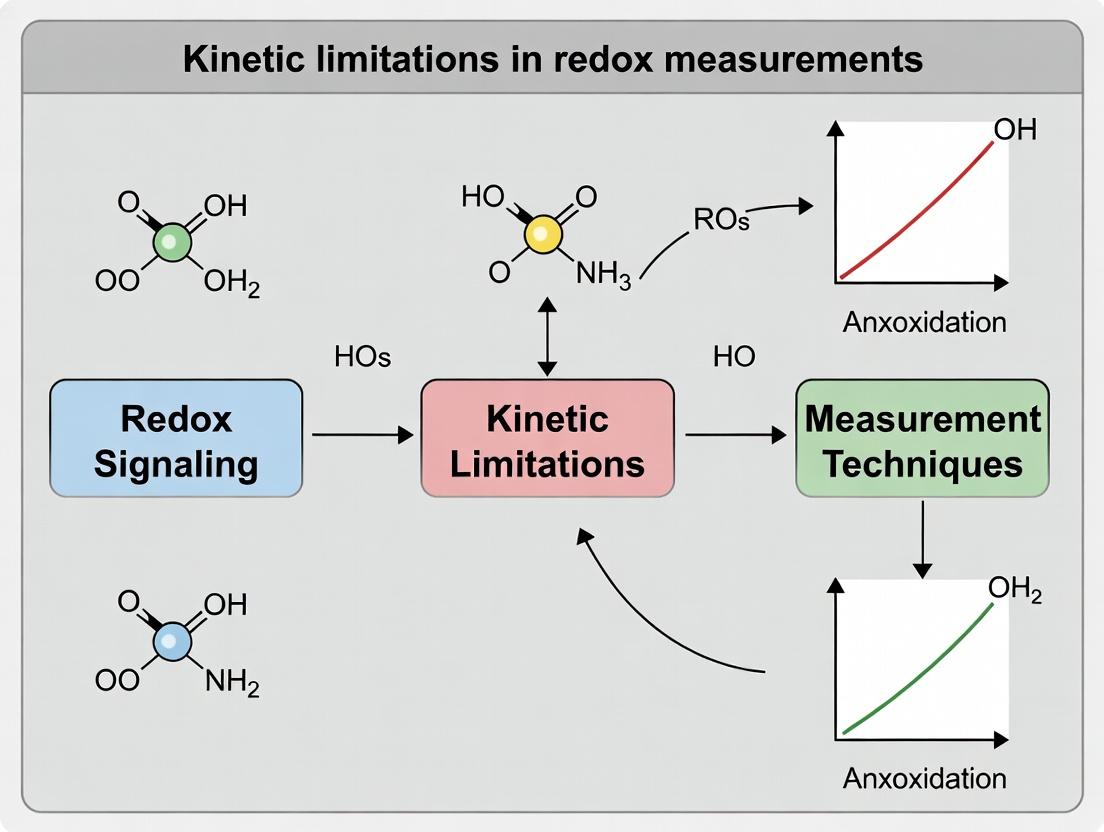
This article provides a comprehensive guide for researchers and drug development professionals on addressing kinetic limitations in redox signaling measurements.
Overcoming Kinetic Hurdles: Advanced Strategies for Accurate Redox Signaling Measurement in Biomedical Research
Abstract
This article provides a comprehensive guide for researchers and drug development professionals on addressing kinetic limitations in redox signaling measurements. We explore the fundamental principles of redox kinetics, from defining rate constants to understanding short-lived reactive species. The article details current methodological approaches, including real-time fluorescent probes and genetically encoded sensors, and offers practical troubleshooting strategies for common experimental pitfalls. Finally, we present a comparative analysis of validation techniques to ensure data reliability, equipping scientists with the knowledge to generate more physiologically relevant and reproducible data in redox biology and therapeutic development.
Redox Signaling Kinetics: Decoding the Speed and Limits of Cellular Communication
Troubleshooting Guides & FAQs
Q1: Why does my probe signal (e.g., roGFP, H2DCFDA) plateau before my expected stimulus endpoint, suggesting a false equilibrium?
A: This is a classic sign of kinetic limitation, where the probe reaction rate cannot match the production rate of the target ROS. The measured signal reflects probe kinetics, not actual cellular redox potential. Verify by:
- Performing an in vitro calibration with bolus H₂O₂ at the end of the experiment. A further signal increase indicates the probe was not saturated in vivo.
- Using a positive control (e.g., direct oxidase expression). If the probe response is slow even with known production, the limitation is confirmed.
- Switching to a faster probe (e.g., Hyper7 from roGFP2) for the same species and repeating the experiment.
Q2: I observe a lack of correlation between my redox probe signal and downstream phenotypic effects (e.g., kinase activation). How do I determine if my measurement is at fault?
A: This disconnect often arises from compartment-specific signaling not resolved by a cytosolic probe, or kinetic delays. Troubleshoot with:
- Compartment-Specific Targeting: Express your redox probe (e.g., Grx1-roGFP2) in the specific organelle of interest (mitochondria, ER).
- Temporal Analysis: Stagger your measurements. Perform high-frequency sampling immediately post-stimulus (first 30 sec) to capture rapid, transient oxidation peaks a slower probe might miss.
- Inhibitor Check: Use a scavenger (e.g., PEG-catalase) or inhibitor of the putative ROS source. If the phenotype is blocked but your probe signal is unchanged, the probe is likely not measuring the relevant pool.
Q3: My genetically encoded redox sensor shows poor dynamic range in my cell model. What optimization steps can I take?
A: Poor dynamic range exacerbates kinetic limitations. Follow this protocol:
Experimental Protocol: Dynamic Range Optimization for roGFP-based Sensors
- Transduction/Transfection: Use a low MOI/low plasmid amount to avoid sensor overexpression and buffering.
- Calibration In Situ: At experiment end, permeabilize cells with 50 µM digitonin in calibration buffer (e.g., 130 mM KCl, 10 mM HEPES, pH 7.4).
- Apply Redox Buffers:
- Fully reduced state: Treat with 10 mM DTT for 5 min.
- Fully oxidized state: Treat with 10 mM H₂O₂ or 2 mM diamide for 5 min.
- Image & Calculate: Acquire images at 400 nm and 480 nm excitation (510 nm emission). Calculate the 400/480 ratio for reduced (Rred) and oxidized (Rox) states.
- Determine Dynamic Range: Dynamic Range (DR) = Rox / Rred. A DR < 5 suggests suboptimal performance. Consider:
- Checking sensor integrity via Western blot.
- Switching to a sensor with higher DR (e.g., rxRFP1 for disulfides).
- Verifying correct excitation filters.
Q4: How do I choose between a chemical probe (e.g., H2DCFDA) and a genetically encoded probe (e.g., roGFP) to minimize kinetic artifacts?
A: The choice is critical and depends on the timescale and compartment.
| Probe Type | Example | Key Kinetic Limitation | Best Use Case | Mitigation Strategy |
|---|---|---|---|---|
| Small-Molecule | H2DCFDA, MitoSOX | Irreversible reaction; consumption; ester hydrolysis kinetics; artifact generation (e.g., oxidation chain reactions). | Initial, rapid screening for broad ROS changes. Use with caution for quantification. | Use low concentrations (µM); include extensive controls (scavengers); avoid for long-term tracking. |
| Genetically Encoded (GE) | roGFP, HyPer | Reversible, but limited by the kinetics of the fused redox-active protein (e.g., Orp1 for roGFP2). Faster than most chemical probes but may still lag. | Compartment-specific, long-term, ratiometric measurement of specific redox couples (e.g., GSH/GSSG, H₂O₂). | Select the fastest variant available (e.g., HyPer7 vs. HyPer3); confirm response time in your system via calibration. |
Q5: What are the essential controls to include in every redox signaling experiment to account for kinetic confounders?
A: A mandatory control table should be implemented:
| Control Type | Purpose | Example Protocol |
|---|---|---|
| Post-Experiment Full Oxidation/Reduction | Confirms probe is functional and not saturated, defining measurement limits. | Permeabilize cells, treat with 10 mM DTT (reduced) and 5 mM H₂O₂ (oxidized). Measure final ratios. |
| Source Inhibition | Validates that the measured signal originates from the intended biology. | Pre-treat with Apocynin (NOX inhibitor) or Rotenone (mitochondrial complex I inhibitor) before stimulus. |
| Scavenger Control | Confirms the signal is specific to the ROS/RNS species. | Co-apply PEG-SOD (for O₂•⁻), PEG-Catalase (for H₂O₂), or NaN₃ (for ONOO⁻). |
| Probe-Less Control | Identifies stimulus-induced autofluorescence changes. | Perform identical experiment in non-transfected/unloaded cells. |
| Kinetic Calibration | Establishes the time-lag of the probe in your specific system. | Use a photoactivatable ROS generator (e.g., KillerRed) and measure the time from activation to 90% probe response. |
The Scientist's Toolkit: Research Reagent Solutions
| Reagent / Material | Function in Addressing Kinetic Limitations |
|---|---|
| roGFP2-Orp1 / HyPer7 | Genetically encoded probes for H₂O₂. HyPer7 offers significantly faster kinetics than earlier versions, reducing measurement lag. |
| Grx1-roGFP2 | Genetically encoded probe for the glutathione redox potential (GSH/GSSG). Grx1 catalysis accelerates equilibration with the glutathione pool. |
| Aconitase-2 (mitochondrial) Activity Assay | Endogenous enzyme-based "probe" for matrix O₂•⁻. Inactivation is rapid and specific, providing a kinetic snapshot complementary to fluorescent probes. |
| PEGylated Antioxidants (PEG-Catalase, PEG-SOD) | Cell-impermeable scavengers used to distinguish intracellular from extracellular ROS events, clarifying the site of rapid signaling. |
| Photoactivatable ROS Generators (e.g., KillerRed, SOPP3) | Tools to generate a precise, rapid, and localized ROS bolus for probe kinetic calibration and pathway triggering. |
| Liquid Chromatography-Mass Spectrometry (LC-MS) | For detecting stable, endogenous redox-modified proteins (e.g., cysteine sulfenylation) as a kinetic "snapshot" that is not limited by probe turnover rates. |
| Microfluidic Perfusion Systems | Enables rapid, precise, and repeatable stimulus delivery (sub-second mixing) to synchronize cellular responses and measure true initial kinetics. |
| Time-Correlated Single Photon Counting (TCSPC) FLIM | Measures fluorescence lifetime of probes like roGFP, which is a ratiometric parameter insensitive to probe concentration, photobleaching, and excitation intensity, improving fidelity in kinetic traces. |
Visualizations
Title: How Kinetic Limitations Skew Data Interpretation
Title: Redox Signal Disconnect Troubleshooting Path
Troubleshooting Guide & FAQs
FAQ 1: My fluorescent redox probe shows a weak or unstable signal. What could be the issue?
A: Weak or unstable signals often stem from kinetic limitations. The probe's reaction rate constant (k) with the target ROS/RNS may be too slow relative to the species' diffusion limit and lifetime. For example, if the rate constant is below ~10³ M⁻¹s⁻¹ for a short-lived species like peroxynitrite (ONOO⁻), the probe will not compete effectively with its decomposition or reaction with other biomolecules. Ensure your probe's k is matched to the kinetics of the target. Check for photobleaching or improper loading protocols.
FAQ 2: How do I know if my measurement is diffusion-limited or reaction-limited?
A: Perform a concentration-dependence experiment. If the observed rate (kobs) scales linearly with probe concentration and reaches a plateau (saturates) at high concentrations, the system is moving from reaction-limited to diffusion-limited control. Compare kobs to the theoretical Smoluchowski diffusion limit (~10⁹ - 10¹⁰ M⁻¹s⁻¹ in aqueous systems). A significantly lower k_obs indicates reaction limitations.
FAQ 3: My genetically encoded sensor (e.g., roGFP, HyPer) responds slowly to a stimulus. Is this a sensor problem or a biological reality?
A: It could be both. First, consult the published rate constants for the sensor's thiol-disulfide exchange or peroxide reaction. Slow response may indicate that the local redox potential changes gradually, or that the sensor is not in kinetic equilibrium with the target couple due to compartmentalization or competing reactions. Verify sensor targeting and consider using a faster-responding small-molecule probe for comparison.
FAQ 4: How can I accurately measure the lifetime of a transient redox species in my cellular model?
A: Direct in-cell measurement is challenging. Use a combination of computational modeling and competitive kinetics experiments. Employ a panel of scavengers or probes with known, graded rate constants. The pattern of which probes "see" the species can bracket its effective lifetime. Alternatively, use rapid-mix/stopped-flow techniques in cell lysates with a fast probe like ABEL-F to establish a baseline.
Table 1: Representative Rate Constants for Redox Reactions
| Reactant A | Reactant B | Rate Constant (k, M⁻¹s⁻¹) | Approx. Lifetime of B in Cell | Notes |
|---|---|---|---|---|
| H₂O₂ | Catalase | ~10⁷ | 1-10 ms | Diffusion-limited for enzyme |
| H₂O₂ | Typical boronate probe (e.g., PF1) | ~1 - 10 | Seconds | Reaction-limited, slow |
| H₂O₂ | Innovative fast probe (e.g., ABEL-F) | ~10⁶ | Seconds | Near diffusion-limited |
| ONOO⁻ | Typical probe (e.g., B-MitoPY1) | ~10⁵ | < 20 ms | Must compete with CO₂ |
| O₂⁻ (Superoxide) | SOD1 | ~2 x 10⁹ | Microseconds | Diffusion-limited |
| •NO | Soluble Guanylyl Cyclase | ~10⁸ | Seconds | Heme-binding, fast |
| Glutathione (GSH) | Protein sulfenic acid | 10¹ - 10³ | Variable | pH-dependent, often slow |
Table 2: Key Kinetic Parameters Influencing Measurement Fidelity
| Parameter | Typical Range | Impact on Measurement | Solution |
|---|---|---|---|
| Diffusion Limit (k_diff) | 10⁸ - 10¹⁰ M⁻¹s⁻¹ | Ultimate speed ceiling for bimolecular reaction | Use tethered probes or enzymes. |
| Probe Reaction Rate (k) | 10⁰ - 10⁶ M⁻¹s⁻¹ | Determines signal amplitude and timing | Select probe with k matched to target lifetime. |
| Target Lifetime (τ) | µs to minutes | Defines the time window for detection | Increase probe concentration to outcompete decay. |
| Local Concentration | nM to mM (microdomains) | Alters observed reaction rates | Use targeted probes; interpret data cautiously. |
Experimental Protocols
Protocol 1: Determining an Apparent Rate Constant (k_app) for a Redox Probe in Cells
Objective: To estimate the effective rate of reaction between a probe and a redox species in a cellular environment. Materials: Cells, redox probe (e.g., fluorescent dye), stimulus (e.g., bolus H₂O₂, SIN-1 for ONOO⁻), fluorescent plate reader or confocal microscope, kinetic analysis software. Method:
- Load cells with the probe according to manufacturer protocol.
- Acquire baseline fluorescence for 1-2 minutes.
- Rapidly add stimulus at a known, final concentration ([S]₀). Use rapid mixing accessories if available.
- Record fluorescence (F) time course until a plateau is reached.
- Fit the trace to a single exponential: F(t) = F₀ + ΔF(1 - e^(-kobs * t)), where kobs is the observed rate.
- Vary probe concentration ([P]₀) and repeat. Plot kobs vs. [P]₀. The slope of the linear region provides kapp.
Protocol 2: Competitive Kinetics Assay to Gauge ROS Lifetime
Objective: To bracket the effective lifetime of a transient species by competition between two probes. Materials: Cell system, two redox probes (ProbeF: fast, ProbeS: slow) with known in vitro rate constants (kF, kS), stimulus. Method:
- Divide samples into three groups: ProbeF alone, ProbeS alone, ProbeF + ProbeS together.
- Apply identical stimulus and record signal development for each group.
- Analyze initial rates (v) of signal increase for each condition.
- Calculate the concentration ratio of the species "seen" by each probe using the relation: [Species]F / [Species]S = (vF / kF[PF]) / (vS / kS[PS]).
- Interpretation: If the fast probe detects significantly more species, the lifetime is too short for the slow probe to compete. Modeling can convert this ratio into an effective lifetime estimate.
Visualizations
Title: Kinetic Competition for a Transient Redox Species
Title: Workflow for Kinetic Redox Measurement
The Scientist's Toolkit: Research Reagent Solutions
Table 3: Essential Reagents for Kinetic Redox Studies
| Reagent / Tool | Function | Key Consideration |
|---|---|---|
| Fast Peroxide Probes (e.g., ABEL-F, NpF) | High rate constant (~10⁶ M⁻¹s⁻¹) for H₂O₂ enables detection of rapid signaling fluxes. | Requires specific imaging setups; may need custom synthesis. |
| Genetically Encoded Redox Sensors (roGFP, HyPer, rxYFP) | Rationetric, targetable probes for specific couples (e.g., GSH/GSSG, H₂O₂). | Relatively slow response (seconds). Calibration is pH-sensitive. |
| Caged ROS/RNS Donors (e.g., Caged H₂O₂, SIN-1) | Allows precise, rapid uncaging of redox species upon UV light or physiological trigger. | Uncaging kinetics and byproducts must be controlled. |
| Superoxide Dismutase (SOD) Mimetics (e.g., MnTBAP) | Scavenges O₂⁻ with known rate constant; used as a diagnostic tool and control. | Specificity for O₂⁻ over H₂O₂ can vary. |
| Catalase & Permeative Catalase Mimetics (e.g., PEG-Catalase) | Scavenges H₂O₂; distinguishes H₂O₂-mediated events. | Large size of native catalase limits cellular access. |
| Stopped-Flow Spectrophotometer/Fluorimeter | Instrument for mixing reagents in <1 ms to measure very fast reaction kinetics in vitro. | Essential for determining pure chemical rate constants (k). |
| Rapid-Perfusion Systems for Microscopy | Enables sub-second solution exchange around cells during live imaging. | Critical for applying stimuli in kinetic cellular experiments. |
Technical Support Center
Troubleshooting Guide & FAQs
Q1: Our Amplex Red assay for H2O2 shows high background fluorescence, obscuring the signal. What could be the cause and how do we fix it? A: High background is often due to auto-oxidation of the Amplex Red reagent or contamination with trace metals. Ensure the assay buffer is prepared fresh with high-purity water (e.g., Milli-Q) and contains a metal chelator like DTPA (Diethylenetriaminepentaacetic acid, 100 µM). Protect reagents from light. Include a no-enzyme control to subtract background. Pre-incubate the plate with assay buffer for 30 minutes in the dark to assess background levels before adding your sample.
Q2: Our DAF-FM DA (for NO detection) signal is weak and inconsistent between cell passages. What are the critical steps? A: Inconsistent loading of the cell-permeable DAF-FM DA is the likely issue. Ensure cells are washed thoroughly with warm, dye-free buffer after the 30-60 minute loading incubation to completely remove extracellular esterase activity. Use a consistent cell confluence (e.g., 80%). Avoid using serum during the loading phase, as serum esterases can cleave the DA ester extracellularly, trapping the dye outside. Confirm intracellular esterase activity is normal.
Q3: During chemiluminescence detection of O2•− with Lucigenin, we observe a rapid, unsustained burst instead of a kinetic curve. Is this valid? A: A rapid, unsustained burst often indicates an artifact. Lucigenin can redox cycle, itself generating O2•−, especially at high concentrations (>10 µM). This leads to a non-physiological signal spike. Switch to a more specific probe like dihydroethidium (DHE) with HPLC validation of the 2-hydroxyethidium product, or use the cytochrome c reduction assay, and ensure your Lucigenin concentration is ≤5 µM.
Q4: Our ONOO− donor (SIN-1) doesn’t produce the expected oxidation of our target probe. What should we check? A: SIN-1 co-generates NO and O2•−, which react to form ONOO−. The kinetics are sensitive to buffer composition and pH. Perform these checks:
- pH: Use a buffer at physiological pH (7.4). ONOO− is unstable at low pH.
- Catalysts: Ensure no contaminating transition metals (use chelators).
- Donor Freshness: Prepare SIN-1 solution immediately before use. Its half-life in buffer is short (~1 hour).
- Validating Donor Activity: Always include a positive control, such as the oxidation of the fluorescent probe DHR123 (dihydrorhodamine 123) under your exact experimental conditions.
Q5: Our cell viability drops significantly when using ROS/RNS probes in live-cell imaging. How can we minimize cytotoxicity? A: Probes like DCFH-DA and DHE can generate additional ROS upon photoexcitation (photo-oxidation). To mitigate:
- Reduce laser power or exposure time.
- Use lower probe concentrations (e.g., 1-5 µM instead of 10-20 µM).
- Image cells less frequently (take time points minutes apart, not seconds).
- Consider using genetically encoded sensors (e.g., HyPer for H2O2) which are more specific and less toxic.
Table 1: Key Kinetic Parameters of Primary ROS/RNS
| Species | Typical Physiological Concentration (nM) | Approximate Half-Life | Primary Detection Method(s) |
|---|---|---|---|
| H2O2 | 1 - 100 | ~1 ms | Amplex Red/HRP, HyPer, Boronate probes |
| NO• | 1 - 1000 | 1-5 s | DAF-FM, DAF-2, FRET sensors (e.g., geNOps) |
| O2•− | 0.01 - 1 | ~1 µs | DHE/HPLC, Cytochrome c reduction, MitoSOX |
| ONOO− | < 1 - 10 | ~10 ms | DHR123, Tyrosine nitration, specific fluorescent probes (e.g., HKGreen) |
Table 2: Comparison of Common Detection Methodologies
| Method | Target | Advantage | Limitation | Typical LOD |
|---|---|---|---|---|
| Amplex Red/HRP | H2O2 | Highly sensitive, specific | Subject to interference by cellular peroxidases | ~50 nM |
| DAF-FM DA | NO | Cell-permeable, ratiometric possible | Requires intracellular esterases, not NO-specific in all contexts | ~3 nM |
| DHE/HPLC | O2•− | Specific for O2•− when validated by HPLC | Not real-time due to HPLC requirement | ~0.1 unit/ml SOD-inhibitable |
| DHR123 | ONOO−/ oxidation | Sensitive to strong oxidants | Not perfectly specific for ONOO− (reacts with •OH, CO3•−) | ~10 nM |
Experimental Protocols
Protocol 1: Specific Measurement of Extracellular H2O2 Kinetics using Amplex Red Objective: To quantify real-time, steady-state extracellular H2O2 production from cells or enzyme systems.
- Prepare fresh Amplex Red Reaction Buffer: 50 mM phosphate buffer (pH 7.4), 100 µM DTPA, 50 µM Amplex Red, 0.1 U/mL Horseradish Peroxidase (HRP).
- Wash cells 2x with warm, serum-free buffer. For enzymes, prepare in appropriate buffer.
- Add Amplex Red Reaction Buffer to sample in a well plate (96- or 384-well). Final volume 100 µL.
- Immediately measure fluorescence (Ex/Em = 530-560/590 nm) kinetically using a plate reader at 37°C for 30-60 minutes.
- Generate a standard curve (0-1000 nM H2O2) in parallel under identical conditions.
- Data Analysis: Subtract the no-sample control (background) fluorescence. Convert fluorescence units to [H2O2] using the standard curve. Report rate as nM/min/mg protein or per 10^6 cells.
Protocol 2: Validated Intracellular O2•− Detection using Dihydroethidium (DHE) Objective: To specifically detect intracellular superoxide formation, minimizing artifactual signals.
- Cell Loading: Load cells with 5 µM DHE in serum-free medium for 30 minutes at 37°C in the dark.
- Stimulation: After washing, add stimulus or vehicle control and incubate for desired time.
- Cell Extraction & HPLC: Lyse cells in acetonitrile with 0.1% formic acid. Centrifuge and collect supernatant.
- HPLC Separation: Inject sample onto a C18 reverse-phase column. Use a mobile phase gradient from 37% to 80% acetonitrile in 0.1% trifluoroacetic acid over 20 min. Flow rate: 1 mL/min.
- Detection: Monitor fluorescence (Ex/Em = 510/580 nm for 2-hydroxyethidium (2-OH-E+), specific for O2•−; and 510/480 nm for ethidium (E+), non-specific oxidation).
- Quantification: Quantify peaks by area and normalize to protein content. Report the ratio of 2-OH-E+ to total DHE products or to E+.
Visualizations
Diagram 1: ROS/RNS Interconversion & Key Detection Points
Title: ROS/RNS Network and Detection Methods
Diagram 2: Workflow for Validated O2•− Measurement
Title: DHE/HPLC Superoxide Assay Workflow
The Scientist's Toolkit: Research Reagent Solutions
| Reagent / Material | Primary Function | Key Consideration |
|---|---|---|
| Amplex Red | Fluorogenic substrate for HRP; reacts 1:1 with H2O2 to produce resorufin. | Susceptible to auto-oxidation. Use with metal chelator (DTPA). |
| Dihydroethidium (DHE) | Cell-permeable probe oxidized by O2•− to 2-hydroxyethidium (specific). | Requires HPLC/MS validation to distinguish specific product from artifacts. |
| DAF-FM DA | Cell-permeable, NO-sensitive dye. Intracellular esterases cleave DA, trapping fluorescent DAF-FM. | Measures NO-related species (N2O3), not NO directly. Sensitive to pH. |
| SIN-1 | Chemical donor that simultaneously releases NO and O2•−, forming ONOO−. | Kinetics are buffer/pH dependent. Use fresh and include an activity control. |
| PEG-SOD / PEG-Catalase | Enzymatic scavengers (polyethylene glycol conjugated) for extracellular O2•− and H2O2. | Cell-impermeable. Critical controls for identifying extracellular vs. intracellular ROS. |
| Metal Chelators (DTPA, DFX) | Bind free transition metals (Fe²⁺, Cu⁺) to prevent Fenton chemistry & probe artifacts. | Prefer DTPA over EDTA for ROS experiments; EDTA can catalyze •OH formation. |
| Specific Inhibitors (e.g., L-NAME, Apocynin, FCCP) | Pharmacologically modulate ROS/RNS producing enzymes (NOS, NADPH oxidase, mitochondria). | Verify specificity and toxicity for each cell type. Use multiple inhibitors. |
Technical Support Center
Troubleshooting Guide: Kinetic Measurements of Redox Signaling
Issue 1: Inconsistent ROS Detection Kinetics in Mitochondria
- Problem: Measured H₂O₂ burst kinetics vary widely between replicates in isolated mitochondria.
- Diagnosis: Likely due to variability in mitochondrial membrane potential or integrity of the outer membrane.
- Solution: Validate membrane potential with JC-1 or TMRM dye prior to each kinetic run. Include an integrity check using cytochrome c retention assay.
- Protocol: 1) Load mitochondria with redox probe (e.g., MitoPY1). 2) Calibrate fluorescence to nM H₂O₂ using a standard curve with glucose/glucose oxidase. 3) Initiate signal (e.g., add succinate). 4) Record fluorescence every 2 seconds for 10 mins. 5) Normalize data to mitochondrial protein content.
Issue 2: Slow or Damped Kinetics in Nuclear GSH/GSSG Ratio Measurements
- Problem: Grx1-roGFP2 probes in the nucleus show slower response times compared to cytosolic readings.
- Diagnosis: Nucleo-cytoplasmic transport limitations or improper probe targeting/nuclear export.
- Solution: Ensure probe construct has a validated nuclear localization signal (NLS, e.g., SV40). Verify nuclear confinement via confocal microscopy. Use shorter excitation pulses to minimize photobleaching in the smaller volume.
- Protocol (Nuclear Targeting Validation): 1) Transfect cells with NLS-roGFP2. 2) Stain nucleus with Hoechst 33342. 3) Perform high-resolution z-stack confocal imaging. 4) Calculate fluorescence co-localization coefficient (Pearson's >0.85 is acceptable).
Issue 3: ER Redox Potential (Eₕ) Measurements Show High Static Values, No Kinetic Response
- Problem: eroGFP or HyPer readings from the ER lumen are stable and do not reflect induced stress kinetics.
- Diagnosis: Probe is not correctly oxidized by the ER-specific system (Ero1/PDI) or is saturated.
- Solution: Confirm probe is functional via in-situ calibration with DTT (reducing) and diamide (oxidizing). Check expression levels; overexpression can swamp the native system.
- Protocol (In-situ Calibration): 1) Image baseline eroGFP ratio (405/488 nm ex). 2) Perfuse with 10mM DTT for 15 min, record. 3) Wash. 4) Perfuse with 5mM diamide for 15 min, record. A dynamic range (Rmin to Rmax) of at least 2.0 is required for kinetic studies.
Frequently Asked Questions (FAQs)
Q1: What is the primary kinetic limitation when measuring H₂O₂ diffusion between organelles? A1: The major limitation is the effective permeability constant, which is not a simple diffusion constant. H₂O₂ must traverse lipid bilayers via aquaporins. The kinetics are governed by the local concentration gradient, the density of peroxiporins (e.g., AQP3, AQP8), and the immediate scavenging capacity (e.g., peroxiredoxins, GPx) in each compartment. This creates organelle-specific lag times and amplitude dampening.
Q2: Why do calcium-induced ROS signals from the ER show biphasic kinetics, while mitochondrial signals are often monophasic? A2: ER signals are biphasic due to sequential release from two pools: 1) A rapid, initial burst from IP3 receptor-mediated Ca²⁺ release activating NOX4 complexes. 2) A slower, sustained phase from ER stress (unfolded protein response) and secondary store-operated Ca²⁺ entry. Mitochondrial signals are typically monophasic and triggered by a single event: the uptake of released Ca²⁺ via the MCU, stimulating the TCA cycle and ETC superoxide production.
Q3: How do I synchronize kinetic measurements across different organelles in a live cell? A3: Use a universal, synchronous trigger and parallel imaging. For example:
- Trigger: Use a microfluidic system to rapidly switch media to a precise concentration of a stimulus (e.g., 100µM histamine).
- Imaging: Use a widefield or confocal microscope with multi-channel, rapid alternating excitation to simultaneously capture probes for different organelles (e.g., Mito-roGFP, eroGFP, NLS-HyPer).
Q4: What are common pitfalls in deriving rate constants from organelle-specific redox data? A4:
- Pitfall 1: Assuming first-order kinetics. Many redox reactions are pseudo-first-order or follow Michaelis-Menten kinetics due to enzyme saturation.
- Pitfall 2: Not accounting for probe kinetics. The fluorescent probe (e.g., roGFP) has its own oxidation/reduction rate, which must be significantly faster than the process being measured.
- Pitfall 3: Ignoring compartment volume. Signal amplitude is concentration-dependent; smaller volumes (e.g., nucleus) fill/empty faster than larger ones (e.g., cytosol) for identical flux rates.
Table 1: Characteristic Time Constants and Apparent Rate Constants for Redox Events
| Organelle | Redox Event / Probe | Typical Stimulus | Apparent t₁/₂ (Seconds) | Apparent Rate Constant (k, s⁻¹) | Key Notes |
|---|---|---|---|---|---|
| Mitochondria | H₂O₂ release (MitoPY1) | Succinate / Antimycin A | 30 - 120 s | 0.023 - 0.006 | Highly dependent on substrate and membrane potential. |
| ER Lumen | Oxidation (eroGFP) | DTT Washout / Ero1α Overexpression | 90 - 300 s | 0.0077 - 0.0023 | Limited by disulfide isomerase activity and glutathione transport. |
| Nucleus | Glutathione Redox (Grx1-roGFP2) | H₂O₂ Bolus (100 µM) | 10 - 30 s | 0.069 - 0.023 | Fast equilibration via nuclear pore; kinetics mirror cytosol unless export is blocked. |
| Cytosol | Peroxiredoxin Oxidation (Prx2-roGFP) | Local H₂O₂ Uncaging | 1 - 5 s | 0.693 - 0.139 | Extremely fast, diffusion-limited reaction. Sets baseline for cellular kinetics. |
Table 2: Key Physical and Chemical Factors Affecting Kinetics
| Factor | Mitochondria Impact | ER Impact | Nuclear Impact |
|---|---|---|---|
| pH | Alkaline matrix (~8.0) accelerates thiol oxidation. | Acidic lumen (~7.2-7.4) favors protein disulfide formation. | Neutral pH (~7.2) similar to cytosol. |
| Membrane Potential | High ΔΨm (~180 mV) drives antioxidant (GSH) import via OGC. | Potential exists but less studied; impacts Ca²⁺ and ROS dynamics. | No membrane potential across nuclear envelope. |
| Primary Scavenger | Peroxiredoxin 3, Glutathione Peroxidase 1, SOD2 | Glutathione Peroxidase 7/8, Peroxiredoxin 4 | Glutathione, Thioredoxin 1, Nucleoredoxin |
| Key Regulatory Protein | Mitochondrial Permeability Transition Pore (MPTP) | Protein Disulfide Isomerase (PDI) | Nuclear Factor Erythroid 2–Related Factor 2 (Nrf2) |
Experimental Protocols
Protocol A: Simultaneous Kinetic Imaging of Mitochondrial and Nuclear ROS
- Objective: Measure the kinetic delay between mitochondrial ROS production and nuclear antioxidant response.
- Materials: Cells stably expressing Mito-HyPer and NLS-roGFP2-Grx1.
- Steps:
- Seed cells in glass-bottom dishes 48h prior.
- Replace media with live-cell imaging buffer (HBSS with 10mM HEPES, 5mM glucose).
- Mount dish on pre-warmed (37°C) stage with CO₂ control.
- Baseline: Acquire HyPer (488/405 ex, 520 em) and roGFP (405/488 ex, 520 em) ratio images every 10s for 2 mins.
- Stimulate: Rapidly add 200µM Tert-Butyl Hydroperoxide (tBHP) via perfusion system.
- Kinetic Acquisition: Acquire dual-ratio images every 5s for 15 mins.
- Data Analysis: Define ROIs for mitochondria and nucleus. Plot ratio over time. Calculate time-to-half-maximum (t₁/₂) for oxidation for each compartment.
Protocol B: Assessing ER Redox Kinetics During Protein Folding Stress
- Objective: Quantify the rate of ER lumen oxidation upon inhibition of protein disulfide reduction.
- Materials: HEK293T cells transfected with eroGFP, thapsigargin, DTT.
- Steps:
- Transfert cells with eroGFP-ER plasmid using standard methods.
- 24h post-transfection, treat cells with 2µM thapsigargin (in DMSO) or vehicle for 0, 15, 30, 60 mins.
- Rapidly wash cells with PBS and lyse in degassed, thiol-free buffer.
- Immediately measure eroGFP fluorescence (ex 400/490 nm, em 510 nm) in a plate reader equipped with injectors.
- In-well calibration: Inject DTT to 10mM final (Rmin), then diamide to 5mM final (Rmax).
- Calculate % oxidation = (Rsample - Rmin) / (Rmax - Rmin) * 100.
- Plot % oxidation vs. time to derive the rate of stress-induced oxidation.
Visualization: Signaling Pathways & Workflows
Diagram Title: Inter-Organelle Redox Signaling Kinetic Cascade
Diagram Title: Workflow for Comparative Organelle Redox Kinetics
The Scientist's Toolkit: Research Reagent Solutions
| Item Name | Function in Experiment | Key Consideration for Kinetics |
|---|---|---|
| Genetically-Encoded Redox Probes (e.g., roGFP2, HyPer, rxYFP) | Target-specific, ratiometric measurement of redox potential or ROS. | Kinetics Critical: Choose probe with reaction speed faster than biological process (e.g., roGFP2 ~1s). |
| Mito/ER/Nuclear Targeting Sequences | Directs probe to correct organelle (e.g., COX8, KDEL, SV40 NLS). | Validation Required: Mislocalization invalidates compartment-specific kinetic data. |
| Microfluidic Perfusion Systems | Enables precise, rapid, and uniform delivery of stimulants/inhibitors. | Essential for Synchronization: Reduces mixing time to <1s, enabling precise t=0. |
| Live-Cell Imaging Buffer (Phenol Red-Free) | Maintains cell health during imaging without interfering with fluorescence. | pH Stability: Use HEPES or CO₂ control to prevent pH shifts that alter probe kinetics. |
| Calibration Reagents (DTT, Diamide, H₂O₂/Glucose Oxidase) | Determines minimum (Rmin) and maximum (Rmax) ratio of ratiometric probes in-situ. | Must be performed for each experiment/field to convert ratio to quantitative metric (e.g., % oxidation). |
| Potent and Specific Inhibitors | Dissect contributions of specific pathways (e.g., Antimycin A, Rotenone, VAS2870). | Pre-incubation Time: Varies; must be optimized to achieve full block before kinetic run. |
| Rationetric Analysis Software (e.g., ImageJ/Fiji, SlideBook) | Processes time-lapse images to calculate ratio (405/488) over time for each ROI. | Batch Processing Capability is essential for analyzing multi-cell, multi-compartment datasets. |
Technical Support Center
Troubleshooting Guide & FAQs
Q1: Our amperometric measurements show sudden, high-amplitude spikes. Are these hydrogen peroxide (H₂O₂) bursts or electrical artifacts? A: This is a common artifact. First, confirm the source:
- Motion Artifact: Ensure the working electrode is securely immobilized. Vibrations from perfusion systems or plate readers cause spike-like currents. Use vibration-damping platforms.
- Reference Electrode Instability: Check the Ag/AgCl reference electrode for air bubbles or clogged frits. Replenish the electrolyte solution.
- Solution-borne Interference: Ascorbate and certain drugs can be oxidized at similar potentials. Use selective coatings (e.g., MnO₂ nanoparticles for H₂O₂, or ascorbate oxidase) or paired electrode subtraction techniques.
Experimental Protocol for Artifact Verification:
- Title: Protocol for Distinguishing H₂O₂ Signal from Motion Artifact.
- Method:
- Set up your amperometric system (e.g., with a Pt working electrode at +0.65V vs. Ag/AgCl).
- Record a baseline in PBS with stirring.
- Test 1 (Signal): Add a bolus of known H₂O₂ (e.g., 10 µM final concentration). Note the current profile.
- Test 2 (Artifact): Gently tap the electrode holder or perfusion line to simulate vibration.
- Analysis: Compare traces. Authentic H₂O₂ addition typically shows a sharp rise followed by a gradual decay (due to diffusion/consumption). Motion artifacts are often bidirectional spikes.
Q2: We observe a slow, continuous drift in baseline current with genetically encoded redox probes (e.g., roGFP). Is this physiological or probe photobleaching/instability? A: Drift often indicates probe limitation, not biology. Key culprits:
- Photobleaching: roGFP is susceptible. Reduce excitation light intensity and frequency of acquisition. Use ratiometric measurements (400nm/490nm excitation) to correct for concentration loss.
- pH Sensitivity: roGFP's redox potential is pH-dependent. Maintain stable pH with robust buffers (e.g., 25 mM HEPES). Perform parallel calibration with dithiothreitol (DTT) and hydrogen peroxide at experimental pH.
- Expression Dynamics: Slow drift may reflect changes in probe expression/localization. Include a fluorescence protein control (e.g., GFP) to monitor expression changes independently of redox state.
Q3: Our EPR spin trapping data for superoxide is inconsistent between biological replicates. What are the critical points for sample preparation? A: Superoxide (O₂•⁻) detection is highly kinetic-limited. Consistency requires strict control of:
- Spin Trap Concentration: Use a molar excess (typically 0.5-10 mM) relative to expected O₂•⁻ flux. Pre-incubate cells/tissue with trap for 30 min.
- Oxygenation: Maintain consistent O₂ levels, as O₂•⁻ generation is oxygen-dependent. Use a tonometer or sealed vials with fixed headspace.
- Cell Number/Protein Content: Normalize results to cell count (exact) or protein concentration. Small variations cause large signal differences.
Experimental Protocol for EPR Spin Trapping:
- Title: Protocol for Consistent Superoxide Detection via EPR.
- Method:
- Sample Prep: Harvest cells by gentle scraping. Wash and resuspend in PBS containing the spin trap (e.g., 1-hydroxy-3-methoxycarbonyl-2,2,5,5-tetramethylpyrrolidine, CMH) and metal chelators (e.g., deferoxamine 25 µM, diethyldithiocarbamate 5 µM).
- Loading: Incubate 30-40 min at 37°C. Keep samples in the dark.
- Measurement: Transfer to a capillary tube or flat cell. Immediately record EPR spectra at room temperature using the following typical settings:
- Microwave power: 20 mW
- Modulation amplitude: 2 G
- Scan time: 60 s
- Quantification: Double-integrate the central peak of the triplet signal. Compare to a standard curve of the nitroxide radical product.
Q4: When using chemiluminescent probes (e.g., L-012), the signal saturates rapidly and does not return to baseline. How can we improve kinetic resolution? A: L-012 has a high quantum yield but non-reversible kinetics, limiting temporal resolution.
- Solution 1: Dilution & Reduced Load. Use lower probe concentrations (e.g., 50-100 µM vs. 500 µM) and fewer cells to slow the reaction and prevent rapid probe exhaustion.
- Solution 2: Use a Flow System. For cell culture, employ a perfusion chamber to continuously supply fresh probe and remove spent media, allowing continuous monitoring.
- Solution 3: Switch to Electrochemical or Genetically Encoded Probes for real-time, reversible measurements if the experimental question allows.
Table 1: Common Artifacts in Redox Signaling Measurements & Diagnostic Tests
| Artifact Type | Typical Cause | Diagnostic Experiment | Corrective Action |
|---|---|---|---|
| Spike Noise | Mechanical vibration, loose connections | Tap test during recording in buffer. | Secure electrodes, use damping, check connections. |
| Baseline Drift | Reference electrode degradation, temperature flux. | Record in stable buffer with no cells. | Replace reference electrolyte, use temperature control. |
| Non-Specific Signal | Direct oxidation of drugs/analytes (e.g., acetaminophen). | Record signal in presence of analyte without cells. | Use selectively permeable membranes (e.g., Nafion), different potential. |
| Probe Saturation | Rapid, irreversible probe reaction (e.g., chemiluminescence). | Titrate cell number vs. signal time-to-peak. | Reduce cell number/probe concentration, use flow system. |
| pH-Confounded Signal | roGFP/pHlorin sensitivity to pH shifts. | Calibrate with DTT/H₂O₂ at different pHs. | Use stronger buffers, employ pH-insensitive controls (e.g., GFP). |
Table 2: Performance Comparison of Key Redox Detection Modalities
| Method | Target | Temporal Resolution | Spatial Resolution | Primary Kinetic Limitation | Artifact Prone? |
|---|---|---|---|---|---|
| Amperometry | H₂O₂, NO | Milliseconds to seconds | ~µm (microelectrode) | Diffusion to electrode surface | High (electrical, motion) |
| Genetically Encoded (roGFP) | GSH/GSSG, H₂O₂ | Seconds to minutes | Subcellular | Thiol-disulfide exchange kinetics | Medium (pH, expression, bleaching) |
| EPR Spin Trapping | O₂•⁻, •NO | Minutes | Tissue/Organ | Spin trap reaction rate & stability | Medium (oxygen sensitivity, metal interference) |
| Chemiluminescence (L-012) | Extracellular O₂•⁻/ONOO⁻ | Seconds to minutes | Bulk solution | Probe consumption rate | High (probe exhaustion, non-specificity) |
| Borosilicate Fe²+ Sensors | Labile Fe²+ | Seconds | Subcellular | Fe²+ binding kinetics | Low (but specificity challenges exist) |
Experimental Protocol Detail
Protocol: Validating Authentic H₂O₂ Signaling with Pharmacological & Genetic Controls
- Objective: To confirm that an observed amperometric signal originates from authentic cellular H₂O₂ flux.
- Materials: Cell culture, carbon fiber microelectrode, amplifier, perfusion system, inhibitors.
- Method:
- Baseline Recording: Record current from cells in physiological buffer.
- Stimulus Application: Apply receptor agonist (e.g., growth factor) or mechanical stimulus.
- Inhibition Test (Pharmacological): Pre-treat cells with 50 U/mL PEG-catalase (extracellular scavenger) for 30 min. Repeat stimulus. Signal should be abolished.
- Source Inhibition Test: Pre-treat cells with 10 µM Diphenyleneiodonium (DPI, NADPH oxidase inhibitor) for 60 min. Repeat stimulus. Signal should be significantly reduced.
- Genetic Control (if applicable): Use cells with CRISPR/Cas9 knockout of NOX2 (or relevant NADPH oxidase). Compare signal to wild-type cells.
- Calibration: After experiments, calibrate electrode with known H₂O₂ additions (1, 5, 10 µM) to convert current (pA) to concentration (nM).
Diagrams
Diagram 1: Decision Tree for Diagnosing Redox Signal Artifacts
Diagram 2: Key Pathways in NADPH Oxidase-Dependent Redox Signaling
Diagram 3: Workflow for Kinetic-Limited Redox Experiment Optimization
The Scientist's Toolkit: Research Reagent Solutions
Table 3: Essential Reagents for Addressing Kinetic Limitations in Redox Measurements
| Reagent / Material | Function / Purpose | Key Consideration for Kinetic Studies |
|---|---|---|
| PEGylated Catalase | Extracellular H₂O₂ scavenger. Validates origin of H₂O₂ signal (membrane-impermeable). | Use to confirm signal is extracellular. Does not quench intracellular probes. |
| Cell-Permeable PEG-Catalase | Intracellular H₂O₂ scavenger. Tests for intracellular H₂O₂ mediation of effects. | Slower uptake; requires pre-incubation (1-2 hrs). Controls for probe specificity. |
| Diphenyleneiodonium (DPI) | Flavoprotein inhibitor (e.g., inhibits NADPH oxidases). Identifies enzymatic O₂•⁻/H₂O₂ source. | Not entirely specific; can inhibit other flavoenzymes (e.g., NOS). Use with genetic controls. |
| Acetaminophen (Paracetamol) | Electroactive interferent control for amperometry. Oxidizes at similar potential to H₂O₂. | Use to test electrode selectivity. A signal from acetaminophen indicates need for better coating. |
| Temporally Controlled, Genetic Inducers/Suppressors (e.g., Doxycycline-inducible NOX, shRNA) | Modulates redox enzyme expression with precise timing. Overcomes limitations of slow pharmacological inhibitors. | Crucial for dissecting signaling kinetics without long-term compensatory adaptations. |
| Nitroblue Tetrazolium (NBT) / Cytochrome c | Classical, colorimetric superoxide detection. Useful for quick, endpoint validation. | Has significant kinetic limitations (slow reduction rate). Not for real-time tracking. |
| Deferoxamine (DFO) & Diethyldithiocarbamate (DETC) | Metal chelators for EPR experiments. Remove interfering metal ions that degrade spin adducts. | Essential for stabilizing superoxide-nitronyl adducts, improving signal-to-noise and reliability. |
| pH-Stable Buffers (e.g., HEPPS, Tricine) | Maintain physiological pH for probes like roGFP which are pH-sensitive. | Prevents false redox signals from pH shifts during stimulation (e.g., metabolic acidification). |
Tools and Techniques: Modern Methodologies for Capturing Fast Redox Events
Within the broader thesis on Addressing kinetic limitations in redox signaling measurements research, the development and application of genetically encoded biosensors have been transformative. These real-time kinetic probes, such as roGFP (redox-sensitive Green Fluorescent Protein) and HyPer (hydrogen peroxide sensor), allow for the dynamic, compartment-specific quantification of redox potential and reactive oxygen species (ROS) in living cells. This technical support center is designed to assist researchers in troubleshooting common experimental issues to obtain reliable, kinetically resolved data.
Troubleshooting Guides & FAQs
FAQ 1: Sensor Expression & Localization
Q: My roGFP2 signal is cytosolic, but I targeted it to the mitochondria. What could be wrong? A: Incorrect localization often stems from insufficient or cleaved targeting sequences.
- Check: Verify your plasmid sequence for the complete mitochondrial targeting sequence (e.g., COX8 presequence). Perform immunofluorescence with organelle-specific markers to confirm co-localization.
- Solution: Use a validated plasmid from a reputable repository (Addgene). Consider using a different, stronger targeting sequence (e.g., for ER: roGFP2-KDEL).
Q: I see no fluorescence in my cells after transfection with HyPer7. A: This indicates failed expression or sensor bleaching.
- Check: Image using a standard GFP filter set first. HyPer is a cpYFP derivative. Ensure your microscope lasers/lamp is functional.
- Solution: Include a positive control (e.g., cytosolic GFP plasmid). Optimize transfection protocol (e.g., increase DNA amount, use fresh transfection reagent). For stable lines, use higher antibiotic concentration or FACS sorting.
FAQ 2: Calibration & Quantification
Q: My ratiometric calibration for roGFP is not producing two clear, maximally oxidized and reduced plateaus. A: Incomplete equilibration with calibrants is the most common cause.
- Protocol: Use a robust calibration protocol in situ:
- Image cells in initial state.
- Treat with 10 mM DTT (strong reductant) in imaging buffer for 5-10 min. Image for fully reduced state.
- Wash and treat with 1-5 mM H₂O₂ or 100 µM Diamide (oxidant) for 5-10 min. Image for fully oxidized state.
- Ensure permeabilization with 0.05% Digitonin if calibrants are not cell-permeant.
- Solution: Increase treatment time and concentration. Verify pH of calibration buffers, as extremes can affect fluorescence. Use freshly prepared DTT and H₂O₂.
Q: The dynamic range of my HyPer sensor seems low in my experimental system. A: Dynamic range can be affected by basal H₂O₂ levels or sensor saturation.
- Check: Perform a positive control by adding a bolus of H₂O₂ (100 µM - 1 mM) at the experiment end. If the ratio increases significantly, your basal signal may be already oxidized.
- Solution: Express the sensor at lower levels to avoid buffering the signal. Work in low serum/media during imaging to reduce external ROS sources. Use the appropriate HyPer variant (e.g., HyPer7 has faster kinetics and reduced pH sensitivity).
FAQ 3: Data Interpretation & Artifacts
Q: My roGFP ratio changes during a treatment, but I'm unsure if it's due to redox changes or pH artifacts. A: roGFP2 is pH-sensitive at extremes. This must be controlled.
- Experimental Control: Perform parallel experiments with a pH-only sensor like pHluorin or SypHer (a pH-sensitive, redox-insensitive HyPer variant).
- Solution: If a pH change coincides with your treatment, use a redox sensor with reduced pH sensitivity (e.g., roGFP2-Orp1, Grx1-roGFP2) or perform experiments in pH-clamped buffers.
Q: The kinetics of the HyPer signal are slower than expected based on the literature. A: This often relates to sensor expression level or cellular antioxidant capacity.
- Check: Ensure you are not overexpressing the sensor, which can buffer H₂O₂ and slow observed kinetics.
- Solution: Generate stable cell lines with lower expression via FACS. Use the newer HyPer7 variant, which has faster oxidation/reduction kinetics (~60 s halftime) compared to older versions.
Key Sensor Properties & Data
Table 1: Characteristics of Common Genetically Encoded Redox Sensors
| Sensor Name | Target | Excitation/Emission Peaks (nm) | Readout Mode | Dynamic Range (Ratio Ox/Red) | Typical Response Time | Key Interferant |
|---|---|---|---|---|---|---|
| roGFP2 | Glutathione redox potential (EGSSG/2GSH) | 400/510 & 490/510 | Ratiometric (400/490 nm exc.) | ~5 - 10 (in vitro) | Oxidation: seconds-minutes | pH (<6.5, >8.5) |
| Grx1-roGFP2 | Glutathione redox potential (via Glutaredoxin) | 400/510 & 490/510 | Ratiometric (400/490 nm exc.) | ~5 - 8 (in vivo) | ~5 minutes (equilib.) | Specific for GSH/GSSG |
| HyPer (e.g., HyPer7) | H₂O₂ | 420/516 & 500/516 (for cpYFP) | Ratiometric (420/500 nm exc.) | ~3 - 5 (in vivo) | Oxidation: <1 min; Reduction: ~minutes | pH (cpYFP is pH-sensitive) |
| rxYFP | Thioredoxin redox potential | 514/527 | Intensity-based | N/A | Minutes | Less specific; general thiol redox |
Table 2: Essential Research Reagent Solutions
| Reagent | Function in Experiment | Example/Brief Protocol Note |
|---|---|---|
| DTT (Dithiothreitol) | Strong reducing agent for roGFP calibration. | Use at 10 mM in imaging buffer for 5-10 min. Freshly prepared. |
| Diamide | Thiol-specific oxidant for roGFP calibration. | Use at 100 µM - 2 mM for 5-10 min. Less likely than H₂O₂ to cause non-specific damage. |
| Hydrogen Peroxide (H₂O₂) | Physiological oxidant; used for calibration and stimulation. | For HyPer calibration, use 100 µM - 1 mM. Aliquot and store frozen; avoid repeated freeze-thaw. |
| Digitonin | Mild detergent for cell permeabilization during calibration. | Use at 0.005-0.05% in calibration buffer to allow entry of non-permeant reagents (e.g., GSSG). |
| N-Acetylcysteine (NAC) | Antioxidant precursor; negative control for redox perturbations. | Pre-treat cells with 1-5 mM NAC for 1-2 hrs to dampen endogenous ROS signals. |
| Butylated Hydroxyanisole (BHA) | Synthetic antioxidant; positive control for reducing environment. | Use at 100 µM to reduce cellular ROS. Can affect multiple pathways. |
Experimental Protocols
Protocol 1:In SituCalibration of roGFP for Absolute Redox Potential Calculation
Objective: To convert ratiometric roGFP data into absolute glutathione redox potential (EGSSG/2GSH). Materials: Cells expressing roGFP, imaging buffer, 10 mM DTT, 5 mM H₂O₂ or 2 mM Diamide, 0.05% Digitonin, fluorescence microscope capable of rapid excitation switching. Steps:
- Image Baseline: Acquire ratio (F405/488) images of cells in standard imaging buffer.
- Reduce: Incubate cells in imaging buffer + 0.05% Digitonin + 10 mM DTT for 10 min. Acquire ratio images (Rmin).
- Wash: Rinse cells 2x with Digitonin-free imaging buffer.
- Oxidize: Incubate cells in imaging buffer + 0.05% Digitonin + 5 mM H₂O₂ (or 2 mM Diamide) for 10 min. Acquire ratio images (Rmax).
- Calculate: Determine the degree of oxidation (OxD) for each time point: OxD = (R - Rmin) / (Rmax - Rmin).
- Convert to EGSSG/2GSH: Use the Nernst equation: E = E0 - (RT/nF) ln([GSH]²/[GSSG]). For roGFP2, E0 is approximately -280 mV. With known total glutathione pool, E can be derived from OxD.
Protocol 2: Measuring H₂O₂ Flux with HyPer
Objective: To dynamically measure localized changes in H₂O₂ concentration. Materials: Cells expressing HyPer (e.g., HyPer7), phenol-red free culture medium, 100 µM - 1 mM H₂O₂ for positive control, stimulus of interest (e.g., Growth Factors, Drugs). Steps:
- Setup: Culture cells in glass-bottom dishes. Switch to pre-warmed, phenol-red free imaging medium 30 min before experiment.
- Acquisition: Set up time-lapse imaging with dual-excitation (ex: 420/10 nm and 500/10 nm, em: 516/10 nm). Acquire images every 30-60 seconds.
- Baseline: Record baseline ratio for 5-10 minutes to establish stability.
- Stimulate: Add your experimental stimulus directly to the medium without moving the dish. Continue acquisition.
- Control: At the experiment end, add a bolus of H₂O₂ (final 100 µM - 1 mM) to record the maximum ratio change for normalization.
- Analysis: Calculate the 420/500 nm ratio over time. Normalize data as (R - Rbaseline) / (Rmax H2O2 - Rbaseline) or report as ratio change (ΔR/R0).
Visualizations
Technical Support Center
Troubleshooting Guides & FAQs
FSCV-Specific Issues
Q: I observe excessive charging current and a unstable baseline during my FSCV experiments, obscuring faradaic signals. What could be the cause?
A: This is typically due to a compromised electrode or poor electrical connections. First, ensure all connections (headstage, reference, working electrode) are clean and secure. Re-polish or re-carbon your microelectrode. If the problem persists, the issue may be with the Ag/AgCl reference electrode; check its chloride coating and replate if necessary. Ensure your electrolyte solution is properly grounded.
Q: My catecholamine oxidation peak potential shifts significantly between calibration and in-vivo measurement. How should I address this?
A: This is a common challenge when moving from a simple buffer to a complex biological milieu (e.g., brain tissue). The shift is often due to changes in local pH, ionic strength, or protein adsorption. To address kinetic limitations in signaling measurements, always perform in-situ or post-experiment calibration in a solution that closely mimics the experimental environment (e.g., artificial cerebrospinal fluid). Do not rely solely on pre-experiment buffer calibrations.
Q: The sensitivity of my carbon-fiber microelectrode has dropped dramatically. How can I restore it?
A: Follow this electrode reconditioning protocol: 1) Sonicate in isopropyl alcohol for 5 minutes. 2) Rinse thoroughly with deionized water. 3) Electrochemically clean by applying a triangular waveform (e.g., -0.4V to +1.3V vs. Ag/AgCl at 400 V/s) in 0.5 M PBS for 10-15 minutes until the cyclic voltammogram stabilizes. 4) Perform a final calibration.
MEA-Specific Issues
Q: I am detecting electrochemical interference (cross-talk) between adjacent microelectrodes on my MEA during simultaneous voltammetry. How can I mitigate this?
A: Cross-talk is a kinetic limitation for high-density, parallel measurements. Implement time-division multiplexing where adjacent electrodes are scanned at slightly offset times. Alternatively, use a "checkerboard" pattern, scanning only non-adjacent electrodes simultaneously. Ensure your instrument's ground paths are optimal and consider using a bipotentiostat with independent control for critical channels.
Q: My MEA recordings show inconsistent sensitivity across electrodes. What is the standard quality control procedure?
A: Perform a uniformity check before each experiment. Immerse the MEA in a standard solution (e.g., 1 µM dopamine in PBS). Run identical CV scans on all electrodes and tabulate the peak oxidation current. Electrodes with a sensitivity deviation >15% from the array mean should be disabled or noted for data exclusion. This step is critical for generating reliable, spatially resolved signaling data.
Q: How do I differentiate between a true redox signal and a pH shift on an MEA?
A: This is a key challenge in interpreting in-vivo signaling. The primary method is via voltammetric "fingerprinting." Collect the full cyclic voltammogram at each electrode. A pH change typically causes a concerted, proportional shift in both oxidation and reduction peaks. A true redox event (e.g., dopamine release) shows a characteristic shape with distinct peak separations. Using principal component analysis (PCA) with training sets for pH and your analyte can automate this discrimination.
Experimental Protocols
Protocol 1: In-Vivo FSCV for Transient Dopamine Detection
- Electrode Preparation: Pull a single carbon-fiber (7 µm diameter) into a glass capillary, seal with epoxy, and bevel at 45° to a tip length of ~50-100 µm.
- Electrochemical Conditioning: Insert the electrode into PBS. Apply a triangle waveform (-0.4 V to +1.3 V vs. Ag/AgCl, 400 V/s, 60 Hz) for 15 min until stable.
- Calibration: Transfer to a stirred solution of 1 µM dopamine in PBS. Apply the experimental waveform (e.g., -0.4 V to +1.3 V and back, 400 V/s, 10 Hz). Record the average oxidation current at the peak potential (~0.6-0.7 V). Calculate sensitivity (nA/µM).
- In-Vivo Implantation: Stereotaxically implant the working electrode alongside a reference and bipolar stimulating electrode in the target region (e.g., striatum).
- Data Acquisition: Apply the FSCV waveform continuously. Use electrical stimulation (e.g., 60 pulses, 60 Hz, 300 µA) to evoke release. Record the voltammetric current in 3D (time, potential, current).
- Data Analysis: Use background subtraction to isolate faradaic current. Identify analytes by their characteristic CV "fingerprint." Convert current to concentration using the pre-calibration sensitivity.
Protocol 2: High-Throughput Screening of Redox-Modulating Compounds with MEAs
- MEA Pre-treatment: Sterilize the MEA (e.g., 16-channel Pt microelectrode) with 70% ethanol and UV light. Coat with a biocompatible layer like Nafion to enhance selectivity for cations.
- Cell Seeding: Seed the MEA chamber with the target cell line (e.g., SH-SY5Y or primary neurons) at a density of 50,000-100,000 cells per well. Culture for 5-7 days to allow adhesion and network formation.
- Experimental Setup: Place the MEA in a Faraday cage on a heated stage (37°C). Connect to a multi-channel potentiostat. Add pre-warmed recording medium.
- Baseline Recording: Perform amperometric or FSCV recordings at all electrodes simultaneously for 10 minutes to establish a stable baseline.
- Compound Addition: Using a microfluidic perfusion system or careful pipetting, introduce the test compound (e.g., a drug candidate) at a range of concentrations (e.g., 1 nM, 10 nM, 100 nM).
- Signal Acquisition & Analysis: Record continuously for 30-60 minutes post-addition. Analyze parameters such as: amplitude of oxidative events, frequency of transient signals, and changes in resting current. Compare to vehicle controls to identify compounds that significantly alter redox signaling kinetics.
| Technique | Temporal Resolution | Spatial Resolution | Primary Analytes | Key Limitation for Kinetic Studies |
|---|---|---|---|---|
| Fast-Scan Cyclic Voltammetry (FSCV) | <100 ms | Single point (µm scale) | Catecholamines, serotonin, pH, O2 | Limited chemical identification in complex mixtures; surface fouling. |
| Microelectrode Arrays (MEA) - Amperometry | <10 ms | Multipoint (mm to µm scale) | Any electroactive species (single potential) | No chemical identification; cross-talk between electrodes. |
| MEA - Multiplexed FSCV | <500 ms per channel | Multipoint (mm to µm scale) | Catecholamines, serotonin | Trade-off between number of channels and scan rate per channel. |
| Artifact/Symptom | Likely Cause | Diagnostic Test | Corrective Action |
|---|---|---|---|
| Drifting Baseline | Temperature fluctuation, unstable reference electrode, electrode fouling. | Record in temperature-controlled buffer without analyte. | Allow system to thermally equilibrate; replace/plate reference electrode; clean/polish working electrode. |
| Broad, ill-defined peaks | Slow scan rate, high solution resistance, damaged electrode. | Check electrode CV in standard ferricyanide solution. | Increase scan rate if possible; use higher ionic strength buffer; re-prepare microelectrode. |
| Spontaneous current spikes | Electrical noise, bubble formation on electrode, cellular debris. | Observe if spikes correlate with equipment (pumps, lights) or are random. | Improve Faraday cage grounding; degas solutions; filter culture media; use a vibration isolation table. |
Visualizations
Figure 1: In-Vivo FSCV Experimental Workflow
Figure 2: Key Kinetic Steps in Redox Signaling at a Microelectrode
The Scientist's Toolkit: Research Reagent Solutions
| Item | Function | Example/Notes |
|---|---|---|
| Carbon-Fiber Microelectrodes | The working electrode. Provides a biocompatible, high-surface-area, conductive surface for electron transfer. | Single 7µm cylindrical fiber or 33µm disc. Choice affects sensitivity and spatial resolution. |
| Ag/AgCl Reference Electrode | Provides a stable, known reference potential against which the working electrode voltage is controlled. | Can be a traditional cell or a chlorinated silver wire. Stability is critical for reproducible potentials. |
| Fast Potentiostat | Applies the voltage waveform and measures the resulting nanoampere-scale current with high temporal fidelity. | Must be capable of high scan rates (>300 V/s) for FSCV and have low-noise specifications. |
| Nafion Perfluorinated Polymer | Cation-exchange coating applied to electrode surface. Repels anions (e.g., ascorbate) to improve selectivity for cationic neurotransmitters. | Typically applied by dip-coating. Thickness must be optimized to avoid hindering analyte diffusion kinetics. |
| Artificial Cerebrospinal Fluid (aCSF) | Physiologically relevant electrolyte solution for in-vitro and in-vivo calibration and experiments. | Contains NaCl, KCl, NaHCO3, CaCl2, MgCl2, buffered to pH 7.4. |
| Dopamine Hydrochloride | Primary standard for calibration and positive control. A model catecholamine for redox signaling studies. | Prepare fresh daily in 0.1M HClO4 or aCSF to prevent oxidation. Used to determine electrode sensitivity. |
Troubleshooting Guide & FAQs
This technical support center addresses common issues encountered when using advanced microscopy techniques to study the kinetics of redox signaling.
FAQ 1: My TIRF images show uneven illumination or aberrantly high background, obscuring membrane-proximal redox events.
- Answer: This is typically caused by improper alignment of the laser beam or contamination on optical components. Ensure the incident angle is precisely calibrated to achieve total internal reflection. Clean the objective lens and the sample-facing side of the TIRF prism/slider. Verify that the evanescent field penetration depth (typically 60-150 nm) is appropriate for your cell type; excessive depth increases background from cytoplasmic fluorescence.
FAQ 2: FLIM measurements for NAD(P)H or redox biosensors exhibit low photon counts and poor fit reliability.
- Answer: Low signal is the primary challenge for FLIM. Increase laser power within the limits of photobleaching and cellular toxicity. Use a high-numerical-aperture (NA >1.45) objective to collect more photons. Ensure your biosensor (e.g., roGFP, HyPer) is expressed at optimal levels—too low gives poor signal, too high causes buffering artifacts. For TCSPC systems, confirm that the count rate does not exceed 5% of the laser repetition rate to avoid pile-up distortion.
FAQ 3: Ratiometric imaging signals (e.g., from roGFP) are noisy, hindering kinetic analysis of redox transients.
- Answer: Noise in ratiometric imaging often stems from sequential acquisition of the two excitation channels. Implement rapid alternating excitation (≤ 100 ms switch time) to minimize temporal mismatch. Use a high-sensitivity, low-read-noise camera (sCMOS or EMCCD). Apply a gentle temporal binning (e.g., 3-frame moving average) post-acquisition, ensuring it does not obscure the kinetic event of interest (e.g., a ROS burst).
FAQ 4: Correlative TIRF-FLIM experiments show temporal drift between modalities.
- Answer: Synchronization is key. Use hardware-triggered acquisition controlled by a single master software (e.g., Micro-Manager) to align TIRF and FLIM data streams temporally. Introduce fiducial markers (immobile fluorescent beads) in the sample to correct for spatial drift post-hoc. Regularly calibrate the delay times between system components.
FAQ 5: My biosensor response is sluggish and does not capture expected rapid redox kinetics.
- Answer: This may be a biosensor limitation, not microscopy. Verify the kinetics of your biosensor (e.g., roGFP oxidation/reduction in vitro half-times). Ensure experimental conditions (e.g., temperature at 37°C, proper perfusion) do not limit the reaction. Consider using faster biosensors (e.g., Mrx1-roGFP2 for H2O2) and confirm expression is targeted to the correct subcellular compartment.
Table 1: Comparative Performance of Advanced Modalities for Redox Kinetics
| Technique | Temporal Resolution | Key Measurable Parameter | Advantage for Redox Signaling | Typical Kinetics Measurable |
|---|---|---|---|---|
| TIRF | 10-1000 ms | Membrane proximity, localization | Isolates membrane-initiated signaling (e.g., receptor oxidation) | Fast recruitment (>1 s) |
| FLIM | 0.2-2 s (TCSPC) | Fluorescence lifetime (τ), sensitive to microenvironment | Rationetric, independent of probe concentration; detects molecular interactions | Lifetime shifts due to oxidation (ns scale) |
| Ratiometric Imaging | 50-500 ms | Emission or excitation ratio | Internally referenced, cancels out artifacts from focus drift | ROS bursts (sub-second to minutes) |
| Correlated TIRF-FLIM | 1-5 s | Co-localization + lifetime changes | Links spatial localization with conformational changes | Slower redox modifications (>5 s) |
Table 2: Common Redox Biosensors & Imaging Parameters
| Biosensor | Redox Species | Excitation/Emission (nm) | Modality of Choice | Dynamic Range (Ratio) | Reported Response Time |
|---|---|---|---|---|---|
| roGFP2-Orp1 | H₂O₂ | 400/490; 480/510 | Ratiometric (Ex) TIRF/FLIM | ~8-10 fold | ~30-60 s |
| HyPer7 | H₂O₂ | 490/516; 405/516 | Ratiometric (Ex) TIRF | ~5 fold | <1 s |
| Grx1-roGFP2 | Glutathione redox potential (E_GSSG) | 400/490; 480/510 | Ratiometric (Ex) FLIM | ~6 fold | ~3-5 min |
| Mito-roGFP2 | Mitochondrial H₂O₂ | 400/510; 480/510 | Ratiometric (Ex) FLIM | ~5 fold | ~1-2 min |
Experimental Protocols
Protocol 1: TIRF Setup for Imaging Growth Factor-Induced Redox Signaling at the Membrane
- Cell Preparation: Plate cells on high-quality, #1.5H glass-bottom dishes. Transfect with a membrane-targeted redox biosensor (e.g., Lyn-tagged roGFP).
- TIRF Calibration: Using the alignment laser, adjust the beam to achieve a clean, elliptical profile at the objective's back focal plane. Fine-tune the incident angle until background from the cytosol is minimized.
- Acquisition: Set up sequential or alternating excitation at 405 nm and 488 nm. Use exposure times of 50-200 ms per channel. Maintain focus using a hardware autofocus system.
- Stimulation: Perfuse cells with pre-warmed growth factor (e.g., EGF at 100 ng/mL) while imaging continuously. Record for at least 5 minutes post-stimulation.
- Analysis: Calculate the 405/488 nm ratio per pixel over time. Identify regions of interest (ROIs) at the membrane to generate kinetic traces.
Protocol 2: FLIM Measurement of NAD(P)H during Metabolic Oscillations
- Sample Preparation: Use wild-type or relevant mutant cells. Do not transfect; rely on endogenous NAD(P)H autofluorescence. Maintain cells in imaging medium without phenol red.
- FLIM Setup (TCSPC): Use a two-photon excitation at 740 nm or a UV laser at 355 nm. Set repetition rate to 20 MHz. Adjust the gain and discriminator levels on the detector to optimize the photon counting rate.
- Data Acquisition: Acquire timestamps until 1000-2000 photons per pixel are collected, typically requiring 1-5 seconds per frame. Acquire a time-series over 10-20 minutes.
- Lifetime Fitting: Fit the decay curves to a double-exponential model using software (e.g., SPCImage, FLIMfit). Report the mean fluorescence lifetime (τ_m) or the relative contributions of free (short τ) and protein-bound (long τ) NAD(P)H.
- Correlation: Correlate shifts in τ_m with simultaneous ratiometric measurements from a redox biosensor like roGFP.
Visualization Diagrams
Title: TIRF Workflow for Membrane Redox Kinetics (100 chars)
Title: FLIM & Ratiometric Correlation Workflow (100 chars)
The Scientist's Toolkit: Research Reagent Solutions
| Item | Function in Experiment |
|---|---|
| roGFP2-Orp1 Plasmid | Genetically encoded biosensor for specific detection of H₂O₂ with high dynamic range. |
| HyPer7 Plasmid | Ultrasensitive, fast-responding genetically encoded biosensor for H₂O₂. |
| Dithiothreitol (DTT) | Strong reducing agent used for in situ calibration of redox biosensors to define the fully reduced state. |
| Diamide | Thiol-oxidizing agent used for in situ calibration to define the fully oxidized state of biosensors. |
| #1.5H Coverslips/Dishes | High-precision glass optimized for TIRF microscopy, ensuring consistent evanescent field depth. |
| Poly-D-Lysine | Coating reagent to improve adherence of cells to glass surfaces for stable TIRF imaging. |
| Hanks' Balanced Salt Solution (HBSS) with 10 mM HEPES | Common imaging medium without phenol red, maintaining pH and ion balance during live-cell experiments. |
| NAD(P)H (Sodium Salt) | Pure chemical for generating calibration curves or testing FLIM system response. |
| Rothenium-based FLIM reference standard | Fluorophore with a known, stable lifetime for daily calibration and validation of the FLIM system. |
Stopped-Flow and Rapid-Mixing Techniques for In Vitro Kinetic Analysis
Technical Support Center: Troubleshooting & FAQs
Frequently Asked Questions
Q1: We observe poor signal-to-noise ratios in our stopped-flow absorbance measurements of cytochrome c reduction. What are the primary causes and solutions? A: Common causes are air bubbles, contaminant quenching, or inadequate mixing. First, ensure thorough degassing of all buffers and reagent solutions. Perform a "water shot" test to check for air bubbles in the drive syringes and observation chamber. Clean all fluidic paths with 0.5 M NaOH followed by copious distilled water to remove any protein or fluorescent contaminants. Verify that the dead time of your instrument (typically 1-3 ms) is appropriate for your expected reaction rates; if your reaction is too fast, consider a continuous-flow instrument. Increase protein concentration if possible, but ensure it remains within the linear range of the detector.
Q2: Our rapid-quench flow experiment shows inconsistent product yield at very short time points (<10 ms). How can we improve reproducibility? A: Inconsistency at sub-10 ms time points typically indicates issues with the quenching process or timing. Calibrate the delay line length meticulously using a standard reaction with a known rate constant (e.g, hydrolysis of 2,4-dinitrophenyl acetate). Ensure the quenching reagent is in at least a 5-fold molar excess and that mixing with the quench is complete and instantaneous. Check for wear on the mechanical stop syringe or pneumatic actuators, as mechanical lag can cause timing drift. Pre-incubate both reactant syringes at the same precise temperature (±0.1°C) before the experiment.
Q3: When measuring fast electron transfer kinetics, we get artifacts suggesting multiple kinetic phases. Are these real or instrumental? A: They may be instrumental. First, perform a "no mix" control by loading the same solution into both syringes; any observed signal change is an artifact (e.g., from shear or pressure changes). Next, perform a "double-mix" experiment to distinguish sequential steps. A common artifact is "teething," where incomplete mixing in the first few milliseconds creates a transient gradient. Verify that the Reynolds number in the mixer is >2000 to ensure turbulent flow. If phases persist, they may be real, indicative of conformational gating or multiple redox-active sites.
Q4: How do we determine the precise dead time of our stopped-flow instrument for a critical kinetic model? A: The dead time must be determined experimentally using a standard reaction with a known second-order rate constant under your specific conditions (buffer, temperature). The most common standard is the reduction of 2,6-dichlorophenolindophenol (DCPIP) by ascorbic acid at pH 4.0. Monitor the absorbance decrease at 600 nm. By varying concentrations and using the known rate constant (≈ 1.2 x 10^4 M^-1 s^-1 at 15°C), you can extrapolate the observed initial rate back to the true start time, defining the dead time. Perform this calibration monthly.
Troubleshooting Guides
Problem: Loss of Pressure / Incomplete Drive Syringe Displacement. Symptoms: Short, truncated signals; inconsistent shot volumes; error messages from the pneumatic drive. Diagnostic Steps:
- Check for leaks in the fluid path by performing a drive test with water onto a weigh scale.
- Inspect O-rings and seals on drive pistons and syringes for wear or cracking.
- Verify the stop syringe is not bent or obstructed. Solutions: Replace all worn seals. Lubricate seals with manufacturer-recommended grease. Ensure the stop syringe is correctly aligned. Check that the gas drive pressure is set to the recommended level (typically 80-120 psi).
Problem: Photomultiplier Tube (PMT) Saturation or Unstable Fluorescence Baseline. Symptoms: Signal peaks then flatlines; high baseline noise; drifting baseline between shots. Diagnostic Steps:
- Test with a stable fluorescent standard (e.g., quinine sulfate).
- Check for ambient light leaks.
- Monitor high voltage supply for the PMT. Solutions: Always start with the PMT high voltage at its minimum. Use neutral density filters if the signal is too strong. Ensure the observation chamber is fully shrouded. Allow the instrument and lamp (if Xenon arc) to warm up for at least 30 minutes for stability. Replace the lamp if it is near the end of its rated life.
Problem: Cross-Contamination Between Experiments. Symptoms: Non-zero baseline; evidence of reaction in control shots. Diagnostic Steps: Run a strong cleaning solution (e.g., 1% Hellmanex) followed by water, then observe the signal for residual absorbance/fluorescence. Solutions: Implement a rigorous cleaning protocol: 1) Flush with experimental buffer (3x volume of fluidics). 2) Use a "cleaning shot" of 10% ethanol or 0.5 M NaOH between different protein samples. 3) For stubborn contaminants, use a pepsin/HCl solution for protein deposits. Always include a buffer-versus-buffer control shot at the start of any experiment series.
Data Presentation
Table 1: Common Calibration Reactions for Stopped-Flow & Rapid-Mixing Instruments
| Reaction | Detection Method | Typical Conditions | Known Rate Constant (k) | Purpose |
|---|---|---|---|---|
| DCPIP + Ascorbate | Abs @ 600 nm | pH 4.0, 15°C | 1.2 x 10^4 M⁻¹ s⁻¹ | Dead Time Determination |
| NBD-Chloride + Butylamine | Fluor. (Ex470/Em540) | pH 9.0, 25°C | ~50 M⁻¹ s⁻¹ | Mixing Efficiency Check |
| Fe(EDTA)⁻ + H₂O₂ | Abs @ 260 nm | pH 7.0, 25°C | 5 x 10^3 M⁻¹ s⁻¹ | Peroxide Kinetics Standard |
| Catalase + H₂O₂ | O₂ Electrode / Abs 240 nm | pH 7.0, 20°C | k_cat ≈ 10^7 s⁻¹ | Very Fast Enzyme Check |
Table 2: Impact of Common Issues on Measured Kinetic Parameters in Redox Signaling Studies
| Artifact / Issue | Typical Effect on k_obs | Effect on Amplitude | Diagnostic Test |
|---|---|---|---|
| Incomplete Mixing | Biphasic, initial k too high | Unreliable | Vary flow velocity; use standard reaction |
| Photobleaching | Apparent first-order decay | Decreases over shots | Run without mixing (light only) |
| Enzyme Inactivation | k_obs decreases with shot # | Decreases with shot # | Plot signal amplitude vs. shot number |
| Contaminant Quenching | k_obs artificially low | Lower than expected | Clean system; use fresh reagents |
Experimental Protocols
Protocol 1: Determination of Instrument Dead Time via DCPIP Reduction. Objective: To empirically measure the dead time (τ) of a stopped-flow spectrophotometer. Reagents: 50 µM 2,6-dichlorophenolindophenol (DCPIP) in 0.1 M sodium acetate buffer, pH 4.0. 10 mM L-ascorbic acid in the same buffer (prepare fresh). Procedure:
- Load one drive syringe with DCPIP solution and the other with ascorbic acid solution.
- Thermostat both syringes and the observation cell to 15.0°C.
- Set detector to monitor absorbance at 600 nm.
- Perform a minimum of 5 shots, averaging the traces.
- Fit the exponential phase of the averaged trace to obtain the observed rate constant (k_obs) at these concentrations.
- The known second-order rate constant k (1.2 x 10^4 M⁻¹ s⁻¹) allows calculation of the expected initial velocity: vi = k [DCPIP]0 [Asc]_0.
- Extrapolate the initial tangent of the observed curve back to the initial absorbance (A0). The time difference between the trigger point (t=0) and the intersection of the tangent with A0 is the dead time (τ).
Protocol 2: Rapid-Quench Flow Kinetics for Phosphotransfer in a Kinase Cascade. Objective: To measure the rate of protein phosphorylation in a redox-regulated MAPK pathway. Reagents: Activated upstream kinase (MEK1), downstream kinase substrate (ERK2), ATP mix (with [γ-³²P]ATP), quench solution (5% TCA, 2% SDS, 100 mM NaPPi). Procedure:
- Prepare Syringe A: 2x MEK1 in reaction buffer.
- Prepare Syringe B: 2x ERK2 + 2x ATP mix (including tracer).
- Set the delay line to achieve the desired first time point (e.g., 20 ms).
- Initiate mixing. The reaction proceeds in the delay line for the set time before being expelled and mixed 1:1 with the quench solution from Syringe C.
- Collect the quenched sample and process for scintillation counting or SDS-PAGE/autoradiography.
- Repeat for a series of delay times (e.g., 20 ms, 50 ms, 100 ms, 200 ms, 500 ms, 1 s, 2 s).
- Plot product formed (pmol) vs. time and fit to the appropriate kinetic model.
Mandatory Visualization
Stopped-Flow Experiment Workflow
Simplified Redox Signaling Relay
Troubleshooting Low Signal-to-Noise
The Scientist's Toolkit: Key Research Reagent Solutions
| Item | Function in Stopped-Flow/Rapid-Mixing | Key Consideration |
|---|---|---|
| Anaerobic Buffer Systems (e.g., Glucose/Glucose Oxidase, Sparging with Argon) | Removes O₂ to study anaerobic redox reactions or prevent oxidase side-reactions. | Must be coupled with sealed syringes; check for gas bubble formation. |
| Quench Solutions (e.g., TCA/SDS, Acid/Base, EDTA, Rapid Freezing in liquid N₂) | Instantly stops a reaction at a defined time for analysis of intermediate species. | Must be chemically compatible with analysis method (e.g., HPLC, MS). |
| Fluorescent Redox Probes (e.g., roGFP, HyPer, MitoSOX) | Enable specific, real-time detection of redox potential changes in defined cellular compartments. | Must calibrate in situ; beware of photobleaching and pH sensitivity. |
| Caged Compounds (e.g., Caged Ca²⁺, ATP, or ROS like Caged H₂O₂) | Allow trigger initiation of a reaction after mixing, simplifying complex multi-step kinetics. | Uncaging laser pulse must be synchronized with flow stop; check for byproducts. |
| Single-Turnover Enzyme Substrates (High-affinity, often fluorescent) | Allow observation of the first catalytic cycle without steady-state complications. | Requires enzyme concentration >> substrate concentration for true single-turnover. |
| Viscogens (e.g., Glycerol, Sucrose) | Modulate solution viscosity to probe diffusion-controlled reaction limits. | Ensure viscosity agent does not interact chemically with reactants. |
| Stopped-Flow Calibration Kits (DCPIP, NBD-Chloride, etc.) | Provide standardized reactions for instrument performance validation and dead time calibration. | Use fresh solutions and adhere strictly to recommended pH and temperature. |
Technical Support Center
Troubleshooting Guides & FAQs
Q1: Our computational model of the thioredoxin-peroxiredoxin network fails to converge when simulating rapid H₂O₂ bursts. What are the primary causes? A: Non-convergence often stems from stiffness due to vastly different rate constants. Implement the following:
- Check Rate Constants: Ensure your sourced kinetic parameters (e.g., for Prx oxidation, k~+~ ≈ 10⁵–10⁷ M⁻¹s⁻⁻¹; for reduction by Trx, k ~+~ ≈ 10⁵–10⁶ M⁻¹s⁻⁻¹) are dimensionally consistent. Disparities >10³ can cause stiffness.
- Solver Adjustment: Switch from explicit (e.g., Runge-Kutta) to implicit or stiff solvers (e.g., CVODE, LSODA).
- Time-Stepping: Implement adaptive time-stepping with a very low initial step size (e.g., 1e-12 s) for the initial burst phase.
Q2: Experimental validation shows a 50% slower NADPH oxidation rate than the model predicts in a reconstituted Trx system. How do we diagnose this? A: This discrepancy typically points to non-ideal reaction conditions or enzyme activity loss.
- Troubleshooting Protocol:
- Verify Enzyme Activity: Assay Trx reductase (TrxR) activity independently using the DTNB [5,5'-dithiobis-(2-nitrobenzoic acid)] reduction assay. Compare to the specific activity assumed in the model.
- Check Oxygen Scavenging: Ensure your anaerobic chamber or cuvette setup effectively removes O₂, which can cause re-oxidation and net rate slowdowns. Measure dissolved O₂.
- Model Adjustment: Add a non-catalytic, slow oxidative side reaction (e.g., Trx-SH auto-oxidation, k ≈ 1-10 M⁻¹s⁻¹) to your model to account for the "leak."
Q3: How should we handle unknown or estimated rate constants for novel redox-active compounds in a network model? A: Use parameter sensitivity analysis (PSA) and Bayesian inference.
- Methodology:
- Assign a plausible log-normal distribution to the uncertain parameter (e.g., k_estimate = 10³ ± 10² M⁻¹s⁻¹).
- Perform global sensitivity analysis (e.g., Sobol indices) to quantify the model output's dependence on this parameter.
- If sensitive, design a minimal in vitro experiment (e.g., stopped-flow with a known redox partner) to directly measure it.
- Use the experimental data to calibrate the parameter via Markov Chain Monte Carlo (MCMC) sampling.
Q4: Our live-cell ROS sensor (e.g., roGFP) data is spatially heterogeneous, but our model is a single, well-mixed compartment. How can we bridge this gap for validation? A: Implement a simple spatial compartment model.
- Workflow: Divide the cellular geometry into 2-3 key compartments (e.g., Cytoplasm, Mitochondrial Matrix, Nucleus).
- Define Transport: Add diffusion terms for H₂O₂ and key redox couples (e.g., GSH/GSSG) between compartments. Use reported apparent H₂O₂ membrane permeability (~10⁻⁴ cm s⁻¹).
- Localize Reactions: Anchor specific reactions (e.g., Prx3 oxidation) to the mitochondrial compartment.
- Calibrate: Use the spatially resolved roGFP data to fit the unknown diffusion coefficients or localized production rates.
Table 1: Key Kinetic Parameters for Major Mammalian Redox Nodes
| Redox Couple / Protein | Reaction Type | Typical Rate Constant (k) | Conditions (pH, T) | Common Source |
|---|---|---|---|---|
| Peroxiredoxin 2 (Prx2) | Oxidation by H₂O₂ | 1.0 × 10⁷ M⁻¹s⁻¹ | pH 7.4, 25°C | Pulse radiolysis |
| Reduction by Thioredoxin (Trx1) | 1.0 × 10⁵ M⁻¹s⁻¹ | pH 7.4, 25°C | Stopped-flow | |
| Thioredoxin 1 (Trx1) | Reduction by Thioredoxin Reductase (TrxR1) | ~1-5 × 10³ M⁻¹s⁻¹ | pH 7.4, 37°C | NADPH oxidation |
| Glutathione (GSH) | Oxidation by H₂O₂ (non-catalytic) | ~0.5 - 5 M⁻¹s⁻¹ | pH 7.0, 25°C | Kinetic competition |
| Glutaredoxin 1 (Grx1) | Reduction of GSH-mixed disulfide | ~1 × 10⁴ M⁻¹s⁻¹ | pH 7.4, 25°C | Spectrophotometric |
| Catalase | Disproportionation of H₂O₂ | k_cat ~ 1 × 10⁷ M⁻¹s⁻¹ | pH 7.0, 25°C | Stopped-flow, O₂ electrode |
Table 2: Common Validation Discrepancies & Solutions
| Discrepancy Type | Likely Cause | Proposed Diagnostic Experiment | Model Adjustment |
|---|---|---|---|
| Slower observed net flux | Enzyme inactivation, side reactions, inadequate cofactor (NADPH) | Independent activity assay, O₂ scavenging check | Add slow oxidative "leak" pathway |
| Lagged response time | Unmodeled upstream signaling or transcription factor activation | Measure early phosphorylation events (e.g., p38, JNK) | Add upstream activating module with time delay |
| Higher sustained steady-state | Incomplete inhibition of antioxidant sources (e.g., NRF2 activation) | qPCR for NRF2 targets (HO-1, NQO1) post-stimulus | Include negative feedback loop |
Experimental Protocols
Protocol 1: In Vitro Validation of a Prx- Trx Redox Relay Model Objective: Measure the coupled oxidation of NADPH to validate kinetic parameters for the Prx/Trx/TrxR system. Reagents: Recombinant human Prx2, Trx1, TrxR1; NADPH, H₂O₂, EDTA, potassium phosphate buffer. Procedure:
- Prepare 1 mL of assay buffer (100 mM KP₄, 1 mM EDTA, pH 7.4) with 200 µM NADPH, 2 µM TrxR1, 10 µM Trx1, and 5 µM Prx2.
- Incubate at 37°C in a spectrophotometer cuvette.
- Initiate reaction by adding a low, defined bolus of H₂O₂ (e.g., 20 µM final).
- Monitor NADPH absorbance at 340 nm (ε₃₄₀ = 6220 M⁻¹cm⁻¹) for 5-10 minutes.
- Fit the initial velocity (first 30s) to calculate the apparent catalytic efficiency. Compare to model-predicted NADPH consumption trace.
Protocol 2: Parameter Fitting via Bayesian Inference Objective: Constrain an unknown rate constant (k_unknown) using experimental time-course data. Procedure:
- Acquire experimental time-series data for substrate depletion/product formation (e.g., from Protocol 1).
- Define prior probability distributions for all adjustable parameters, especially k_unknown (e.g., uniform between 10³ and 10⁶).
- Use a differential equation model to simulate the experiment.
- Employ an MCMC algorithm (e.g., PyMC3, Stan) to sample the parameter space, minimizing the difference (log-likelihood) between simulation and data.
- The result is a posterior distribution for k_unknown, giving the most probable value and credible intervals.
Diagrams
Title: Redox Signaling Network Core
Title: Model Validation Workflow
The Scientist's Toolkit: Research Reagent Solutions
Table 3: Essential Reagents for Redox Network Studies
| Reagent / Material | Function & Application | Key Consideration |
|---|---|---|
| Recombinant Redox Proteins (e.g., Prx, Trx, Grx, SRX) | For in vitro reconstitution of networks and direct kinetic assays. | Ensure correct folding/activity; check for residual cysteine oxidation. Use strict anaerobic handling. |
| Cell-Permeable ROS Probes (e.g., roGFP2-Orp1, HyPer) | Genetically encoded, rationetric sensors for specific ROS (H₂O₂) in live cells. | Calibrate in situ with DTT and diamide. Expression level affects buffering. |
| NADPH / NADH Quantification Kits (Fluorometric) | Measures the reducing power status of cells, critical for antioxidant capacity. | Snap-freeze cells rapidly. Distinguish between NADPH and NADH pools. |
| Thiol-Alkylating Agents (Iodoacetamide, NEM) | Traps reduced thiol states in proteomic or biochemical assays. | Must quench samples rapidly ( |
| Anaerobic Chamber / Glove Box | Maintains oxygen-free environment for handling sensitive proteins and reactions. | Keep oxygen levels <1 ppm. Pre-equilibrate all buffers and consumables. |
| Stopped-Flow Spectrophotometer | Measures fast reaction kinetics (ms-s) of redox reactions (e.g., Prx oxidation). | Requires high protein concentrations and precise reactant mixing. |
Troubleshooting Guide: Identifying and Solving Common Kinetic Artifacts
Technical Support Center: Troubleshooting Guides & FAQs
FAQ: General Principles & Theory
Q1: What is the fundamental cause of signal saturation in redox-sensitive fluorescent probes (e.g., H2DCFDA, MitoSOX), and why does it compromise my data? A1: Signal saturation occurs when the probe concentration, its oxidation/reduction kinetics, or the detector's dynamic range is overwhelmed. This leads to a non-linear, plateaued response where increases in analyte concentration (e.g., ROS) no longer produce proportional increases in signal. This severely compromises quantitative analysis, as the signal no longer reflects true analyte dynamics, falsely suggesting a ceiling effect in redox signaling.
Q2: How do kinetic limitations specifically affect the linearity of my measurements? A2: Kinetic limitations—such as slow probe reaction rates, competing side reactions, or poor cellular uptake—cause a temporal lag and potential underestimation of rapid redox transients. If the probe cannot react quickly enough to match the kinetics of the analyte flux, the measured signal is not proportional to the real-time concentration, distorting the observed signaling dynamics.
FAQ: Troubleshooting Experimental Issues
Q3: My negative control shows high background fluorescence. What steps should I take? A3: High background often indicates probe autoxidation, media components interacting with the probe, or incomplete removal of excess extracellular probe.
- Actionable Steps:
- Prepare fresh probe solution in anhydrous DMSO, shielded from light and moisture.
- Include a vehicle control (e.g., DMSO-only treated cells) and an antioxidant quenching control (e.g., + N-acetylcysteine).
- Optimize wash steps: Perform 3x gentle washes with warm, clear PBS or HBSS after loading.
- Use a plate reader or microscope with environmental control to minimize probe oxidation during reading.
- Consider using a more specific, next-generation probe with a higher stability index.
Q4: My standard curve is linear only at very low concentrations. How can I extend the linear dynamic range? A4: This is a classic sign of probe or instrument saturation.
- Actionable Steps:
- Titrate probe concentration: Systematically reduce the loading concentration (e.g., from 10 µM to 0.5 µM) to find the range where signal scales with analyte.
- Dilute your sample: For lysate or supernatant assays, perform a dilution series to bring readings into the linear instrument range.
- Adjust detection settings: Reduce gain, laser power, or integration time on your detector to avoid pixel saturation (in microscopy) or photomultiplier tube saturation (in flow cytometry).
- Validate with an internal standard: Spike samples with a known concentration of analyte to check recovery rates.
Q5: I observe cell-to-cell heterogeneity in probe response. Is this biological or an artifact? A5: It can be both. Biological heterogeneity in metabolic activity is real, but probe loading artifacts can exacerbate it.
- Actionable Steps:
- Ensure uniform loading: Pre-warm loading buffers, incubate cells at 37°C, and gently agitate plates.
- Use a loading normalization dye: Co-load with a cell-permeant, non-reactive dye (e.g., CellTracker or a cytosolic stain) to correct for variations in cell volume and probe uptake.
- Employ imaging/flow cytometry controls: Gate on healthy, single cells and use ratio-metric probes where possible (e.g., cpYFP-based probes) to cancel out loading differences.
- Perform a kinetic "ramp-up" check: Monitor signal increase in real-time; uniform initial kinetics suggest consistent loading.
Table 1: Common Redox Probes and Their Linear Dynamic Range Data compiled from recent manufacturer specifications and peer-reviewed validation studies.
| Probe Name | Target Analyte | Typical Loading Conc. (µM) | Published Linear Range (Fold-Increase over Baseline) | Common Saturation Point | Key Limitation |
|---|---|---|---|---|---|
| H2DCFDA | General ROS (H2O2, ONOO-) | 5-20 | 1-8 fold | >10-15 fold | Photo-oxidation, non-specific, pH-sensitive |
| MitoSOX Red | Mitochondrial O2•− | 2-5 | 1-6 fold | >8-10 fold | Potential interference with heme, fluorescence quenching at high signal |
| RFP-HyPer7 | Cytosolic H2O2 | Genetically encoded | 1-20 fold | >25 fold | Requires transfection, pH sensitivity requires control |
| roGFP2-Orp1 | Peroxiredoxin oxidation | Genetically encoded | 10-90% oxidation | >95% oxidation | Requires calibration with DTT/H2O2 |
Table 2: Optimization Results for Extending Linearity in a Model System Example data from a titration experiment using HEK293 cells stimulated with bolus H2O2.
| Probe (Conc.) | Detector Gain | Max Linear [H2O2] (µM) | R² of Linear Fit | Signal-to-Background at 50µM H2O2 | Recommended for Kinetics? |
|---|---|---|---|---|---|
| H2DCFDA (10µM) | High | 20 | 0.97 | 12.5 | No (Saturates) |
| H2DCFDA (2µM) | Medium | 50 | 0.99 | 8.2 | Yes |
| RFP-HyPer7 (Expr.) | Low | 100 | 0.99 | 15.7 | Yes |
Experimental Protocols
Protocol 1: Validating Probe Linearity and Defining Dynamic Range Objective: To empirically determine the linear working range of a redox-sensitive probe in your specific experimental system.
Materials: See "The Scientist's Toolkit" below. Method:
- Plate Cells: Seed cells in a 96-well black-walled, clear-bottom plate. Include wells for background (no probe, no stimulus), negative control (probe, no stimulus), and positive control (probe, max stimulus).
- Generate Analyte Gradient: Prepare a 2X concentration series of your stimulus (e.g., H2O2 from 0 to 200 µM final concentration) in assay buffer.
- Load Probe: Load cells with the probe at your chosen concentration in serum-free media for the optimized time (e.g., 30 min, 37°C). Wash 3x with warm buffer.
- Stimulate and Measure: Add an equal volume of the 2X stimulus solutions to the wells. Immediately begin kinetic measurement (e.g., every 30 seconds for 30-60 minutes) on a plate reader with appropriate excitation/emission filters.
- Data Analysis: Plot maximum initial rate of signal change (or endpoint fluorescence) against stimulus concentration. The linear dynamic range is the concentration interval where the R² value of a linear fit is >0.98. Perform in at least triplicate.
Protocol 2: Performing a Kinetic Calibration for Ratio-Metric Probes (e.g., roGFP) Objective: To convert ratio-metric probe signals into a quantitative measure of oxidation state.
Materials: See "The Scientist's Toolkit" below. Method:
- Transfect/Infect Cells: Express the roGFP-based probe in your cells.
- Plate and Image: Plate cells on an imaging dish. Acquire baseline images at two excitation wavelengths (e.g., 405nm and 488nm for roGFP, emission ~510nm).
- Apply Redox Calibrants:
- Fully Reduced State: Treat cells with 10mM Dithiothreitol (DTT) for 5-10 minutes.
- Fully Oxidized State: In a separate dish, treat cells with 1-5mM H2O2 for 5-10 minutes.
- Image Calibrated States: Acquire images of the fully reduced and fully oxidized cells using identical settings.
- Calculation: For each cell/pixel, calculate the 405/488 excitation ratio. The degree of oxidation is calculated as:
- Oxidation (%) = (Rsample - Rreduced) / (Roxidized - Rreduced) * 100 where R = fluorescence intensity ratio (405nm/488nm). This normalized value is largely independent of probe concentration.
Visualizations
Title: Workflow for Linear Kinetic Measurements
Title: Probe Competition with Native Redox Signaling
The Scientist's Toolkit: Research Reagent Solutions
| Item | Function in Redox Linearity Experiments | Example Product / Note |
|---|---|---|
| Next-Gen ROS Probes | More specific, less prone to autoxidation, often ratio-metric. | CellROX Deep Red, Peroxy Yellow 1 (PY1), Hyper7 genetically encoded sensors. |
| Antioxidant Controls | To quench specific ROS and confirm signal origin. | PEG-Catalase (H2O2), Tempol (O2•−), FeTPPS (ONOO−). |
| Redox Calibrants | To define 0% and 100% oxidation states for ratio-metric probes. | Dithiothreitol (DTT) (reductant), Hydrogen Peroxide (H2O2) (oxidant). Use fresh. |
| Loading & Scavenging Controls | Distinguish probe signal from artifacts. | N-acetylcysteine (NAC) (general antioxidant), Vehicle control (DMSO). |
| Viability Stain | To gate on live cells and exclude dead-cell autofluorescence. | Propidium Iodide, SYTOX Green. |
| Normalization Dye | To correct for cell number, volume, and loading efficiency. | CellTracker Green CMFDA, Hoechst 33342 (nuclear). |
| Anhydrous DMSO | High-quality solvent for probe reconstitution, minimizing hydrolysis. | ≥99.9%, under inert gas. Aliquot and store desiccated. |
| Phenol Red-Free Media | Eliminates background fluorescence from phenol red. | Essential for plate reader assays. |
Technical Support & Troubleshooting Center
Frequently Asked Questions (FAQs)
Q1: My sensor fluorescence is sluggish and does not track rapid cellular ROS bursts. What is the likely cause and how can I fix it? A: The most likely cause is that the kinetic rate constant (k) of your chemical probe for reacting with the target species (e.g., H₂O₂) is significantly slower than the biological event. The sensor becomes the rate-limiting step.
- Verify Probe Kinetics: Consult the manufacturer's data sheet for the second-order rate constant (k, M⁻¹s⁻¹). Compare it to the rate constants of endogenous enzymes like peroxiredoxins (10⁷–10⁸ M⁻¹s⁻¹). If your probe's k is <10³ M⁻¹s⁻¹, it is too slow.
- Solution: Switch to a genetically encoded sensor (e.g., HyPer, roGFP2-Orp1) with faster reaction kinetics (k often >10⁵ M⁻¹s⁻¹) or a small-molecule probe from the "Ratiometric Peroxy Crimson" class with improved rates.
Q2: I observe a high, static background signal with my redox probe, masking dynamic changes. How do I reduce this? A: High background often stems from probe overloading or slow probe oxidation kinetics leading to accumulation of the oxidized product.
- Troubleshooting Steps:
- Titrate Probe Concentration: Reduce loading concentration by 10-fold increments. Aim for the lowest concentration that yields a detectable signal above autofluorescence.
- Shorten Loading & Incubation Time: Reduce pre-incubation time post-loading to minimize basal oxidation.
- Include a Quencher/Scavenger Control: In parallel experiments, add a cell-permeable antioxidant (e.g., PEG-Catalase, N-acetylcysteine) during loading. The residual signal in this condition is non-specific background.
Q3: My probe shows excellent in vitro kinetics but fails in my cellular model. Why? A: Subcellular localization and microenvironment (pH, viscosity, competing species) critically influence performance.
- Potential Issues & Fixes:
- Compartmentalization: The probe may not localize to the redox compartment of interest (e.g., mitochondria vs. cytosol).
- Fix: Use targeted probes (e.g., MitoPY1 for mitochondria) or genetically encoded sensors with organelle-specific targeting sequences.
- Microenvironment Interference: Local pH changes can affect fluorescence of some dyes (e.g., fluorescein-based probes).
- Fix: Use pH-insensitive, ratiometric probes or perform parallel pH measurements with a pH sensor.
- Compartmentalization: The probe may not localize to the redox compartment of interest (e.g., mitochondria vs. cytosol).
Q4: How can I experimentally prove that my sensor is the kinetic bottleneck? A: Perform a calibration and perturbation experiment using a bolus of a known oxidant.
- Protocol:
- Load cells with your probe and image continuously.
- At time t=30s, rapidly add a bolus of exogenous H₂O₂ (e.g., 100 µM final concentration) and monitor the fluorescence response.
- Interpretation: If the time constant (τ) of the probe's fluorescence increase is significantly slower than the known diffusion and reaction kinetics of H₂O₂ in your system (typically <1 second), the probe is rate-limiting. Compare this τ to the τ observed with a faster sensor.
Key Experimental Protocols
Protocol 1: Determining Apparent Probe Response Time Constant (τ) in Cells Objective: Quantify the kinetic lag between a biological stimulus and the fluorescent probe's signal change. Methodology:
- Cell Preparation: Plate cells in an imaging-compatible dish. Load with the redox-sensitive probe according to manufacturer guidelines, using the minimal effective concentration.
- Stimulus Application: Use a rapid perfusion system or direct injection method to apply a stimulus (e.g., 100 µM H₂O₂, or a receptor agonist like EGF for ROS signaling) with a mixing time <2 seconds.
- Data Acquisition: Acquire fluorescence images (or plate reader kinetics) at a high temporal resolution (≥1-2 Hz) for 5-10 minutes.
- Analysis: Fit the resulting fluorescence vs. time trace (after stimulus addition) to a single exponential equation: F(t) = F_max - (F_max - F_0)exp(-t/τ)*. The fitted parameter τ (in seconds) is the apparent response time constant of your probe in the cellular context.
Protocol 2: Side-by-Side Kinetic Benchmarking Against a Reference Sensor Objective: Directly compare the response speed of a chemical probe versus a genetically encoded sensor. Methodology:
- Dual-Sensor Cell Line: Generate or obtain cells stably expressing a fast genetically encoded redox sensor (e.g., roGFP2-Orp1).
- Probe Loading: Load these cells with the chemical probe of interest using standard protocols.
- Simultaneous Imaging: Set up microscopy with rapid alternating excitation/emission settings for both the chemical probe and the roGFP2 sensor (e.g., 405/488 nm ex for roGFP2 ratiometric imaging; optimal channels for the chemical probe).
- Rapid Perturbation: Apply a uniform, rapid oxidative burst (e.g., 50 µM H₂O₂ via perfusion).
- Analysis: Plot normalized response trajectories over time. Calculate the time to reach 50% of maximum response (t₁/₂) for each sensor. A longer t₁/₂ for the chemical probe indicates it is kinetically slower.
Data Presentation: Probe Kinetic Parameters
Table 1: Comparison of Representative Redox Probe Kinetics
| Probe Name | Target Species | Second-Order Rate Constant (k, M⁻¹s⁻¹) | Approx. Cellular t₁/₂ for H₂O₂ Response | Key Limitation |
|---|---|---|---|---|
| H2DCF-DA | Broad ROS | ~10⁰ - 10³ (slow, non-specific) | >10 minutes | Irreversible, photo-oxidation, slow kinetics. |
| MitoSOX Red | Mitochondrial O₂•⁻ | Not well defined | Minutes | Superoxide-specific, but kinetics not quantitively fast. |
| Ratiometric Peroxy Crimson-1 (RPC-1) | H₂O₂ | 4.0 x 10⁴ | ~10-30 seconds | Improved kinetics over DCF, ratiometric. |
| HyPer7 (Genetically Encoded) | H₂O₂ | 1.2 x 10⁵ | <5 seconds | Fast, subcellularly targetable, ratiometric. |
| roGFP2-Orp1 (Genetically Encoded) | H₂O₂ | ~10⁸ | <2 seconds | Very fast, via peroxidase relay, ratiometric. |
Table 2: The Scientist's Toolkit: Essential Research Reagents & Materials
| Item | Function/Description | Example Product/Catalog Number |
|---|---|---|
| Fast, Ratiometric Chemical Probe | Small-molecule sensor with two excitation/emission peaks for ratioing, minimizing artifacts. | Ratiometric Peroxy Crimson-1 (RPC-1) |
| Genetically Encoded Redox Sensor | Protein-based sensor (e.g., roGFP, HyPer variants) for high-speed, compartment-specific imaging. | pCAGGS-roGFP2-Orp1 (Addgene #64985) |
| Rapid Perfusion System | Enables sub-second exchange of extracellular buffer for applying stimuli or inhibitors. | Warner Instruments Fast-Step Perfusion System |
| Cell-Permeable Scavenger/Quencher | Validates signal specificity by eliminating true redox signal. | PEG-Catalase (Sigma-Aldrich C4963) |
| pH Control Sensor | Monitors intracellular pH changes to rule out pH-induced fluorescence artifacts. | pHluorin, BCECF-AM |
| Kinetic Plate Reader | Allows moderate-throughput kinetic measurements from multi-well plates. | BioTek Synergy H1 with injectors |
Mandatory Visualizations
Optimizing Buffer Systems and Scavengers to Control Background Reactivity
Technical Support & Troubleshooting Center
Q1: During my Amplex Red assay for H₂O₂, I observe high background fluorescence in the negative control (no enzyme). What are the primary causes and solutions?
A: High background in Amplex Red assays is often caused by autoxidation of the probe or trace contaminant reactivity. Follow this troubleshooting protocol:
- Test Buffer Components: Prepare your assay buffer (e.g., 50 mM phosphate buffer, pH 7.4) fresh and test each component (salt, metal chelators like EDTA) individually with Amplex Red and HRP.
- Implement Scavengers: Add superoxide dismutase (SOD, 50-100 U/mL) to eliminate O₂•⁻-driven autoxidation. Include catalase (100-500 U/mL) as a specificity control—it should quench signal from true H₂O₂.
- Optimize Chelators: Replace EDTA with the more specific chelator diethylenetriaminepentaacetic acid (DTPA, 100 µM) to better sequester trace transition metals (Fe, Cu) that catalyze radical formation.
- Purify Buffers: Pass buffers over a Chelex resin column to remove metal contaminants preemptively.
Q2: My DCFDA (or DCFH-DA) assay shows rapid, non-linear increases in fluorescence, making quantification difficult. How can I improve signal stability?
A: DCFDA is notoriously prone to artifacts. Use this optimized protocol to improve kinetic readings:
- Pre-load Cells and Wash: Load cells with DCFH-DA (10-20 µM) for 30 min in a plain, serum-free buffer. Wash cells three times thoroughly to remove extracellular esterase-cleaved probe, which contributes to extracellular background.
- Employ a Scavenger System: Add a combined scavenger "cocktail" to the assay medium:
- SOD (50 U/mL) to scavenge superoxide.
- Catalase (250 U/mL) to decompose H₂O₂ and validate the signal source.
- Sodium Azide (0.1 mM) to inhibit peroxidase-like activity from cellular components (e.g., heme proteins). Caution: Azide is toxic and inhibits cytochrome c oxidase.
- Monitor Kinetics: Take readings every 1-2 minutes for the first 15-20 minutes to identify the initial linear phase of the reaction for quantification.
- Consider Alternative Probes: Switch to a more specific probe like Amplex Red (extracellular) or genetically encoded roGFP (intracellular).
Q3: In my lucigenin-based chemiluminescence assay for superoxide, I get signal even when I add SOD. Is this a valid assay?
A: This is a critical artifact. Lucigenin can undergo redox-cycling itself, generating superoxide. A SOD-insensitive signal indicates direct probe oxidation or other luminescent reactions.
- Run a Diagnostic Test: Perform the assay with the following controls in parallel:
- Buffer + Lucigenin
- Buffer + Lucigenin + your putative O₂•⁻ source
- Buffer + Lucigenin + source + SOD (500 U/mL)
- Buffer + Lucigenin + source + heat-inactivated SOD
- Interpretation: A signal that persists in the presence of active SOD is an artifact. Consider these actions:
- Lower Probe Concentration: Reduce lucigenin concentration to ≤5 µM to minimize redox-cycling.
- Use an Alternative Probe: Switch to Diogenes or L-012, which have higher specificity, or use cytochrome c reduction coupled with SOD as a negative control.
- Validate with Scavengers: Always include Tiron (4,5-Dihydroxy-1,3-benzenedisulfonic acid, 10 mM) or MnTBAP as a cell-permeable SOD mimetic control.
Q4: For my protein cysteine modification studies, background oxidation is obscuring my results. How do I prepare and maintain a truly reducing buffer?
A: Controlling redox potential in protein buffers is essential.
- Prepare an Aqueous Scavenger Solution: Degas all water and buffers by bubbling with argon or nitrogen for 30 minutes. Consider adding 1-10 µM of the transition metal scavenger DTPA.
- Use an Oxygen Scavenging System: For long-term incubations, employ enzymatic oxygen removal. Add the following system to your protein storage buffer:
- Glucose Oxidase (10-50 µg/mL)
- Catalase (5-20 µg/mL)
- D-Glucose (5-10 mM) This system continuously consumes ambient oxygen.
- Choose the Right Thiol Reagent: Avoid volatile β-mercaptoethanol for long-term storage. Use Tris(2-carboxyethyl)phosphine (TCEP) (1-5 mM) as it is more stable, does not form mixed disulfides, and works at a wider pH range than DTT.
FAQs on Buffer & Scavenger Optimization
Q: What is the most common source of background reactivity in redox assays? A: Trace transition metal contaminants (especially Fe and Cu) in buffer salts are the most pervasive cause. They catalyze Fenton/Haber-Weiss reactions, generating hydroxyl radicals and oxidizing probes non-specifically.
Q: When should I use EDTA vs. DTPA? A: Use EDTA for general divalent cation chelation (e.g., blocking Mg²⁺-dependent enzymes). For redox control, DTPA is superior because it more effectively chelates and reduces the catalytic activity of trace Fe³⁺/Cu²⁺ at neutral pH.
Q: Can scavengers interfere with my biological system? A: Yes. Always include viability and functional controls. For example:
- Sodium Azide inhibits respiration.
- Catalase is a large protein that does not cross cell membranes.
- Metal chelators (DTPA, BPS) can strip essential metals from metalloproteins if used at high concentrations or for prolonged periods.
Q: How do I validate that my scavenger system is working? A: Perform a positive control experiment using a defined chemical system. Example: Generate a known flux of superoxide using xanthine/xanthine oxidase and confirm that SOD, but not heat-inactivated SOD, abolishes the signal from your detection probe (e.g., cytochrome c reduction).
Table 1: Efficacy of Common Scavengers on Probe Background
| Scavenger/Treatment | Target | Amplex Red Background Reduction | DCFDA Background Stabilization | Lucigenin Artifact Prevention | Key Consideration |
|---|---|---|---|---|---|
| DTPA (100 µM) | Trace Metals (Fe³⁺, Cu²⁺) | 60-80% | 40-60% | Moderate | Preferred over EDTA for redox. |
| SOD (50 U/mL) | Superoxide (O₂•⁻) | 20-50% | 30-50% | Essential | Validates O₂•⁻ involvement. |
| Catalase (250 U/mL) | Hydrogen Peroxide (H₂O₂) | >95% (control) | 20-40%* | None | Specificity control for H₂O₂. |
| Sodium Azide (0.1 mM) | Peroxidases/Heme Proteins | 30-50% | 50-70% | None | Toxic to mitochondria. |
| Chelated Buffer (Chelex) | All Metal Contaminants | 70-90% | 50-70% | High | Essential pre-treatment for kinetic work. |
| Glucose Oxidase/Catalase System | Dissolved Oxygen | >90% (long-term) | N/A | N/A | For protein/biochemical storage. |
*Effect is indirect, via removal of H₂O₂ that could fuel chain reactions.
Table 2: Recommended Scavenger "Cocktails" for Common Assays
| Assay Type | Primary Goal | Recommended Scavenger System | Protocol Step |
|---|---|---|---|
| Extracellular H₂O₂ (Amplex Red) | Maximize specificity for H₂O₂ | 100 µM DTPA, 50 U/mL SOD, 250 U/mL Catalase (control) | Add to assay buffer prior to probe. |
| Intracellular ROS (DCFDA) | Stabilize baseline, reduce artifact | 100 µM DTPA, 50 U/mL SOD (extracellular), 0.1 mM Sodium Azide* | Add to reading medium after loading/washing cells. |
| Superoxide (Cytochrome c Reduction) | Confirm superoxide-dependent signal | 100 µM DTPA, 500 U/mL SOD (reversible control) | Include parallel reactions +/- active SOD. |
| Protein Thiol Studies | Prevent unwanted oxidation | 1 mM TCEP, 50 µg/mL Glucose Oxidase, 5 µg/mL Catalase, 10 mM Glucose | Add to storage/binding buffer; degas first. |
*Use azide only for endpoint assays or with proper mitochondrial inhibition controls.
Experimental Protocols
Protocol 1: Preparation of Chelex-Treated, Metal-Free Buffer
- Prepare your standard buffer solution (e.g., 50 mM phosphate, pH 7.4, 100 mM NaCl) using highest purity reagents.
- Add 5 g of Chelex 100 resin per 100 mL of buffer slurry.
- Stir gently at 4°C for 1 hour.
- Filter the buffer through a 0.22 µm filter to remove all resin beads. Do not use filter paper.
- Adjust the pH if necessary, as Chelex can slightly alter it.
- Use the buffer immediately or store under argon.
Protocol 2: Diagnostic Test for Lucigenin Redox-Cycling Artifacts
- In a white 96-well plate, add 80 µL of your assay buffer (with DTPA).
- Add 10 µL of lucigenin stock to a final concentration of 5 µM.
- Add 10 µL of the following to separate wells:
- Well A (Background): Buffer.
- Well B (Sample): Your superoxide-generating system (e.g., 100 µM NADPH + 10 nM NOX enzyme).
- Well C (Specificity Control): Your system + active SOD (500 U/mL final).
- Well D (Inactive Control): Your system + heat-inactivated SOD.
- Immediately measure chemiluminescence kinetically for 30-60 minutes.
- Analysis: Signal in Well C (active SOD) should be equal to or very close to background (Well A). If signal in Well C is >150% of Well A, the assay is invalid due to redox-cycling.
Protocol 3: Implementing an Enzymatic Oxygen Scavenging System for Protein Stability
- Prepare your protein in its final storage buffer (e.g., 20 mM HEPES, 150 mM NaCl, pH 7.5) that has been degassed.
- From fresh stocks, add:
- Glucose Oxidase to 25 µg/mL final.
- Catalase to 10 µg/mL final.
- D-Glucose to 5 mM final.
- Mix gently and incubate at room temperature for 5 minutes to allow the system to consume residual oxygen.
- Aliquot the protein, flush the headspace with argon or nitrogen if possible, and store at the appropriate temperature.
The Scientist's Toolkit: Research Reagent Solutions
| Item | Primary Function | Key Application Note |
|---|---|---|
| DTPA (Diethylenetriaminepentaacetic acid) | High-affinity chelator for trace Fe³⁺ and Cu²⁺. | Superior to EDTA for suppressing metal-catalyzed oxidation; use at 50-200 µM in buffers. |
| Chelex 100 Resin | Polymeric resin that immobilizes polyvalent metal ions. | Use to pre-treat all buffers for sensitive kinetic redox assays; removes contaminant metals. |
| TCEP (Tris(2-carboxyethyl)phosphine) | Strong, odorless, water-soluble reducing agent. | Preferred over DTT for stabilizing protein thiols; effective at pH 4.5-9; use at 0.5-5 mM. |
| Glucose Oxidase/Catalase System | Enzymatic oxygen scavenging system. | GOx consumes O₂, producing H₂O₂, which Cat immediately degrades; for maintaining anoxia. |
| PEG-SOD & PEG-Catalase | Polyethylene glycol-conjugated enzymes. | Longer circulating half-life in vivo; used for animal studies or prolonged cell incubations. |
| BPS (Bathophenanthrolinedisulfonic acid) | Specific, cell-impermeable Fe²⁺ chelator. | Used to specifically chelate extracellular Fe²⁺ to block Fenton chemistry; use at 100 µM. |
| MnTBAP (Mn(III) tetrakis(4-benzoic acid)porphyrin) | Cell-permeable SOD mimetic and peroxynitrite scavenger. | Pharmacological tool to mimic SOD activity inside cells; controls for superoxide-mediated effects. |
Visualizations
Diagram 1: Strategy to Control Background for Clean Kinetics
Diagram 2: Background Reactivity Troubleshooting Workflow
FAQs & Troubleshooting Guides
Q1: During in situ calibration for H₂O₂ measurement, my calibration curve is non-linear. What could be wrong? A: This is often due to sensor saturation or interference from the biological matrix.
- Troubleshooting Steps:
- Confirm Sensor Range: Verify the reported dynamic range of your sensor (e.g., HyPer, roGFP2-Orp1, Amplex Red) and ensure your added H₂O₂ concentrations fall within this range. Start with a lower concentration series (e.g., 0-100 µM).
- Assess Matrix Effects: Perform a standard addition experiment. Spike known H₂O₂ concentrations into your complete cellular lysate or buffer system and compare the curve to one in pure buffer. A difference indicates matrix interference.
- Check Reagent Integrity: Ensure your H₂O₂ stock solution is fresh and accurately titrated. Decomposed H₂O₂ will give inconsistent results.
- Protocol - Standard Addition for Matrix Assessment:
- Prepare 5 identical samples of your biological matrix (cell lysate, culture media).
- Spike with increasing, known concentrations of H₂O₂ (e.g., 0, 5, 10, 20, 40 µM).
- Add your detection probe (at standard concentration) and measure signal (e.g., fluorescence).
- Plot signal vs. spiked concentration. The slope of the linear portion is your effective sensitivity in the matrix.
Q2: My ex situ calibration data does not match my in situ measurements. Which should I trust? A: In situ calibration is generally more reliable for quantifying intracellular species due to the cellular microenvironment. Discrepancy often stems from differing conditions.
- Primary Causes & Fixes:
- pH Difference: Redox-sensitive fluorescent proteins (e.g., roGFP) are pH-sensitive. Ensure your ex situ calibration buffers match the intracellular pH.
- Fix: Perform ex situ calibrations at multiple pH levels (e.g., 6.8, 7.2, 7.4) and interpolate.
- Sensor Immobilization/Crowding: Sensor behavior differs in solution (ex situ) versus when genetically targeted (in situ).
- Fix: Use rationetric sensors (e.g., roGFP) and calibrate in situ using cell-permeable oxidants (DTNB) and reductants (DTT). See protocol below.
- Consumption/Scavenging: The analyte (e.g., H₂O₂) is being metabolized during the in situ experiment.
- Fix: Use rapid calibration methods (e.g., injection of bolus H₂O₂ with simultaneous kinetic reading) or pharmacological inhibitors of scavenging enzymes (e.g., catalase inhibitor ATZ) during calibration.
- pH Difference: Redox-sensitive fluorescent proteins (e.g., roGFP) are pH-sensitive. Ensure your ex situ calibration buffers match the intracellular pH.
Q3: How do I perform a proper in situ rationetric calibration for roGFP? A: This protocol establishes the minimum (reduced) and maximum (oxidized) fluorescence ratios.
- Experimental Protocol:
- Seed Cells: Seed cells expressing roGFP in an imaging-compatible plate.
- Acquire Baseline: Acquire images at the two excitation wavelengths (e.g., 400nm and 488nm for roGFP2).
- Full Oxidation: Treat cells with 2-5 mM Dithiobis(2-nitrobenzoic acid) (DTNB) for 5-10 minutes. Acquire images.
- Full Reduction: Treat cells with 10-20 mM Dithiothreitol (DTT) for 5-10 minutes. Acquire images.
- Data Analysis: Calculate the ratio (e.g., Ex400/Ex488) for each condition. The DTT-treated cells give Rmin, the DTNB-treated cells give Rmax. The degree of oxidation is calculated as: (R - Rmin) / (Rmax - R).
Q4: What are the key considerations for calibrating with unstable species like peroxynitrite (ONOO⁻)? A: Ex situ calibration is mandatory due to its rapid decomposition and complex intracellular generation.
- Troubleshooting Guide:
- Problem: Rapid signal decay during plate reading.
- Solution: Use a stopped-flow apparatus for mixing and measurement, or perform single time-point measurements at a fixed, short interval after mixing.
- Problem: Uncertain stock concentration.
- Solution: Confirm ONOO⁻ concentration before each experiment by measuring absorbance at 302 nm (ε302 = 1670 M⁻¹cm⁻¹) in 1M NaOH.
- Protocol - Ex Situ Calibration for ONOO⁻:
- Prepare a fresh dilution series of ONOO⁻ in alkaline buffer (pH ~12) on ice.
- Rapidly mix with your detection buffer (containing probe, e.g., HKGreen-3) in a cuvette or plate.
- Measure initial rate of signal change or endpoint signal immediately (within 10-30 seconds).
- Plot signal vs. concentration. Note: This curve is only valid for the specific timing and mixing conditions used.
- Problem: Rapid signal decay during plate reading.
Data Summary Tables
Table 1: Comparison of Calibration Method Challenges
| Aspect | In Situ Calibration | Ex Situ Calibration |
|---|---|---|
| Microenvironment | Accounts for pH, crowding, metabolism. | Does not replicate cellular conditions. |
| Accuracy for [Species]Quant | High for steady-state/equilibrium. | Potentially Low due to matrix mismatch. |
| Ease of Execution | Technically challenging, requires live-cell manipulation. | Straightforward, performed in buffer. |
| Best for | Genetically-encoded sensors (roGFP, HyPer); Intracellular quantification. | Chemical probes (DCF, Amplex Red); Extracellular or lysate measurement. |
| Key Artifact Source | Cellular toxicity of calibrants (DTT, DTNB). | Probe reactivity differences in buffer vs. cells. |
Table 2: Common Calibrants and Their Applications
| Calibrant | Target Analyte | Typical Concentration Range | Critical Consideration |
|---|---|---|---|
| Hydrogen Peroxide (H₂O₂) | H₂O₂, General ROS | 0.1 - 1000 µM | Decomposes; titrate stock spectrophotometrically (ε240 = 43.6 M⁻¹cm⁻¹). |
| Dithiothreitol (DTT) | Reduced Thiol / Redox State | 1 - 20 mM | Reduces disulfide bonds; can affect cell physiology over time. |
| Diamide | Oxidized Thiol / Redox State | 0.1 - 5 mM | Thiol oxidant; requires careful timing. |
| S-Nitrosoglutathione (GSNO) | Nitrosothiol (RSNO) | 10 - 500 µM | Decomposes to release NO; prepare fresh. |
| SIN-1 | Peroxynitrite (ONOO⁻) Generator | 10 - 500 µM | Simultaneously produces NO and O₂•⁻; use as a source, not for precise [ONOO⁻]. |
Visualizations
Diagram Title: Decision Workflow for Calibration Method Selection
Diagram Title: In Situ Rationetric Calibration of roGFP
The Scientist's Toolkit: Key Research Reagent Solutions
| Reagent / Material | Function in Calibration / Measurement |
|---|---|
| roGFP2-Orp1 Plasmid | Genetically-encoded, rationetric biosensor specific for H₂O₂. Enables in situ calibration. |
| HyPer Family Plasmids | Genetically-encoded, rationetric biosensors for H₂O₂ (HyPer) or thiol redox state (HyPer-Red). |
| Cell-Permeable Redox Calibrants (DTT, DTNB) | Used in in situ protocols to forcibly reduce or oxidize sensors in live cells to define Rmin and Rmax. |
| Amplex Red / Horseradish Peroxidase (HRP) | Fluorogenic probe system for ex situ quantification of extracellular H₂O₂. Requires ex situ standard curve. |
| PEG-Catalase & PEG-SOD | High-molecular-weight enzymes. Used as negative controls to verify H₂O₂ or superoxide specificity, respectively. |
| ATZ (3-Amino-1,2,4-triazole) | Irreversible catalase inhibitor. Used during in situ experiments to minimize H₂O₂ scavenging. |
| BCA or Bradford Assay Kit | For quantifying total protein concentration. Essential for normalizing sensor signals from cell lysates. |
| pH Buffers (e.g., HEPES, PBS) | For preparing ex situ calibration curves. Must be matched to presumed intracellular pH (e.g., 7.2-7.4). |
| Stopped-Flow Spectrofluorometer | Instrument for rapid mixing and measurement, essential for calibrating with fast-reacting/unstable species. |
Best Practices for Sample Preparation to Preserve Native Kinetic Profiles
Troubleshooting Guide & FAQs
Q1: My measured reaction rates are consistently slower than expected. What could be going wrong during sample prep? A: This is a classic sign of compromised sample integrity. Primary culprits are:
- Temperature Fluctuations: Enzymatic and signaling activities are highly temperature-sensitive. Ensure all steps from cell lysis to assay are performed on ice or at a rigorously controlled 4°C using pre-chilled equipment and buffers.
- Protease/Phosphatase Activity: Native kinetics are distorted by endogenous proteases and phosphatases. Implement a cocktail of reversible, mechanism-based inhibitors (e.g., serine, cysteine, metalloprotease inhibitors, plus phosphatase inhibitors) added directly to the lysis buffer immediately before use. Avoid harsh inhibitors like sodium orthovanadate unless validated, as they can introduce artifacts.
- Lysis Buffer Stringency: Overly harsh detergents (e.g., high SDS) can denature proteins and disrupt complexes. Use mild, non-denaturing detergents like digitonin or n-dodecyl-β-D-maltoside at optimized concentrations to preserve protein-protein interactions critical for native kinetics.
Q2: How do I prevent post-lysis oxidation or reduction that alters my redox signaling measurements? A: Redox states are exceptionally labile. Your protocol must include:
- Specific Antioxidants/Reductants: Include low-molecular-weight thiols like glutathione in its physiological reduced (GSH) and oxidized (GSSG) ratio, or a system like DTT/TCEP, but only if required and at minimal concentration, as they can over-reduce the system. For cysteine sulfenic acid preservation, use specific trapping agents like dimedone or derivatives.
- Hypoxic Conditions: Perform lysis and initial processing in an anaerobic chamber or under a nitrogen/argon blanket to prevent artifactual oxidation by atmospheric oxygen.
- Metal Chelators: Include EDTA or EGTA in buffers to chelate free metal ions that catalyze Fenton reactions and non-specific oxidation.
Q3: I'm getting high background noise in my kinetic assays. Could my sample preparation be the issue? A: Yes. High background often stems from:
- Incomplete Clarification: Cellular debris can interfere with readings. Increase centrifugation speed and time (e.g., 16,000-20,000 x g for 20 min at 4°C) and consider a filtration step (0.22 or 0.45 μm low-protein-binding filter).
- Buffer Components: Certain additives (e.g., some carrier proteins, glycerol) can auto-fluoresce or absorb at key wavelengths. Run a buffer-only control and substitute or remove interfering components.
- Non-Specific Binding: Use plates or tubes with low-protein-binding surfaces. Include a non-ionic detergent (e.g., 0.01-0.1% Tween-20) in assay buffers to reduce adherence.
Q4: My time-course data is irreproducible between replicates. What sample prep variables should I standardize? A: Kinetic reproducibility demands extreme consistency in:
- Cell Number & Confluence: Use precisely counted cells in a consistent state of confluence. Variations alter metabolite and enzyme concentrations.
- Lysis Timing & Duration: Keep the time from stimulation to lysis, and the duration of lysis itself, identical across all samples. Use a timer and process samples in batches small enough to handle rapidly.
- Buffer-to-Sample Ratio: Maintain a strict and consistent volume of lysis buffer per cell count or tissue mass to ensure uniform protein and inhibitor concentrations.
Experimental Protocol: Native Kinetics Preservation for Redox Sensor Analysis
Objective: To lyse cells while preserving the instantaneous, native activity states of redox-sensitive kinases (e.g., ASK1, PKC) and phosphatases (e.g., PTEN) for downstream activity assays.
Materials:
- Pre-chilled Native Lysis Buffer: 40 mM HEPES (pH 7.4), 120 mM NaCl, 1% Digitonin, 10% Glycerol, 2 mM EDTA, 1:100 dilution of commercial protease inhibitor cocktail (without EDTA), 1:100 dilution of phosphatase inhibitor cocktail 2 & 3, 10 μM Dimedone (for sulfenic acid trapping), 1 mM Sodium Orthovanadate (if validated for target).
- Other: Liquid N₂, ice-cold PBS, cell scraper, microcentrifuge tubes, refrigerated centrifuge capable of 20,000 x g.
Methodology:
- Stimulation & Rapid Termination: Stimulate cells in culture dish for desired time (t=0, 30s, 2min, 5min, etc.). At the exact time point, immediately aspirate media and add 1 mL of liquid N₂ directly to the dish. Place the dish on dry ice.
- Lysis Under Preserved State: To the frozen cell monolayer, immediately add 200 μL of ice-cold Native Lysis Buffer. Rapidly scrape cells while the ice crust remains. Transfer the viscous slurry to a pre-chilled tube. Maintain on ice.
- Gentle Extraction: Rotate tubes end-over-end at 4°C for 15 minutes for complete, non-denaturing extraction.
- Clarification: Centrifuge at 20,000 x g for 20 minutes at 4°C. Carefully collect the supernatant (native lysate) into a new pre-chilled tube. Aliquot and flash-freeze in liquid N₂ for storage at -80°C. Do not undergo freeze-thaw cycles.
Table 1: Impact of Lysis Buffer Additives on Preservation of Kinase Activity Half-life (t½) In Vitro
| Additive/Omission | PKA Activity t½ (min) | ASK1 Activity t½ (min) | Notes |
|---|---|---|---|
| Complete Native Buffer | 42.5 ± 3.1 | 18.2 ± 1.7 | Gold standard for preservation. |
| Minus Protease Inhibitors | 15.8 ± 2.4 | 6.5 ± 0.9 | Rapid degradation of kinases/upstream regulators. |
| Minus Phosphatase Inhibitors | 40.1 ± 2.8 | 4.3 ± 0.5 | ASK1 activity rapidly lost due to dephosphorylation. |
| 0.5% SDS (Harsh Lysis) | 5.2 ± 1.1 | 2.1 ± 0.3 | Denaturation and complex disruption. |
| Plus 5mM DTT (Strong Reductant) | 44.0 ± 3.0 | 25.5 ± 2.0* | Artifactual activation/inhibition of redox-sensitive targets. |
Data is representative; actual values depend on cell system. *Potentially non-physiological.
Table 2: Effect of Processing Delay on Measured Initial Velocity (V₀) of Redox-Sensitive Catalase
| Delay to Lysis (sec, post-stimulus) | Measured V₀ (μmol/min/mg) | % of Optimal V₀ |
|---|---|---|
| 5 (Instant freeze) | 450 ± 25 | 100% |
| 30 | 380 ± 30 | 84% |
| 60 | 295 ± 22 | 66% |
| 120 (Room Temp) | 155 ± 18 | 34% |
Diagrams
Title: Native Kinetic Sample Prep Workflow
Title: Key Redox Signaling Pathway: ROS-PTEN-Akt
The Scientist's Toolkit: Research Reagent Solutions
| Item | Function & Rationale |
|---|---|
| Digitonin | Mild, non-ionic detergent. Selective permeabilization of cholesterol-rich plasma membranes while leaving organelle and protein complexes intact, crucial for native activity. |
| HALT or cOmplete Protease Inhibitor Cocktail (EDTA-free) | Broad-spectrum, reversible cocktail. Suppresses serine, cysteine, calpain, and proteasomal proteases without chelating metals needed for some enzyme activities. |
| PhosSTOP or PhosLOCK Phosphatase Inhibitor Cocktail | Mixture targeting serine/threonine and tyrosine phosphatases. Prevents rapid dephosphorylation that collapses signaling kinase/phosphatase activity states. |
| Dimedone (or DAz-2, DYn-2) | Cyclic 1,3-diketone that selectively and covalently reacts with cysteine sulfenic acid, "trapping" this transient oxidative modification for detection. |
| TCEP (Tris(2-carboxyethyl)phosphine) | Odorless, metal-free reducing agent. More stable than DTT, used to maintain a controlled reducing environment in buffers if needed. |
| Anaerobic Chamber (Coy Labs type) | Maintains an oxygen-free atmosphere (typically <1 ppm O₂) for lysis and processing, preventing artefactual oxidation of labile redox species. |
Validation Strategies: Benchmarking Techniques and Comparative Analysis for Reliable Data
Troubleshooting Guides & FAQs
Q1: During cross-validation, our model shows high accuracy with Probe Class A but fails completely with Probe Class B. What could be the cause? A: This is a classic sign of probe-class-specific bias or a measurement artifact. First, verify that the kinetic limitations (e.g., reaction rates, quenching times) are consistent across probe classes. Ensure your normalization protocol accounts for differential baseline fluorescence. Re-examine your feature extraction; features meaningful for Probe A may be irrelevant for Probe B. Implement a "leave-one-probe-class-out" cross-validation scheme to identify systematic drift.
Q2: We observe inconsistent redox signaling measurements when repeating the same protocol. How can we improve reproducibility? A: Inconsistent kinetics are a major hurdle. Follow this checklist:
- Temperature Control: Use a thermally regulated stage (±0.5°C). Redox reaction rates are highly temperature-sensitive.
- Probe Loading: Validate intracellular probe concentration using a plate reader standard curve for each experiment.
- Quenching Solution: Prepare fresh quenching solution (e.g., N-ethylmaleimide in PBS) for each run to avoid oxidation.
- Positive/Negative Controls: Include a well with a known oxidant (e.g., H₂O₂) and a reductant (e.g., DTT) in every plate to calibrate the probe response range.
Q3: How many different probe classes are sufficient for robust cross-validation in redox studies? A: A minimum of three distinct chemical classes is recommended (e.g., genetically encoded sensors like roGFP, small molecule dyes like H₂DCFDA, and boron-based probes like Peroxy Orange-1). The table below summarizes recommended probe classes for cross-validation:
| Probe Class | Example | Target Species | Key Advantage | Key Kinetic Limitation |
|---|---|---|---|---|
| Genetically Encoded | roGFP2-Orp1 | H₂O₂ | Subcellular targeting; ratiometric | Slow response time (>minutes) |
| Small Molevecule (Dye) | H₂DCFDA | Broad ROS | High sensitivity | Non-specific oxidation; photo-bleaching |
| Boronate-Based | Peroxy Orange-1 | H₂O₂ | High selectivity | Signal saturation at high concentrations |
| Luminol-Based | L-012 | ONOO⁻/HOCI | High throughput compatibility | Requires catalyst (e.g., HRP) |
Q4: Our computational model is overfitting despite using cross-validation. What step are we likely missing? A: You are likely performing standard k-fold cross-validation within a single probe class dataset. This does not test generalizability across probe chemistries. To address kinetic limitations robustly, you must structure your cross-validation to hold out all data from one or more entire probe classes as the test set. This "leave-one-probe-class-out" method rigorously tests if your conclusions are probe-agnostic.
Detailed Experimental Protocols
Protocol 1: Leave-One-Probe-Class-Out (LOPCO) Cross-Validation for Redox Signaling Objective: To validate that observed signaling patterns are not artifacts of a specific probe's kinetic properties.
- Cell Culture & Treatment: Seed cells in 96-well plates. Apply your experimental treatments (e.g., drug doses, time points) in triplicate.
- Parallel Probing: For the same treatment set, load three separate plates with three different probe classes (e.g., Plate A: roGFP2 cells, Plate B: H₂DCFDA, Plate C: Peroxy Orange-1). Follow manufacturer protocols for loading and incubation.
- Signal Acquisition: Read fluorescence on a plate reader or high-content imager using appropriate wavelengths. Crucial: Keep acquisition settings (exposure time, gain) constant for a given probe, but optimize for each probe class separately.
- Data Segmentation: Compile data into a master dataset. Tag each data point with its probe class identity.
- LOPCO Iteration: Train your predictive model (e.g., classification of signaling strength) on data from two probe classes. Test the model's performance on the held-out third probe class.
- Rotation & Analysis: Repeat step 5, rotating the held-out class. Final performance is the average across all three rotations.
Protocol 2: Calibration for Kinetic Delay Correction Objective: To measure and correct for the time-lag (kinetic limitation) in probe response.
- Rapid Mixing Experiment: In a cuvette, mix probe-loaded cell lysate with a bolus of known oxidant concentration.
- Time-Resolved Recording: Record fluorescence intensity every 100ms for 2 minutes.
- Curve Fitting: Fit the time-course data to a first-order kinetic model:
Fluorescence(t) = F_max * (1 - e^{-k*t}) + F_0. - Determine Time Constant: Extract the time constant
τ = 1/kfor each probe-oxidant pair. Thisτdefines the minimum time-scale of observable events for that probe. - Apply Threshold: In live-cell experiments, disregard signaling events that occur on a timescale shorter than
τfor the probe in use.
Visualizations
Title: LOPCO Cross-Validation Workflow vs. Overfit Risk
Title: Kinetic Limitations Differ Across Probe Classes
The Scientist's Toolkit: Key Research Reagent Solutions
| Item | Function in Context of Redox CV Experiments |
|---|---|
| roGFP2-Orp1 expressing cell line | Genetically encoded, ratiometric probe for H₂O₂. Allows organelle-specific targeting and serves as one critical class for LOPCO validation. |
| Cell-permeable, boron-based ROS probe (e.g., Peroxy Orange-1) | A chemically distinct, highly selective small-molecule probe class. Its different kinetics and chemical basis challenge the model. |
| N-ethylmaleimide (NEM) / Quenching Buffer | Alkylating agent used to rapidly freeze/thiol redox states at the moment of lysis, preventing post-lysis artifacts during sample processing. |
| Tert-butyl hydrogen peroxide (tBHP) | Stable, membrane-permeable organic peroxide used as a standardized positive control oxidant across all probe classes to normalize responses. |
| Kinetic Plate Reader with temperature control | Essential for acquiring time-resolved data from multiple probe classes under identical environmental conditions to measure kinetic delays (τ). |
| Data analysis software (e.g., Python/R with scikit-learn/caret) | Required to implement the custom LOPCO cross-validation scripting, which is not a standard option in most basic statistical software packages. |
Technical Support Center
Frequently Asked Questions (FAQs)
Q1: My fluorescent probe (e.g., H2DCFDA) shows high background signal. What can I do to improve the signal-to-noise ratio? A: High background is often due to probe autoxidation or insufficient removal of residual probe. Ensure all working solutions are prepared fresh from DMSO stocks and kept on ice, shielded from light. Include a stringent wash step (at least 3x) after loading cells with the probe. Implement a kinetic read, plotting fluorescence over time; the initial rate of increase is more informative than a single endpoint measurement which can be contaminated by background. Always run a vehicle control (no stimulus) to subtract baseline.
Q2: My electrochemical sensor shows signal drift during long-term measurement of H2O2. How do I stabilize the baseline? A: Signal drift in electrochemical systems (e.g., with horseradish peroxidase-modified electrodes) can arise from protein fouling or reference electrode instability. Pre-condition the electrode by running multiple cyclic voltammetry scans in blank buffer before measurement. Use a double-junction reference electrode to prevent clogging. For continuous flow systems, ensure thorough degassing of buffers to minimize bubble formation. Regular calibration (e.g., post-experiment) is mandatory to correct for drift.
Q3: I am using spin traps for ESR detection of superoxide, but my signals are weak and inconsistent. What are the critical parameters to optimize? A: ESR spin trapping (e.g., with DMPO) is highly sensitive to experimental conditions. First, verify the freshness of your spin trap; store aliquots at -80°C and use once. Second, optimize the concentration of the spin trap and the incubation time—too low a concentration or too short a time yields weak signals, while too long can lead to spin adduct decay. Third, ensure precise tuning and matching of the ESR resonator for each sample. Finally, confirm the identity of the adduct by using specific scavengers (e.g., SOD for superoxide).
Q4: When comparing results from fluorescent and electrochemical methods for the same redox species (like NO), the kinetics appear different. Which method is more reliable? A: This discrepancy highlights the core thesis of addressing kinetic limitations. Fluorescent dyes (e.g., DAF-FM) may have slower reaction kinetics and require cellular esterase processing, introducing a lag. Electrochemical microsensors offer real-time, direct measurement with millisecond temporal resolution. The electrochemical data likely reflects the true kinetic profile. Validate by using a pharmacological inhibitor of the signaling pathway; the response time in the electrochemical trace should match the expected biochemistry.
Q5: My ESR sample yields a strong signal from the spin trap itself, masking the biological signal. How do I troubleshoot this? A: This is likely a signal from an impurity or a degraded spin trap. Always purify commercial spin traps using activated charcoal filtration or vacuum distillation. Run a control sample containing only the spin trap in your buffer system. Ensure all buffers and reagents are metal-free by using chelators (e.g., DETAPAC), as transition metals can catalyze decomposition. Use high-purity solvents and water (HPLC or trace metal grade).
Table 1: Comparative Analysis of Redox Signaling Measurement Techniques
| Parameter | Fluorescent Probes | Electrochemical Methods | Electron Spin Resonance (ESR) |
|---|---|---|---|
| Sensitivity | High (pM-nM for dyes) | Very High (fM-pM) | Moderate-High (nM-μM) |
| Temporal Resolution | Moderate (Seconds to Minutes) | Excellent (Milliseconds) | Slow (Minutes) |
| Spatial Resolution | Excellent (Confocal Imaging) | Good (Microsensors) | Poor (Bulk Sample) |
| Specificity | Moderate (Cross-reactivity common) | High (with selective coatings) | Very High (Fingerprint spectra) |
| Invasiveness | Moderate (Probe loading required) | Low to High (depends on sensor size) | Minimal (Non-invasive detection) |
| Primary Artifact Sources | Photobleaching, Auto-oxidation, pH | Electrode Fouling, Drift | Spin Trap Instability, Metal Interference |
| Key Kinetic Limitation | Reaction kinetics of the probe | Mass transport to electrode | Rate of spin trap reaction & adduct stability |
| Best for Thesis Context | Spatial mapping in cells | Real-time kinetic profiling | Specific radical identification |
Detailed Experimental Protocols
Protocol 1: Real-Time H2O2 Kinetics using an Amperometric Microsensor Objective: To measure the rapid release kinetics of H2O2 from stimulated endothelial cells.
- Sensor Preparation: Use a platinum microelectrode (25µm diameter). Polish electrode sequentially with 1.0, 0.3, and 0.05 µm alumina slurry. Electroplate with a fresh solution of 2.5 mM K2PtCl6 in 0.5 M H2SO4 by applying -0.25 V vs. Ag/AgCl for 60 seconds.
- HRP Immobilization: Drop-cast 5 µL of a solution containing 10 mg/mL HRP, 1% (w/v) BSA, and 0.125% glutaraldehyde in 10 mM phosphate buffer (pH 7.0) onto the Pt surface. Let crosslink for 1 hour at 4°C. Rinse gently with PBS.
- Calibration: Place sensor in a stirred cell with 0.1 M PBS (pH 7.4) at 37°C. Apply +50 mV vs. Ag/AgCl reference. Inject successive aliquots of a standardized H2O2 solution (e.g., 100 µM) and record the steady-state current. Plot current vs. concentration.
- Cell Measurement: Mount calibrated sensor on a micromanipulator. Position tip ~5 µm above a monolayer of cells in a perfusion chamber. Perfuse with warm buffer. Begin recording current. After baseline stabilization, switch perfusion to buffer containing stimulus (e.g., 100 µM ATP). Record the amperometric trace. Analyze the initial rate of current change.
Protocol 2: Superoxide Detection in Mitochondria using ESR Spin Trapping Objective: To specifically detect and quantify mitochondrial superoxide production in isolated mitochondria.
- Mitochondria Isolation: Isolate mitochondria from rat liver or cultured cells using standard differential centrifugation in ice-cold isolation buffer (e.g., 250 mM sucrose, 10 mM HEPES, 1 mM EGTA, pH 7.4).
- Sample Preparation: Prepare reaction mixture in a final volume of 200 µL: 0.1 mg mitochondrial protein, 50 mM DMPO (freshly thawed), 5 mM succinate (substrate), 10 µM DETAPAC (chelator) in respiration buffer (125 mM KCl, 10 mM HEPES, 5 mM MgCl2, 2 mM K2HPO4, pH 7.4). Incubate at 37°C for 15 minutes.
- ESR Measurement: Transfer mixture to a quartz flat cell. Acquire ESR spectrum immediately using the following instrumental settings: microwave power, 20 mW; modulation frequency, 100 kHz; modulation amplitude, 1 G; center field, 3360 G; sweep width, 100 G; time constant, 0.1 s; scan time, 2 min.
- Data Analysis: Identify the characteristic 1:2:2:1 quartet signal of the DMPO‑OOH adduct. Quantify signal intensity by measuring the peak-to-peak height of the first line. Confirm specificity by pre-incubating mitochondria with 100 U/mL SOD, which should abolish the signal.
The Scientist's Toolkit: Key Research Reagent Solutions
Table 2: Essential Reagents for Redox Signaling Experiments
| Reagent | Function & Application | Key Consideration |
|---|---|---|
| H2DCFDA / CM-H2DCFDA | Cell-permeable fluorescent probe for general ROS (primarily H2O2/ONOO-). Becomes fluorescent upon oxidation. | Susceptible to photobleaching and autoxidation. Use low loading concentrations (1-10 µM). |
| Amplex Red / Horseradish Peroxidase (HRP) | Fluorogenic system for highly specific extracellular H2O2 detection. HRP catalyzes H2O2-dependent oxidation of Amplex Red to resorufin. | Very sensitive. Critical to include HRP in assay buffer. Can be adapted for electrochemical sensors. |
| Pt/Ir Carbon Fiber Microelectrode | The working electrode for real-time amperometric detection of redox-active species (H2O2, NO). | Small tip size minimizes cellular damage. Requires precise polishing and modification for selectivity. |
| 5,5-Dimethyl-1-pyrroline N-oxide (DMPO) | Spin trap for short-lived radical species (e.g., superoxide, hydroxyl radical). Forms a more stable nitroxide adduct detectable by ESR. | Purity is paramount. Must be stored under inert atmosphere at -80°C to prevent formation of ESR-active impurities. |
| Triplet State Probes (e.g., TEMP-H, BTTES) | Phosphorescent probes for direct O2 detection via ESR. Interaction with O2 causes line broadening proportional to O2 concentration. | Allows non-consumptive measurement of dissolved oxygen, crucial for monitoring respiration in parallel with redox events. |
| Superoxide Dismutase (SOD) & Catalase | Enzymatic scavengers used as specificity controls. SOD inhibits superoxide-dependent signals; Catalase inhibits H2O2-dependent signals. | Use cell-impermeable (PEGylated) forms for extracellular confirmation. Always run parallel experiments with scavengers. |
Method Selection and Workflow Diagram
Title: Decision Workflow for Selecting a Redox Measurement Method
Redox Signaling Pathway with Measurement Points
Title: Redox Signaling Cascade and Method Measurement Points
Technical Support Center: Troubleshooting Redox Kinetics & Cellular Assays
Frequently Asked Questions (FAQs)
Q1: My in vitro kinetic assay shows excellent compound activity, but I see no corresponding phenotypic change in my cell-based assay. What are the primary causes? A: This disconnect often stems from kinetic limitations in cellular delivery or contextual quenching. Key factors to investigate:
- Membrane Permeability: The compound may not enter the cell rapidly enough to achieve the required intracellular concentration for target engagement within the relevant time window.
- Cellular Metabolism/Scavenging: Intracellular antioxidants (e.g., GSH, thioredoxin) may react with the probe/compound faster than the target, quenching the signal or effect.
- Compartmentalization: The target may be in a specific organelle (e.g., mitochondria, ER) that the compound cannot access efficiently.
- Off-target Kinetics: The compound may react rapidly with other cellular components, depleting it before it engages the intended target.
Q2: My genetically encoded biosensor (e.g., roGFP, HyPer) shows a saturated or negligible response, even when I expect a change. How can I troubleshoot this? A: This typically involves calibration and dynamic range issues.
- Calibration: Always perform an in situ calibration at the end of each experiment using defined oxidants (e.g., H₂O₂, diamide) and reductants (e.g., DTT).
- Sensor Dynamics: The biosensor's own kinetics (oxidation/reduction rates) may be slower than the physiological event. Confirm the sensor's reported
k_oxandk_redare appropriate for your timescale. - Expression Level: Excessively high biosensor expression can buffer the redox signal, dampening the measurable response. Titrate expression levels.
Q3: How do I determine if the rate constant (k) I measured in a purified system is relevant to the cellular context?
A: You must compare it to the estimated cellular flux of the reactive species. Use the following conceptual framework:
Table 1: Criteria for Functional Relevance of In Vitro Rate Constants
| Parameter | Definition | Threshold for Relevance | How to Estimate |
|---|---|---|---|
Pseudo-first order rate (k') |
k' = k * [Target]_cell |
k' should be ≥ rate of competing reactions. |
Measure or cite cellular target concentration. |
Bimolecular Rate Constant (k) |
Second-order rate constant from in vitro assay. | k should be > 1 x 10^3 M⁻¹s⁻¹ for most signaling-relevant targets. |
From stopped-flow or competition assays. |
| Kinetic Priority | Ratio: (k * [Target]) / (Σ(k_comp * [Comp])) |
Ratio >> 1 indicates target specificity. | Estimate major cellular competitor concentrations (e.g., GSH ~1-10 mM). |
Q4: My cell viability readout (e.g., apoptosis, proliferation) is ambiguous after redox perturbation. What more specific phenotypic assays should I use? A: Move to earlier, more specific signaling nodes upstream of viability.
- Immediate: Measure phosphorylation kinetics of key pathway nodes (e.g., p38, JNK, AKT) via phospho-flow cytometry or western blot with densitometry.
- Early-Term: Assess transcriptional changes of specific redox-sensitive genes (e.g., HMOX1, SQSTM1) via qRT-PCR at 2-6 hours.
- Functional: Use a Seahorse analyzer to measure mitochondrial respiration (OCR) and glycolysis (ECAR) kinetics in real-time.
Troubleshooting Guides
Issue: Low Signal-to-Noise in Live-Cell Kinetic Imaging of ROS/RNS Symptoms: Fluorescent probe (e.g., CM-H2DCFDA, MitoSOX) signal is faint, bleaches quickly, or has high background. Solution Protocol:
- Optimize Loading:
- Reduce probe concentration (try 1-10 µM instead of 25 µM).
- Shorten loading time (15-30 min at 37°C).
- Include a gentle wash step and a 15-minute de-esterification period in dye-free media before imaging.
- Minimize Phototoxicity:
- Use the lowest acceptable laser power and exposure time.
- Employ a sensitive camera (EMCCD, sCMOS).
- Reduce acquisition frequency.
- Validate Specificity:
- Always include a positive control (e.g., bolus H₂O₂) and a scavenger control (e.g., N-acetylcysteine, catalase-PEG).
- For mitochondrial ROS, confirm co-localization with a MitoTracker dye.
Issue: Discrepancy Between Biochemical and Cellular IC₅₀ Values for a Redox-Active Inhibitor Symptoms: The IC₅₀ for enzyme inhibition in a test tube is 100 nM, but the IC₅₀ for cellular pathway inhibition is 10 µM. Investigation Workflow:
- Measure Cellular Accumulation: Use LC-MS/MS to quantify intracellular concentration of the inhibitor after treatment. The cellular IC₅₀ should correlate with biochemical IC₅₀ when based on intracellular [drug].
- Check for Serum Protein Binding: Re-run the biochemical assay with 0.1-1% serum albumin. If the IC₅₀ shifts dramatically, protein binding is reducing free drug availability.
- Assess Target Engagement Directly: Use a cellular thermal shift assay (CETSA) or intracellular activity-based protein profiling (ABPP) to confirm the drug engages the target at the purported cellular EC₅₀.
Experimental Protocols
Protocol 1: Stopped-Flow Kinetics for Determining Bimolecular Rate Constants (k) Objective: Measure the second-order rate constant for the reaction between a reactive species (e.g., H₂O₂) and a sensor/target protein. Materials: Stopped-flow spectrometer, anaerobic chamber (if needed), degassed buffers. Method:
- Prepare concentrated stocks of reactant A (e.g., 10x final concentration of H₂O₂) and reactant B (sensor/target protein) in identical, degassed buffer (e.g., 50 mM phosphate, pH 7.4, 100 µM DTPA).
- Load syringes. Typical final conditions: [H₂O₂] = 0.1-1 mM, [Sensor] = 1-5 µM.
- Set detector to appropriate wavelength (e.g., 420 nm for peroxiredoxin oxidation).
- Perform rapid mixing and record absorbance/fluorescence change over time (typically 0.1-10 s).
- Fit the resulting exponential curve to obtain the observed rate (
k_obs). - Repeat Step 4 with at least four different concentrations of reactant A.
- Plot
k_obsvs. [Reactant A]. The slope of the linear fit is the bimolecular rate constantk.
Protocol 2: In Situ Calibration of Genetically Encoded Redox Biosensors Objective: Define the minimum and maximum fluorescence ratio corresponding to fully reduced and oxidized sensor in living cells. Materials: Live-cell imaging setup, 35 mm imaging dish, calibration reagents. Method:
- Image Cells: Acquire baseline ratio images (e.g., 405/488 nm excitation for roGFP).
- Apply Oxidant: Gently add 100 µM - 2 mM H₂O₂ (or 1-5 mM diamide) directly to the dish. Incubate 5-10 min until the ratio stabilizes. Image for maximum oxidation (R_ox).
- Wash: Gently wash cells 2x with pre-warmed buffer.
- Apply Reductant: Add 5-10 mM DTT. Incubate 10-15 min until ratio stabilizes. Image for maximum reduction (R_red).
- Optional - Apply Inhibitor: Add 10 mM sodium azide (for roGFP-Orp1) to prevent reoxidation.
- Calculate: The degree of sensor oxidation (OxD) for any experimental ratio (R) is: OxD = (R - Rred) / (Rox - Rred) * (Fred/Fox). (Include correction factors Fred and F_ox if available from literature).
Diagrams
Diagram Title: The Kinetics-to-Phenotype Translation Challenge
Diagram Title: Simplified Redox Signaling Pathway to Phenotype
The Scientist's Toolkit: Research Reagent Solutions
Table 2: Essential Reagents for Redox Kinetics & Phenotype Correlation
| Reagent | Category | Primary Function | Example Product/Catalog # |
|---|---|---|---|
| CM-H2DCFDA | Chemical ROS Probe | Cell-permeable, general oxidative stress sensor. Becomes fluorescent upon oxidation. Sensitive to H₂O₂, ONOO⁻. | Thermo Fisher Scientific, C6827 |
| MitoSOX Red | Chemical ROS Probe | Targets mitochondria. Selective for superoxide (O₂•⁻). Ethidium product binds to nucleic acids, emitting red fluorescence. | Thermo Fisher Scientific, M36008 |
| roGFP2-Orp1 | Genetically Encoded Sensor | Rationetric (405/488 ex), H₂O₂-specific. Fused to yeast peroxidase (Orp1) for rapid equilibration with endogenous H₂O₂. | Addgene, #64972 |
| Human Peroxiredoxin-2 (Prx2) | Recombinant Protein | Key redox relay protein. Used in stopped-flow kinetics to establish in vitro rate constants for H₂O₂ reaction. | R&D Systems, 7335-PR-010 |
| PEG-Catalase | Scavenger Control | Cell-impermeable catalase. Validates extracellular origin of ROS signals or effects. | Sigma-Aldrich, C4963 |
| Auranofin | Pharmacological Inhibitor | Potent inhibitor of thioredoxin reductase (TrxR). Used to perturb the thioredoxin system and test specificity. | Tocris, 3631 |
| CellROX Reagents | Chemical ROS Probes | Oxidation-sensitive fluorogenic dyes with different spectral profiles and organelle targeting (Green, Orange, Deep Red). | Thermo Fisher Scientific, C10444, C10443 |
| Seahorse XFp Analyzer Kits | Metabolic Phenotyping | Measures mitochondrial respiration (OCR) and glycolysis (ECAR) in real-time, a key functional phenotype downstream of redox changes. | Agilent, 103325-100 |
FAQs & Troubleshooting
Q1: Why do I observe vastly different rates of H2O2 release when comparing Amplex UltraRed (AUR) with genetically encoded biosensors (e.g., HyPer) in intact cells? A: This discrepancy is a core kinetic limitation in redox signaling measurement. AUR, coupled with exogenous horseradish peroxidase (HRP), measures extracellular H2O2 that has diffused across membranes, missing rapid, compartmentalized consumption and signaling events. HyPer measures matrix H2O2. The difference highlights transport kinetics and the "antenna" effect of AUR/HRP amplifying low fluxes. Ensure you are comparing equivalent compartments and account for probe kinetics (e.g., ( k{cat} ) of HRP, ( Kd ) of HyPer).
Q2: My AUR fluorescence signal plateaus or decreases over time during isolated mitochondrial experiments. What's wrong? A: This is likely due to photobleaching of the AUR reagent or depletion of a critical reaction component. Troubleshoot: 1) Reduce excitation light intensity/integration time. 2) Include a positive control (e.g., a known H2O2 bolus) to confirm reagent activity. 3) Ensure your assay buffer contains sufficient HRP (typically 1-10 U/mL) and that the respiratory substrate (e.g., succinate) is not exhausted. 4) Check for ascorbate contamination in mitochondrial preparations, which can reduce the resorufin product.
Q3: How do I correct for non-mitochondrial H2O2 production when using probes like MitoPY1 or MitoB? A: Always use specific inhibitors. Include parallel experiments with mitochondrial inhibitors:
- Rotenone (Complex I) or Antimycin A (Complex III) to assess inhibitor-sensitive flux.
- Myxothiazol (inhibits ROS production at Complex III outer site) for mechanistic studies.
- Validate with mitochondria-deficient (ρ0) cell lines if possible. The signal from these controls should be subtracted from the total signal to attribute flux to mitochondria.
Q4: My HyPer ratiometric signal is noisy and has a low dynamic range. How can I improve it? A: This often stems from low expression or improper calibration. 1) Optimize transfection/expression; use stable cell lines if available. 2) Perform an in-situ calibration at the end of each experiment: record the 488/405 nm excitation ratio after sequential addition of buffer (basal), a saturating dose of H2O2 (e.g., 100 µM, Oxidized signal), and DTT (10 mM, Reduced signal). Normalize your data as (R - Rmin)/(Rmax - R_min). 3) Ensure you are using the correct filter sets for HyPer (Ex: 405/488 nm, Em: 520 nm).
Q5: What are the critical controls for confirming that a measured signal represents genuine mitochondrial H2O2 flux in a live-cell imaging experiment? A: Implement a layered control strategy:
- Probe Specificity: Treat with catalase (cell-impermeable) or PEG-catalase (cell-permeable) to quench H2O2.
- Mitochondrial Source: Treat with mitochondrial uncoupler (FCCP) to collapse membrane potential and typically reduce driving force for ROS; treat with specific site inhibitors (see Q3).
- Sensor Artifacts: For chemical probes, confirm localization with a mitochondrial marker (e.g., TMRM). For biosensors, express a redox-insensitive mutant control.
Experimental Protocols
Protocol 1: Measuring H2O2 Release from Isolated Mitochondria using Amplex UltraRed
Principle: HRP catalyzes the reaction of H2O2 with AUR to produce highly fluorescent resorufin. Reagents: Isolation buffer, assay buffer (e.g., 125 mM KCl, 10 mM HEPES, pH 7.2), mitochondria, substrates (e.g., 5 mM succinate/2 mM rotenone or 5 mM glutamate/5 mM malate), HRP (10 U/mL final), Amplex UltraRed (10 µM final), SOD (50 U/mL), inhibitors. Procedure:
- Prepare 2 mL of assay buffer with HRP, AUR, and SOD in a stirred cuvette at 37°C.
- Record baseline fluorescence (Ex/Em ~565/585 nm) for 1-2 min.
- Add mitochondria (0.1-0.5 mg protein).
- Add substrate to initiate respiration and H2O2 production.
- Add inhibitors (e.g., antimycin A) as required.
- Calibrate with sequential additions of a known H2O2 standard (e.g., 200 pmol).
- Calculate flux: ( Flux = (Slope{sample} / Slope{standard}) \times [H2O2_{standard}] ) / mg protein.
Protocol 2: Live-Cell Ratiometric Imaging of Mitochondrial Matrix H2O2 with HyPer7
Principle: HyPer7 is a circularly permuted GFP with an H2O2-sensitive domain; oxidation increases 488 nm excitation, decreases 405 nm excitation. Reagents: Cells expressing Mito-HyPer7, imaging medium, calibrants (H2O2, DTT). Procedure:
- Plate cells on glass-bottom dishes and transfert with Mito-HyPer7 plasmid.
- Image 24-48h post-transfection. Use a 40x/60x oil objective.
- Acquire time-series images using alternating 405 nm and 488 nm laser excitation, collecting emission at 500-540 nm.
- After baseline, apply experimental treatments (e.g., paraquat, growth factors).
- At experiment end, perform calibration: add 100 µM H2O2, then 10 mM DTT.
- Process images: generate ratio images (488/405), subtract background, and normalize to calibration values. Express data as normalized ratio.
Data Presentation
Table 1: Comparison of Methodological Outcomes for Mitochondrial H2O2 Flux Measurement
| Method | Typical Compartment Measured | Approximate Detection Limit | Temporal Resolution | Key Advantages | Key Limitations | Reported Basal Flux (HEK293 Cells) |
|---|---|---|---|---|---|---|
| Amplex Red/UltraRed + HRP | Extracellular (cells); Bulk (isolated mito) | ~1-5 nM H2O2 | Seconds to minutes | Highly sensitive, quantitative, plate-reader compatible | Measures escaped H2O2 only, subject to "antenna effect," interference by antioxidants | 0.1 - 0.5 pmol/min/10^6 cells |
| Genetically Encoded (e.g., HyPer7) | Matrix (if targeted) | ~10-100 nM H2O2 | Seconds | Spatially resolved, ratiometric, minimal perturbation | Requires transfection, pH-sensitive (HyPer), limited dynamic range vs. chemigenetic | N/A (reports normalized ratio, not absolute flux) |
| Chemical Probes (e.g., MitoPY1) | Matrix (design-dependent) | ~50-100 nM H2O2 | Minutes | Cell-permeable, no transfection needed | Irreversible reaction, specificity challenges, signal depends on accumulation | N/A (qualitative or semi-quantitative) |
| LC-MS/MS (MitoB assay) | Whole-tissue/organism | ~0.1 pmol/mg tissue | Hours (endpoint) | In vivo applicable, highly specific, quantitative | No real-time data, complex sample processing | ~50-200 pmol/mg protein (mouse heart) |
The Scientist's Toolkit
Research Reagent Solutions
| Item | Function & Rationale |
|---|---|
| Amplex UltraRed | Fluorogenic substrate. Reacts with H2O2 via HRP to form fluorescent resorufin. More stable and photostable than Amplex Red. |
| Horseradish Peroxidase (HRP) | Enzyme catalyst. Essential for the Amplex assay. Drives the peroxidation reaction with high turnover ((k_{cat} ~10^3 s^{-1})). |
| PEG-Catalase | Polyethylene glycol-conjugated catalase. Cell-permeable enzyme that degrades H2O2 to H2O and O2. Used as a critical control to verify H2O2-dependent signals. |
| Rotenone & Antimycin A | Electron Transport Chain (ETC) inhibitors. Rotenone inhibits Complex I (induces ROS from FMN site). Antimycin A inhibits Complex III (induces ROS from Qo site). Used to probe site-specific production. |
| MitoTEMPO | Mitochondria-targeted SOD mimetic/antioxidant. Scavenges mitochondrial superoxide, thereby reducing H2O2 generation. Used to confirm mitochondrial origin of ROS. |
| HyPer7 cDNA | Genetically encoded, H2O2-sensitive biosensor. 7th generation with improved dynamic range and reduced pH sensitivity. Targeted to matrix via MLS. |
| MitoB / MitoP | Mass-spectrometry based probes. MitoB is oxidized by H2O2 to MitoP. Ratio of MitoP/MitoB gives quantitative, in vivo measure of mitochondrial H2O2. |
Diagrams
Establishing Standard Protocols and Reporting Guidelines for the Field
Technical Support Center: Troubleshooting Redox Signaling Measurements
Frequently Asked Questions (FAQs)
Q1: What are the most common causes of low signal-to-noise ratio in my fluorescent redox probe (e.g., H2DCFDA, MitoSOX) measurements? A: Low signal-to-noise typically arises from three sources: 1) Probe auto-oxidation due to prolonged exposure to light or medium, 2) Incomplete removal of serum-containing media (serum has high antioxidant activity), and 3) Overly confluent cell cultures leading to probe quenching. Implement strict light-limiting protocols and use serum-free incubation buffers.
Q2: My electron paramagnetic resonance (EPR) spectroscopy readings for nitroxide radicals are inconsistent between replicates. What should I check? A: Focus on sample preparation consistency. Variances in cell count, radical probe concentration, or the presence of trace metals in buffers can drastically alter decay kinetics. Use the standardized sample preparation table below.
Q3: How can I distinguish between specific redox signaling events and general oxidative stress in live-cell imaging? A: Employ ratiometric or reversible probes (e.g., roGFP, HyPer) over irreversible ones. Combine with specific pharmacological inhibitors (e.g., Auranofin for Thioredoxin Reductase, PEG-Catalase for H2O2). Control experiments with scavengers are essential.
Q4: My lucigenin-based chemiluminescence assay shows high background. How can I mitigate this? A: High background is often due to lucigenin's redox-cycling potential. Use it at the lowest possible concentration (typically 5-20 µM). Validate key findings with an alternative method like Amplex Red/Horseradish Peroxidase assay for H2O2.
Troubleshooting Guides
Issue: Inconsistent kinetics in NAD(P)H autofluorescence measurements. Steps:
- Verify Instrumentation: Ensure the microscope incubator has reached stable temperature (37°C) and CO2 (5%) for at least 45 minutes before imaging.
- Standardize Cell State: Seed cells at a consistent density (see Table 1) and measure at the same time post-seeding.
- Control Photobleaching: Use minimal excitation intensity and exposure time. Perform a photobleaching control experiment to establish a safe imaging window.
Issue: Poor reproducibility in Thioredoxin (Trx) reductase activity assay (DTNB endpoint). Steps:
- Check Reagent Freshness: NADPH is critical. Prepare a fresh aliquot for each experiment.
- Account for Sample Lysis: Ensure uniform lysis. Avoid freeze-thaw cycles of lysates.
- Include Appropriate Controls: Always run a no-enzyme control (buffer only) and a no-NADPH control to account for non-specific DTNB reduction.
Data Presentation
Table 1: Standardized Cell Seeding Densities for Common Redox Assays
| Cell Line / Type | 96-well Plate | 24-well Plate (Glass Bottom) | Notes |
|---|---|---|---|
| HEK 293 | 2.0 x 10⁴ cells/well | 1.0 x 10⁵ cells/well | Adherent, fast-growing. |
| Primary Neurons | 5.0 x 10⁴ cells/well | 2.5 x 10⁵ cells/well | Susceptible to oxidative stress from high density. |
| RAW 264.7 | 1.5 x 10⁴ cells/well | 7.5 x 10⁴ cells/well | Non-adherent; use coated plates. |
Table 2: Common Redox Probes & Their Key Kinetic Parameters
| Probe | Target | Excitation/Emission (nm) | Typical Working Concentration | Critical Consideration |
|---|---|---|---|---|
| H2DCFDA | Broad ROS (H2O2, ONOO⁻) | 495/529 nm | 5-20 µM | Irreversible; prone to auto-oxidation. |
| MitoSOX Red | Mitochondrial Superoxide | 510/580 nm | 2-5 µM | Can generate artifacts if overused. |
| roGFP2-Orp1 | Specific H2O2 | 400/490 nm (Ratiometric) | Genetically encoded | Reversible; requires transfection. |
| Cytochrome c (Ferric) | Superoxide | 550 nm (Abs.) | 50 µM (in solution) | Used in cell-free supernatant assays. |
Experimental Protocols
Protocol 1: Standardized H2DCFDA Assay for Non-Specific ROS Objective: To measure relative changes in cellular reactive oxygen species (ROS) levels. Methodology:
- Cell Preparation: Seed cells per Table 1 in black-walled, clear-bottom plates. Grow for 24h.
- Loading: Remove medium. Wash cells once with warm, serum-free PBS. Add H2DCFDA diluted in serum-free, phenol-red free medium to the recommended concentration. Incubate for 30 minutes at 37°C in the dark.
- Washing & Equilibration: Remove probe solution. Wash cells twice with warm PBS. Add fresh serum-free, phenol-red free medium and incubate for 15 minutes to allow for esterase conversion.
- Treatment & Measurement: Add experimental compounds directly to wells. Immediately read fluorescence (Ex/Em: 485/535 nm) kinetically every 5 minutes for 1-2 hours using a plate reader.
Protocol 2: EPR Spin Trapping for Superoxide Detection Objective: To directly detect and quantify superoxide radical production using DMPO as a spin trap. Methodology:
- Sample Preparation: Prepare a reaction mixture containing: 50 mM phosphate buffer (pH 7.4), 0.1 mM DTPA (metal chelator), 50 mM DMPO, and your enzyme/cell system. Critical: Purge DMPO of impurities using activated charcoal.
- Reaction Initiation: Add the substrate (e.g., NADPH for NADPH oxidase, xanthine for xanthine oxidase) to initiate superoxide production. Rapidly mix.
- Measurement: Transfer the mixture to a flat cell or capillary within 60 seconds. Acquire EPR spectra under the following standard conditions: center field 3480 G, sweep width 100 G, microwave frequency 9.78 GHz, modulation amplitude 1.0 G, power 20 mW.
- Quantification: Measure the amplitude of the DMPO-OOH adduct's second peak. Compare against a standard curve generated with a known superoxide-generating system (xanthine/xanthine oxidase).
Diagrams
The Scientist's Toolkit: Research Reagent Solutions
| Reagent / Material | Function & Rationale | Example Product / Specification |
|---|---|---|
| Phenol-Red Free Medium | Eliminates background fluorescence from phenol red during fluorescence-based assays. | Gibco DMEM, phenol red-free (11054-020) |
| H2DCFDA (DCFH-DA) | Cell-permeable, fluorogenic general ROS probe. Becomes fluorescent upon oxidation. | Thermo Fisher Scientific, D399 |
| MitoSOX Red | Mitochondria-targeted, fluorogenic probe for selective superoxide detection. | Thermo Fisher Scientific, M36008 |
| roGFP2-Orp1 Plasmid | Genetically encoded, ratiometric, and reversible biosensor for specific H2O2 measurement. | Addgene, plasmid #64973 |
| Auranofin | Potent, specific inhibitor of Thioredoxin Reductase (TrxR). Used to perturb Trx system. | Sigma-Aldrich, A6733 |
| PEGylated Catalase (PEG-Cat) | Cell-impermeable H2O2 scavenger. Distinguishes extracellular from intracellular H2O2. | Sigma-Aldrich, C4963 |
| DMPO (5,5-Dimethyl-1-pyrroline N-oxide) | Spin trap for EPR spectroscopy, forms stable adducts with superoxide and hydroxyl radicals. | Dojindo, D347 |
| NADPH, Tetrasodium Salt | Essential electron donor for assays involving NOX enzymes or TrxR. Use fresh aliquots. | Sigma-Aldrich, N1630 |
Conclusion
Accurate measurement of redox signaling requires a concerted effort to overcome inherent kinetic limitations. By grounding experiments in foundational kinetic principles (Intent 1), employing a suite of complementary real-time methodologies (Intent 2), rigorously troubleshooting artifacts (Intent 3), and validating findings through comparative analysis (Intent 4), researchers can transform qualitative observations into robust, quantitative data. Moving forward, the integration of next-generation sensors with higher temporal resolution and computational models will be crucial. This enhanced kinetic understanding is not merely technical; it is fundamental for deciphering redox biology in health, accurately modeling disease states like cancer and neurodegeneration, and rationally designing redox-modulating therapeutics with predictable pharmacological kinetics.