NAD+ Biosynthesis Pathways: De Novo vs. Salvage – Mechanisms, Research Methods & Therapeutic Implications
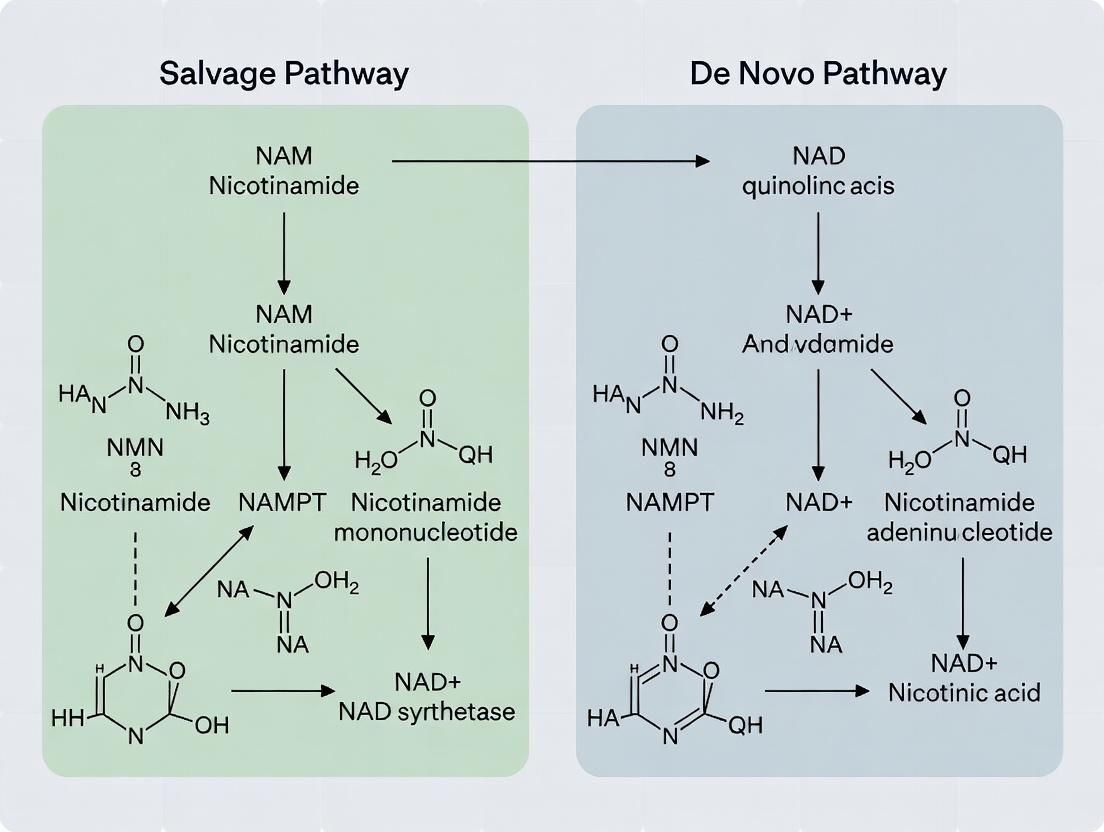
This comprehensive review examines the intricate NAD+ biosynthetic landscape, contrasting the de novo and salvage pathways.
NAD+ Biosynthesis Pathways: De Novo vs. Salvage – Mechanisms, Research Methods & Therapeutic Implications
Abstract
This comprehensive review examines the intricate NAD+ biosynthetic landscape, contrasting the de novo and salvage pathways. Targeted at researchers and drug development professionals, the article details the foundational biochemistry, core enzymatic players (NAMPT, NAPRT, QAPRT, NMNAT), and cellular compartmentalization of each route. We explore current methodological approaches for pathway analysis, common experimental challenges, and validation strategies for distinguishing pathway contributions. The synthesis highlights how pathway preference shifts in disease states—notably aging, cancer, and neurodegeneration—and evaluates emerging therapeutic strategies that target specific pathway nodes to modulate NAD+ metabolism for clinical benefit.
Building Blocks of Vitality: Unpacking the Core Biochemistry of NAD+ Biosynthesis
1. Introduction and Thesis Context Nicotinamide adenine dinucleotide (NAD+) is a quintessential molecule in cellular physiology, serving dual roles as a critical redox coenzyme and a substrate for signaling enzymes. Within the broader research thesis investigating the NAD+ salvage pathway versus the de novo biosynthesis pathway, understanding the compartmentalization, flux, and signaling functions of NAD+ pools is paramount. Current research aims to delineate how precursor choice (e.g., nicotinamide (NAM) vs. tryptophan/nicotinic acid (NA)) influences specific NAD+-dependent processes, offering targets for therapeutic intervention in aging, metabolic disease, and neurodegeneration.
2. Core Biochemical Functions and Signaling Pathways
NAD+ functions are categorized into redox reactions and non-redox signaling.
- Redox Metabolism: NAD+ cycles between its oxidized (NAD+) and reduced (NADH) forms in catabolic and anabolic pathways, including glycolysis, the TCA cycle, and oxidative phosphorylation.
- Signaling Substrate: NAD+ is consumed as a substrate by three major enzyme families:
- Sirtuins (SIRTs): Deacylases (deacetylases, desuccinylases, etc.) linking NAD+ levels to epigenetic regulation, metabolism, and stress response.
- Poly(ADP-ribose) Polymerases (PARPs): Involved in DNA damage repair and genomic stability.
- CD38/CD157: Ectoenzymes majorly responsible for NAD+ hydrolysis, influencing intracellular NAD+ levels and calcium signaling.
The competition for NAD+ among these consumers creates a signaling network sensitive to NAD+ bioavailability, which is directly governed by the activity of its biosynthesis pathways.
Diagram 1: NAD+ Biosynthesis, Consumption, and Recycling Pathways
3. Quantitative Data on NAD+ Metabolism
Table 1: Comparative Analysis of Major NAD+ Biosynthesis Pathways in Mammals
| Feature | De Novo Pathway (kynurenine) | Preiss-Handler Pathway | Salvage Pathway (from NAM) |
|---|---|---|---|
| Primary Precursor | Tryptophan (Trp) | Nicotinic Acid (NA) | Nicotinamide (NAM) |
| Key Rate-Limiting Enzyme | Indoleamine 2,3-dioxygenase (IDO1) / TDO | Nicotinate phosphoribosyltransferase (NAPRT) | Nicotinamide phosphoribosyltransferase (NAMPT) |
| Tissue Predominance | Liver, Kidney, Macrophages | Liver, Kidney, Intestine | Ubiquitous (High in brain, heart, muscle) |
| Estimated Contribution to Cellular NAD+ | ~15% (diet-dependent) | Variable (diet-dependent) | ~85% (Major pathway) |
| Response to DNA Damage | Largely unaffected | Downregulated | Critically upregulated to supply PARPs |
| Therapeutic Targeting | IDO1 inhibitors (oncology) | NA supplementation (NAPRT+ cancers) | NAMPT inhibitors (oncology), NR/NMN supplements |
Table 2: NAD+-Consuming Enzymes and Their Impact on NAD+ Pools
| Enzyme Family | Primary Function | NAD+ Consumption Rate | Km for NAD+ (μM) | Effect on NAD+ Pool |
|---|---|---|---|---|
| PARP1 | DNA Repair | Very High (up to 500x basal) | ~50-100 | Rapid, severe depletion upon genotoxic stress |
| SIRT1 | Transcriptional Regulation | Low-Moderate | ~100-200 | Gradual, tonic consumption; regulates metabolism |
| CD38 | Calcium Signaling | High (Major hydrolase) | ~20-50 | Significant controller of basal NAD+ turnover |
4. Experimental Protocols for NAD+ Research
Protocol 1: Quantifying Intracellular NAD+ and NADH Pools (Cyclic Enzyme Assay)
- Principle: NAD+ is reduced to NADH via alcohol dehydrogenase (ADH), which then reduces a tetrazolium salt to a colored formazan via diaphorase, measurable at 565 nm. Separate assays for total NAD(H) and NAD+ (after decomposing NADH at 60°C) allow calculation of NADH.
- Detailed Steps:
- Cell Extraction: Wash cells with cold PBS. Lyse in 200-500 μL of NAD+/NADH extraction buffer (e.g., containing 1% dodecyltrimethylammonium bromide). For NAD+ only, use an acidic extraction; for NADH only, use an alkaline extraction.
- Sample Preparation: Centrifuge lysate at 12,000g for 5 min at 4°C. Transfer supernatant to a fresh tube. For total NAD(H) measurement, use a neutralized lysate.
- Reaction Mix (96-well plate):
- Background Well: 50 μL sample + 50 μL assay buffer.
- Sample Well: 50 μL sample + 40 μL assay buffer + 10 μL ADH enzyme mix.
- Incubation: Incubate at 37°C for 10-30 min to allow complete conversion of NAD+ to NADH.
- Color Development: Add 100 μL of colorimetric developer (containing diaphorase and tetrazolium salt) to all wells. Incubate at 37°C for 30-60 min protected from light.
- Measurement: Read absorbance at 565 nm. Calculate concentration from a standard curve of known NAD+ concentrations (e.g., 0-10 μM).
- Data Analysis: Normalize values to total protein content (e.g., BCA assay).
Protocol 2: Tracing NAD+ Flux via Stable Isotope Labeling and LC-MS/MS
- Principle: Using precursors like ¹⁵N-NAM or ¹³C-Trp to trace the incorporation into NAD+ and related metabolites, allowing flux analysis between pathways.
- Detailed Steps:
- Labeling: Treat cells with isotopically labeled precursor (e.g., 100 μM ¹⁵N-NAM) in standard culture medium for desired time (e.g., 2, 4, 8, 24h).
- Metabolite Extraction: Quickly wash cells with cold ammonium acetate buffer. Quench metabolism with -20°C 80% methanol/water. Scrape cells, vortex, and incubate at -20°C for 1h. Centrifuge at 16,000g for 15 min at 4°C.
- LC-MS/MS Analysis:
- Column: HILIC or reverse-phase column (e.g., Atlantis T3).
- Mobile Phase: A: 10 mM ammonium acetate in water; B: acetonitrile. Use a gradient from high to low B.
- MS: Operate in positive/negative ESI mode with Multiple Reaction Monitoring (MRM) for NAD+, NAAD, NMN, NAM, ADPR, etc., and their labeled counterparts.
- Flux Analysis: Calculate labeling enrichment (M+1, M+2... peaks) and fractional contribution using software (e.g., IsoCor, MetaBoAnalyst).
Diagram 2: Stable Isotope Tracing Workflow for NAD+ Flux
5. The Scientist's Toolkit: Key Research Reagents
Table 3: Essential Reagents for NAD+ Biosynthesis and Signaling Research
| Reagent / Material | Function / Application | Example Target/Use |
|---|---|---|
| FK866 (APO866) | High-potency, specific inhibitor of NAMPT. | To pharmacologically block the salvage pathway and deplete NAD+ pools. |
| NAM / NA / NR / NMN | NAD+ precursors. | To supplement cultures or animals and study pathway-specific NAD+ repletion and signaling effects. |
| EX-527 (Selisistat) | Potent and specific inhibitor of SIRT1. | To dissect the role of SIRT1-mediated NAD+ consumption and signaling. |
| Olaparib | Potent PARP1/2 inhibitor. | To block PARP activity, preventing NAD+ depletion during DNA damage studies. |
| 78c | Potent inhibitor of CD38. | To inhibit the major NAD+-hydrolase and elevate intracellular NAD+ levels. |
| Anti-ADPR/PAR Antibody | Detect PARylation (PARP activity). | Immunoblot/immunofluorescence readout of PARP activation. |
| Acetyl-p53 (Lys382) Antibody | Substrate-specific antibody. | Readout of SIRT1 deacetylase activity in cells. |
| LC-MS/MS Grade Solvents & Standards | Metabolite extraction and quantification. | Absolute quantification and isotope tracing of NAD+ metabolome. |
| NAD+/NADH-Glo Assay | Luminescent coupled-enzyme assay. | High-throughput, sensitive quantification of NAD+ and NADH ratios. |
Within the broader context of NAD+ biosynthesis research, the salvage pathway is often contrasted with the de novo pathway initiated from tryptophan. While the salvage pathway recycles pre-formed nicotinamide derivatives, the de novo pathway represents a critical biosynthesis route from an amino acid precursor, essential under conditions of dietary niacin deficiency or heightened cellular demand. This whitepaper provides an in-depth technical examination of the first segment of this pathway: the conversion of tryptophan to quinolinic acid (QA), the direct precursor to NAD+, via the kynurenine route. Understanding the regulation and flux of this pathway is paramount in drug development, given its roles in immunology, neurology, and aging.
The Biochemical Pathway: Enzymatic Steps and Regulation
The de novo NAD+ biosynthesis from tryptophan is a multi-step process primarily occurring in the liver and in immune-responsive cells. The pathway to QA involves seven key enzymatic reactions.
Diagram: Tryptophan to Quinolinic Acid Pathway
Pathway Summary:
- Rate-Limiting Step: Conversion of L-Tryptophan to N-Formylkynurenine by Indoleamine 2,3-dioxygenase 1 (IDO1) or Tryptophan 2,3-dioxygenase (TDO2).
- Formyl Group Removal: Kynurenine formamidase hydrolyzes N-Formylkynurenine to L-Kynurenine (KYN).
- Branch Point: KYN is the central metabolite. It can be:
- Hydroxylated by Kynurenine 3-monooxygenase (KMO) to 3-Hydroxykynurenine (3-HK).
- Transaminated by Kynurenine aminotransferases (KATs) to form the neuroactive metabolite Kynurenic Acid (KYNA).
- Kynureninase Action: Kynureninase (KYNU) cleaves 3-HK to 3-Hydroxyanthranilic Acid (3-HAA).
- Ring-Opening Dioxygenation: 3-Hydroxyanthranilate 3,4-dioxygenase (HAAO) opens the benzene ring of 3-HAA, producing an unstable intermediate that spontaneously cyclizes to form Quinolinic Acid (QA).
QA is then taken up by quinolinate phosphoribosyltransferase (QPRT) in the Preiss-Handler pathway to yield NAD+.
Quantitative Data: Enzyme Kinetics and Metabolite Levels
Table 1: Key Human Enzyme Parameters in the Tryptophan-to-QA Pathway
| Enzyme (Gene) | EC Number | Primary Location | Approx. Km for Main Substrate | Key Inhibitors/Regulators |
|---|---|---|---|---|
| IDO1 (IDO1) | 1.13.11.52 | Extrahepatic, immune cells | ~20 µM (Trp) | Epacadostat, Navoximod; Induced by IFN-γ |
| TDO2 (TDO2) | 1.13.11.11 | Liver | ~190 µM (Trp) | 680C91; Induced by glucocorticoids, Trp |
| KMO (KMO) | 1.14.13.9 | Mitochondrial Outer Membrane | ~25 µM (Kyn) | Ro 61-8048, JM6 |
| KYNU (KYNU) | 3.7.1.3 | Cytosol | ~30 µM (3-HK) | Benserazide |
| HAAO (HAAO) | 1.13.11.6 | Cytosol | ~3 µM (3-HAA) | -- |
Table 2: Representative Metabolite Concentrations in Human Biofluids
| Metabolite | Plasma/Serum (Approx. Range) | CSF (Approx. Range) | Notes |
|---|---|---|---|
| Tryptophan (Trp) | 50 - 80 µM | 1 - 3 µM | Subject to dietary fluctuation |
| Kynurenine (Kyn) | 1 - 3 µM | 0.04 - 0.08 µM | Kyn/Trp ratio is a clinical marker of IDO/TDO activity |
| 3-Hydroxykynurenine (3-HK) | 0.04 - 0.10 µM | 1 - 5 nM | |
| Quinolinic Acid (QA) | 0.5 - 1.5 µM | 10 - 50 nM | Elevated in neuroinflammatory states |
Detailed Experimental Protocol: Measuring Pathway FluxIn Vitro
Protocol: LC-MS/MS-Based Quantification of Tryptophan-Kynurenine Pathway Metabolites from Cell Culture.
Objective: To quantify the flux of tryptophan through the kynurenine pathway in stimulated human primary macrophages, reflecting immune-induced de novo NAD+ biosynthesis activity.
I. Cell Treatment and Metabolite Extraction
- Cell Culture: Plate primary human monocyte-derived macrophages (e.g., 1x10^6 cells/well in 6-well plates) in phenol-red free RPMI 1640.
- Stimulation: Treat cells with IFN-γ (100 ng/mL) or vehicle control for 24-48 hours to induce IDO1 expression.
- Metabolite Harvest: Aspirate medium. Rapidly quench metabolism by adding 1 mL of ice-cold 80% methanol/water (-20°C) to the well.
- Scrape and Transfer: Scrape cells on ice, transfer the suspension to a pre-chilled 1.5 mL microcentrifuge tube.
- Extraction: Vortex for 30 sec, incubate at -20°C for 1 hour, then centrifuge at 16,000 x g for 15 min at 4°C.
- Collection: Transfer 800 µL of supernatant to a new tube. Dry under a gentle stream of nitrogen or using a vacuum concentrator.
- Reconstitution: Reconstitute the dried pellet in 100 µL of LC-MS grade 0.1% formic acid in water, vortex thoroughly, and centrifuge at 16,000 x g for 10 min before LC-MS/MS analysis.
II. LC-MS/MS Analysis
- Column: HILIC column (e.g., BEH Amide, 2.1 x 100 mm, 1.7 µm).
- Mobile Phase: A) 0.1% Formic acid in water; B) 0.1% Formic acid in acetonitrile.
- Gradient: 95% B to 50% B over 10 min, hold, re-equilibrate.
- MS: Triple quadrupole MS in positive/negative electrospray ionization (ESI) mode with Multiple Reaction Monitoring (MRM). Example transitions:
- Tryptophan: 205.1 > 188.1 (CE 12 eV)
- Kynurenine: 209.1 > 146.1 (CE 14 eV)
- 3-Hydroxykynurenine: 225.1 > 162.1 (CE 12 eV)
- Quinolinic Acid: 168.0 > 150.0 (CE 16 eV, negative mode)
- Quantification: Use stable isotope-labeled internal standards (e.g., d5-Tryptophan, d4-Kynurenine) for each analyte to ensure accuracy.
Workflow Diagram: Metabolite Extraction and Analysis Protocol
The Scientist's Toolkit: Research Reagent Solutions
Table 3: Essential Reagents for Studying the Kynurenine Pathway
| Reagent / Material | Function & Application | Example Product/Supplier |
|---|---|---|
| Recombinant Human IDO1/KMO Enzymes | In vitro enzyme activity assays, inhibitor screening. | R&D Systems, Sino Biological |
| Stable Isotope-Labeled Tryptophan (¹³C₁₁- TRP) | Metabolic flux analysis (MFA) to trace pathway kinetics. | Cambridge Isotope Labs |
| IDO1/TDO/KMO Selective Inhibitors (e.g., Epacadostat, 680C91, Ro 61-8048) | Pharmacological pathway modulation, target validation. | Tocris Bioscience, MedChemExpress |
| Anti-IDO1 / Anti-KYN Antibodies | Western blot, IHC for protein expression validation. | Cell Signaling Technology |
| Targeted LC-MS/MS Metabolite Panel | Absolute quantification of Trp, Kyn, 3-HK, QA, etc. | Commercial kits (e.g., Biocrates MxP Quant 500) |
| Human Primary Immune Cells (e.g., monocytes, macrophages) | Physiologically relevant ex vivo models of inflammation. | STEMCELL Technologies, PromoCell |
| Kynurenine ELISA Kit | High-throughput screening of KYN levels in cell media/plasma. | Immunodiagnostik AG |
Nicotinamide adenine dinucleotide (NAD+) is an essential redox cofactor and signaling molecule. Its biosynthesis occurs via two primary routes: the de novo pathway from tryptophan and the salvage pathway from preformed precursors like nicotinamide (NAM) and nicotinic acid (NA). This whitepaper focuses on the mammalian salvage pathway, a critical recycling mechanism that maintains NAD+ homeostasis. Within the broader thesis of NAD+ research, the salvage pathway is prioritized in many tissues for its efficiency and rapid response to cellular demand, contrasting with the more metabolically costly and regulated de novo synthesis. Dysregulation of salvage is implicated in aging, metabolic disorders, and neurodegeneration, making it a prime target for therapeutic intervention.
Core Enzymatic Machinery of the Salvage Pathway
The salvage pathway utilizes distinct but parallel routes for NAM and NA.
1. Nicotinamide (NAM) Salvage (The Predominant Route): The enzyme Nicotinamide Phosphoribosyltransferase (NAMPT) is the rate-limiting step, catalyzing the conversion of NAM to Nicotinamide Mononucleotide (NMN) using phosphoribosyl pyrophosphate (PRPP). NMN is then adenylated to NAD+ by NMNATs (NMN adenylyltransferases 1-3).
2. Nicotinic Acid (NA) Salvage (The Preiss-Handler Pathway): Nicotinate Phosphoribosyltransferase (NAPRT) converts NA to Nicotinic Acid Mononucleotide (NaMN). NaMN is then adenylylated to NaAD+ by NMNAT. Finally, NAD+ synthetase (NADSYN) aminates NaAD+ to yield NAD+.
3. Key Regulatory Enzyme: CD38/CD157/ SARM1: These are major NAD+-consuming glycohydrolases and ectoenzymes that cleave NAD+ to generate NAM and ADPR/ cADPR, directly feeding NAM back into the salvage cycle.
Quantitative Data: Enzyme Kinetics & Tissue Distribution
Table 1: Key Kinetic Parameters of Salvage Pathway Enzymes (Human)
| Enzyme | Gene | Primary Substrate (Km) | Key Cofactor/Activator | Tissue Expression (High) | Inhibitors (Research Tools) |
|---|---|---|---|---|---|
| NAMPT | NAMPT | NAM (~0.8-3 µM) | PRPP, ATP | Liver, Skeletal Muscle, WAT | FK866 (APO866), CHS-828 |
| NMNAT1 | NMNAT1 | NMN (~12-30 µM) | ATP (Mg²⁺) | Nucleus, Ubiquitous | - |
| NMNAT2 | NMNAT2 | NMN (~80 µM) | ATP (Mg²⁺) | Golgi, Brain, Testis | - |
| NMNAT3 | NMNAT3 | NMN (~180 µM) | ATP (Mg²⁺) | Mitochondria, Spleen | - |
| NAPRT | NAPRT | NA (~0.6 µM) | PRPP, ATP | Liver, Kidney, Heart | - |
| NADSYN | NADSYN1 | NaAD+ (~10 µM) | Glutamine, ATP | Liver, Small Intestine | - |
Table 2: Comparative NAD+ Pool Dynamics in Mouse Tissues (pmol/mg tissue)
| Tissue | Basal NAD+ (Salvage-Dependent) | % Δ after NAMPT Inhibition (FK866) | % Δ after NA Supplementation | Primary Salvage Isoform Expressed |
|---|---|---|---|---|
| Liver | 800-1000 | -70% to -80% | +200% to +300% | NAMPT, NAPRT |
| Brain | 250-400 | -50% to -60% | +20% to +30% | NAMPT, NMNAT2 |
| Skeletal Muscle | 300-500 | -40% to -50% | +100% to +150% | NAMPT |
| Heart | 400-600 | -60% to -70% | +150% to +200% | NAMPT, NAPRT |
| Kidney | 500-700 | -50% to -60% | +250% to +350% | NAPRT |
Detailed Experimental Protocols
Protocol 1: Measuring Cellular NAD+ Levels via Cycling Assay
Principle: An enzymatic cycling reaction amplifies the signal from low NAD+ concentrations.
- Cell Extraction: Wash cells (e.g., 1x10⁶ HEK293) with cold PBS. Lyse with 200 µl of 0.6 N HClO₄. Incubate 10 min on ice.
- Neutralization: Add 100 µl of 1 M K₂HPO₄ (pH 10.5), vortex, and centrifuge at 15,000g for 10 min (4°C). Collect supernatant.
- Cycling Reaction: Prepare a master mix (final volume 100 µl/well) containing 100 mM Bicine (pH 7.8), 1.0 M ethanol, 8 mM EDTA, 0.5 mM MTT, 2.4 mM PES, and 6 U/ml alcohol dehydrogenase (ADH). Add 50 µl of sample or standard (0-10 µM NAD+) to 50 µl of master mix in a 96-well plate.
- Measurement: Incubate at 30°C for 5-30 min (kinetic reading). Measure absorbance at 570 nm. Calculate concentration from standard curve.
Protocol 2: Assessing NAMPT Activity Using Radiolabeled NAM
- Preparation of Cell/Tissue Lysate: Homogenize sample in lysis buffer (50 mM Tris-HCl pH 7.5, 150 mM NaCl, 1% NP-40, with protease inhibitors). Clarify by centrifugation.
- Reaction Setup: In a 50 µl reaction, combine 2 µCi [carbonyl-¹⁴C]NAM, 1 mM PRPP, 5 mM ATP, 5 mM MgCl₂, and 50 µg of lysate protein in activity buffer (50 mM HEPES pH 7.5). Incubate at 37°C for 30 min.
- Reaction Termination: Add 20 µl of 2 N HCl and place on ice.
- Product Separation: Spot the reaction mix onto a Polygram CEL 300 PEI TLC plate. Develop the plate in a solvent system of 0.5 M LiCl / 1 M Acetic Acid (1:1, v/v).
- Quantification: Visualize and quantify the radioactive NMN product spot using a phosphorimager or by scintillation counting of the scraped spot.
Pathway & Experimental Workflow Visualizations
Diagram 1: Core Enzymatic Flow of NAD+ Salvage Pathways
Diagram 2: Workflow for Quantifying Cellular NAD+ Levels
The Scientist's Toolkit: Key Research Reagent Solutions
Table 3: Essential Reagents and Tools for Salvage Pathway Research
| Reagent/Tool | Function/Application | Example Product (Supplier) |
|---|---|---|
| FK866 (APO866) | Potent, specific chemical inhibitor of NAMPT. Used to deplete cellular NAD+ pools and study salvage dependence. | APExBIO (A4103), Sigma (F8557) |
| [carbonyl-¹⁴C]NAM | Radiolabeled substrate for direct measurement of NAMPT enzymatic activity in vitro or in cells. | American Radiolabeled Chemicals (ARC 1076) |
| Recombinant Human NAMPT/NAPRT | Purified enzyme for in vitro kinetic studies, inhibitor screening, or as an assay standard. | R&D Systems (4395-EN), Sigma (SRP6107) |
| NAD+/NADH Assay Kits | Fluorometric or colorimetric kits for convenient, high-throughput quantification of NAD+ and NADH ratios. | Promega (G9071), Abcam (ab65348), Sigma (MAK037) |
| NMNAT Activity Assay Kit | Coupled enzymatic assay to measure NMNAT activity via NAD+ formation. | BioVision (K437-100) |
| Anti-NAMPT Antibodies | For detection of NAMPT protein expression (Western Blot, IHC) and localization studies. | Cell Signaling Tech (#66837), Santa Cruz (sc-393444) |
| NR (Nicotinamide Riboside) & NMN | NAD+ precursors that feed into the salvage pathway. Used in supplementation studies. | Sigma (N3501, SMB00310) |
| CD38 Inhibitors (e.g., 78c) | Tool compounds to inhibit the major NAD+ consumer, increasing baseline NAD+ and altering salvage flux. | Tocris (5691) |
The homeostasis of nicotinamide adenine dinucleotide (NAD+) is critical for cellular bioenergetics, signaling, and genomic stability. Research focuses on two primary pathways: the de novo pathway from tryptophan and the salvage pathways from preformed precursors like nicotinic acid (NA), nicotinamide (Nam), and nicotinamide riboside (NR). This whitepaper details the core enzymes—NAMPT, NAPRT, QAPRT, and NMNAT isoforms—that define the flux and regulation between these pathways. A central thesis in current NAD+ research posits that targeted modulation of these specific enzymes, rather than broad precursor supplementation, may offer more precise therapeutic interventions in age-related diseases, cancer, and metabolic disorders by controlling compartmentalized NAD+ pools.
Enzyme Definitions, Roles, and Quantitative Data
Nicotinamide Phosphoribosyltransferase (NAMPT)
NAMPT is the rate-limiting enzyme in the mammalian NAD+ salvage pathway from nicotinamide (Nam). It catalyzes the condensation of Nam and 5-phosphoribosyl-1-pyrophosphate (PRPP) to yield nicotinamide mononucleotide (NMN).
Table 1: NAMPT Biochemical & Expression Data
| Parameter | Value / Characteristic | Notes |
|---|---|---|
| Reaction | Nam + PRPP → NMN + PPi | Mg²⁺ dependent |
| Isoforms | Intracellular (iNAMPT), Extracellular (eNAMPT) | eNAMPT has cytokine-like function |
| Km (Nam) | ~0.7 - 3.0 µM | High affinity for Nam |
| Inhibitors | FK866, CHS-828 | Potent non-competitive inhibitors, IC₅₀ ~1-10 nM |
| Tissue Expression | High in liver, kidney, heart; regulated by circadian clock | SIRT1-dependent feedback loop |
Nicotinate Phosphoribosyltransferase (NAPRT)
NAPRT catalyzes the first step in the Preiss-Handler pathway, converting nicotinic acid (NA) and PRPP to nicotinic acid mononucleotide (NaMN). This is a key entry point for dietary NA.
Table 2: NAPRT Biochemical & Genetic Data
| Parameter | Value / Characteristic | Notes |
|---|---|---|
| Reaction | NA + PRPP → NaMN + PPi | Requires Mg²⁺ and ATP for activity |
| Km (NA) | ~1 - 10 µM | Varies by tissue |
| Genetic Regulation | Regulated by NAMPT levels & NAD+ feedback | Low in some cancers (e.g., glioblastoma, neuroblastoma) |
| Therapeutic Relevance | Biomarker for NA efficacy; NAPRT-deficient tumors resistant to NAMPTi | NA can rescue NAMPT inhibition toxicity in NAPRT+ cells |
Quinolinic Acid Phosphoribosyltransferase (QAPRT)
QAPRT is a central enzyme in the de novo pathway from tryptophan. It converts quinolinic acid (QA) and PRPP to nicotinic acid mononucleotide (NaMN), bridging tryptophan catabolism to NAD+ synthesis.
Table 3: QAPRT Biochemical Data
| Parameter | Value / Characteristic | Notes |
|---|---|---|
| Reaction | Quinolinic Acid + PRPP → NaMN + CO₂ | Unique decarboxylation step |
| Subcellular Location | Cytosolic | |
| Km (QA) | ~20 - 50 µM | Lower affinity than NAMPT/NAPRT for substrates |
| Physiological Role | Major NAD+ source in liver, immune cells (macrophages) | Induced by inflammatory stimuli (e.g., IFN-γ) |
Nicotinamide Mononucleotide Adenylyltransferase (NMNAT) Isoforms
NMNATs are the final common enzymes in multiple NAD+ biosynthesis pathways, adenylylating NMN or NaMN to form NAD+ or NaAD. Mammals have three nuclear-encoded isoforms with distinct subcellular localizations, dictating compartment-specific NAD+ production.
Table 4: Mammalian NMNAT Isoforms Comparison
| Parameter | NMNAT1 | NMNAT2 | NMNAT3 |
|---|---|---|---|
| Gene Locus | NMNAT1 | NMNAT2 | NMNAT3 |
| Primary Localization | Nucleus | Golgi/Cytosol | Mitochondria |
| Substrate Preference | NMN ≈ NaMN | NMN > NaMN | NMN ≈ NaMN |
| Km (NMN) | ~2 - 6 µM | ~50 - 100 µM | ~20 - 40 µM |
| Key Roles | Nuclear NAD+ synthesis, axon survival factor | Axonal transport, key for neuronal health | Mitochondrial NAD+ maintenance |
| Disease Links | Mutations cause Leber Congenital Amaurosis | Wallerian degeneration, neurodegeneration | Overexpression linked to some cancers |
Experimental Protocols for Key Assays
Protocol: Measuring NAMPT Enzyme Activity
Principle: A coupled enzymatic assay detecting NMN production via ATP formation (using NMNAT and NAD+ synthetase) or a fluorescence-based assay. Detailed Method:
- Prepare Reaction Mix (100 µL): 50 mM HEPES (pH 7.5), 2 mM MgCl₂, 0.5 mM PRPP, 1 mM ATP, 0.1 mM Nam, 1 µCi [³H]-Nam (if radioactive), 1 µg recombinant NMNAT, 1 µg recombinant NAD+ synthetase.
- Initiate Reaction: Add purified NAMPT (10-100 ng) or cell lysate (10-50 µg total protein). Incubate at 37°C for 30-60 min.
- Terminate & Detect: Stop with 10 µL of 2M HCl. For radioactive detection, separate products by HPLC and quantify [³H]-NMN. Alternatively, use a commercial NAD+/NADH detection kit after converting NMN to NAD+.
- Control: Include reactions without PRPP or with specific inhibitor FK866 (100 nM).
Protocol: Differentiating NAD+ Pathway Flux Using Isotopic Tracers
Principle: Using stable isotope-labeled precursors ([¹³C₁₅]-Nam, [D₄]-NA, [¹³C₁₁]-Tryptophan) to track flux through salvage vs. de novo pathways via LC-MS. Detailed Method:
- Cell Treatment: Seed cells in 6-well plates. At ~80% confluency, replace media with tracer-containing media (e.g., 50 µM [¹³C₁₅]-Nicotinamide).
- Incubation & Extraction: Incubate for 2-24h. Quench metabolism with ice-cold 80% methanol. Scrape cells, vortex, and centrifuge (15,000xg, 15 min, 4°C).
- LC-MS Analysis: Dry supernatant under N₂ gas. Reconstitute in H₂O. Analyze using a C18 column coupled to a high-resolution mass spectrometer in positive ion mode.
- Data Analysis: Quantify isotopologues of NAD+ (e.g., M+1 for [¹³C₁]-ribose from salvage, M+5 for full incorporation of labeled Nam). Calculate fractional contributions of each pathway.
Protocol: Assessing NMNAT Isoform-Specific Activity in Subcellular Fractions
Principle: Isolate organelles (nuclei, mitochondria, cytosol) and measure NMNAT activity with isoform-specific substrates/inhibitors. Detailed Method:
- Subcellular Fractionation: Use differential centrifugation. Homogenize tissue/cells in isotonic buffer (250 mM sucrose, 10 mM HEPES, pH 7.4) with protease inhibitors. Pellet nuclei (1,000xg, 10 min). Pellet mitochondria (10,000xg, 15 min). Supernatant is cytosolic fraction.
- Activity Assay: For each fraction, set up a reaction (50 µL): 50 mM Tris-HCl (pH 8.0), 5 mM MgCl₂, 1 mM ATP, 0.5 mM NMN (or NaMN). Start by adding 10-20 µg fraction protein. Incubate 20 min at 37°C.
- NAD+ Detection: Stop reaction with 50 µL of 0.5M perchloric acid, neutralize with KOH. Quantify NAD+ using an enzymatic cycling assay (e.g., using alcohol dehydrogenase and resazurin) or commercial kit.
- Isoform Specificity: Use selective inhibitors (e.g., Gallotannin for NMNAT2) or siRNA knockdowns to attribute activity.
Diagrams of Pathways and Relationships
Title: NAD+ Biosynthesis Pathways: De Novo, Preiss-Handler, and Salvage
Title: NMNAT Isoforms Gatekeep Compartmentalized NAD+ Pools
The Scientist's Toolkit: Research Reagent Solutions
Table 5: Essential Reagents for NAD+ Enzyme Research
| Reagent / Material | Function / Application | Example Vendor(s) |
|---|---|---|
| Recombinant Human Enzymes (NAMPT, NAPRT, NMNAT1-3) | Positive controls for activity assays; substrate specificity studies. | BPS Bioscience, Sigma-Aldrich, R&D Systems |
| Potent Inhibitors (FK866, GMX1778 for NAMPT; Gallotannin for NMNAT2) | Pharmacological probes to dissect pathway contributions and for cancer therapy research. | Cayman Chemical, MedChemExpress, Tocris |
| Stable Isotope-Labeled Precursors ([¹³C₁₅]-Nicotinamide, [D₄]-Nicotinic Acid, [¹³C₁₁]-Tryptophan) | Tracing metabolic flux through salvage vs. de novo pathways via LC-MS. | Cambridge Isotope Labs, Sigma-Aldrich |
| NAD+/NADH/NADP+/NADPH Quantitation Kits (Colorimetric/Fluorometric) | High-throughput measurement of total and phosphorylated pyridine nucleotides. | Promega (CellTiter-Glo), Abcam, BioVision, Sigma-Aldrich |
| Isoform-Selective Antibodies (anti-NMNAT1, anti-NMNAT2, anti-NMNAT3) | Validation of knockdown/knockout; subcellular localization by WB/IF. | Santa Cruz Biotechnology, Abcam, Proteintech |
| PRPP (5-Phosphoribosyl-1-pyrophosphate) | Essential substrate for NAMPT, NAPRT, and QAPRT activity assays. | Sigma-Aldrich, Carbosynth |
| NMN & NaMN Standards (Authentic, HPLC-grade) | Calibration standards for LC-MS; substrate for NMNAT assays. | Sigma-Aldrich, Toronto Research Chemicals |
| siRNA/shRNA Libraries (Targeting NAMPT, NMNATs, etc.) | Genetic validation of enzyme function and synthetic lethality screens. | Dharmacon, Sigma-Aldrich, Origene |
1. Introduction Within the context of NAD+ metabolism research, a critical distinction exists between the salvage and de novo biosynthesis pathways. Beyond their biochemical differences, these pathways are compartmentalized within specific cellular and subcellular niches. This spatial organization dictates substrate availability, regulatory control, and functional output. Understanding this localization is paramount for developing targeted therapeutic interventions aimed at modulating NAD+ levels in disease contexts, such as aging, neurodegeneration, and metabolic disorders.
2. Pathway Overview and Primary Cellular Localization The de novo pathway from tryptophan (kynurenine pathway) and the salvage pathway utilizing nicotinamide (NAM) or nicotinic acid (NA) operate in distinct cellular compartments. The salvage pathway is ubiquitously active in most mammalian cell types, while the de novo pathway exhibits more restricted expression.
Table 1: Cellular and Tissue Distribution of NAD+ Biosynthesis Pathways
| Pathway | Primary Cell/Tissue Types | Key Regulatory/Inducible Contexts |
|---|---|---|
| Salvage (from NAM) | Nearly all cell types (constitutive). High activity in brain, liver, muscle. | Universally essential; induced by DNA damage (PARP activation), inflammation. |
| Salvage (from NA) | Liver, intestine, macrophages. | Induced by lipid/cholesterol metabolism demands (NA is a hypolipidemic agent). |
| De Novo (from Trp) | Liver, kidney, immune cells (macrophages, dendritic cells), brain microglia. | Strongly induced by pro-inflammatory cytokines (IFN-γ, TNF-α); immune challenge. |
3. Detailed Subcellular Compartmentalization The enzymatic machinery of each pathway is precisely localized, creating dedicated NAD+ pools.
Table 2: Subcellular Localization of Core Enzymes in Human NAD+ Biosynthesis
| Enzyme | Pathway Step | Subcellular Localization | Notes on NAD+ Pool Impact |
|---|---|---|---|
| NAMPT | Salvage (Rate-limiting: NAM → NMN) | Primarily cytosolic. Secreted (eNAMOT) acts extracellularly. | Maintains cytosolic & nuclear NAD+. eNAMPT produces extracellular NMN. |
| NMNAT1 | Salvage & De Novo (NMN/NaMN → NAD+) | Nucleus. | Critical for nuclear NAD+ pool fueling PARPs, SIRTs. |
| NMNAT2 | Salvage & De Novo (NMN/NaMN → NAD+) | Cytosol, Golgi apparatus, vesicles. | Maintains cytosolic NAD+, essential for neuronal health. |
| NMNAT3 | Salvage & De Novo (NMN/NaMN → NAD+) | Mitochondria. | Sole enzyme synthesizing NAD+ inside mitochondria, crucial for oxidative phosphorylation. |
| IDO/TDO | De Novo (Trp → Kynurenine) | Cytosol. | Rate-limiting step of de novo pathway; immune-regulated. |
| KMO | De Novo (Kynurenine → 3-HK) | Mitochondrial outer membrane. | Links de novo flux to mitochondrial compartment. |
| QPRT | De Novo (QA → NaMN) | Cytosol. | Commits QA to NAD+ synthesis, preventing QA neurotoxicity. |
4. Experimental Protocols for Localization Studies 4.1. Immunofluorescence Microscopy for Enzyme Localization
- Objective: Visualize subcellular localization of endogenous or tagged enzymes (e.g., NAMPT, NMNAT isoforms).
- Protocol:
- Cell Culture & Seeding: Grow target cells (e.g., HeLa, primary hepatocytes) on glass coverslips in 12-well plates.
- Fixation: Aspirate media, rinse with PBS, fix with 4% paraformaldehyde (PFA) in PBS for 15 min at RT.
- Permeabilization & Blocking: Rinse with PBS, permeabilize with 0.1% Triton X-100 in PBS for 10 min. Block with 5% BSA/1% normal goat serum in PBS for 1 hour.
- Primary Antibody Incubation: Incubate with validated primary antibodies (e.g., anti-NMNAT2, anti-TOMM20 for mitochondria) diluted in blocking buffer overnight at 4°C.
- Secondary Antibody & Stain: Rinse, incubate with fluorescent secondary antibodies (e.g., Alexa Fluor 488, 568) and organelle markers (e.g., MitoTracker, Hoechst for nucleus) for 1 hour at RT in dark.
- Imaging: Mount coverslips and acquire high-resolution confocal images. Perform colocalization analysis (e.g., Pearson's coefficient) with organelle-specific signals.
- Key Controls: Use siRNA knockdown or KO cells for antibody specificity. Include single-antibody stains to check for bleed-through.
4.2. Subcellular Fractionation with Western Blot Analysis
- Objective: Biochemically quantify pathway enzyme distribution across compartments.
- Protocol (Differential Centrifugation for Cytosol, Mitochondria, Nuclei):
- Harvesting: Collect 1x10^7 cells, wash with PBS, resuspend in ice-cold isotonic homogenization buffer (250 mM sucrose, 10 mM HEPES, pH 7.4, protease inhibitors).
- Homogenization: Use a Dounce homogenizer (30-40 strokes) or nitrogen cavitation. Check >90% cell lysis by trypan blue.
- Fractionation:
- Nuclei & Debris: Centrifuge homogenate at 800 x g for 10 min at 4°C. Pellet contains nuclei and unbroken cells (further purify nuclei through a sucrose cushion if needed).
- Mitochondria: Centrifuge the 800 x g supernatant at 10,000 x g for 15 min at 4°C. Pellet is the crude mitochondrial fraction.
- Cytosol: Centrifuge the 10,000 x g supernatant at 100,000 x g for 60 min at 4°C. The resulting supernatant is the cytosolic fraction.
- Validation & Analysis: Run equal protein amounts from each fraction on SDS-PAGE. Probe for target enzymes (e.g., NAMPT, NMNAT3) and compartment markers (e.g., Lamin B1 for nucleus, VDAC1 for mitochondria, GAPDH for cytosol).
5. Visualization of Pathway Localization and Metabolic Flow
6. The Scientist's Toolkit: Research Reagent Solutions Table 3: Essential Reagents for Studying NAD+ Pathway Localization
| Reagent/Category | Example Product/Assay | Primary Function in Localization Research |
|---|---|---|
| Validated Antibodies | Anti-NAMPT (Polyclonal, CST), Anti-NMNAT1/2/3 (Santa Cruz), Anti-VDAC1 (Abcam), Anti-Lamin B1 (Proteintech). | Target protein detection via immunofluorescence (IF) and western blot (WB) for spatial mapping. |
| Organelle-Specific Dyes | MitoTracker Deep Red (Thermo), Hoechst 33342 (Nuclear), LysoTracker (Lysoosomes). | Live-cell or fixed-cell compartment staining for colocalization analysis. |
| NAD+/NMN Metabolite Assays | NAD/NADH-Glo Assay (Promega), NMN/NAD+ ELISA Kits (Cell Biolabs). | Quantify metabolite levels in subcellular fractions or whole cells. |
| Subcellular Fractionation Kits | Mitochondria Isolation Kit (Thermo), Nuclear Extraction Kit (NE-PER, Thermo). | Rapid, standardized isolation of organelles for biochemical analysis. |
| Chemical Pathway Modulators | FK866 (NAMPT inhibitor), CHS-828 (NAMPT inhibitor), P7C3 (NMNAT2 stabilizer). | Pharmacological perturbation to study pathway dynamics and compensation. |
| Live-Cell Metabolite Sensors | SoNar (NAD+ sensor), iNAP sensors (specific for NAD+ in organelles). | Genetically encoded biosensors for real-time tracking of compartment-specific NAD+ dynamics. |
| siRNA/shRNA Libraries | ON-TARGETplus siRNA pools (Dharmacon) against NAMPT, NMNATs, QPRT. | Knockdown of specific enzymes to assess impact on localization and metabolite flux. |
Within the context of NAD+ metabolism research, a central thesis distinguishes the efficiency and regulation of the Preiss-Handler pathway (utilizing nicotinic acid, NA), the salvage pathways (utilizing nicotinamide, NAM, and nicotinamide riboside, NR), and the de novo pathway (utilizing tryptophan, Trp). The dependency of these pathways on specific dietary precursors determines cellular NAD+ homeostasis under varying physiological and pathological conditions. This whitepaper provides a technical analysis of these dietary sources, their quantitative bioavailability, and associated experimental methodologies critical for research and therapeutic development.
Dietary Precursors: Quantitative Analysis & Bioavailability
The four primary dietary precursors enter distinct metabolic nodes. Their relative abundance in food sources and absorption kinetics are summarized below.
Table 1: Dietary Sources and Representative Content of NAD+ Precursors
| Precursor | Primary Dietary Sources | Representative Content (Approximate) | Key Bioavailability Notes |
|---|---|---|---|
| Nicotinamide (NAM) | Animal products (meat, poultry, fish), mushrooms, legumes, nuts. | Chicken breast: ~10 mg/100g; Canned tuna: ~20 mg/100g. | Readily absorbed in stomach & small intestine. High doses can inhibit sirtuins (feedback inhibition). |
| Nicotinic Acid (NA) | Fortified cereals, whole grains, legumes, coffee, meat (lower than NAM). | Fortified breakfast cereal: ~20 mg/serving; Rice bran: ~30 mg/100g. | Rapidly absorbed, causes characteristic "flush" via prostaglandin D2 release. |
| Tryptophan (Trp) | Protein-rich foods: turkey, chicken, milk, cheese, eggs, seeds, nuts. | Turkey breast: ~300 mg/100g; Pumpkin seeds: ~570 mg/100g. | ~60 mg Trp is theoretically converted to 1 mg NAD+. Conversion is highly regulated by immune and hormonal status. |
| Nicotinamide Riboside (NR) | Trace amounts in milk, yeast, beer. | Cow's milk: ~1-3 µM. | Phosphorylated by NR kinases (NRK1/2) to NMN. More efficiently utilized than NAM in some tissues. |
Table 2: Pathway Assignment and Key Enzymes for Dietary Precursors
| Precursor | Primary Entry Pathway | Key Converting Enzyme(s) | Initial Metabolite | Pathway Class |
|---|---|---|---|---|
| NAM | Salvage Pathway | Nicotinamide phosphoribosyltransferase (NAMPT) | NMN | Salvage |
| NA | Preiss-Handler Pathway | Nicotinate phosphoribosyltransferase (NAPRT) | NAAD | De Novo from Diet |
| Tryptophan | De Novo Pathway | Indoleamine 2,3-dioxygenase (IDO1) / Tryptophan 2,3-dioxygenase (TDO) | Quinolinic Acid | De Novo from Scratch |
| NR | Salvage Pathway | Nicotinamide riboside kinases (NRK1/2) | NMN | Salvage |
Experimental Protocols for Precursor Metabolism Analysis
Protocol: Tracing NAD+ Flux from Labeled Precursors in Cell Culture
Objective: To quantify the contribution of specific precursors to the intracellular NAD+ pool. Methodology:
- Cell Preparation: Seed relevant cell line (e.g., HEK293, hepatocytes) in 6-well plates.
- Precursor Treatment: Replace media with media containing isotopically labeled precursors (e.g., [¹⁵N]-Trp, [²H₄]-NAM, [¹³C]-NR).
- Harvest: At time points (e.g., 1, 4, 12, 24h), wash cells with cold PBS and extract metabolites using 80% methanol/water at -80°C.
- LC-MS/MS Analysis:
- Chromatography: HILIC or reverse-phase column.
- Mass Spec: MRM mode. Transitions: NAD+ (m/z 664→428), labeled NAD+ (mass shift dependent on label).
- Data Analysis: Calculate isotopic enrichment (%) = (labeled NAD+ peak area / total NAD+ peak area) * 100.
Protocol: Measuring NAMPT Activity in Tissue Lysates
Objective: Assess the capacity of the salvage pathway from NAM. Methodology:
- Lysate Preparation: Homogenize tissue/cells in cold assay buffer (50 mM Tris-HCl pH 7.4, 150 mM NaCl, protease inhibitors). Centrifuge at 12,000g for 15 min at 4°C. Use supernatant.
- Reaction Mix: 50 mM Tris-HCl (pH 7.5), 2 mM ATP, 5 mM MgCl₂, 0.5 mM PRPP, 0.1 mM [¹⁴C]-NAM, and lysate. Incubate at 37°C for 30-60 min.
- Reaction Stop: Add equal volume of cold methanol.
- Detection: Separate products via TLC or HPLC. [¹⁴C]-NMN product is quantified using a scintillation counter.
- Normalization: Express activity as pmol NMN formed/min/mg protein.
Visualizing NAD+ Biosynthesis Pathways
Diagram 1: NAD+ Biosynthesis Pathways from Dietary Precursors (76 chars)
Diagram 2: Experimental Workflow for NAD+ Flux Analysis (61 chars)
The Scientist's Toolkit: Key Research Reagents & Materials
Table 3: Essential Reagents for NAD+ Precursor Research
| Reagent / Material | Function / Application | Key Considerations |
|---|---|---|
| Stable Isotope-Labeled Precursors (e.g., [¹⁵N]-L-Tryptophan, [ring-¹³C₆]-NAM, [¹³C₅]-NR Chloride) | Tracing metabolic flux through specific pathways via LC-MS/MS. | Purity (>98%) is critical. Store per manufacturer's instructions (often -20°C or -80°C, desiccated). |
| NAMPT Inhibitor (FK866/Daporinad) | Pharmacological inhibition of the primary salvage pathway to probe precursor dependency. | Highly potent (nM range). Use appropriate vehicle controls (e.g., DMSO). |
| NAPRT siRNA/shRNA | Genetic knockdown to assess cellular reliance on the Preiss-Handler pathway and NA. | Verify knockdown efficiency via qPCR/Western. Controls: Non-targeting siRNA. |
| Recombinant NAMPT/NAPRT/NRK Enzymes | In vitro kinetic assays to measure enzyme activity or screen for modulators. | Source (e.g., bacterial, mammalian) can affect post-translational modifications and activity. |
| NAD/NADH Quantification Kits (Colorimetric/Fluorometric) | Rapid, high-throughput measurement of total NAD+ or NADH/NAD+ ratio in samples. | Ensure lysis method inactivates NAD+-consuming enzymes immediately. Distinguish between oxidized and reduced forms. |
| Anti-NMNAT / Anti-NAMPT Antibodies | Western blot or IHC to determine protein expression levels across tissues or conditions. | Validate antibody specificity for intended isoform (e.g., NMNAT1 vs NMNAT2). |
| CD38 Inhibitor (e.g., 78c) | Inhibiting major NAD+-consuming enzyme to study net NAD+ pool dynamics. | Assess selectivity vs other ecto-enzymes. |
Evolutionary Conservation and Tissue-Specific Pathway Expression
Within the central thesis of NAD+ biosynthesis research—contrasting the salvage and de novo pathways—lies the critical dimension of evolutionary conservation and tissue-specific expression. This technical guide explores how core enzymes and regulatory elements of these pathways have been conserved across phylogeny and are differentially expressed across mammalian tissues. This duality underpins metabolic flexibility, defines vulnerability in disease, and informs targeted therapeutic development for conditions ranging from aging to cancer.
NAD+ is an essential cofactor and signaling molecule. Its biosynthesis occurs via two primary routes:
- The Salvage Pathway: Recycles nicotinamide (NAM) and other nicotinamide-containing precursors back to NAD+. It is the dominant pathway in most mammalian tissues and is energy-efficient.
- De Novo Pathway: Synthesizes NAD+ ab initio from dietary tryptophan via the kynurenine pathway. It is critical under conditions of precursor limitation but can generate bioactive intermediates with neuroactive or immunomodulatory properties.
The evolutionary pressure to maintain both pathways suggests distinct, non-redundant physiological roles. Their tissue-specific expression patterns reveal how different organs meet their unique NAD+ demands.
Evolutionary Conservation Analysis
Core enzymes of both NAD+ biosynthesis pathways show remarkable evolutionary conservation from bacteria to humans, though with varying degrees.
Key Conserved Enzymes
- Salvage Pathway: Nicotinamide phosphoribosyltransferase (NAMPT) is highly conserved in eukaryotes. Bacterial homologs (e.g., NadV) exist but with lower sequence similarity.
- De Novo Pathway: Enzymes like indoleamine 2,3-dioxygenase (IDO1/TDO2) and quinolinate phosphoribosyltransferase (QPRT) are ancient, with homologs found in prokaryotes and plants.
Quantitative Analysis of Conservation
Table 1: Evolutionary Conservation Metrics of Core NAD+ Biosynthesis Enzymes
| Enzyme (Gene) | Pathway | Human Protein Length (aa) | % Identity (Human vs. Mouse) | % Identity (Human vs. D. melanogaster) | Presence in E. coli |
|---|---|---|---|---|---|
| NAMPT | Salvage | 491 | ~95% | ~60% | No (but functional analog NadV) |
| NMNAT1/2/3 | Salvage / Final Step | 279-304 | >90% | ~70-80% | Yes (NadD) |
| IDO1 | De Novo | 403 | ~85% | ~40% | No |
| QPRT | De Novo | 298 | ~92% | ~65% | Yes (NadC) |
| NADSYN1 | De Novo | 699 | ~90% | ~55% | Yes (NadA, NadB) |
Protocol 1: Phylogenetic Conservation Analysis via Multiple Sequence Alignment (MSA)
- Sequence Retrieval: Obtain protein sequences for your target gene (e.g., NAMPT) from public databases (NCBI, UniProt) across multiple model organisms (e.g., H. sapiens, M. musculus, D. rerio, D. melanogaster, C. elegans, S. cerevisiae).
- Alignment: Use a tool like Clustal Omega or MUSCLE to perform an MSA. Default parameters are often sufficient.
- Tree Construction: Generate a phylogenetic tree from the alignment using Maximum Likelihood (e.g., MEGA software, RAxML) or Neighbor-Joining methods. Bootstrap analysis (1000 replicates) should be used to assess node support.
- Conservation Scoring: Use the MSA output to calculate percent identity or, more informatively, use a tool like ConSurf to map evolutionary conservation grades onto a 3D protein structure.
Tissue-Specific Expression Profiles
The expression of salvage vs. de novo pathway components varies dramatically across tissues, reflecting local NAD+ metabolism.
Experimental Protocols for Expression Analysis
Protocol 2: Quantitative PCR (qPCR) for Tissue-Specific Gene Expression
- Tissue Collection: Rapidly dissect tissues of interest from euthanized model organisms (e.g., C57BL/6 mice), snap-freeze in liquid nitrogen, and store at -80°C.
- RNA Extraction: Homogenize tissue in TRIzol reagent. Perform phase separation with chloroform, precipitate RNA with isopropanol, wash with 75% ethanol, and resuspend in nuclease-free water. Assess purity (A260/A280 ~2.0) and integrity (RIN > 8.0 via Bioanalyzer).
- cDNA Synthesis: Use 1 µg of total RNA with a reverse transcription kit (e.g., High-Capacity cDNA Reverse Transcription Kit) including random hexamers.
- qPCR: Prepare reactions with SYBR Green Master Mix, gene-specific primers (e.g., for Nampt, Qprt, Nmnat1-3), and cDNA template. Run in triplicate on a real-time PCR system. Use stable housekeeping genes (e.g., Gapdh, β-actin) for normalization.
- Data Analysis: Calculate relative expression using the 2^(-ΔΔCt) method, comparing expression in each tissue to a reference tissue (e.g., liver).
Protocol 3: Analysis of Public RNA-Seq Datasets (e.g., GTEx)
- Data Access: Download normalized gene expression data (Transcripts Per Million, TPM) for genes of interest from the GTEx Portal or similar repository.
- Data Wrangling: Use R (tidyverse) or Python (pandas) to subset data for your target genes and tissues.
- Visualization: Create a heatmap using
pheatmaporComplexHeatmapin R, scaling expression (z-score) across tissues to highlight patterns. Alternatively, generate bar plots for specific tissue comparisons.
The Scientist's Toolkit: Research Reagent Solutions
Table 2: Essential Research Tools for NAD+ Pathway Analysis
| Reagent / Material | Supplier Examples | Function / Application |
|---|---|---|
| FK866 (Tipifarnib) | Tocris, Sigma-Aldrich | A potent, specific chemical inhibitor of NAMPT. Used to probe salvage pathway dependence in vitro and in vivo. |
| NAD/NADH & NADP/NADPH Assay Kits | Abcam, Sigma-Aldrich (MAK037), Promega | Colorimetric or fluorometric quantification of total NAD(H) and NADP(H) pools from cells or tissues. |
| Recombinant Human/Mouse NAMPT Protein | R&D Systems, Novus Biologicals | For in vitro enzyme activity assays, substrate kinetics studies, or as a standard in immunoassays. |
| Anti-NAMPT Antibody (monoclonal) | Santa Cruz Biotechnology, Cell Signaling Tech | For Western blotting, immunohistochemistry, and ELISA to quantify NAMPT protein expression across tissues. |
| Stable Isotope-Labeled Tryptophan ([¹³C₁₁]-Trp) | Cambridge Isotope Labs | Tracer for LC-MS/MS-based metabolic flux analysis to quantify de novo pathway activity in different cell types. |
| NMN (Nicotinamide Mononucleotide) | Sigma-Aldrich, Oriental Yeast | A key salvage pathway intermediate. Used as a dietary supplement in preclinical studies to boost NAD+ via the salvage pathway. |
| SiRNA/shRNA Libraries (e.g., for NAMPT, QPRT) | Dharmacon, Sigma-Aldrich | For targeted knockdown of pathway genes to assess functional consequences in specific cell lines. |
Integrated Pathway Visualization
Discussion and Therapeutic Implications
The intersection of deep evolutionary conservation and precise tissue-specific regulation makes the NAD+ biosynthesis network a robust yet tunable therapeutic target. For instance, the near-ubiquitous dependence on NAMPT in many cancers contrasts with the liver's ability to utilize the de novo pathway, suggesting NAMPT inhibitors may have a therapeutic window. Conversely, boosting the salvage pathway with precursors like NMN or NR may effectively elevate NAD+ in tissues with high NAMPT/NMNAT expression (e.g., skeletal muscle, heart) but be less effective in others. Future drug development must account for this tissue-specific pathway expression to predict efficacy and avoid off-target metabolic disruption.
From Lab Bench to Insight: Techniques for Studying NAD+ Pathway Flux and Activity
The biosynthesis of nicotinamide adenine dinucleotide (NAD+) is a critical metabolic process sustained by two primary pathways: the de novo pathway, which builds NAD+ from amino acid precursors like tryptophan, and the salvage pathway, which recycles pre-formed nicotinamide (NAM) back into NAD+. A central thesis in modern metabolism research posits that the relative flux through these pathways is dynamically regulated, with implications for aging, cancer, and neurodegenerative diseases. Precise quantification of this flux is essential. Tracer studies employing stable isotope-labeled precursors, such as ¹³C-Tryptophan and ¹⁵N-Nicotinamide (¹⁵N-NAM), provide the definitive methodological framework for mapping these metabolic routes, offering quantitative insights into pathway preference under varying physiological and pathological conditions.
Core Principles of Isotopic Tracing for NAD+ Flux Analysis
Stable isotope labeling allows for the non-radioactive, safe tracking of atoms through complex metabolic networks. When a labeled precursor is introduced into a biological system, its incorporation into downstream metabolites can be measured using mass spectrometry (MS) or nuclear magnetic resonance (NMR) spectroscopy.
- ¹³C-Tryptophan Tracing (De Novo Pathway): Introduces heavy carbon atoms into the de novo pathway. The label travels via kynurenine intermediates into quinolinic acid and ultimately into the nicotinamide ring of NAD+, enabling quantification of de novo synthesis flux.
- ¹⁵N-Nicotinamide Tracing (Salvage Pathway): Introduces a heavy nitrogen atom into the salvage pathway. The label is directly incorporated by the rate-limiting enzyme nicotinamide phosphoribosyltransferase (NAMPT) into nicotinamide mononucleotide (NMN) and then NAD+, allowing specific measurement of salvage activity.
The simultaneous use of both tracers in a single experiment (dual-labeling) can resolve the absolute contribution of each pathway to the total NAD+ pool.
Key Experimental Protocols
Protocol: In Vitro Cell Culture Tracer Experiment (Dual-Labeling)
This protocol outlines a standard experiment for simultaneous flux analysis in cultured mammalian cells.
Objective: To determine the relative contributions of the de novo and salvage pathways to the intracellular NAD+ pool in HEK293 cells under standard and stressed (e.g., NAMPT-inhibited) conditions.
Materials: See "Research Reagent Solutions" table below.
Methodology:
- Cell Seeding & Quenching: Seed HEK293 cells in 6-well plates. Grow to ~80% confluence. For stressed condition, pre-treat one set with 10 µM FK866 (NAMPT inhibitor) for 6 hours.
- Tracer Administration: Prepare tracer media: DMEM lacking tryptophan and NAM, supplemented with 100 µM U-¹³C11-Tryptophan (uniformly labeled) and 100 µM ¹⁵N1-Nicotinamide. Replace existing media with tracer media for all experimental wells. Incubate for 1, 4, 8, and 24 hours (time course).
- Metabolite Extraction: At each time point, rapidly aspirate media and quench cells with 1 mL of ice-cold 80% methanol/H₂O. Scrape cells, transfer suspension to a microtube, and vortex. Incubate at -20°C for 1 hour.
- Sample Processing: Centrifuge at 16,000 x g for 15 min at 4°C. Transfer supernatant to a new tube. Dry under a gentle stream of nitrogen gas. Reconstitute the dried metabolite pellet in 100 µL of LC-MS compatible solvent (e.g., H₂O:ACN, 95:5).
- LC-MS Analysis:
- Chromatography: Use a HILIC column (e.g., BEH Amide). Mobile phase A: 95:5 H₂O:ACN with 20 mM ammonium acetate; B: ACN. Gradient elution.
- Mass Spectrometry: Operate in positive ion mode. Use High-Resolution MS (HRMS) for accurate mass detection of NAD+ and its precursors (e.g., QA, NaMN, NMN). Monitor for mass shifts corresponding to ¹³C and ¹⁵N incorporation.
- Data Analysis: Calculate isotopic enrichment (M+0, M+n) for each metabolite. Use isotopomer distribution analysis or computational flux modeling (e.g., with software like INCA or Metran) to calculate absolute flux rates.
Protocol: In Vivo Tracing in a Rodent Model
Objective: To assess whole-body NAD+ biosynthesis flux in a mouse model.
Methodology:
- Tracer Formulation: Prepare a sterile solution of ¹⁵N-NAM (e.g., 10 mg/kg) in saline.
- Administration: Administer via intraperitoneal injection to mice.
- Tissue Harvest: Euthanize animals at specified time points (e.g., 15, 30, 60, 120 min). Rapidly harvest tissues (liver, brain, muscle) and freeze in liquid N₂.
- Tissue Processing: Homogenize frozen tissue in ice-cold extraction solvent. Follow steps similar to 3.1.4-3.1.6 for LC-MS analysis.
Data Presentation & Quantitative Insights
Table 1: Typical Isotopic Enrichment Data from a Dual-Labeling Cell Study
| Metabolite | Condition | % M+0 (Unlabeled) | % M+11 (¹³C from Trp) | % M+1 (¹⁵N from NAM) | Total Labeled (%) |
|---|---|---|---|---|---|
| NAD+ | Control (8h) | 45.2 ± 3.1 | 18.5 ± 1.8 | 36.3 ± 2.5 | 54.8 |
| +FK866 (8h) | 68.7 ± 4.5 | 31.3 ± 2.2 | 0.0 ± 0.1 | 31.3 | |
| NMN | Control (8h) | 32.1 ± 2.4 | 5.2 ± 0.9 | 62.7 ± 3.1 | 67.9 |
| +FK866 (8h) | 99.0 ± 0.5 | 1.0 ± 0.2 | 0.0 ± 0.0 | 1.0 | |
| Quinolinic Acid | Control (8h) | 22.0 ± 1.8 | 78.0 ± 2.5 | N/A | 78.0 |
Data is illustrative. M+11 enrichment indicates full incorporation of the tryptophan-derived ring. FK866 treatment abolishes salvage (¹⁵N) labeling and increases reliance on de novo (¹³C) synthesis.
Table 2: Calculated Flux Rates (pmol/min/10⁶ cells)
| Pathway | Condition | Flux Rate (Mean ± SD) | P-value vs. Control |
|---|---|---|---|
| Salvage Flux | Control | 12.5 ± 1.1 | -- |
| (via NAMPT) | +FK866 | 0.3 ± 0.1 | <0.001 |
| De Novo Flux | Control | 3.2 ± 0.4 | -- |
| (from Trp) | +FK866 | 8.9 ± 0.7 | <0.01 |
| Total NAD+ Synthesis | Control | 15.7 ± 1.3 | -- |
| +FK866 | 9.2 ± 0.8 | <0.05 |
Visualizing Pathways and Workflows
The Scientist's Toolkit: Research Reagent Solutions
| Reagent/Material | Function & Rationale | Example Vendor/ Cat. No. (Illustrative) |
|---|---|---|
| U-¹³C11-Tryptophan | Uniformly ¹³C-labeled tryptophan; traces carbon flux through the entire de novo pathway, enabling detection of fully labeled NAD+ species. | Cambridge Isotope Labs; CLM-1543 |
| ¹⁵N1-Nicotinamide | ¹⁵N-labeled on the pyridine ring; specifically traces the Preiss-Handler salvage pathway via NAMPT, distinguishing it from de novo input. | Sigma-Aldrich; 490716 |
| FK866 (APO866) | A potent, specific small-molecule inhibitor of NAMPT. Used as a pharmacological tool to clamp salvage pathway flux and stress the de novo system. | Tocris Bioscience; 2317 |
| HILIC Chromatography Column | Stationary phase for polar metabolite separation (e.g., NAD+, NMN, QA) prior to MS detection, critical for resolving isobaric compounds. | Waters; BEH Amide Column |
| High-Resolution Mass Spectrometer | Instrument essential for distinguishing the small mass differences (e.g., 1.00335 Da for ¹³C, 0.997 Da for ¹⁵N) between isotopologues with high accuracy. | Thermo Fisher; Q Exactive HF |
| Metabolic Flux Analysis Software | Computational platform for modeling isotopic steady-state or non-steady-state data to calculate absolute intracellular flux rates. | INCA (Isotopomer Network Compartmental Analysis) |
Within the critical study of cellular NAD+ homeostasis, the competition and interplay between the Preiss-Handler de novo pathway and the NAD+ salvage pathway are of paramount importance. The salvage pathway, responsible for recycling NAD+ precursors like nicotinamide, is energetically favorable and is often dysregulated in aging and metabolic diseases. Its core enzymatic machinery comprises Nicotinamide Phosphoribosyltransferase (NAMPT), Nicotinate Phosphoribosyltransferase (NAPRT), and Nicotinamide Mononucleotide Adenylyltransferases (NMNATs). Precise kinetic characterization of these enzymes is essential for understanding pathway flux, identifying regulatory nodes, and developing targeted therapeutics. This guide provides detailed methodologies for assaying the activity and kinetics of NAMPT, NAPRT, and NMNAT isoforms.
NAMPT Kinetics Assay
NAMPT catalyzes the rate-limiting step in the NAD+ salvage pathway from nicotinamide (Nam): Nam + PRPP NMN + PPi.
Detailed Protocol: Continuous Coupled Spectrophotometric Assay
This method couples NAMPT activity to a downstream enzyme system for real-time monitoring.
- Reaction Buffer: 50 mM HEPES (pH 7.5), 100 mM NaCl, 5 mM MgCl₂, 1 mM DTT.
- Coupling Enzymes: Purified phosphoribosyl pyrophosphate synthetase (PRPPS), pyrophosphatase (PPase), and purine nucleoside phosphorylase (PNP) with 7-methylguanosine (7-MG).
- Master Mix Preparation: In a quartz cuvette, combine buffer, 2.5 mM ATP (for PRPPS), 2 mM PRPP, 0.5 mM 7-MG, and coupling enzymes. Pre-incubate at 37°C.
- Initiation: Start the reaction by adding the NAMPT enzyme and the variable substrate (nicotinamide). The sequence is: a. NAMPT produces NMN and pyrophosphate (PPi). b. PPase hydrolyzes PPi to 2 Pi. c. PRPPS uses ATP and ribose-5-phosphate (from a separate stock) with Pi to regenerate PRPP. d. The net consumption of Pi is coupled by PNP to the conversion of 7-MG to ribose 1-phosphate and 7-methylguanine, resulting in a decrease in absorbance at 360 nm (Δε360 = 9,100 M⁻¹cm⁻¹).
- Data Acquisition: Monitor A₃₆₀ for 10-15 minutes. Initial rates are calculated from the linear slope.
Key Kinetic Parameters for NAMPT
Table 1: Representative Kinetic Constants for Human NAMPT
| Substrate | ( K_m ) (µM) | ( k_{cat} ) (min⁻¹) | ( k{cat}/Km ) (µM⁻¹min⁻¹) | Assay Type |
|---|---|---|---|---|
| Nicotinamide | 0.5 - 3.0 | 30 - 60 | ~20 | Coupled Spectrophotometric |
| PRPP | 10 - 50 | 30 - 60 | ~1.5 | Coupled Spectrophotometric |
| Inhibitor (FK866) | ( IC{50} ) / ( Ki ) | Mode | Notes | |
| 0.1 - 1.0 nM | Non-competitive | Potent, clinically relevant |
NAPRT Kinetics Assay
NAPRT initiates the Preiss-Handler de novo pathway: Nicotinic Acid (NA) + PRPP NaMN + PPi.
Detailed Protocol: HPLC-Based Endpoint Assay
Due to the lack of a robust continuous assay, HPLC separation is preferred.
- Reaction Mixture: 50 mM Tris-HCl (pH 7.5), 5 mM MgCl₂, 2 mM ATP, 1 mM DTT, varying [NA] and [PRPP].
- Initiation & Quenching: Start reaction with NAPRT enzyme. Incubate at 37°C for precisely 10 minutes. Stop by adding an equal volume of 0.2 M HClO₄ and place on ice.
- Sample Preparation: Neutralize with KOH, centrifuge to remove KClO₄ precipitate, and filter the supernatant (0.22 µm).
- HPLC Analysis: Use a C18 reverse-phase column. Mobile phase: 50 mM potassium phosphate buffer (pH 6.0) with a gradient of methanol (0-10%). Detect nucleotides at 254 nm. Quantify NaMN peak area against a standard curve.
- Kinetic Analysis: Plot initial velocity vs. substrate concentration to determine ( Km ) and ( V{max} ).
Key Kinetic Parameters for NAPRT
Table 2: Representative Kinetic Constants for Human NAPRT
| Substrate | ( K_m ) (µM) | ( k_{cat} ) (min⁻¹) | ( k{cat}/Km ) (µM⁻¹min⁻¹) | Assay Type |
|---|---|---|---|---|
| Nicotinic Acid (NA) | 1 - 10 | 100 - 200 | ~25 | HPLC Endpoint |
| PRPP | 20 - 100 | 100 - 200 | ~2 | HPLC Endpoint |
NMNAT Kinetics Assay
NMNATs are the convergent step, adenylating NMN or NaMN to NAD+ or NaAD: (Na)MN + ATP (Na)AD + PPi. Three human isoforms (NMNAT1-3) have distinct cellular localizations.
Detailed Protocol: Direct Spectrophotometric Assay
The reaction can be followed by the inherent absorbance of NAD+.
- Reaction Buffer: 50 mM Tris-HCl (pH 8.0), 5 mM MgCl₂, 1 mM DTT.
- Initiation: In a cuvette, combine buffer, fixed [ATP] (e.g., 2 mM), and varying [NMN]. Start reaction by adding the specific NMNAT isoform.
- Data Acquisition: Immediately monitor absorbance at 260 nm (for NAD+ formation, Δε260 ≈ 2,000 M⁻¹cm⁻¹) or at 340 nm (if coupling to a dehydrogenase system). Use the linear phase for rate calculation.
- Isoform-Specific Notes: NMNAT2 is unstable; assays require fresh lysate or stabilizing agents. NMNAT3 (mitochondrial) may require specific lipid or detergent conditions.
Key Kinetic Parameters for NMNAT Isoforms
Table 3: Comparative Kinetics of Human NMNAT Isoforms
| Isoform (Location) | Substrate | ( K_m ) (µM) | ( k_{cat} ) (min⁻¹) | ( k{cat}/Km ) (µM⁻¹min⁻¹) | Notes |
|---|---|---|---|---|---|
| NMNAT1 (Nucleus) | NMN | 10 - 30 | 500 - 1000 | ~40 | High affinity, robust |
| ATP | 100 - 300 | 500 - 1000 | ~4 | ||
| NMNAT2 (Golgi/Cytosol) | NMN | 50 - 150 | 200 - 500 | ~3 | Labile, requires stabilization |
| NMNAT3 (Mitochondria) | NMN | 20 - 60 | 100 - 300 | ~6 | Broad substrate tolerance |
The Scientist's Toolkit
Table 4: Essential Research Reagent Solutions for NAD+ Enzyme Kinetics
| Reagent | Function & Specification | Example Supplier / Cat. # |
|---|---|---|
| Recombinant Human NAMPT | Purified enzyme for kinetic standardization and inhibitor screening. | R&D Systems, 7415-SE-010 |
| FK866 (APO866) | High-affinity, non-competitive NAMPT inhibitor; positive control. | Tocris, 4510 |
| PRPP (Mg salt) | Essential cosubstrate for NAMPT and NAPRT. Must be fresh/aliquot. | Sigma, P8296 |
| Nicotinamide/Nicotinic Acid | Core substrates for salvage and de novo pathways, respectively. | Sigma, N3376 / N0761 |
| NMN / NaMN | Intermediate substrates and standards for HPLC. | Sigma, N3501 / SML2153 |
| Recombinant NMNAT1/2/3 | Isoform-specific enzymes for comparative kinetics. | Origene, TP series |
| Anti-NAMPT Antibody | For immunoprecipitation and monitoring expression in cell lysates. | Cell Signaling, 86615 |
| NAD+/NADH Quantitation Kit (Colorimetric/Fluorometric) | Validates enzymatic activity and measures pathway output. | Abcam, ab65348 / ab186031 |
| HEPES & Tris Buffers | Maintaining optimal pH for enzyme activity. | Thermo Fisher, 15630080 / 17926 |
| DTT (Dithiothreitol) | Reducing agent to maintain cysteine-dependent enzyme activity. | GoldBio, DTT100 |
Pathways and Workflow Visualizations
This technical guide details the application of liquid chromatography-tandem mass spectrometry (LC-MS/MS) for the targeted metabolomic profiling of NAD+ and its key biosynthetic precursors, nicotinamide mononucleotide (NMN) and nicotinamide riboside (NR), as well as other pathway intermediates. Precise quantification of these metabolites is critical for research investigating the relative flux and physiological contributions of the NAD+ salvage pathway versus the de novo biosynthesis pathway in health, aging, and disease. This document provides a comprehensive resource for researchers aiming to implement robust, quantitative assays to advance this field.
NAD+ Biosynthesis Pathways: A Research Context
The homeostasis of nicotinamide adenine dinucleotide (NAD+) is governed by multiple biosynthetic routes. The Preiss-Handler (de novo) pathway utilizes dietary tryptophan, converting it through a series of enzymatic steps (kynurenine pathway) to quinolinic acid, which is then transformed into nicotinic acid mononucleotide (NaMN) and subsequently to NAD+. The salvage pathway recycles pre-formed nicotinamide (Nam) back to NAD+ via the rate-limiting enzyme nicotinamide phosphoribosyltransferase (NAMPT), which produces NMN. NR serves as an additional salvage precursor, entering the pathway via phosphorylation to NMN by nicotinamide riboside kinases (NRKs). The balance between these pathways is a focal point of current research, with implications for metabolic disorders, neurodegeneration, and aging interventions. LC-MS/MS profiling is the gold standard for quantifying these metabolites in biological matrices to dissect pathway dynamics.
Diagram Title: NAD+ Biosynthesis: De Novo vs. Salvage Pathways
Table 1: Representative LC-MS/MS Quantification of NAD+ Pathway Metabolites in Mouse Liver (pmol/mg tissue)
| Metabolite | Mean Concentration | Standard Deviation | Range (Reported) | Pathway Association |
|---|---|---|---|---|
| NAD+ | 850.2 | 95.7 | 600-1200 | Terminal Product |
| NMN | 12.5 | 3.2 | 5.0-25.0 | Salvage (NAMPT product) |
| NR | 1.8 | 0.5 | 0.5-4.0 | Salvage (NRK substrate) |
| Nicotinamide | 150.5 | 45.3 | 80-300 | Salvage Precursor |
| NaAD | 5.5 | 1.8 | 2.0-10.0 | De Novo Intermediate |
| Quinolinic Acid | 0.9 | 0.3 | 0.2-2.0 | De Novo Intermediate |
Table 2: Comparison of Key Methodological Parameters in Recent Studies
| Parameter | Study A (Cell Lysates) | Study B (Plasma) | Study C (Tissue) | Recommended Approach |
|---|---|---|---|---|
| Extraction Solvent | 80% Methanol (-80°C) | Acetonitrile/Methanol | 50% Acetonitrile | Cold Acidic Methanol |
| LC Column | HILIC (amide) | C18 (reverse phase) | HILIC (amide) | HILIC for Polar Metabolites |
| MS Mode | Positive/Negative ESI | Positive ESI | Positive ESI | Positive ESI for most |
| LLOQ for NAD+ (nM) | 5.0 | 2.0 | 10.0 (in tissue) | <5 nM recommended |
Detailed Experimental Protocols
Sample Preparation and Metabolite Extraction
Principle: Rapid quenching of metabolism and efficient extraction of labile and polar metabolites is essential. Protocol:
- Tissue/Cell Harvesting: Snap-freeze tissue in liquid N₂. For cells, rapidly aspirate media, wash with ice-cold PBS, and quench with liquid N₂ or cold extraction solvent.
- Homogenization: Homogenize tissue or cell pellets in a 1:10 (w/v) ratio of ice-cold 80% methanol containing 0.1% formic acid and stable isotope-labeled internal standards (e.g., ¹³C-NAD+, d₄-NMN). Use a bead mill or probe homogenizer pre-chilled to -20°C.
- Incubation: Vortex vigorously for 30 seconds, then incubate on dry ice or at -80°C for 15 minutes.
- Clarification: Centrifuge at 16,000 x g for 15 minutes at 4°C.
- Collection: Transfer the supernatant to a clean microcentrifuge tube.
- Concentration & Reconstitution: Evaporate the supernatant to dryness under a gentle stream of nitrogen or using a vacuum concentrator. Reconstitute the dried extract in 100 µL of LC-MS grade water or initial mobile phase. Vortex thoroughly.
- Final Clarification: Centrifuge again at 16,000 x g for 10 minutes at 4°C. Transfer the clear supernatant to an LC-MS vial for analysis.
LC-MS/MS Analysis
Principle: Chromatographic separation of isomers (e.g., NMN vs. NaMN) followed by selective, sensitive detection via multiple reaction monitoring (MRM). Instrumentation: Triple quadrupole mass spectrometer coupled to a UHPLC system. Chromatography (HILIC Method Example):
- Column: SeQuant ZIC-pHILIC (2.1 x 150 mm, 5 µm).
- Mobile Phase A: 20 mM ammonium acetate, pH 9.3 (with ammonium hydroxide) in water.
- Mobile Phase B: Acetonitrile.
- Gradient: 0 min: 80% B; 15 min: 50% B; 15.5-18 min: 20% B; 18.1-25 min: 80% B for re-equilibration.
- Flow Rate: 0.25 mL/min. Column Temperature: 40°C. Injection Volume: 5 µL.
Mass Spectrometry (Positive ESI Mode):
- Ion Source Parameters: Capillary Voltage: 3.0 kV; Source Temperature: 150°C; Desolvation Temperature: 500°C; Cone Gas Flow: 150 L/hr; Desolvation Gas Flow: 1000 L/hr.
- MRM Transitions (Examples):
- NAD+: 664.1 → 136.0 / 428.0 (Quantifier: 664.1→428.0)
- NMN: 335.1 → 123.0 / 97.0
- NR: 255.1 → 123.0 / 135.0
- NaMN: 336.1 → 124.0 / 97.0
- Internal Standards: Use corresponding transitions for labeled analogs.
Diagram Title: LC-MS/MS Metabolomic Profiling Workflow
The Scientist's Toolkit: Research Reagent Solutions
Table 3: Essential Materials for NAD+ Metabolite Profiling
| Item Category & Name | Function/Benefit |
|---|---|
| Stable Isotope-Labeled Internal Standards (e.g., ¹³C₁₅-NAD+, d₄-NMN, ¹³C₆-NA) | Critical for accurate quantification; corrects for matrix effects and variable extraction efficiency. Must be added at the very beginning of sample preparation. |
| Cold Acidic Methanol (80% MeOH, 0.1% Formic Acid) | Optimal quenching/extraction solvent. Rapidly halts enzymatic activity, denatures proteins, and efficiently extracts polar, labile metabolites like NAD+. |
| HILIC Chromatography Column (e.g., ZIC-pHILIC, BEH Amide) | Provides superior retention and separation for highly polar, hydrophilic metabolites (NMN, NR, NAD+) compared to reverse-phase columns. |
| Mass Spectrometry Calibration Solution | For regular mass axis and detector response calibration specific to the instrument manufacturer (e.g., sodium formate clusters for accurate mass). |
| High-Purity Metabolite Standards (unlabeled NAD+, NMN, NR, QA, NaMN, NaAD) | Essential for constructing external calibration curves, identifying retention times, and optimizing MRM transitions. Purity should be ≥95% (HPLC grade). |
| Biological QC Pools | A pooled sample from all experimental groups, injected periodically throughout the analytical run. Monitors instrument stability, batch effects, and data reproducibility. |
This technical guide details methodologies for modulating the NAD+ metabolome, a critical cofactor in cellular redox reactions and signaling. Research is framed by the pivotal thesis that the balance between the de novo biosynthesis pathway (from tryptophan) and the salvage pathway (from nicotinamide/Nam) determines cellular NAD+ levels, impacting physiology, aging, and disease. Precise genetic and pharmacological tools are essential to dissect the contributions of specific enzymes (e.g., NAMPT in salvage, QPRT in de novo) and to validate therapeutic targets for conditions like cancer, neurodegeneration, and metabolic disorders.
Part 1: Genetic Modulation Tools
Knockout Models
Knockout (KO) models provide a complete, heritable loss-of-function system for studying NAD+ pathway enzymes.
Key Models & Phenotypes:
| Gene (Pathway) | Model Type | Major Phenotype/Outcome | Key Reference |
|---|---|---|---|
| NAMPT (Salvage) | Whole-Body KO (Mouse) | Embryonic lethal at E10.5; severe defects in development. | Revollo et al., 2004 |
| NAMPT (Salvage) | Conditional KO (e.g., in liver, pancreas) | Impaired glucose tolerance, reduced β-cell function. | Revollo et al., 2007 |
| QPRT (De Novo) | Whole-Body KO (Mouse) | Viable but resistant to dietary tryptophan deficiency-induced NAD+ decline. | Terakata et al., 2012 |
| PARP1 (Consumer) | Whole-Body KO | Increased NAD+ levels, enhanced oxidative metabolism, protected from metabolic decline. | Bai et al., 2011 |
Detailed Protocol: Generation of a Conditional NAMPT Knockout Mouse
- Targeting Vector Design: Create a vector with LoxP sites flanking exons 2-4 of the Nampt gene, plus positive (neomycin resistance) and negative (thymidine kinase) selection markers.
- ES Cell Electroporation & Selection: Electroporate the linearized vector into embryonic stem (ES) cells. Select with G418 (neomycin analog) and ganciclovir for homologous recombinants.
- Screening: Use long-range PCR and Southern blotting to confirm correct 5' and 3' integration.
- Blastocyst Injection & Breeding: Inject positive ES cells into blastocysts. Generate chimeric mice and breed to germline transmission to obtain floxed (Namptfl/fl) mice.
- Crossing with Cre Drivers: Cross Namptfl/fl mice with tissue-specific Cre recombinase mice (e.g., Alb-Cre for liver) to generate conditional KO.
siRNA/shRNA-Mediated Knockdown
RNA interference allows transient or stable gene silencing in vitro and in vivo.
Key Protocols:
- In Vitro Transfection of siRNAs Targeting NAMPT:
- Seed HeLa or HEK293 cells in 6-well plates (2x10^5 cells/well) 24h pre-transfection.
- Dilute 5 nM of ON-TARGETplus Human NAMPT siRNA pool (Dharmacon) in 250 µL serum-free Opti-MEM. In a separate tube, dilute 7.5 µL Lipofectamine RNAiMAX in 250 µL Opti-MEM. Incubate 5 min.
- Combine solutions, incubate 20 min at RT.
- Add complex dropwise to cells. Assay knockdown (qPCR, WB) and NAD+ levels (cycling assay) at 48-72h.
- In Vivo shRNA Delivery via AAV:
- Clone shRNA sequence against mouse Nampt into an AAV vector (e.g., pAAV-U6-shRNA-CMV-GFP).
- Package into AAV9 serotype capsids via triple transfection in HEK293T cells and purify via iodixanol gradient.
- Inject 1x10^11 viral genomes via tail vein into mice.
- Analyze tissue-specific knockdown and NAD+ depletion after 3-4 weeks.
Part 2: Pharmacological Modulation: The Case of FK866
FK866 (APO866, Daporinad) is a potent, specific, non-competitive inhibitor of NAMPT, forcing reliance on the de novo pathway.
Mechanism & Quantitative Data:
| Parameter | Value | Notes |
|---|---|---|
| IC50 (NAMPT inhibition) | ~0.1 - 1 nM (in vitro) | High potency, non-competitive wrt nicotinamide. |
| EC50 (NAD+ depletion) | 1-10 nM (in cells) | Time- and concentration-dependent. |
| Cmax (Mouse, 10 mg/kg i.p.) | ~400 ng/mL | |
| Half-life (Mouse) | ~2-4 h | |
| Therapeutic Window | Narrow | Cytotoxicity in high-NAD+-turnover cells (e.g., cancer, T-cells). |
Detailed Protocol: In Vitro Cytotoxicity Assay with FK866
- Cell Seeding: Plate cancer cells (e.g., Jurkat, HL-60) in 96-well plates at 5,000 cells/well in 180 µL complete medium.
- Drug Treatment: Prepare serial dilutions of FK866 in DMSO, then in medium (final [DMSO] ≤ 0.1%). Add 20 µL to wells for final concentrations (e.g., 0.01 nM to 100 nM). Include DMSO-only controls.
- Incubation: Incubate for 72h at 37°C, 5% CO2.
- Viability Readout: Add 20 µL of CellTiter-Glo Reagent. Shake, incubate 10 min, measure luminescence. Calculate IC50 via non-linear regression.
- Validation: Parallel wells can be harvested for NAD+ measurement (NAD/NADH-Glo Assay) at 24h to confirm pathway inhibition precedes cell death.
Visualization of Core Concepts
Title: NAD+ Biosynthesis Pathways & Modulation Points
Title: NAD+ Research Experimental Workflow
The Scientist's Toolkit: Key Research Reagent Solutions
| Reagent/Catalog # | Supplier Examples | Function in NAD+ Pathway Research |
|---|---|---|
| FK866 (Daporinad) | Tocris, Sigma-Aldrich | Gold-standard chemical inhibitor of NAMPT (salvage pathway). Used to deplete cellular NAD+ and probe pathway dependence. |
| NAD/NADH-Glo & NADP/NADPH-Glo Assays | Promega | Luminescent assays for quantitating total NAD(H) and NADP(H) pools from cells or tissues. |
| ON-TARGETplus siRNA Pools (NAMPT, QPRT, etc.) | Horizon Discovery | Pre-designed, validated siRNA pools for high-confidence gene knockdown in human or mouse cells. |
| Recombinant Human NAMPT Protein | R&D Systems, Abcam | Positive control for enzymatic assays (e.g., fluorometric NAMPT activity kits) or for inhibitor screening. |
| Anti-NAMPT Antibodies | Cell Signaling Technology, Santa Cruz | For Western blot (WB) and immunohistochemistry (IHC) validation of protein expression following genetic modulation. |
| NMN (β-Nicotinamide Mononucleotide) | Sigma-Aldrich, Cayman Chemical | Precursor in salvage pathway. Used in rescue experiments to bypass NAMPT inhibition (e.g., FK866 treatment). |
| Mouse/Rat NAD+ ELISA Kits | Abcam, BioAssay Systems | Colorimetric quantification of NAD+ from biological samples (serum, tissue homogenates). |
| pAAV-U6-shRNA-CMV-GFP Vector | Addgene | Backbone for cloning and packaging AAV-shRNAs for in vivo gene knockdown studies. |
| CellTiter-Glo 2.0 Assay | Promega | Luminescent cell viability assay to determine cytotoxicity of pathway modulators. |
| Nam Calorimetric Assay Kit | BioVision | Measures nicotinamide levels, useful for tracking salvage pathway flux. |
Within the broader thesis on NAD+ biosynthesis, the competition and balance between the salvage pathway (primary in most tissues) and the de novo pathway (from tryptophan) are critical regulatory nodes in cellular homeostasis. Dysregulation of NAD+ metabolism is a hallmark across cancer, aging/senescence, and neurodegeneration. Accurately assessing the quantitative contribution of each biosynthetic route within disease models is therefore essential for understanding pathophysiology and identifying precise therapeutic targets. This guide provides a technical framework for such assessment.
Core NAD+ Biosynthesis Pathways: A Primer
NAD+ can be synthesized via:
- Preiss-Handler De Novo Pathway: Utilizes dietary tryptophan through a series of enzymatic steps (IDO/TDO, KMO, etc.) to form quinolinic acid (QA), which is then converted to NAD+ via QPRT and NADSYN1.
- Salvage Pathways:
- Nicotinamide (NAM) Salvage: The dominant route in mammals. NAM, generated as a byproduct of NAD+-consuming enzymes (PARPs, SIRTs, CD38), is recycled back to NMN by NAMPT and then to NAD+ by NMNATs.
- Nicotinic Acid (NA) Salvage (Preiss-Handler Salvage): NA is converted to NaMN by NAPRT, then follows the same steps as the de novo pathway from NaMN onward.
- Nicotinamide Riboside (NR) Salvage: NR is phosphorylated by NRKs to NMN, entering the NAMPT-dependent step.
Table 1: Key Enzymes and Inhibitors in NAD+ Biosynthesis Pathways
| Pathway | Key Enzyme | Common Inhibitors | Genetic Tools (KO, shRNA) |
|---|---|---|---|
| De Novo (Tryptophan→QA) | Indoleamine 2,3-dioxygenase 1/2 (IDO1/2) | Epacadostat, Navoximod | IDO1/2 KO cells/mice |
| De Novo (QA→NAD+) | Quinolinate phosphoribosyltransferase (QPRT) | --- | QPRT KO cells/mice |
| NAM Salvage | Nicotinamide phosphoribosyltransferase (NAMPT) | FK866, STF-118804 | NAMPT KO (embryonic lethal), conditional KO |
| NA Salvage | Nicotinate phosphoribosyltransferase (NAPRT) | --- | NAPRT KO cells; NAPRT methylation (biomarker) |
| NR Salvage | Nicotinamide riboside kinases (NRK1/2) | --- | NRK1/2 DKO cells |
Methodologies for Pathway Contribution Assessment
Isotopic Tracer Analysis
This is the gold standard for quantifying metabolic flux.
- Protocol: Culture cells or administer tracers in vivo. Common tracers include:
- ¹⁵N-Tryptophan: Tracks de novo pathway flux. Measure ¹⁵N incorporation into NAD+ via LC-MS/MS.
- ¹³C-NAM / ¹³C-NA / ¹³C-NR: Tracks salvage pathway contributions. Distinguish between NAM, NA, and NR routes based on labeled precursor.
- Dual/Label Switching: Use ¹³C-NAM + ¹⁵N-Tryptophan to simultaneously assess salvage vs. de novo in competition.
- Workflow: Harvest cells/tissue → Metabolite extraction → LC separation → MS/MS detection → Data analysis (e.g., Isotopologue distribution analysis using software like METLIN, Skyline).
Table 2: Example Isotopic Tracer Data in Disease Models (Hypothetical Flux Rates)
| Disease Model | Tracer Used | NAD+ Pool Labeling (%) | Inferred Dominant Pathway | Key Finding |
|---|---|---|---|---|
| Glioblastoma Cells | ¹³C-NAM vs ¹⁵N-Tryptophan | 85% (NAM) vs 2% (Trp) | NAM Salvage | NAMPT highly upregulated; de novo minimal. |
| Aged Liver Tissue | ¹³C-NA vs ¹³C-NR | 40% (NA) vs 25% (NR) | NA Salvage | NRK activity may decline with age. |
| Alzheimer's Model Neurons | ¹⁵N-Tryptophan | 15% (Trp) | De Novo (Elevated) | Compensatory upregulation of QPRT noted. |
Pharmacological and Genetic Perturbation
Combine inhibitors with readouts of NAD+ levels, cell viability, or disease phenotypes.
- Protocol:
- Treat disease model cells with pathway-specific inhibitors (e.g., FK866 for NAMPT, Epacadostat for IDO1).
- Measure NAD+ levels over time (using enzymatic cycling assays or LC-MS).
- Assess rescue by adding pathway-specific intermediates downstream of the blockade (e.g., NMN for FK866, NaMN for NAPRT inhibition, QA for de novo pathway assessment).
- Correlate with functional outputs: senescence (SA-β-Gal), apoptosis (caspase-3), ATP levels, etc.
- Genetic Knockdown/Out: Use siRNA against NAMPT, QPRT, or NAPRT to create pathway-specific dependency profiles.
Expression Profiling and Metabolomics
Integrate multi-omics data.
- Protocol: Perform RNA-seq or qPCR on key enzymes (NAMPT, NAPRT, QPRT, NMNATs, IDO1). Couple with targeted metabolomics quantifying NAD+, NMN, NAAD, QA, and Trp. Calculate ratios (e.g., NAMPT/QPRT expression, NAD+/NMN) as proxy indicators of pathway activity.
Disease-Specific Assessment Frameworks
Cancer
- Context: Many cancers overexpress NAMPT, becoming "addicted" to the salvage pathway. Some (e.g., certain gliomas, sarcomas) silence NAPRT via methylation, creating synthetic lethality with NAMPT inhibition.
- Experimental Design:
- Screen cancer cell lines for NAPRT promoter methylation (MSP, bisulfite sequencing).
- Treat NAPRT-methylated vs. unmethylated lines with FK866. NAPRT-methylated lines show severe NAD+ depletion and cell death.
- Validate in vivo using patient-derived xenografts (PDXs) with tracer studies (¹³C-NAM).
Aging & Cellular Senescence
- Context: NAD+ decline is a hallmark of aging. The salvage pathway capacity diminishes (NAMPT downregulation), potentially shifting reliance.
- Experimental Design:
- Induce senescence (e.g., by irradiation, oncogenic stress) in primary fibroblasts.
- Perform isotopic flux analysis (¹³C-NAM, ¹⁵N-Trp) in early vs. late passage/senescent cells.
- Test if NR or NMN supplementation (salvage boost) vs. Trp supplementation (de novo boost) more effectively restores NAD+ and mitigates senescence markers.
Neurodegeneration (Alzheimer's, Parkinson's)
- Context: Neurons have high NAD+ demand. Both salvage impairment and neuroinflammation-driven de novo activation (via microglial IDO1/QPRT) may occur.
- Experimental Design:
- In neuronal cultures under oxidative stress, measure pathway-specific enzyme expression.
- Use microglia-neuron co-cultures. Apply inflammatory stimulus (e.g., LPS) to microglia, then track ¹⁵N-Trp flux from microglia to neuronal NAD+.
- Assess neuroprotection by pathway-specific precursors (NR vs. QA) in animal models.
The Scientist's Toolkit: Key Research Reagents
Table 3: Essential Research Reagents for NAD+ Pathway Analysis
| Reagent Category | Specific Example(s) | Function in Experiments |
|---|---|---|
| Isotopic Tracers | ¹⁵N4-Tryptophan, ¹³C-1-Nicotinamide, ¹³C-1-Nicotinic Acid | Quantifying metabolic flux through specific pathways. |
| Enzyme Inhibitors | FK866 (NAMPTi), Epacadostat (IDO1i), 6-Aminonicotinamide (6-AN, non-specific) | Chemically blocking specific pathways to assess dependency. |
| NAD+ Precursors | Nicotinamide Riboside (NR), Nicotinamide Mononucleotide (NMN), Quinolinic Acid (QA) | Rescuing inhibitor effects; testing pathway capacity. |
| Detection Kits | NAD/NADH-Glo Assay (Promega), Colorimetric/Fluorometric NAD+ ELISA Kits | Quantifying total NAD+ and redox state. |
| LC-MS Standards | d4-NAD+, ¹³C5-NMN, ¹⁵N-NAD+ | Internal standards for absolute quantification via mass spectrometry. |
| Senescence Markers | SPiDER-βGal reagent, Antibodies for p21, p16INK4a | Correlating NAD+ pathway flux with cellular senescence. |
Visualizing Pathway Relationships and Workflows
Title: NAD+ Biosynthesis: De Novo vs. Salvage Pathways
Title: Workflow for Assessing Pathway Contributions
Title: NAPRT Methylation Drives Cancer Dependency on NAMPT
NAD+ is a critical coenzyme for cellular metabolism, redox reactions, and DNA repair. Its biosynthesis in mammalian cells occurs primarily via two pathways: the de novo synthesis pathway from tryptophan and the salvage pathway from nicotinamide. This whitepaper is framed within the broader thesis that cancer cells exhibit a differential dependency on these pathways, presenting exploitable therapeutic vulnerabilities. The salvage pathway, initiated by the rate-limiting enzyme Nicotinamide Phosphoribosyltransferase (NAMPT), is frequently overexploited by many cancers. Inhibition of NAMPT depletes NAD+ and induces cytotoxic stress. However, a key resistance mechanism involves the Preiss-Handler pathway, reliant on Nicotinate Phosphoribosyltransferase (NAPRT). Tumors with functional NAPRT can bypass NAMPT inhibition by utilizing nicotinic acid (NA). This review provides an in-depth technical analysis of targeting NAMPT for monotherapy and explores rational combination strategies involving NAPRT modulation.
NAMPT Biology and Inhibition as a Monotherapy
NAMPT catalyzes the conversion of nicotinamide (NAM) and 5-phosphoribosyl-1-pyrophosphate (PRPP) to nicotinamide mononucleotide (NMN), the first and committed step in the NAD+ salvage pathway. Its overexpression is linked to poor prognosis in multiple cancer types.
Key Experimental Protocol: Assessing Cellular Sensitivity to NAMPT Inhibitors (e.g., FK866, GMX1778)
- Cell Seeding: Plate cancer cells (e.g., HCT-116, MDA-MB-231) in 96-well plates at optimal density (e.g., 3,000 cells/well).
- Compound Treatment: Serially dilute NAMPT inhibitor (from 10 µM to 0.1 nM) and add to cells in triplicate. Include DMSO vehicle controls.
- Incubation: Incubate for 72-96 hours in a 37°C, 5% CO₂ incubator.
- Viability Assay: Add CellTiter-Glo reagent, lyse cells, and measure luminescence on a plate reader. Luminescence correlates with ATP levels/viability.
- Data Analysis: Calculate % viability relative to DMSO control. Fit dose-response curve using a four-parameter logistic model to determine IC₅₀ values.
Quantitative Data on NAMPT Inhibitor Efficacy:
Table 1: Preclinical Efficacy of Select NAMPT Inhibitors
| Compound | Cancer Cell Line | Reported IC₅₀ (nM) | Key Finding/Model | Reference (Year) |
|---|---|---|---|---|
| FK866 (Daporinad) | HL-60 (Leukemia) | 0.4 | Induces apoptosis via NAD+ depletion; not rescued by NA. | Hasmann & Schemainda (2003) |
| GMX1778 (CHS-828) | SKOV-3 (Ovarian) | 30 | Synergistic with DNA-damaging agents; shows efficacy in xenografts. | Hjarnaa et al. (1999) |
| KPT-9274 | PA-TU-8988T (PDAC) | 150 | Also inhibits PAK4; reduces tumor growth in NAPRT-deficient models. | Zhang et al. (2019) |
| OT-82 | Raji (Lymphoma) | 7.2 | Selective toxicity in hematological malignancies; advanced to clinical trials. | Shames et al. (2018) |
Diagram Title: NAMPT Inhibition in the NAD+ Salvage Pathway (Max 760px)
NAPRT as a Determinant of Resistance and Target for Combination
NAPRT catalyzes the analogous step in the Preiss-Handler pathway, converting nicotinic acid (NA) to nicotinic acid mononucleotide (NaMN). Tumors with functional NAPRT gene expression can rescue NAD+ synthesis when NAMPT is inhibited by supplementing with NA, leading to therapeutic resistance.
Key Experimental Protocol: Determining NAPRT Status and Rescue Potential
- Genomic/Transcriptomic Analysis:
- Extract DNA/RNA from tumor samples or cell lines.
- Perform sequencing or qPCR to assess NAPRT copy number loss or promoter methylation (common silencing mechanisms) and mRNA expression levels.
- Functional Rescue Assay:
- Treat cells with a NAMPT inhibitor IC₉₀ dose ± 100 µM Nicotinic Acid (NA).
- Measure viability (as above) and intracellular NAD+ levels at 24h using a commercial NAD+/NADH assay kit (e.g., Colorimetric/ Fluorometric from BioVision or Promega).
- Interpretation: Cells with functional NAPRT show significant viability/NAD+ rescue with NA. Cells with epigenetically silenced or deleted NAPRT do not.
Quantitative Data on NAPRT Impact:
Table 2: NAPRT Status and Response to NAMPT Inhibition
| Tumor Type | % with NAPRT Deficiency (Copy Loss/Methylation) | Fold-Change in NAMPTi IC₅₀ with NA Rescue (in NAPRT+ cells) | Reference |
|---|---|---|---|
| High-Grade Serous Ovarian Cancer | ~25-30% | >100x | Chowdhry et al. (2019) |
| Glioblastoma | ~15-20% | >50x | Piacente et al. (2017) |
| Neuroblastoma | ~40% | >100x | Gonsalves et al. (2021) |
| Pancreatic Ductal Adenocarcinoma | ~10% | Varies widely | Srivastava et al. (2022) |
Diagram Title: NAPRT-Mediated Resistance to NAMPT Inhibition (Max 760px)
Advanced Combination Strategies
Rational drug combinations aim to block salvage and de novo/Preiss-Handler pathways simultaneously or induce synthetic lethality.
- NAMPTi + NA Deprivation / NAPRT Inhibition: For NAPRT-positive tumors, co-administration of a NAMPTi with a NAPRT inhibitor (under development) or a diet devoid of NA (non-trivial in humans) could block all extracellular NAD+ precursor routes.
- NAMPTi + Chemotherapy/Radiotherapy: NAMPTi depletes NAD+, reducing substrate for PARP and energy for DNA repair. This synergizes with DNA-damaging agents like temozolomide or radiation.
- NAMPTi + Immune Checkpoint Inhibitors: Preclinical data shows NAMPT inhibition can modulate the tumor microenvironment, potentially enhancing response to anti-PD-1/PD-L1 therapy.
Key Experimental Protocol: In Vivo Efficacy of NAMPTi Combination
- Xenograft Model: Implant NAPRT-deficient cancer cells (e.g., OVCAR-8) subcutaneously in immunodeficient mice.
- Cohort Design: Randomize mice (n=8-10/group) into: Vehicle control, NAMPTi alone (e.g., 30 mg/kg FK866, IP), Combination agent alone (e.g., Chemo), Combination.
- Dosing: Administer treatments per established schedule (e.g., QD or QOD) for 3-4 weeks.
- Endpoint Monitoring: Measure tumor volume bi-weekly with calipers. Harvest tumors at study end for IHC analysis (e.g., cleaved caspase-3, γH2AX). Monitor animal weight for toxicity.
The Scientist's Toolkit: Key Research Reagent Solutions
Table 3: Essential Reagents for NAD+ Pathway Cancer Research
| Reagent / Material | Function / Application | Example Product / Vendor |
|---|---|---|
| Recombinant Human NAMPT Protein | Biochemical assays for inhibitor screening and enzyme kinetics. | R&D Systems, Cat # 3588-EN |
| NAD+/NADH Quantification Kit | Colorimetric/Fluorometric measurement of intracellular NAD+ levels post-inhibition. | Promega NAD/NADH-Glo Assay |
| CellTiter-Glo Luminescent Viability Assay | High-throughput assessment of cell viability based on ATP content. | Promega, Cat # G7571 |
| Validated NAPRT Antibody | Western blot or IHC to determine NAPRT protein expression in tumors/cells. | Santa Cruz Biotechnology, sc-393902 |
| FK866 (Daporinad) | Prototypical, potent small-molecule NAMPT inhibitor for in vitro/in vivo studies. | Tocris, Cat # 4428 |
| Nicotinic Acid (Niacin) | Essential for conducting NAPRT rescue experiments in cell culture. | Sigma-Aldrich, Cat # N4126 |
| NMNAT Activity Assay Kit | Measures downstream enzyme activity to rule off-target effects. | BioVision, Cat # K328-100 |
| Methylation-Specific PCR Primers for NAPRT Promoter | Detects epigenetic silencing of the NAPRT gene. | Custom design from vendors like IDT. |
Targeting NAMPT remains a compelling but challenging strategy for cancer therapy. Success hinges on robust patient stratification based on NAPRT deficiency and the development of rational combinations. Future research must focus on: 1) Developing clinically viable NAPRT inhibitors or NA-blocking agents for combinations, 2) Understanding the metabolic adaptations and resistance mechanisms to long-term NAMPT inhibition, and 3) Exploring the intersection of NAD+ metabolism with immunotherapy. The dynamic interplay between the salvage and Preiss-Handler pathways, as outlined in this thesis, will continue to guide the next generation of targeted metabolic therapies.
High-Throughput Screening for Pathway Modulators and Activators
Nicotinamide adenine dinucleotide (NAD+) is a critical coenzyme for cellular metabolism, redox reactions, and signaling. Its homeostasis is governed primarily by two pathways: the salvage pathway (recycling precursors like nicotinamide) and the de novo pathway (synthesizing NAD+ from tryptophan). Dysregulation of NAD+ levels is implicated in aging, metabolic disorders, and neurodegeneration. High-throughput screening (HTS) is a pivotal strategy for identifying small-molecule modulators or activators of key enzymes in these pathways (e.g., NAMPT in salvage, QPRT in de novo). This whitepaper provides a technical guide for designing and executing HTS campaigns aimed at discovering novel chemical tools and therapeutics that selectively target these biosynthetic routes.
Key Enzymes and Quantitative Parameters for HTS Targeting
A successful HTS campaign requires well-characterized targets and robust assays. Below are the core enzymatic targets in NAD+ biosynthesis with relevant quantitative parameters for assay design.
Table 1: Key Enzymatic Targets in NAD+ Biosynthesis Pathways
| Target Enzyme | Pathway | Substrate(s) | Product(s) | Reported Km (µM) | Typical Assay Readout |
|---|---|---|---|---|---|
| Nicotinamide Phosphoribosyltransferase (NAMPT) | Salvage | Nicotinamide, PRPP | NMN | 0.7-3.0 (Nicotinamide) | Luminescence (ATP depletion), Fluorescence (coupled enzyme) |
| Nicotinamide Mononucleotide Adenylyltransferase (NMNAT 1-3) | Salvage | NMN, ATP | NAD+ | 15-50 (NMN) | Fluorescence (enzyme-coupled NAD+ detection) |
| Quinolinic Acid Phosphoribosyltransferase (QPRT) | De Novo | Quinolinic Acid, PRPP | NAAD | ~60 (Quinolinic Acid) | Absorbance (PRPP depletion), Fluorescence |
| Nicotinic Acid Phosphoribosyltransferase (NAPRT) | Preiss-Handler | Nicotinic Acid, PRPP | NaMN | ~0.5 (Nicotinic Acid) | Luminescence (ATP depletion) |
Core High-Throughput Screening Methodologies
Homogeneous Time-Resolved Fluorescence (HTRF) Assay for NAMPT Modulators
Objective: Identify activators or inhibitors of NAMPT enzymatic activity in a 384-well format. Principle: A coupled enzyme assay measures NAD+ production via an enzyme acceptor/donor pair with time-resolved FRET. Protocol:
- Reagent Prep: Prepare assay buffer (50 mM HEPES pH 7.5, 100 mM NaCl, 5 mM MgCl2, 0.01% Tween-20, 1 mM DTT). Reconstitute recombinant human NAMPT, PRPP, and ATP. Prepare NMNAT (coupling enzyme) and HTRF NAD+ detection reagents per manufacturer's instructions.
- Compound Dispensing: Using an acoustic liquid handler, transfer 20 nL of compound (from 10 mM DMSO stock) or DMSO control to assay plates.
- Enzyme/Substrate Addition: Add 5 µL of NAMPT/NMNAT enzyme mix (final [NAMPT]=2 nM) followed by 5 µL of substrate mix (final [Nicotinamide]=10 µM, [PRPP]=50 µM, [ATP]=100 µM). Final DMSO concentration is 0.2%.
- Incubation: Seal plate, centrifuge briefly, incubate at 25°C for 60 min.
- Detection: Add 10 µL of HTRF detection mix (containing NAD+ antibodies). Incubate for 30 min at 25°C.
- Readout: Measure fluorescence at 620 nm and 665 nm on a plate reader. Calculate activity ratio (665 nm/620 nm * 10,000).
Luminescent ATP-Depletion Assay for QPRT Inhibitors
Objective: Screen for inhibitors of QPRT in the de novo pathway. Principle: QPRT consumes PRPP and ATP. Residual ATP is quantified via luciferase luminescence (inverse signal). Protocol:
- Reagent Prep: Assay buffer (100 mM Tris-HCl pH 8.0, 10 mM MgCl2, 0.01% BSA). Prepare recombinant QPRT, substrates (Quinolinic Acid, PRPP, ATP), and ATP detection reagent.
- Compound & Enzyme: Dispense 2 µL compound/DMSO into white, low-volume 1536-well plates. Add 2 µL QPRT (final 5 nM).
- Reaction Initiation: Add 2 µL substrate mix (final [Quinolinic Acid]=50 µM, [PRPP]=50 µM, [ATP]=10 µM).
- Incubation: Incubate 30 min at 25°C.
- ATP Detection: Add 4 µL of CellTiter-Glo Reagent. Incubate for 10 min.
- Readout: Measure luminescence. Signal inversely proportional to QPRT activity.
Table 2: Typical HTS Assay Performance Metrics
| Parameter | NAMPT HTRF Assay | QPRT Luminescence Assay |
|---|---|---|
| Assay Format | 384-well, homogeneous | 1536-well, homogeneous |
| Z'-factor | 0.7 - 0.8 | 0.6 - 0.75 |
| Signal-to-Background | 8:1 | 6:1 |
| CV (%) | < 8% | < 12% |
| Library Capacity | 100,000 compounds/week | 200,000 compounds/week |
| Primary Hit Criteria | >40% inhibition or >150% activation | >50% inhibition |
Pathway and Workflow Visualizations
Diagram 1: NAD+ Biosynthesis Pathways & HTS Targets
Diagram 2: HTS Campaign Workflow
The Scientist's Toolkit: Key Research Reagent Solutions
Table 3: Essential Reagents for NAD+ Pathway HTS
| Reagent / Material | Function in HTS | Example Product/Catalog # (Representative) |
|---|---|---|
| Recombinant Human NAMPT | Target enzyme for salvage pathway screens. High purity for low background. | R&D Systems, cat# 8660-NM-010 |
| Recombinant Human QPRT | Target enzyme for de novo pathway screens. | Novus Biologicals, cat# H00002341-P01 |
| PRPP (Mg salt) | Essential substrate for NAMPT, NAPRT, QPRT. Critical for kinetics. | Sigma-Aldrich, cat# P8296 |
| HTRF NAD+ Detection Kit | Homogeneous, no-wash detection of NAD+ production. High Z'. | Cisbio, cat# 62NADPEB |
| CellTiter-Glo Luminescent Kit | Quantifies ATP depletion for coupled assays. Robust signal. | Promega, cat# G7572 |
| NMNAT (Coupling Enzyme) | Couples NAMPT reaction to allow continuous NAD+ detection. | BPS Bioscience, cat# 40210 |
| Nicotinamide (Vitamin B3) | NAMPT substrate. Used as control and for standard curves. | Sigma-Aldrich, cat# N0636 |
| Quinolinic Acid | QPRT substrate. Key for de novo pathway assays. | Tocris, cat# 0948 |
| Low-Volume 384/1536-Well Plates | Microtiter plates for miniaturized assays. White for luminescence. | Corning, cat# 3824 / 3728 |
| DMSO, HPLC Grade | Universal solvent for compound libraries. Low residual water. | Sigma-Aldrich, cat# D8418 |
| Acoustic Liquid Handler | Non-contact transfer of nanoliter compound volumes. Precision. | Labcyte Echo 655 |
Navigating Experimental Hurdles: Common Pitfalls in NAD+ Pathway Research
Within the context of a thesis investigating the competition and interplay between the NAD+ biosynthesis salvage pathway (e.g., via NAMPT) and the de novo pathway (e.g., from tryptophan via the kynurenine pathway), a primary methodological challenge is the accurate quantification of labile intermediates. NAD+ and its precursors (e.g., NMN, NaMN) are characterized by rapid enzymatic turnover and chemical instability during lysis, leading to artifacts that can confound pathway flux analysis. This guide details the core challenges and advanced protocols to preserve the native NAD+ metabolome.
The Instability Problem: Quantitative Data
The half-lives of key metabolites under suboptimal conditions are summarized below.
Table 1: Instability of Key NAD+ Pathway Metabolites Under Common Lysis Conditions
| Metabolite | Pathway Origin | Approx. Half-life in Neutral Aqueous Lysis (25°C) | Major Degradation/Conversion Route |
|---|---|---|---|
| NAD+ | Both | 15-30 minutes | Hydrolase activity, phosphatases |
| NMN | Salvage | < 10 minutes | 5'-Nucleotidases, phosphatases |
| NaMN | De novo | < 10 minutes | 5'-Nucleotidases, phosphatases |
| NADH | Both | 30-60 minutes | Oxidation, enzymatic conversion |
| Nicotinamide (NAM) | Salvage | Stable | N/A (stable end product) |
| Tryptophan | De novo | Stable | N/A |
Foundational Experimental Protocols
Protocol 1: Snap-Freezing and Acidic Extraction for NAD+ and NMN/NMN Stabilization
Principle: Rapid thermal inactivation of enzymes followed by extraction in acidic conditions to inhibit degradative enzymes (e.g., NADases, phosphatases).
Detailed Methodology:
- Tissue/Cell Harvest: For adherent cells, rapidly aspirate media and add liquid nitrogen directly to the culture dish. Scrape cells into a pre-chilled mortar or cryogenic vial. For tissues, freeze-clamp immediately with aluminum tongs pre-cooled in liquid N₂.
- Homogenization: Under continuous liquid N₂ cooling, pulverize tissue/cells to a fine powder. Do not allow thawing.
- Acidic Extraction: Transfer powder to ice-cold extraction buffer (e.g., 0.6 M perchloric acid, 0.1 M phosphate buffer, pH ~2.0) at a 1:10 (w/v) ratio. Vortex vigorously for 60 seconds.
- Neutralization: Centrifuge at 20,000 x g for 10 minutes at 4°C. Transfer supernatant to a fresh tube. Neutralize with 2M KOH/0.1 M K₂HPO₄ on ice. Centrifuge again to pellet potassium perchlorate salts.
- Analysis: Use the clarified, neutralized extract for LC-MS/MS analysis with stable isotope-labeled internal standards (e.g., ¹³C-NAD+, D₄-NMN).
Protocol 2: Enzyme Inhibition Cocktail forIn-situStabilization
Principle: Application of a broad-spectrum cocktail to cells/tissues prior to lysis to arrest metabolism instantly.
Detailed Methodology:
- Inhibitor Preparation: Prepare a 10X concentrated cocktail in PBS, containing:
- 50 μM FK866 (potent NAMPT inhibitor to halt salvage synthesis).
- 2 mM iodoacetamide (alkylating agent to inhibit dehydrogenases).
- 10 mM nicotinamide (non-specific NADase inhibitor).
- 10 mM sodium fluoride (phosphatase inhibitor).
- Application: For cell culture, rapidly aspirate media and add warm (37°C) inhibitor cocktail directly to cells. Incubate for exactly 60 seconds before aspiration and immediate addition of acidic extraction buffer (from Protocol 1, Step 3).
- Proceed with extraction as in Protocol 1.
Key Signaling Pathways and Workflow
Diagram Title: NAD+ Biosynthesis and Turnover Pathways
Diagram Title: Stabilized NAD+ Metabolome Sample Prep Workflow
The Scientist's Toolkit: Research Reagent Solutions
Table 2: Essential Reagents for NAD+ Metabolite Stability Research
| Reagent/Category | Example Product/Compound | Primary Function in Stabilization |
|---|---|---|
| Enzyme Inhibitors | FK866 (APO866), CHS-828 | Specific, high-potency inhibition of NAMPT to instantly freeze salvage pathway flux. |
| Broad-Spectrum Metabolic Arrest | Iodoacetamide, Perchloric Acid | Alkylates enzymes; strong acid denatures all proteins instantly upon contact. |
| Phosphatase/Nucleotidase Inhibitors | Sodium Fluoride (NaF), β-Glycerophosphate | Inhibits degradation of phosphorylated intermediates (NMN, NaMN, NAD+). |
| NADase Inhibitors | High-dose Nicotinamide (NAM) | Competitively inhibits ecto- and endo-NADases (e.g., CD38, SARM1). |
| Extraction Buffers | 80% Methanol (-80°C), 0.6M HClO₄, 1% Formic Acid | Organic solvents or strong acids rapidly penetrate and denature enzymes. |
| Internal Standards for LC-MS/MS | ¹³C₁₅-NAD+, D₄-NMN, ¹³C₆-NAM | Corrects for losses during sample prep and matrix effects during analysis; essential for accuracy. |
| Cryogenic Tools | Freeze-Clamps, Liquid N₂-cooled Mortars/Pestles | Enable true snap-freezing of tissues to stop metabolism in < 1 second. |
The regeneration of nicotinamide adenine dinucleotide (NAD+) is essential for cellular energy metabolism, DNA repair, and signaling. Research in mammalian systems focuses on two primary routes: the multi-step de novo pathway from tryptophan and the more efficient salvage pathways. Within salvage metabolism, a critical technical and biological challenge is the accurate differentiation between parallel inputs: Nicotinamide (NAM), Nicotinic Acid (NA), and Nicotinamide Riboside (NR). This guide provides an in-depth technical framework for distinguishing these precursors, which is pivotal for elucidating pathway preferences in different tissues, disease states, and in response to therapeutic interventions.
Chemical and Metabolic Distinctions: The Foundational Layer
The three primary salvage precursors enter the NAD+ pool at distinct metabolic nodes.
- Nicotinamide (NAM): The direct product of NAD+-consuming enzymes (e.g., PARPs, sirtuins). It is salvaged via the rate-limiting enzyme Nicotinamide Phosphoribosyltransferase (NAMPT), forming Nicotinamide Mononucleotide (NMN).
- Nicotinic Acid (NA): Salvaged via the Nicotinate Phosphoribosyltransferase (NAPRT)-dependent Preiss-Handler pathway, forming Nicotinic Acid Mononucleotide (NaMN).
- Nicotinamide Riboside (NR): First phosphorylated by Nicotinamide Riboside Kinases (NRK1/2) to NMN, bypassing NAMPT.
Table 1: Core Characteristics of Parallel Salvage Inputs
| Precursor | Primary Salvage Enzyme | Initial Product | Key Distinguishing Feature |
|---|---|---|---|
| Nicotinamide (NAM) | NAMPT | NMN | Feedback inhibited by NAD+; linked to circadian regulation. |
| Nicotinic Acid (NA) | NAPRT | NaMN | Often deficient in certain cancers; strong lipid-modifying effects. |
| Nicotinamide Riboside (NR) | NRK1/2 | NMN | Independent of NAMPT; can be hydrolyzed extracellularly to NAM. |
Experimental Protocols for Pathway Discrimination
Protocol 2.1: Isotopic Tracer Analysis with LC-MS/MS
Objective: Quantify flux through each precursor-specific pathway in cells or tissues. Methodology:
- Cell Culture: Seed cells in 6-well plates. Prior to treatment, switch to standard medium for 2 hours.
- Tracer Administration: Treat cells with isotopically labeled precursors:
- d4-NAM (e.g., [pyridine-d4]-NAM)
- 13C5-NA (e.g., [carboxyl-13C]-NA)
- d3-NR (e.g., [ribose-2,4,5-d3]-NR) Use physiologically relevant concentrations (e.g., 10-100 µM).
- Metabolite Extraction: At time points (e.g., 15min, 1h, 4h), extract metabolites using 80% methanol/water at -80°C.
- LC-MS/MS Analysis: Use a hydrophilic interaction chromatography (HILIC) column. Quantify labeled and unlabeled species of NAM, NA, NR, NMN, NaMN, NAD+.
- Data Analysis: Calculate enrichment (M+? / Total peak area) and incorporation rates into NAD+.
Protocol 2.2: Genetic/Pharmacologic Perturbation of Key Enzymes
Objective: Determine the essentiality of specific salvage routes in a given model system. Methodology:
- Genetic Knockdown/Knockout: Use siRNA (transient) or CRISPR-Cas9 (stable) to create models deficient in NAMPT, NAPRT, or NRK1/2.
- Pharmacological Inhibition: Treat cells with specific inhibitors:
- NAMPT: FK866 (also known as APO866; 10 nM)
- NAPRT: (Less specific; often use NA starvation or genetic knockout)
- General salvage: Use a pan-inhibitor like benzamide derivatives as a control.
- Rescue Experiments: Challenge each deficient model with each of the three precursors (NAM, NA, NR). Measure NAD+ levels via enzymatic cycling assay or LC-MS at 24h.
- Interpretation: A precursor that rescues NAD+ levels in a specific enzyme-deficient model indicates functional redundancy or an alternative route.
Table 2: Key Research Reagent Solutions
| Reagent / Material | Function / Purpose | Example Product/Catalog |
|---|---|---|
| Stable Isotope-Labeled Precursors | Tracing metabolic flux without radioisotopes. | Cambridge Isotope d4-NAM, 13C5-NA |
| FK866 (APO866) | Potent and specific chemical inhibitor of NAMPT. | Tocris Bioscience (Cat. No. 2319) |
| NRK1/2 siRNA Pool | For targeted knockdown of NR kinases. | Dharmacon SMARTPool |
| NAD+/NADH-Glo Assay | Luminescent, high-throughput NAD+ quantification. | Promega (Cat. No. G9071) |
| HILIC-UPLC Column | Separation of polar nucleotide metabolites for MS. | Waters ACQUITY UPLC BEH Amide |
| CRISPR-Cas9 NAPRT KO Kit | Generation of stable cell lines deficient in the NA salvage pathway. | Santa Cruz (sc-400659-KO-2) |
Data Integration and Pathway Mapping
Integrating data from tracer studies and perturbation experiments allows for the construction of a quantitative flux model. The use of specific inhibitors during tracer pulsing can further isolate parallel routes.
Diagram 1: Parallel Salvage Pathways Converging on the NAD+ Pool
Diagram 2: Workflow for Distinguishing Salvage Input Flux
Table 3: Representative Quantitative Outcomes from Distinction Experiments
| Experimental Readout | NAM Salvage | NA Salvage | NR Salvage | Notes |
|---|---|---|---|---|
| Baseline Contribution (%) to NAD+ Pool (Liver) | ~85% | ~15% | <1% | Highly tissue-dependent; NR contribution higher in muscle. |
| Fold NAD+ Increase (HeLa cells, 100µM, 24h) | 1.5 - 2.0 | 2.0 - 3.0 | 1.8 - 2.5 | NAPRT expression levels drastically affect NA response. |
| IC50 of NAD+ Depletion (with NAMPT Inhibitor FK866) | >1000 nM (Resistant) | <10 nM (Sensitive) | 10-50 nM (Moderate) | Measures dependence on each pathway for survival. |
| Isotope Enrichment in NAD+ after 4h Pulse | High (d4) | High (13C5) | Detectable (d3) | Signal for NR may be lower due to extracellular hydrolysis. |
Precisely distinguishing between NAM, NA, and NR salvage is not an academic exercise but a prerequisite for targeted therapeutic development. For instance, NAMPT inhibitors are in cancer trials, while NA is a known lipid drug. Understanding which salvage pathways are active in a specific tumor or diseased tissue enables rational combination therapies and patient stratification. This technical framework provides the necessary tools to move beyond measuring static NAD+ levels and towards a dynamic, flux-based understanding of NAD+ biology, a cornerstone for the next generation of metabolic therapeutics.
Within the central thesis investigating the NAD+ biosynthesis salvage pathway versus the de novo pathway, a critical experimental challenge emerges: compensatory pathway upregulation in genetic knockout models. This phenomenon, where the disruption of one NAD+ biosynthetic gene leads to the increased activity or expression of components from the alternative pathway, fundamentally confounds the interpretation of phenotypic data. This guide provides a technical framework for identifying, quantifying, and controlling for such compensation in preclinical research, ensuring accurate attribution of observed effects to the intended genetic target.
Mechanisms of Compensation in NAD+ Biosynthesis
The mammalian NAD+ metabolome is maintained by two primary pathways: the salvage pathway, recycling nicotinamide (NAM) via nicotinamide phosphoribosyltransferase (NAMPT), and the de novo pathway, synthesizing NAD+ from tryptophan through the kynurenine pathway via enzymes like quinolinate phosphoribosyltransferase (QPRT). Genetic knockout (KO) of a key enzyme in one pathway often triggers feedback and transcriptional mechanisms that upregulate the other, maintaining NAD+ homeostasis and masking the true metabolic consequence of the loss.
Key Compensatory Interactions:
- NAMPT KO → De Novo Upregulation: Inhibition of the salvage pathway increases reliance on tryptophan catabolism, upregulating enzymes like IDO1/TDO2 and QPRT.
- QPRT or TDO2 KO → Salvage Upregulation: Disruption of de novo synthesis elevates NAMPT expression and activity to enhance recycling.
- NRK1/2 KO → Alternative Salvage Routes: Knockout of nicotinamide riboside kinases may upregulate the Preiss-Handler pathway or direct conversion via NAMPT.
Experimental Detection & Quantification Protocols
A multi-omics approach is essential to conclusively demonstrate compensatory upregulation.
Protocol 3.1: Longitudinal NAD+ Metabolomics Profiling
Objective: To track temporal changes in the full NAD+ metabolome following knockout, distinguishing acute depletion from stable, compensated states.
Methodology:
- Model Generation: Generate tissue-specific or inducible knockout models (e.g., Nampt(^fl/fl); Cre-ERT2) to control the timing of gene disruption.
- Sample Collection: Collect tissues (liver, muscle, brain) at multiple time points post-knockout induction (e.g., 24h, 72h, 1 week, 4 weeks).
- LC-MS/MS Analysis:
- Extraction: Homogenize tissue in 80:20 methanol:water at -80°C. Use stable isotope-labeled internal standards for each analyte (e.g., (^{13})C({10})-NAD+, (^{15})N({1})-NAM).
- Chromatography: Employ a hydrophilic interaction liquid chromatography (HILIC) column (e.g., XBridge BEH Amide).
- Mass Spectrometry: Use positive/negative electrospray ionization and multiple reaction monitoring (MRM).
- Data Analysis: Normalize analyte peaks to internal standards and tissue weight. Plot concentrations over time.
Expected Data & Interpretation: An initial sharp drop in NAD+ and rise in precursor (e.g., NAM in Nampt KO) followed by a return towards baseline indicates successful compensation, guiding the timing for subsequent molecular assays.
Protocol 3.2: Transcriptomic & Proteomic Validation of Upregulation
Objective: To confirm compensatory upregulation at the gene and protein level.
Methodology:
- RNA-Seq/qPCR: Isolate RNA from tissues at the time point identified in Protocol 3.1 where NAD+ levels begin to normalize. Perform RNA-Seq or targeted qPCR for pathway genes (Ido1, Tdo2, Qprt, Nmnat1-3, Nadk1, Nadk2). Use Gapdh and Hprt as housekeeping genes.
- Western Blot/ELISA: Confirm protein-level changes. For example, in a Nampt KO model, probe for QPRT and IDO1 protein levels.
- Activity Assays: Measure enzyme activity (e.g., NAMPT activity via a coupled enzymatic assay detecting NMN; QPRT activity via HPLC).
Table 1: Representative Metabolomic Changes in Liver-Specific Knockout Models
| Knockout Model | Time Point | NAD+ (nmol/g) | NAM (nmol/g) | NMN (nmol/g) | NAAD (nmol/g) | Key Inference |
|---|---|---|---|---|---|---|
| Wild-Type | Baseline | 800 ± 45 | 50 ± 8 | 25 ± 4 | 5 ± 1 | Homeostatic baseline |
| Nampt(^{hep-/-}) | 48 hours | 250 ± 60 | 400 ± 75 | 5 ± 2 | 4 ± 1 | Acute salvage blockade |
| Nampt(^{hep-/-}) | 2 weeks | 650 ± 70 | 90 ± 15 | 20 ± 5 | 15 ± 3 | Compensation via de novo (↑ NAAD) |
| Qprt(^{-/-}) | 2 weeks | 720 ± 50 | 40 ± 10 | 45 ± 8 | 2 ± 1 | Compensation via salvage (↑ NMN) |
Table 2: Transcriptomic Fold-Change in Compensatory Genes
| Target KO | Compensatory Gene | mRNA Fold-Change (vs. WT) | Tissue | Assay |
|---|---|---|---|---|
| Nampt (Inducible) | Ido1 | +4.2 ± 0.8 | Liver | RNA-Seq |
| Nampt (Inducible) | Qprt | +3.1 ± 0.5 | Liver | qPCR |
| Tdo2 (Global) | Nampt | +2.5 ± 0.6 | Kidney | RNA-Seq |
| Qprt (Global) | Nmnat1 | +1.8 ± 0.3 | Brain | qPCR |
Visualizing Pathways and Experimental Logic
Diagram Title: NAD+ Pathways and Knockout-Driven Compensation
Diagram Title: Experimental Workflow for Detecting Compensation
The Scientist's Toolkit: Research Reagent Solutions
Table 3: Essential Reagents for Studying NAD+ Compensation
| Reagent / Material | Function & Application in Compensation Studies | Example Product/Cat. # (Representative) |
|---|---|---|
| Tamoxifen | Induces Cre-ERT2-mediated recombination in inducible, tissue-specific KO models, allowing controlled timing of gene disruption. | Sigma-Aldrift T5648 |
| Stable Isotope-Labeled NAD+ Metabolites (e.g., (^{13})C({10})-NAD+, (^{15})N({1})-NAM) | Internal standards for absolute quantification in LC-MS/MS metabolomics, critical for accurate longitudinal tracking. | Cambridge Isotope Laboratories CLM-10637 |
| Anti-QPRT / Anti-IDO1 / Anti-NAMPT Antibodies | Validate protein-level upregulation of compensatory pathway components via Western Blot or IHC. | Proteintech 14727-1-AP (QPRT) |
| NAMPT Activity Assay Kit | Fluorometric or colorimetric measurement of salvage pathway flux in tissue lysates post-KO. | Colorimetric Assay Kit (BioVision K447) |
| QPRT Activity Assay Reagents | Custom HPLC-based assay to measure de novo pathway flux via conversion of QA to NAAD. | Requires QA substrate (Sigma 13870) & ATP. |
| NMN/NR (Dietary Supplement) | Used in rescue experiments to test if bypassing the blocked step reverses phenotype, confirming functional compensation. | ChromaDex (NR), Sigma (NMN) |
| FK866 (NAMPT Inhibitor) | Small molecule inhibitor used in combination with genetic models (e.g., Qprt KO) to pharmacologically block the compensating pathway. | Tocris 4652 |
| siRNA/shRNA pools targeting Ido1, Tdo2 | Transiently knock down upregulated compensatory genes in the KO background to assess synthetic lethality or phenotypic unmasking. | Dharmacon ON-TARGETplus pools |
Nicotinamide adenine dinucleotide (NAD+) is an essential coenzyme for redox reactions and a critical substrate for signaling enzymes like sirtuins, PARPs, and CD38. Its cellular pool is maintained by multiple, partially redundant biosynthetic routes, the two primary being the de novo pathway (from tryptophan) and the salvage pathway (from preformed nicotinamide, NAM). Emerging evidence indicates that the reliance on one pathway over another is not uniform but exhibits significant cell-type and context-specific dominance. This guide details the methodologies and analytical frameworks for investigating this phenomenon, framed within the broader thesis that precise targeting of the dominant NAD+ pathway in a specific disease context is paramount for therapeutic efficacy and minimal toxicity.
Pathway Biochemistry and Comparative Flux Analysis
De Novo Pathway (Kynurenine Pathway): Starts with: Tryptophan. Key Enzymes: TDO/IDO, KMO, ACMSD, QPRT. End Product: Nicotinic acid mononucleotide (NaMN), which is converted to NAD+ via the Preiss-Handler pathway. Tissue Context: Primarily dominant in liver, kidney, and immune cells under inflammatory conditions. Hepatic de novo synthesis supports systemic NAD+ homeostasis.
Salvage Pathway: Starts with: Nicotinamide (NAM) from NAD+-consuming enzymes or dietary sources. Key Enzyme: Nicotinamide phosphoribosyltransferase (NAMPT) – rate-limiting. End Product: Nicotinamide mononucleotide (NMN), which is adenylated to NAD+. Tissue Context: Dominant in most tissues under homeostatic conditions, especially in brain, heart, and skeletal muscle. Highly responsive to cellular stress and NAMPT regulation.
Table 1: Quantitative Comparison of NAD+ Pathway Characteristics
| Parameter | De Novo Pathway | Salvage Pathway |
|---|---|---|
| Primary Precursor | Tryptophan (~0.6-1.1 mM in plasma) | Nicotinamide (NAM) (~0.3-0.5 µM in plasma) |
| Estimated Contribution to Cellular NAD+ Pool | 5-30% (tissue-dependent) | 70-95% (tissue-dependent) |
| Key Rate-Limiting Enzyme | Quinolinate phosphoribosyltransferase (QPRT) or ACMSD | Nicotinamide phosphoribosyltransferase (NAMPT) |
| Typical Vmax (Liver) | ~0.1 nmol/min/mg protein | ~1.5 nmol/min/mg protein |
| Pathway Intermediates with Signaling Roles | Quinolinic acid (neuroactive), Kynurenines (immunomodulatory) | Nicotinamide mononucleotide (NMN), ADPR |
| Response to Inflammatory Signals (e.g., IFN-γ) | ↑↑↑ (IDO1 induction) | ↓ (NAMPT transcriptional repression) |
Experimental Protocols for Determining Pathway Dominance
Isotopic Tracer Analysis for Metabolic Flux
Objective: Quantify the relative contribution of de novo and salvage pathways to the total NAD+ pool in a specific cell type.
Protocol (using LC-MS):
- Cell Culture & Labeling: Plate target cells (e.g., hepatocytes vs. cardiomyocytes). Use SILAC media or direct tracer supplementation.
- De novo flux: Use [U-¹³C₁₁]-Tryptophan (e.g., 100 µM).
- Salvage flux: Use [¹⁵N₁]-Nicotinamide or [¹³C₁]-Nicotinamide Riboside.
- Incubation: Culture cells with tracers for 4-24 hours (time-course recommended).
- Metabolite Extraction: Wash cells with cold saline. Quench metabolism with 80% methanol (-80°C). Scrape, vortex, centrifuge (16,000g, 15 min, 4°C). Dry supernatant under nitrogen.
- LC-MS Analysis: Reconstitute in LC-MS grade water.
- Column: HILIC or reversed-phase (e.g., BEH Amide).
- Detection: Positive/Negative ion mode ESI. Monitor mass shifts in:
- NAD+, NADP+, NADH: For M+? isotopologue distribution.
- Pathway intermediates: Quinolinic acid, NaMN, NMN, ADPR.
- Data Analysis: Calculate fractional enrichment and corrected flux rates using software (e.g., IsoCor, MetaBoAnalyst). Compare incorporation rates between cell types.
Genetic/Pharmacologic Perturbation and NAD+ Quantification
Objective: Assess the functional importance of each pathway by inhibiting key enzymes and measuring NAD+ depletion.
Protocol:
- Cell Treatment:
- De novo inhibition: Use an IDO1/TDO inhibitor (e.g., Epacadostat, 1 µM) or a QPRT siRNA.
- Salvage inhibition: Use an NAMPT inhibitor (e.g., FK866, 10 nM) or NAMPT siRNA.
- Include combinatorial inhibition and precursor rescue (e.g., NAM, NMN, Na).
- NAD+ Extraction & Measurement (Colorimetric/Enzymatic Cyclic Assay):
- Lyse cells in NAD+ extraction buffer (e.g., with 1% dodecyltrimethylammonium bromide).
- Use a commercial NAD+/NADH assay kit or perform in-house:
- Reaction Mix: Bicarbonate buffer (pH 8.0), ethanol, alcohol dehydrogenase (ADH), MTT, phenazine ethosulfate (PES).
- The cyclic reaction (NAD+ NADH) reduces MTT, forming a purple formazan.
- Measure absorbance at 565 nm. Quantify against a standard curve.
- Data Interpretation: A cell type where FK866 causes >80% NAD+ depletion is salvage-dominant. A cell type where FK866 has minimal effect but QPRT inhibition depletes NAD+ is de novo-dominant.
Gene Expression Profiling (RNA-seq/qPCR)
Objective: Correlate pathway dominance with the transcriptional landscape.
Protocol:
- RNA Isolation: From relevant tissues/cell lines under basal and stressed conditions (e.g., fasting, inflammation, DNA damage).
- Library Prep & Sequencing: Use poly-A selection and standard Illumina protocols.
- Bioinformatic Analysis:
- Map reads (STAR, HISAT2) and quantify transcripts (featureCounts, Kallisto).
- Create a "NAD+ Pathway Signature" from core genes:
- De novo: TDO2, IDO1, KYNU, QPRT.
- Salvage: NAMPT, NMNAT1/2/3, NRK1/2.
- Consumption: SIRT1-7, PARP1-16, CD38/157.
- Perform clustering (t-SNE, UMAP) and pathway analysis (GSEA) to identify context-specific transcriptional modules.
Mandatory Visualizations
Diagram 1: Core NAD+ Biosynthesis and Recycling Pathways (78 chars)
Diagram 2: Experimental Workflow for Dominance Determination (82 chars)
The Scientist's Toolkit: Research Reagent Solutions
Table 2: Essential Reagents for NAD+ Pathway Dominance Research
| Reagent | Function & Application | Example Product/Cat. # (for reference) |
|---|---|---|
| [¹³C₁₁]-Tryptophan | Stable isotope tracer for quantifying de novo pathway flux via LC-MS. | Cambridge Isotope CLM-1545 |
| [¹⁵N₁]-Nicotinamide | Stable isotope tracer for quantifying salvage pathway flux via LC-MS. | Sigma-Aldaberich 490305 |
| FK866 (APO866) | High-potency, specific NAMPT inhibitor. Used for salvage pathway blockade. | Tocris 4428 |
| Epacadostat | Potent IDO1 inhibitor. Used for de novo pathway blockade in immune/hepatic contexts. | Selleckchem S7252 |
| NAD+/NADH Assay Kit | Colorimetric or fluorometric quantitation of NAD+ pool after perturbations. | Abcam ab65348; Sigma MAK037 |
| siRNA Pools (QPRT, NAMPT) | For genetic knockdown of key enzymes to assess pathway dependency. | Dharmacon ON-TARGETplus |
| Recombinant NAMPT Protein | Positive control for enzyme activity assays or for in vitro NMN synthesis. | R&D Systems 7419-PG-010 |
| Anti-NAMPT / Anti-QPRT Antibodies | For Western blot validation of protein expression across cell types. | Cell Signaling #14317; Proteintech 16755-1-AP |
| NMN / Na / NR Precursors | For rescue experiments to confirm pathway specificity and therapeutic testing. | Sigma N3501; Merck 72340 |
| Quinolinic Acid ELISA | To quantify neuroactive de novo intermediate, linking flux to function. | Abcam ab285252 |
The precise quantification of intracellular metabolites is foundational to dissecting the relative contributions and regulation of the NAD+ salvage and de novo biosynthesis pathways. Accurate measurement of pathway intermediates—such as nicotinamide (NAM), nicotinic acid (NA), nicotinamide mononucleotide (NMN), nicotinic acid mononucleotide (NaMN), nicotinamide adenine dinucleotide (NAD+), and its reduced form (NADH)—is critical. This guide details optimized protocols for metabolite extraction and LC-MS/MS analysis, contextualized for research aiming to modulate NAD+ metabolism for therapeutic intervention.
I. Critical Considerations in Metabolite Extraction
The lability and rapid turnover of NAD+ pathway intermediates necessitate stringent, quenching-based extraction protocols to capture an accurate metabolic snapshot.
Core Principle: Instantaneous quenching of cellular metabolism followed by efficient extraction of both polar and charged metabolites.
Detailed Protocol: Methanol/Water-Based Extraction for Adherent Cells (e.g., HEK293, HepG2)
Quenching & Washing:
- Rapidly aspirate culture medium.
- Immediately add 1 mL of ice-cold 80% methanol (LC-MS grade) in water (-80°C pre-chilled) to the monolayer (6-well plate).
- Place the plate on a dry ice/ethanol bath for 5 minutes.
Metabolite Extraction:
- Scrape cells on dry ice and transfer the slurry to a pre-chilled 1.5 mL microcentrifuge tube.
- Vortex for 30 seconds, then incubate at -80°C for 1 hour.
- Centrifuge at 21,000 x g for 15 minutes at 4°C.
Sample Preparation:
- Transfer the supernatant (containing metabolites) to a new pre-chilled tube.
- Dry the supernatant under a gentle stream of nitrogen gas or using a vacuum concentrator at 4°C.
- Reconstitute the dried metabolite pellet in 100 µL of LC-MS grade water or initial mobile phase suitable for your LC method. Vortex thoroughly for 1 minute.
- Centrifuge at 21,000 x g for 10 minutes at 4°C to pellet any insoluble material.
- Transfer the clarified supernatant to an LC-MS vial for analysis.
Key Variables: Maintaining a cold chain (< -20°C) during quenching is non-negotiable. The 80% methanol concentration effectively denatures enzymes while ensuring high extraction efficiency for polar nucleotides.
II. Optimization of LC-MS/MS Parameters for NAD+ Metabolites
Separation of isobaric and isomeric species (e.g., NMN vs. NaMN) is paramount.
A. Liquid Chromatography (LC) Optimization
- Column: HILIC (e.g., BEH Amide, 2.1 x 150 mm, 1.7 µm) is preferred for separating highly polar, charged metabolites without ion-pairing reagents.
- Mobile Phase:
- A: 95:5 Acetonitrile:Water with 10 mM ammonium acetate, pH 9.0 (adjusted with ammonium hydroxide).
- B: 50:50 Acetonitrile:Water with 10 mM ammonium acetate, pH 9.0.
- Gradient: 0-3 min: 95% A; 3-10 min: 95% A → 40% A; 10-12 min: 40% A; 12-12.1 min: 40% A → 95% A; 12.1-15 min: 95% A (re-equilibration).
- Flow Rate: 0.25 mL/min. Column Temp: 35°C. Injection Volume: 5-10 µL.
B. Tandem Mass Spectrometry (MS/MS) Optimization
- Ion Source: Heated Electrospray Ionization (HESI) in positive ion mode is typically optimal for NAD+ precursors and nucleotides.
- Source Parameters: Spray Voltage: +3.5 kV; Sheath Gas: 40; Aux Gas: 15; Sweep Gas: 2; Capillary Temp: 300°C; Heater Temp: 350°C.
- Detection: Multiple Reaction Monitoring (MRM) is required for specificity and sensitivity. Optimal parameters for key analytes are summarized in Table 1.
Table 1: Optimized MRM Transitions for Key NAD+ Pathway Metabolites
| Metabolite | Precursor Ion (m/z) | Product Ion (m/z) | Collision Energy (V) | Tube Lens (V) | Polarity |
|---|---|---|---|---|---|
| NAM | 123.1 | 80.1 | 20 | 80 | Positive |
| NA | 124.0 | 80.0 | 18 | 78 | Positive |
| NMN | 335.1 | 123.1 | 22 | 90 | Positive |
| NaMN | 336.1 | 124.1 | 21 | 90 | Positive |
| NAD+ | 664.1 | 542.1 | 25 | 105 | Positive |
| NADH | 666.1 | 649.1 | 18 | 108 | Positive |
| d-NAD+ (IS) | 669.1 | 547.1 | 25 | 105 | Positive |
Note: Deuterated NAD+ (d-NAD+) is a recommended internal standard for quantification. Instrument-dependent parameters (e.g., Tube Lens) should be re-optimized on your specific system.
III. Data Normalization & Quality Control
- Normalization: Data should be normalized to total cellular protein (determined by BCA assay on the cell pellet post-extraction) and internal standard peak area to account for extraction efficiency and matrix effects.
- QC Samples: Include a pooled sample from all experimental conditions as a process control. Run solvent blanks and calibration curves with each batch.
IV. The Scientist's Toolkit: Research Reagent Solutions
| Item | Function & Rationale |
|---|---|
| LC-MS Grade Methanol/Acetonitrile | Minimizes ion suppression and background noise from solvent impurities. |
| Ammonium Acetate (MS Grade) | Provides volatile buffer for mobile phase, compatible with MS detection. |
| HILIC Column (e.g., BEH Amide) | Retains highly polar metabolites without requiring ion-pairing agents. |
| Deuterated Internal Standards (e.g., d4-NAM, d-NAD+) | Corrects for metabolite losses during extraction and ion suppression during MS analysis. |
| Pre-chilled Rapid-Filtration Kit | For quenching metabolism in suspension cells (e.g., PBMCs) in < 5 seconds. |
| Protein Assay Kit (BCA) | For post-extraction protein quantification on the cell pellet for data normalization. |
| Solid Phase Extraction (SPE) Plates (C18 & Mixed-Mode) | For sample clean-up to remove salts and lipids in complex matrices (e.g., tissue, plasma). |
V. Visualizing the NAD+ Biosynthesis Pathways & Analytical Workflow
Diagram 1: NAD+ Biosynthesis Pathways & Quantification Workflow
Rigorous optimization of both the "front-end" (quenching and extraction) and "back-end" (chromatographic separation and mass spectrometric detection) is critical for generating reliable quantitative data on NAD+ metabolism. The protocols outlined here provide a robust framework for researchers to accurately measure flux through the salvage and de novo pathways, enabling deeper insights into their physiological and pathological roles.
Within the burgeoning field of NAD+ biology, a central thesis contrasts the salvage and de novo biosynthesis pathways. Research interrogates their relative contributions to tissue-specific NAD+ homeostasis, their dysregulation in aging and disease, and their potential as therapeutic targets. To address this thesis, the selection of a physiologically relevant and experimentally tractable in vivo model is paramount. This guide provides a technical framework for optimizing model selection for pathway-specific studies, with a focus on NAD+ biosynthesis research.
NAD+ levels are maintained via three major pathways: De novo synthesis from tryptophan (kynurenine pathway), the Preiss-Handler pathway from niacin, and the salvage pathway from nicotinamide (Nam). The salvage pathway, centered on the rate-limiting enzyme NAMPT, is considered dominant in most mammalian tissues. The central research question often revolves around the compartmentalization and stress-responsive flexibility between these pathways, necessitating models that allow for genetic manipulation, tissue-specific analysis, and metabolic phenotyping.
Comparative Analysis of Common In Vivo Models
Live search data indicates the following commonly used models, with their advantages and limitations summarized in the table below.
Table 1: In Vivo Models for NAD+ Pathway Research
| Model System | Key Advantages for NAD+ Research | Major Limitations | Best Suited For |
|---|---|---|---|
| Mouse (Mus musculus) | - Extensive genetic toolbox (KO, tissue-specific Cre). - Physiological complexity mirrors humans. - Amenable to longitudinal aging studies. - Robust metabolic and behavioral readouts. | - High cost and ethical overhead. - Complex microbiome can confound metabolite studies. | - Validating in vitro findings in a mammalian system. - Tissue-specific pathway manipulation (e.g., Nampt KO). - Aging/intervention studies. |
| Rat (Rattus norvegicus) | - Larger size facilitates repeated blood/tissue sampling. - Well-established models of metabolic disease. - Superior for surgical/cannulation procedures. | - More limited genetic models than mice. - Higher husbandry costs than smaller models. | - Pharmacokinetic/ADME studies of NAD+ precursors. - Detailed physiological monitoring in disease models. |
| Zebrafish (Danio rerio) | - High fecundity, rapid development, transparent embryos. - Amenable to high-throughput drug screening. - Ease of genetic manipulation (CRISPR, morpholinos). | - Limited in modeling complex mammalian physiology/aging. - Differential expression of some NAD+ enzymes. | - High-throughput genetic screens of pathway components. - Real-time imaging of developmental/metabolic phenotypes. |
| Drosophila (D. melanogaster) | - Short lifespan ideal for aging studies. - Simple genetics, low cost, conserved core NAD+ pathways. - Minimal ethical constraints. | - Limited organ systems and metabolic complexity. - Significant evolutionary distance from mammals. | - Rapid genetic screening of salvage vs. de novo pathway genes on lifespan. - Mechanistic studies in a simplified whole-organism context. |
| C. elegans | - Extremely short lifespan, invariant cell lineage. - Fully mapped connectome, ease of RNAi screening. - Excellent for mitochondrial function assays. | - Lacks many mammalian organ systems. - Absence of an NAMPT ortholog; uses distinct salvage enzymes. | - Fundamental studies of NAD+ in aging and mitochondrial biology. - Unbiased genetic screens for NAD+-mediated phenotypes. |
Experimental Protocols for Key Methodologies
Protocol 4.1: Tissue-Specific NAD+ Metabolome Profiling (LC-MS/MS)
Objective: Quantify absolute levels of NAD+, NADH, and key pathway intermediates (e.g., NaMN, NaAD, NMN, Nam, Trp) from target tissues.
- Tissue Harvest & Snap-Freeze: Euthanize model organism per IACUC protocol. Rapidly dissect target tissue (<60 sec), immediately freeze in liquid N₂. Store at -80°C.
- Metabolite Extraction: Homogenize ~20 mg tissue in 500 µL of 80:20 methanol:water (-20°C) with 0.1% formic acid and internal standards (e.g., ¹³C-NAD+). Vortex, sonicate on ice, centrifuge at 16,000 x g, 15 min, 4°C.
- Sample Preparation: Transfer supernatant, dry under vacuum. Reconstitute in 100 µL LC-MS grade water.
- LC-MS/MS Analysis: Inject onto a HILIC or reverse-phase column. Use a triple quadrupole mass spectrometer in MRM (Multiple Reaction Monitoring) mode. Quantify using calibration curves from pure analyte standards.
- Data Normalization: Normalize metabolite concentrations to tissue weight or protein content (Bradford assay).
Protocol 4.2: Isotopic Tracer Analysis to Determine Pathway Flux
Objective: Determine the relative contribution of salvage vs. de novo pathways to the NAD+ pool.
- Tracer Administration: Administer a stable isotope-labeled precursor (e.g., ¹³C₁₅- Tryptophan for de novo; ²H₄- Nicotinamide for salvage) via IP injection or diet in the chosen in vivo model.
- Time-Course Sampling: Collect blood/tissues at multiple time points (e.g., 1, 6, 24 hours).
- Metabolite Extraction & Analysis: Follow Protocol 4.1 steps 2-4.
- Flux Calculation: Using MS data, calculate the isotopic enrichment (M+? isotopologue abundance) in NAD+ and its precursors. Model the flux into NAD+ from each administered precursor using compartmental modeling software (e.g., Isotopomer Network Compartmental Analysis - INCA).
Visualization of Core Concepts
Diagram 1: NAD+ Biosynthesis and Recycling Pathways (85 chars)
Diagram 2: Model Selection Decision Flow (73 chars)
The Scientist's Toolkit: Research Reagent Solutions
Table 2: Essential Reagents for NAD+ Pathway Studies
| Reagent/Material | Function & Application | Key Considerations |
|---|---|---|
| Stable Isotope Tracers (e.g., ¹³C₁₁-NA, ²H₄-Nam, ¹³C₁₅-Trp) | To trace metabolic flux through specific pathways in vivo. Administered via injection, gavage, or diet. | Purity (>98% isotope enrichment), solubility, route of administration, cost. |
| NAD+/NADH & Metabolite Assay Kits (Colorimetric/Luminescent) | Rapid, high-throughput quantification of total NAD(H) levels in tissue/cell lysates. | Sensitivity, specificity (distinguishes NAD+ vs. NADH), compatibility with sample type. |
| LC-MS/MS System with HILIC Column | Gold-standard for absolute quantification and isotopologue analysis of the full NAD+ metabolome. | Requires significant capital investment and technical expertise for operation and data analysis. |
| Validated Antibodies (anti-NAMPT, NMNAT, QPRT, etc.) | For Western blot, ELISA, or IHC to assess protein expression and localization in tissues. | Species reactivity, validation in KO tissue, application-specific citations. |
| Genetic Models (KO mice, tissue-specific Cre lines, mutant flies/worms) | To interrogate the in vivo function of specific pathway genes. | Availability from repositories (JAX, Bloomington), background strain, need for breeding. |
| NAD+ Precursors (NMN, NR, NA, Nam) | For dietary or interventional studies to boost NAD+ levels and test phenotypic rescue. | Formulation (e.g., stabilized NR chloride), dosage, bioavailability, potential off-target effects. |
| PARP/SIRT Inhibitors/Activators (e.g., Olaparib, EX527, Resveratrol) | To pharmacologically manipulate NAD+-consuming enzymes and study effects on NAD+ flux. | Selectivity, potency, solubility, appropriate vehicle controls. |
Within the context of NAD+ biosynthesis research, distinguishing between the salvage and de novo pathways is crucial for understanding cellular metabolism, aging, and disease. This technical guide focuses on the optimization and validation of pharmacological inhibitors and enzyme assays used to dissect these pathways. Specificity validation is paramount, as off-target effects can lead to erroneous conclusions about pathway contribution and therapeutic potential.
Key Inhibitors in NAD+ Pathway Research
Pharmacological inhibition remains a primary tool for probing NAD+ biosynthesis. The following table summarizes key inhibitors, their primary targets, and common specificity challenges.
Table 1: Pharmacological Inhibitors for NAD+ Biosynthesis Pathways
| Inhibitor | Primary Target | Pathway Affected | Common Off-Target Concerns | Recommended Validation Approach |
|---|---|---|---|---|
| FK866 (Daporinad) | NAMPT | Salvage | Potential intracellular NAD+ depletion affecting all NAD+-dependent processes; apoptosis induction. | Use in combination with NMR metabolite tracing; rescue with nicotinamide mononucleotide (NMN). |
| Methotrexate (MTX) | Dihydrofolate Reductase (DHFR) | De Novo (from tryptophan) | Broad antifolate effects on nucleotide synthesis; cellular toxicity. | Co-administration of folinic acid (leucovorin) to bypass DHFR inhibition; monitor kynurenine levels. |
| 6-Aminonicotinamide (6-AN) | Nicotinamide Phosphoribosyltransferase (NAMPT) & others | Salvage & Pentose Phosphate Pathway | Inhibits glucose-6-phosphate dehydrogenase (G6PD), altering redox state. | Employ selective NAMPT siRNA as parallel confirmation; measure 6-phosphogluconate accumulation. |
| Gallotannin | Nicotinamide Mononucleotide Adenylyltransferase (NMNAT) | Salvage & Final Step of Both | Reported inhibition of multiple enzymes; polyphenol-related non-specific binding. | Use isoform-specific NMNAT recombinant enzyme assays; thermal shift assays to confirm direct binding. |
| TePA | Tryptophan 2,3-Dioxygenase (TDO) | De Novo (First Step) | Less characterized; potential effects on other heme-containing enzymes. | Validate with CRISPR/Cas9 TDO knockout cell lines; measure tryptophan and kynurenine via LC-MS/MS. |
Quantitative Enzyme Assay Optimization
Accurate kinetic measurements are essential. Assay conditions must be optimized to prevent cross-interference from related enzymes and metabolites.
Table 2: Optimized Parameters for Core NAD+ Pathway Enzyme Assays
| Enzyme | Standard Substrate | Detection Method | Key Interfering Enzyme | Optimization to Ensure Specificity | Typical Km (μM) |
|---|---|---|---|---|---|
| NAMPT | Nicotinamide (Nam), PRPP | Fluorescent-coupled (via NMN/ATP cycling) | Purified nucleoside phosphorylases | Include immucillin-A to inhibit purine nucleoside phosphorylase (PNP). | Nam: 0.5 - 3.0; PRPP: ~50 |
| NMNAT (Isoforms 1-3) | NMN, ATP | HPLC-UV (detect NAD+ at 260 nm) | ATPases, NAD+ glycolydrolases (NADases) | Add sodium fluoride (ATPase inhibitor) and thionicotinamide-NAD (NADase inhibitor). | NMN: 15 - 120 (isoform-dependent) |
| Nicotinamide N-Methyltransferase (NNMT) | Nam, S-adenosyl methionine (SAM) | HPLC-MS/MS (detect 1-Methylnicotinamide) | Other methyltransferases | Use recombinant enzyme; control with S-adenosyl homocysteine (SAH). | Nam: ~500; SAM: ~10 |
| Quinolinate Phosphoribosyltransferase (QPRT) | Quinolinic Acid (QA), PRPP | Radioactive [14C]-QA → [14C]-NAD | Non-specific PRPP-consuming enzymes | Pre-incubate lysate with nicotinic acid phosphoribosyltransferase (NAPRT) inhibitor (e.g., 2-Hydroxynicotinic acid). | QA: ~20; PRPP: ~60 |
Experimental Protocols for Specificity Validation
Protocol 1: Specificity Rescue Experiment for NAMPT Inhibition
Objective: To confirm that observed phenotypic effects of FK866 are due specifically to NAMPT inhibition and subsequent NAD+ depletion via the salvage pathway.
- Cell Treatment: Seed cells in 6-well plates. Establish four conditions:
- Control (vehicle only).
- FK866 (10 nM) for 24 hours.
- NMN (500 μM) for 24 hours.
- FK866 (10 nM) + NMN (500 μM) co-treatment for 24 hours.
- NAD+ Extraction: Lyse cells in 500 μL of extraction buffer (1% dodecyltrimethylammonium bromide, 0.2% protease inhibitor). Neutralize with 250 μL of 40 mM NaOH.
- Quantification: Use a cycling enzymatic assay (e.g., based on alcohol dehydrogenase) to measure total NAD+ levels. Normalize to protein content.
- Validation: A specific effect is supported if FK866 depletes NAD+, and co-treatment with NMN (the direct product of NAMPT) rescues NAD+ levels and any concomitant phenotype (e.g., reduced cell viability).
Protocol 2: Isotopic Tracing to Discern Pathway Flux
Objective: To quantitatively distinguish salvage from de novo flux in cells treated with inhibitors.
- Labeling: Culture cells with stable isotope tracers:
- For salvage: [carbonyl-13C]-nicotinamide.
- For de novo: [indole-15N]-tryptophan.
- Inhibition: Treat cells with inhibitor (e.g., FK866 or Methotrexate) or vehicle for the final 12 hours of a 48-hour labeling period.
- Metabolite Extraction: Use cold 80% methanol/H2O. Dry extracts under nitrogen gas.
- LC-MS/MS Analysis: Resuspend in H2O. Use hydrophilic interaction chromatography (HILIC) coupled to a high-resolution mass spectrometer. Monitor masses for labeled and unlabeled NAD+, NMN, NAAD, and quinolinic acid.
- Data Analysis: Calculate fractional contribution of each labeled precursor to the NAD+ pool. Specific inhibition should selectively reduce the fractional contribution from its targeted pathway.
Visualizing Pathway Logic and Validation Strategies
Specificity Validation Workflow for Inhibitors
The Scientist's Toolkit: Research Reagent Solutions
Table 3: Essential Reagents for Specificity Validation in NAD+ Research
| Reagent | Function in Validation | Key Consideration |
|---|---|---|
| Recombinant Human Enzymes (NAMPT, NMNATs, QPRT) | Provides pure target for direct biochemical inhibition assays (IC50 determination). | Ensure correct isoform and post-translational modification state if relevant. |
| Stable Isotope-Labeled Precursors ([13C]-Nam, [15N]-Trp) | Enables precise measurement of pathway-specific flux via LC-MS/MS, the gold standard for inhibitor validation. | Use at physiological concentrations to avoid artifactual flux. |
| siRNA or CRISPR/Cas9 Knockout Cell Lines (Target Gene) | Genetic knockdown/out provides a parallel, non-pharmacological confirmation of target importance. | Essential control for inhibitor phenotypes; mismatched results indicate off-target effects. |
| Validated Chemical Inhibitors (Positive Controls) | Used as benchmarks in comparative studies (e.g., FK866 for NAMPT inhibition). | Source from reputable suppliers with documented purity and bioactivity data. |
| NAD+/NADH Detection Kits (Fluorometric/Cycling Assays) | Quantifies the primary biochemical output of the pathways. | Choose kits that distinguish NAD+ from NADH and NADPH to avoid cross-signal. |
| High-Resolution Mass Spectrometer (LC-HRMS/MS) | The core analytical instrument for untargeted metabolomics and precise isotopic tracing. | Requires careful method development to separate isobaric metabolites (e.g., NMN vs. NaMN). |
| Thermal Shift Assay Dye (e.g., SYPRO Orange) | Detects ligand-induced stabilization of target protein, confirming direct binding. | Useful for validating novel inhibitors where a biochemical activity assay is not yet established. |
Head-to-Head Analysis: Comparative Roles of Salvage vs. De Novo in Health and Disease
Within the field of NAD+ biosynthesis, a central metabolic cofactor, research into pathway efficiency is critical for therapeutic targeting. This analysis compares the thermodynamics and ATP expenditure of the salvage pathways versus the de novo synthesis pathway. The salvage pathways, primarily initiated by nicotinamide phosphoribosyltransferase (NAMPT) or nicotinic acid phosphoribosyltransferase (NAPRT), are often contrasted with the de novo pathway starting from tryptophan (kynurenine pathway). For drug development, especially in aging and metabolic diseases, understanding the ATP cost and energy efficiency of these routes is paramount for predicting cellular outcomes under stress and designing pathway-specific inhibitors or enhancers.
Thermodynamic Principles & ATP Accounting Framework
The free energy change (ΔG) of a biochemical pathway determines its spontaneity. However, the cellular "cost" is often measured in consumed or produced ATP equivalents. Our comparison uses the following framework:
- ATP Equivalents: Includes ATP, GTP, and other nucleoside triphosphates hydrolyzed to drive reactions.
- Net ATP Yield/Cost: Sum of all ATP-generating and ATP-consuming steps per molecule of NAD+ synthesized.
- Precursor Cost: The energy required to generate pathway-specific precursors (e.g., phosphoribosyl pyrophosphate, PRPP) is included in the total accounting.
Quantitative Comparison of Pathway Energetics
Table 1: ATP Cost Per Molecule of NAD+ Synthesized
| Pathway & Key Enzyme | Total Precursor Molecules Consumed (per NAD+) | ATP Equivalents Consumed (Gross) | ATP Equivalents Generated | Net ATP Cost | Estimated ΔG'° (kJ/mol) of Pathway* |
|---|---|---|---|---|---|
| Preiss-Handler (de novo from NA) | 1 NA, 1 PRPP, 1 ATP, 1 Gln | 2 (PRPP synth. + NAPRT step) | 0 | -2 | ~ -60 |
| NAMPT-mediated Salvage (from NAM) | 1 NAM, 1 PRPP | 2 (PRPP synth. + NAMPT step) | 0 | -2 | ~ -45 |
| Kynurenine De Novo (from Trp) | 1 Tryptophan, 2 O₂, 1 PRPP | 7-8 (Multiple ATP/GTP steps) | 0 | -7 to -8 | ~ -210 |
| NR Kinase Pathway (from NR) | 1 NR, 1 ATP | 1 (NRK step) | 0 | -1 | ~ -25 |
Note: NA = Nicotinic Acid, NAM = Nicotinamide, NR = Nicotinamide Riboside, PRPP = Phosphoribosyl Pyrophosphate. Estimated ΔG'° values are calculated from standard transformed Gibbs energies of formation. The kynurenine pathway cost includes ATP for PRPP synthesis and multiple energy-intensive oxidation and amidation steps.
Table 2: Pathway Characteristics & Physiological Context
| Pathway | Rate-Limiting Enzyme | Primary Tissue/Condition | Key Thermodynamic Driver |
|---|---|---|---|
| NAMPT Salvage | NAMPT (low Km) | Ubiquitous; high in cancer, inflammation | High affinity for NAM, coupled to PRPP hydrolysis |
| Preiss-Handler | NAPRT | Liver, kidney; NA-supplemented | PRPP and ATP hydrolysis drive reaction |
| Kynurenine De Novo | Indoleamine 2,3-dioxygenase (IDO1) | Liver, immune regulation; Trp-replete | Highly exergonic but massive ATP investment |
Experimental Protocols for Determining Pathway ATP Cost
Protocol 1: Isotopic Tracer-Based ATP Coupling Assay
Objective: Quantify net ATP molecules consumed per NAD+ synthesized in intact cells.
- Cell Culture & Labeling: Culture relevant cells (e.g., HepG2 for de novo, HEK293 for salvage) in stable isotope-labeled medium (e.g., [U-¹³C]-glucose).
- Pathway Modulation: Treat cells with specific pathway substrates (e.g., ¹³C₅-NA for Preiss-Handler, ¹³C₆-Trp for de novo) and/or inhibitors (FK866 for NAMPT).
- Metabolite Extraction & Quantification: At timed intervals, perform rapid quenching in liquid N₂ and extract metabolites using 80% methanol (-20°C). Use LC-MS/MS to quantify:
- NAD+ isotopologues to track pathway-specific flux.
- ATP/ADP/AMP ratios via targeted MS.
- ³²P-ATP turnover (optional parallel experiment using γ-³²P-ATP).
- Calculation: Correlate the rate of labeled NAD+ production with the change in cellular ATP pool and/or accumulation of ADP/AMP. Use metabolic flux analysis (MFA) software to model stoichiometry and infer ATP coupling coefficients.
Protocol 2:In VitroReconstituted Pathway Calorimetry
Objective: Directly measure enthalpy changes of purified enzyme cascades.
- Protein Purification: Recombinantly express and purify all enzymes for a target pathway (e.g., for Preiss-Handler: NAPRT, NMNAT, NAD+ synthetase).
- Isothermal Titration Calorimetry (ITC): Assemble reactions in the ITC cell with all components except one critical substrate. Perform sequential titrations.
- Example Workflow: Fill cell with NAPRT, NMNAT, NAD+ synthetase, ATP, Gln. Titrate PRPP. Then titrate Nicotinic Acid.
- Data Analysis: Integrate heat flow peaks. The total heat released/absorbed for the complete reaction cycle, corrected for control titrations, provides the experimental reaction enthalpy (ΔH). Combined with known reaction entropies, ΔG can be calculated.
Visualization of Pathway Logic and Energetics
Title: NAD+ Biosynthesis Pathways: ATP Cost & Flux
The Scientist's Toolkit: Key Research Reagent Solutions
| Reagent/Category | Example Product/Source | Function in NAD+ Pathway Research |
|---|---|---|
| NAMPT Inhibitor | FK866 (APO866), GMX1778 | Chemically probes salvage pathway dependency; induces NAD+ depletion. |
| IDO1/TDO2 Inhibitor | Epacadostat, 680C91 | Inhibits de novo pathway from tryptophan; used to study immune-metabolic crosstalk. |
| Stable Isotope Tracers | ¹³C₅-Nicotinic Acid, ¹⁵N₅-Tryptophan (Cambridge Isotopes) | Enables flux analysis to quantify pathway contribution and metabolic fate. |
| Nucleotide Analogs | ³H- or ³²P-NAD+, Biotin-NAD+ (BioVision) | Substrates for studying enzyme kinetics, binding, or ADP-ribosylation reactions. |
| Recombinant Enzymes | Human NAMPT, NAPRT, NMNAT (R&D Systems) | For in vitro reconstitution, kinetic studies, and inhibitor screening assays. |
| NAD+/NADH Quant Kits | Colorimetric/Fluorometric NAD/NADH Assay Kit (Abcam) | Measures cellular redox state and pathway output. |
| PRPP Analog | 2'-Deoxy-PRPP (Sigma) | Competes with PRPP to inhibit PRPTase family enzymes (NAMPT, NAPRT). |
| LC-MS/MS Standards | ¹³C₁₅-NAD+ (Internal Standard) | Essential for accurate, absolute quantification of NAD+ and related metabolites via mass spectrometry. |
Comparative Flux Analysis Under Basal Conditions vs. Metabolic Stress
1. Introduction and Thesis Context
This whitepaper details methodologies for comparative metabolic flux analysis (MFA), framed within a broader research thesis investigating the dynamic balance between the NAD+ salvage and de novo biosynthesis pathways. Understanding the rerouting of NAD+ precursor flux under stress is critical for targeting these pathways in age-related diseases and cancer. This guide provides the technical framework for quantifying these metabolic shifts.
2. Key Metabolic Pathways: NAD+ Biosynthesis
The synthesis of NAD+ proceeds via distinct routes. The Preiss-Handler (de novo) pathway uses dietary niacin (NA), while the salvage pathway recycles nicotinamide (NAM) from NAD+-consuming enzymes. Under stress, the demand for NAD+ shifts, necessitating flux analysis to quantify pathway contributions.
Diagram: NAD+ Biosynthesis and Salvage Pathways
3. Experimental Protocols for Flux Analysis
3.1. Stable Isotope Tracing and LC-MS/MS Analysis
- Objective: Quantify flux through salvage vs. de novo pathways.
- Tracer Application:
- For Salvage Pathway: Use ¹³C,¹⁵N-labeled Nicotinamide (NAM) or ¹³C-labeled Nicotinamide Riboside (NR). Cells/media are supplemented with tracer.
- For De Novo Pathway: Use uniformly ¹³C-labeled Tryptophan (Trp) or Quinolinate (QA).
- Protocol:
- Culture cells in standard media (Basal) or stress-inducing media (e.g., glucose deprivation, H₂O₂, DNA-damaging agents).
- Replace media with identical media containing the chosen isotopic tracer.
- Harvest cells at multiple time points (e.g., 0, 15min, 30min, 1h, 4h, 24h) using rapid cold methanol quenching.
- Extract metabolites using 80% methanol/water at -80°C.
- Analyze extracts via LC-MS/MS. Use a HILIC column (e.g., SeQuant ZIC-pHILIC) for polar metabolite separation.
- Detect and quantify isotopic enrichment (M+0, M+1, M+2... species) of NAD+, NAAD, NMN, NAMN, and pathway intermediates using mass spectrometry software (e.g., XCalibur, Skyline).
3.2. Computational Flux Estimation
- Objective: Translate labeling patterns into quantitative flux rates.
- Protocol:
- Construct a stoichiometric network model encompassing central carbon metabolism and NAD+ biosynthesis branches.
- Incorporate measured extracellular rates (e.g., glucose consumption, lactate production) and isotopic labeling data.
- Use software such as INCA, Isotopo, or 13C-FLUX2 to perform isotopically non-stationary MFA (INST-MFA) or stationary MFA.
- Optimize the network model to find a set of metabolic fluxes that best fit the experimental data, generating confidence intervals for each flux.
4. Quantitative Data Summary
Table 1: Representative Flux Data (Hypothetical Model System - HepG2 Cells)
| Metabolic Flux (pmol/10⁶ cells/h) | Basal Condition (5mM Glucose) | Metabolic Stress (0.5mM Glucose + 0.2mM H₂O₂) | Fold Change |
|---|---|---|---|
| Total NAD+ Synthesis | 150 ± 12 | 420 ± 35 | 2.8 |
| Salvage Pathway (from NAM) | 110 ± 10 | 380 ± 32 | 3.45 |
| De Novo Pathway (from Trp) | 40 ± 5 | 40 ± 6 | 1.0 |
| NAD+ Consumption (PARP activity) | 100 ± 8 | 350 ± 30 | 3.5 |
| Intracellular NAD+ Pool Size | 4500 ± 250 | 2800 ± 200 | 0.62 |
Table 2: Isotopic Enrichment (%) of NAD+ after 4h of ¹³C-NAM Labeling
| NAD+ Isotopologue (M+n) | Basal Condition | Metabolic Stress |
|---|---|---|
| M+0 (Unlabeled) | 45% | 15% |
| M+1 | 38% | 25% |
| M+2 | 15% | 48% |
| M+3 | 2% | 12% |
5. The Scientist's Toolkit: Research Reagent Solutions
Table 3: Essential Materials for NAD+ Flux Studies
| Item | Function & Application |
|---|---|
| ¹³C,¹⁵N-Nicotinamide (NAM) | Isotopic tracer for quantifying salvage pathway flux; used in labeling experiments. |
| U-¹³C-Tryptophan | Isotopic tracer for quantifying de novo pathway flux from its primary precursor. |
| Recombinant Human NAMPT | Enzyme used for in vitro activity assays to measure salvage pathway capacity. |
| FK866 (NAMPT Inhibitor) | Potent, specific small-molecule inhibitor used to chemically knock down salvage flux. |
| PARP Inhibitor (Olaparib) | Tool to block NAD+ consumption by PARPs, allowing isolation of synthesis fluxes. |
| NAD/NADH Assay Kit (Colorimetric/Fluorometric) | For rapid, absolute quantification of total pool sizes from cell lysates. |
| HILIC Chromatography Columns | Essential for LC-MS separation of highly polar NAD+ pathway intermediates (NMN, NAAD, etc.). |
| INST-MFA Software (e.g., INCA) | Computational platform for modeling isotopic labeling data and calculating net fluxes. |
Diagram: Experimental Workflow for Comparative Flux Analysis
6. Interpretation and Conclusion
Comparative flux analysis reveals that under metabolic stress, total NAD+ turnover increases dramatically, primarily driven by a surge in salvage pathway activity, while the de novo pathway remains relatively static. The depletion of the NAD+ pool despite increased synthesis indicates overwhelming consumption, likely by stress-responsive enzymes like PARPs. This validates the salvage pathway as a critical, inducible node for therapeutic intervention. Accurate flux measurement, as detailed herein, is indispensable for characterizing this dynamic and developing targeted modulators.
1. Introduction & Contextual Thesis
Within the field of NAD+ biosynthesis, a central thesis has emerged: the salvage pathway is not merely a backup route but is the dominant and essential mechanism for maintaining NAD+ homeostasis in several metabolically critical and post-mitotic tissues. This dominance stands in contrast to the de novo pathway from tryptophan, which, while critical in specific contexts like inflammation, often plays a supplemental or inducible role. This whitepaper details the quantitative evidence, molecular mechanisms, and experimental approaches that underpin this thesis, highlighting why targeting the salvage pathway is a primary strategic focus for therapeutic intervention in age-related and metabolic diseases.
2. Quantitative Evidence of Pathway Dominance
The tissue-specific reliance on the salvage pathway is demonstrated by gene expression data, metabolite flux analysis, and the phenotypic consequences of genetic disruption. Key quantitative findings are summarized below.
Table 1: Expression of Salvage vs. De Novo Pathway Enzymes in Key Tissues (Relative mRNA Levels)
| Tissue | NAMPT (Salvage) | NMNAT1/2/3 (Salvage) | QPRT (De Novo) | Dominant Pathway | Key Reference |
|---|---|---|---|---|---|
| Brain (Neurons) | High | High (NMNAT1/2) | Very Low | Salvage | Zhang et al., 2022 |
| Skeletal Muscle | High | High (NMNAT1/2) | Low | Salvage | Trammell et al., 2016 |
| Heart | Moderate-High | High | Negligible | Salvage | Hsu et al., 2009 |
| Liver | Moderate | High | Moderate | Both (Conditional) | Rongvaux et al., 2008 |
| Kidney | Low | Moderate | High | De Novo | Liu et al., 2018 |
Table 2: Metabolic Consequences of Salvage Pathway Inhibition in Key Tissues
| Experimental Model (Tissue) | Intervention | NAD+ Depletion (%) | Functional Outcome | Key Reference |
|---|---|---|---|---|
| Neuron-specific Nampt KO (Mouse Brain) | Genetic knockout | ~70% | Axonal degeneration, motor deficits | Wang et al., 2021 |
| Systemic FK866 (Mouse Muscle) | NAMPT inhibitor | ~50-80% | Impaired mitochondrial function, fatigue | Frederick et al., 2016 |
| Cardiomyocyte-specific Nampt KO (Mouse Heart) | Genetic knockout | ~65% | Dilated cardiomyopathy, heart failure | Hsu et al., 2009 |
| Hepatocyte Qprt KO (Mouse Liver) | Genetic knockout | ~20% (No stress) | Minimal phenotype; salvage compensates | Rongvaux et al., 2008 |
3. Mechanistic Underpinnings and Signaling Pathways
The critical nature of the salvage pathway stems from its integration with core metabolic and stress-response signaling.
Diagram 1: NAD+ Salvage Pathway Core Mechanism
Diagram 2: SIRT1-PGC-1α Axis in Muscle & Brain Bioenergetics
4. Detailed Experimental Protocols
Protocol 1: Quantifying Tissue-Specific NAD+ Metabolome via LC-MS/MS
- Sample Preparation: Rapidly freeze tissue (~50 mg) in liquid N₂. Homogenize in 500 µL of 80% methanol/water (-80°C) containing isotopically labeled internal standards (e.g., ¹⁵N-NAM, d4-NMN, ¹³C-NAD). Centrifuge at 16,000 x g for 15 min at 4°C. Dry supernatant under nitrogen and reconstitute in 100 µL H₂O for analysis.
- LC-MS/MS Analysis: Use a hydrophilic interaction liquid chromatography (HILIC) column (e.g., Acquity BEH Amide). Mobile phase A: 10 mM ammonium acetate in water, pH 9.0; B: acetonitrile. Gradient elution. Operate a triple quadrupole mass spectrometer in multiple reaction monitoring (MRM) mode. Quantify by ratio of analyte peak area to internal standard area, using external calibration curves.
Protocol 2: Assessing Pathway Flux with Isotopic Tracers
- In Vivo Tracing: Administer ¹³C,¹⁵N-tryptophan (for de novo) or ²H4-nicotinamide (for salvage) via intraperitoneal injection to mice. Sacrifice at timed intervals (e.g., 1, 4, 12h).
- Flux Analysis: Process tissues as in Protocol 1. Analyze using high-resolution MS (e.g., Q-Exactive Orbitrap) to detect isotopic enrichment in NAD+, NMN, and intermediates. Calculate the fractional contribution of each precursor to the NAD+ pool using mass isotopomer distribution analysis (MIDA) software.
Protocol 3: Tissue-Specific Genetic Knockout Validation
- Model Generation: Cross mice harboring a floxed allele of Nampt (salvage) or Qprt (de novo) with tissue-specific Cre recombinase drivers (e.g., Myh6-Cre for heart, Camk2a-Cre for forebrain neurons).
- Phenotypic Assessment: Confirm knockout via qPCR and immunoblotting on target tissue. Measure NAD+ levels (Protocol 1). Conduct tissue functional assays: echocardiography (heart), rotarod/beam walk (brain), treadmill exhaustion (muscle).
5. The Scientist's Toolkit: Key Research Reagent Solutions
Table 3: Essential Reagents for NAD+ Salvage Pathway Research
| Reagent / Material | Function & Application | Example Vendor/Cat # (Representative) |
|---|---|---|
| FK866 (APO866) | Potent, specific small-molecule inhibitor of NAMPT. Used to chemically inhibit the salvage pathway in vitro and in vivo. | Sigma-Aldrich (F8557) |
| Recombinant human NAMPT protein | Positive control for enzyme activity assays; substrate for inhibitor screening. | R&D Systems (7418-SE) |
| Stable Isotope Tracers | Quantifying pathway flux: ²H4-Nicotinamide (salvage), ¹³C,¹⁵N-Tryptophan (de novo). | Cambridge Isotope Laboratories (DLM-4319, CNLM-4602) |
| NAD/NADH & NADP/NADPH Glo Assays | Luminescent kits for rapid, high-throughput quantification of total NAD(H) and NADP(H) pools in cells. | Promega (G9071, G9081) |
| Anti-NAMPT Antibody | Validating NAMPT expression and localization via western blot, IHC. | Cell Signaling Technology (66387S) |
| Tissue-Specific Cre Mouse Lines | Generating conditional knockouts: Myh6-Cre (heart), Camk2a-Cre (neurons), HSACre (skeletal muscle). | The Jackson Laboratory |
| NMN and NR (Nicotinamide Riboside) | Salvage pathway precursors used for in vitro and in vivo NAD+ repletion studies. | Sigma-Aldrich (N3501), ChromaDex |
| SIRT Activity Assay Kits | Fluorometric or luminescent kits to measure SIRT1/3 activity, a key functional readout of NAD+ bioavailability. | Cayman Chemical (10011165) |
Within the thesis context of NAD+ biosynthesis—contrasting the salvage pathway against the de novo pathway—aging is characterized by a profound metabolic shift. The salvage pathway, initiating with nicotinamide (NAM) and catalyzed by the rate-limiting enzyme nicotinamide phosphoribosyltransferase (NAMPT), is the predominant source of NAD+ in most mammalian tissues. A central tenet of modern aging biology is the significant, tissue-specific decline in NAMPT with age. This decline precipitates a cascade of pathway failures, as NAD+ is an essential co-substrate for sirtuins (SIRTs), poly(ADP-ribose) polymerases (PARPs), and CD38/157 ectoenzymes. This whitepaper details the molecular consequences of NAMPT decline, the resultant imbalance between NAD+ biosynthesis routes, and the experimental paradigms for quantifying and rescuing this deficit.
The Salvage vs. De Novo Pathway Framework
NAD+ homeostasis is maintained through multiple biosynthetic routes. Their relative contributions shift with age and metabolic stress.
- Salvage Pathway (from Nicotinamide): NAM + 5'-Phosphoribosyl-1-pyrophosphate (PRPP) → Nicotinamide Mononucleotide (NMN) via NAMPT. NMN is then adenylated to NAD+ by NMNATs. This is the dominant, high-flux pathway in most tissues.
- De Novo Pathway (from Tryptophan): Tryptophan → Quinolinic Acid → Nicotinic Acid Mononucleotide (NaMN) → NaAD+ → NAD+. This pathway is kinetically slower and more prominent in the liver and kidney.
Thesis Context: Aging-associated NAMPT decline creates a bottleneck in the primary salvage pathway. This may theoretically increase reliance on the de novo pathway, but its capacity is insufficient to compensate, leading to systemic NAD+ depletion. Therapeutic strategies aim to bypass the NAMPT bottleneck (e.g., with NMN or NR supplementation) or upregulate NAMPT itself.
Table 1: Quantitative Comparison of NAD+ Biosynthesis Pathways
| Feature | Salvage Pathway (NAMPT-dependent) | De Novo Pathway (from Tryptophan) |
|---|---|---|
| Primary Precursor | Nicotinamide (NAM) | Tryptophan (Trp) |
| Rate-Limiting Enzyme | Nicotinamide Phosphoribosyltransferase (NAMPT) | α-Amino-β-carboxymuconate-ε-semialdehyde Decarboxylase (ACMSD) |
| Key Tissue Expression | Ubiquitous; high in muscle, brain, heart | Primarily liver, kidney |
| Estimated Flux in Aging | Decreases 30-80% (tissue-dependent) | May increase modestly but insufficient |
| NAD+ Contribution (Adult Mouse) | ~85% (non-liver tissues) | ~15% (liver can be higher) |
| Response to Inflammation | Suppressed by TNF-α, IL-1β | Induced by IFN-γ |
Core Mechanism: NAMPT Decline and Downstream Consequences
NAMPT exists in intracellular (iNAMPT) and extracellular (eNAMPT) forms. iNAMPT is the enzymatic workhorse. Its decline disrupts the NAD+-SIRT axis.
Diagram 1: NAMPT-NAD+-SIRT Axis Disruption in Aging
Experimental Protocols for Assessing NAMPT and NAD+ Biology
Protocol 4.1: Quantifying Intracellular NAD+ Pools (HPLC/MS)
Objective: Accurately measure NAD+, NADH, and related metabolites (NMN, NR) from tissue or cell lysates. Methodology:
- Sample Preparation: Snap-freeze tissue in liquid N₂. Homogenize in 80:20 methanol:water buffer at -20°C containing isotopically labeled internal standards (e.g., ¹³C-NAD+).
- Metabolite Extraction: Centrifuge at 16,000 x g, 15 min, 4°C. Transfer supernatant, dry under nitrogen, and reconstitute in LC-MS compatible solvent.
- LC-MS/MS Analysis:
- Column: HILIC or reverse-phase C18.
- Mobile Phase: Gradient of ammonium acetate/formate in water and acetonitrile.
- Detection: Multiple Reaction Monitoring (MRM) on a triple quadrupole mass spectrometer.
- Quantification: Normalize peak area ratios (analyte/internal standard) to protein content or cell count using a standard curve.
Protocol 4.2: Measuring NAMPT Enzymatic Activity
Objective: Determine the catalytic rate of NAMPT in tissue lysates or purified protein. Methodology:
- Reaction Mix: 50 mM HEPES (pH 7.5), 1 mM NAM, 2 mM PRPP, 10 mM MgCl₂, 0.5 mM ATP, 0.1 mg/ml BSA, and cell lysate.
- Coupled Enzymatic Assay: Include the downstream enzymes NMNAT and alcohol dehydrogenase (ADH). NAMPT produces NMN, which NMNAT converts to NAD+. ADH uses NAD+ to oxidize ethanol, with NAD+ reduction to NADH measured at 340 nm.
- Kinetics: Monitor A340 for 30-60 min at 37°C. Calculate activity (nmol NAD+/min/mg protein) using NADH's extinction coefficient (6220 M⁻¹cm⁻¹).
Protocol 4.3: In Vivo Tracing of NAD+ Flux
Objective: Determine the relative contribution of salvage vs. de novo pathways. Methodology:
- Isotope Administration: Administer ¹³C,¹⁵N-labeled precursors (e.g., ¹³C-NAM for salvage, ¹³C-Trp for de novo) to mice via IP injection or diet.
- Tissue Harvest & Extraction: Harvest tissues at multiple time points (e.g., 1, 6, 24h). Process as in Protocol 4.1.
- Flux Analysis: Use LC-MS to detect mass isotopologue distributions (MIDs) of NAD+. Model the enrichment kinetics to calculate fractional contributions of each pathway.
Table 2: Research Reagent Solutions Toolkit
| Reagent/Catalog | Function & Application | Key Note |
|---|---|---|
| FK866 (APO866) | Specific, potent NAMPT inhibitor. Used to chemically induce NAD+ depletion in vitro and in vivo. | Positive control for NAMPT deficiency phenotypes. |
| Recombinant Human NAMPT Protein | Positive control for enzymatic assays; for in vitro rescue experiments or structural studies. | Verify antibody specificity in WB. |
| Stable Isotope-Labeled Precursors (¹³C-NAM, ¹⁵N-Trp, D4-NR) | For metabolic flux experiments (MIDA) to quantify pathway-specific NAD+ synthesis. | Essential for kinetic modeling. |
| Anti-NAMPT Antibodies (for WB, IHC, IP) | Detect protein expression levels and localization. Distinguish iNAMPT vs. eNAMPT. | Validate knockdown/overexpression. |
| NAD/NADH-Glo Assay | Luminescent cell-based assay for quantifying total NAD+ and NADH ratios. | High-throughput screening of modulators. |
| SIRT Activity Assay Kits | Fluorometric/defluorometric kits using acetylated substrates to measure SIRT1/3/6 activity. | Functional readout of NAD+ bioavailability. |
Therapeutic Rescue Strategies and Validation
Therapeutic approaches target different nodes of the pathway. The experimental workflow for validating a NAMPT-targeting therapy is outlined below.
Diagram 2: Validation Workflow for NAD+ Therapies
Table 3: Quantitative Outcomes of Selected Rescue Strategies in Preclinical Models
| Intervention | Model | NAD+ Increase | Key Functional Outcome | Reference (Example) |
|---|---|---|---|---|
| NMN Supplementation | Aged C57BL/6J mice (24mo) | ~50-80% (muscle, liver) | Improved insulin sensitivity, mitochondrial respiration, & locomotor activity | Yoshino et al., 2011 |
| NAMPT Gene Therapy | High-fat diet mice | ~2-fold (liver) | Reversed hepatic steatosis, improved glucose homeostasis | Yoshida et al., 2019 |
| CD38 Inhibitor (78c) | Aged C57BL/6J mice (32mo) | ~1.5-fold (spleen, liver) | Enhanced NAD+ levels, reduced inflammation | Tarragó et al., 2018 |
| PARP-1 Inhibition | Ercc1−/Δ progeroid mice | Modest (~25%) | Improved lifespan, delayed sarcopenia | Beneke et al., 2010 |
The decline of NAMPT is a linchpin event in aging, forcing a critical shift in NAD+ biosynthesis pathway reliance and precipitating systemic metabolic dysfunction. Research framed within the salvage vs. de novo thesis must employ precise quantitative tools—from isotopic flux analysis to targeted metabolomics—to dissect this shift. Successful therapeutic rescue, whether via enzyme enhancement, precursor supplementation, or consumption blockade, requires rigorous validation through the integrated workflow of molecular, functional, and phenotypic assays. This approach ensures not merely NAD+ repletion, but the restoration of the entire downstream signaling network essential for healthy aging.
Within the broader landscape of NAD+ biosynthesis research, the salvage pathway, initiated by nicotinamide phosphoribosyltransferase (NAMPT), has emerged as a critical dependency for many cancers. While the de novo pathway synthesizes NAD+ from tryptophan, the predominant route in rapidly proliferating cells is the recycling of nicotinamide (NAM) via NAMPT. This whitepaper details the mechanistic basis of NAMPT overexpression in oncology, explores its role as a therapeutic target, and provides a technical guide for its investigation.
NAD+ Biosynthesis Pathways: A Comparative Framework
The thesis of selective pathway dependency posits that while normal cells can utilize both de novo and salvage pathways, many cancers become "addicted" to the more efficient NAMPT-driven salvage pathway to meet their elevated NAD+ demands for redox reactions, DNA repair, and signaling.
Table 1: Core NAD+ Biosynthesis Pathways
| Feature | Preiss-Handler Pathway | De Novo Pathway (kynurenine) | Salvage Pathway (NAMPT) |
|---|---|---|---|
| Primary Substrate | Nicotinic Acid (NA) | Tryptophan | Nicotinamide (NAM) |
| Rate-Limiting Enzyme | Nicotinate phosphoribosyltransferase (NAPRT) | Quinolinate phosphoribosyltransferase (QPRT) | Nicotinamide phosphoribosyltransferase (NAMPT) |
| Key Tissue/Cell Type | Liver, ubiquitous | Liver, immune-regulated | Highly active in proliferating cells, cancers |
| Primary Role | Dietary NA utilization | De novo synthesis from amino acid | Recycling of NAM from NAD+-consuming enzymes |
| Cancer Relevance | Low; NAPRT loss can create vulnerability | Often downregulated; immune modulation | Frequently overexpressed; critical dependency |
NAMPT in Oncogenesis: Mechanisms and Evidence
NAMPT overexpression is documented in numerous cancers (e.g., glioblastoma, colorectal, breast, prostate). Its oncogenic role is multifaceted:
- NAD+ Pool Maintenance: Fuels glycolysis and TCA cycle via NADH, supports PARP-mediated DNA repair, and serves as substrate for sirtuins (SIRT1, SIRT6) influencing metabolism and epigenetics.
- Direct Signaling Roles: Extracellular NAMPT (eNAMPT) can act as a cytokine (PBEF/visfatin), promoting inflammation and cell survival via TLR4 or insulin receptor signaling.
- Transcriptional Regulation: NAMPT is a target of oncogenic transcription factors (e.g., Myc, HIF-1α).
Table 2: Quantified NAMPT Overexpression in Human Cancers
| Cancer Type | Reported Fold-Change (Tumor vs. Normal) | Associated Clinical Parameter | Key Study (Recent Example) |
|---|---|---|---|
| Glioblastoma | 2-5 fold | Correlates with tumor grade and poor survival | Wang et al., 2023* |
| Colorectal Adenocarcinoma | 3-8 fold | Associated with metastasis and chemoresistance | Lee et al., 2024* |
| Triple-Negative Breast Cancer | 4-10 fold | Linked to recurrence-free survival | Zhang et al., 2022* |
| Prostate Cancer | 2-6 fold | Correlates with Gleason score and progression | Costa et al., 2023* |
Note: Representative studies from recent literature search.
Experimental Protocols for Investigating NAMPT Dependency
Protocol: Assessing Cellular NAD+ Pool Dependence
Objective: Determine if a cancer cell line relies on the NAMPT-mediated salvage pathway for NAD+ homeostasis.
- Cell Seeding: Plate cells in 96-well or 6-well plates.
- Pathway Inhibition:
- NAMPT Inhibition: Treat with a specific inhibitor (e.g., FK866, GMX1778) at a dose range (1-100 nM) for 24-72h.
- De Novo Inhibition: Treat with a QPRT inhibitor (e.g., phthalic acid) or use tryptophan-free media.
- Dual Inhibition: Combine inhibitors.
- NAD+ Quantification (Endpoint): At 48h, extract metabolites. Use a commercial NAD+/NADH assay kit (colorimetric or fluorometric). Normalize NAD+ levels to total protein or cell count.
- Viability Assessment (Parallel): Use CellTiter-Glo ATP assay to correlate NAD+ depletion with cell death.
Protocol: Evaluating NAMPT as a Therapeutic TargetIn Vivo
Objective: Test the efficacy of a NAMPT inhibitor in a xenograft model.
- Model Generation: Subcutaneously inject 5x10^6 NAMPT-overexpressing cancer cells into immunodeficient mice (e.g., NSG).
- Treatment Arms: Randomize mice (n=8-10/group) when tumors reach ~100 mm³.
- Vehicle control (PEG-400/saline)
- NAMPT inhibitor (e.g., FK866 at 50 mg/kg)
- Standard-of-care chemotherapy (positive control)
- Dosing: Administer inhibitor intraperitoneally, daily for 14-21 days.
- Endpoint Analysis:
- Measure tumor volume bi-daily with calipers.
- At study end, harvest tumors. Weigh and process for:
- IHC staining for cleaved caspase-3 (apoptosis) and Ki-67 (proliferation).
- LC-MS analysis for intratumoral NAD+ and NMN levels.
Signaling Pathways and Metabolic Logic
NAD+ Biosynthesis Pathways and Cancer Dependency
NAMPT Inhibition Experimental Workflow
The Scientist's Toolkit: Key Research Reagent Solutions
Table 3: Essential Reagents for NAMPT/Salvage Pathway Research
| Reagent / Material | Function / Application | Example Product (Vendor) |
|---|---|---|
| NAMPT Inhibitors (Chemical Probes) | Pharmacologically inhibit NAMPT to validate target dependency and induce NAD+ depletion. | FK866 (APO866), GMX1778 (CHS828) (Selleckchem, MedChemExpress) |
| NAD+/NADH Quantification Kits | Measure intracellular NAD+ pool dynamics in response to pathway inhibition. | Colorimetric NAD/NADH Assay Kit (Abcam, BioAssay Systems) |
| Recombinant Human NAMPT Protein | For in vitro enzyme activity assays, screening, or antibody validation. | >95% pure, active NAMPT (R&D Systems, BPS Bioscience) |
| Anti-NAMPT Antibodies | Detect NAMPT protein expression via Western Blot, IHC, or IF. | Validated monoclonal antibodies (Cell Signaling Tech, Santa Cruz) |
| NMN / NR (Nicotinamide Riboside) | Salvage pathway substrates; used in rescue experiments to confirm on-target effect of inhibitors. | β-NMN (Sigma-Aldrich), NR Chloride (ChromaDex) |
| PARP Inhibitors (e.g., Olaparib) | Tool to increase NAD+ consumption and stress the salvage pathway, revealing synthetic lethality. | Olaparib (Selleckchem) |
| LC-MS Metabolomics Standards | Quantitative analysis of NAD+, NMN, NAM, and related metabolites. | Stable isotope-labeled NAD+ (^13C, ^15N) (Cambridge Isotopes) |
| Viability/Proliferation Assays | Correlate NAD+ depletion with cytotoxic or cytostatic effects. | CellTiter-Glo (ATP-based) (Promega), Real-Time Cell Analyzers (ACEA) |
The integrity of neuronal function is critically dependent on cellular bioenergetics and redox homeostasis, with nicotinamide adenine dinucleotide (NAD+) serving as a central metabolic cofactor. Within the context of neurological disorders, research has increasingly focused on distinguishing the roles of the NAD+ salvage pathway versus the de novo biosynthesis pathway. This whitepaper posits that pathway-specific deficits in NAD+ metabolism underlie distinct neuropathological mechanisms, and that targeted neuroprotection can be achieved by selectively modulating these biosynthetic routes. The salvage pathway, initiated by nicotinamide phosphoribosyltransferase (NAMPT), is the predominant route in most mammalian tissues, while the de novo pathway from tryptophan via the kynurenine route is particularly relevant in liver, immune cells, and the brain. Dysregulation in both pathways has been implicated in Alzheimer's disease, Parkinson's disease, and traumatic brain injury, making them prime targets for therapeutic intervention.
Quantitative Analysis of Pathway-Specific Deficits in Neurological Models
Recent studies provide quantitative evidence for distinct alterations in NAD+ biosynthetic pathways across neurological conditions.
Table 1: NAD+ Pathway Metabolite and Enzyme Alterations in Neurological Disorders
| Disorder / Model | Key Deficit (Salvage Pathway) | Key Deficit (De Novo Pathway) | Measured NAD+ Change | Reference (Year) |
|---|---|---|---|---|
| Alzheimer's (3xTg mice) | ↓ NAMPT protein (Hippocampus, -40%) | ↑ QUIN levels (CSF, +300%) | ↓ -50% (Cortex) | Lautrup et al. (2019) |
| Parkinson's (MPTP mice) | ↓ NAMPT activity (Striatum, -60%) | ↓ KMO activity (Substantia nigra, -35%) | ↓ -70% (Striatum) | Harlan et al. (2020) |
| ALS (SOD1G93A mice) | ↓ NMNAT1/2 expression (Spinal cord, -55%) | ↑ 3-HK levels (Spinal cord, +250%) | ↓ -45% (Motor cortex) | Liu et al. (2022) |
| Ischemic Stroke (tMCAO) | ↑ NAMPT secretion (Plasma, +800%) | ↑ IDO1 activity (Penumbra, +400%) | ↓ -80% (Core) | Wang et al. (2021) |
| Traumatic Brain Injury | ↓ NAD+ consumption by PARP1 (Acute, +150%) | Altered TDO2 expression (Variable) | ↓ -60% (Acute Phase) | Zhao et al. (2023) |
Table 2: Efficacy of Pathway-Specific NAD+ Precursors in Preclinical Models
| Precursor (Target Pathway) | Model | Dosage & Route | NAD+ Elevation | Functional Outcome |
|---|---|---|---|---|
| Nicotinamide Riboside (NR) (Salvage) | APP/PS1 mice | 400 mg/kg/d, oral | +50% (Brain) | ↓ Aβ plaques, improved memory |
| Nicotinamide Mononucleotide (NMN) (Salvage) | Aged mice | 300 mg/kg/d, i.p. | +80% (Hypothalamus) | ↑ Mitochondrial function, extended healthspan |
| Tryptophan (De Novo) | Quinolinic Acid Lesion | 150 mg/kg/d, oral | +25% (Striatum) | Partial rescue of motor deficits |
| P7C3 (NAMPT Activator) | TBI model | 10 mg/kg/d, i.p. | +70% (Hippocampus) | ↓ Neuronal death, improved cognition |
Core Experimental Protocols for Evaluating NAD+ Pathway Deficits
Protocol: Quantitative Profiling of NAD+ Metabolites via LC-MS/MS
Objective: To simultaneously quantify intermediates of salvage and de novo pathways from brain tissue homogenate. Materials: Frozen brain regions (50 mg), extraction buffer (80% methanol, 0.1% formic acid), internal standards (¹³C-NAD+, D4-tryptophan), UHPLC system coupled to a triple quadrupole mass spectrometer. Procedure:
- Homogenize tissue in 500 µL ice-cold extraction buffer using a bead mill homogenizer (5 min, 4°C).
- Centrifuge at 16,000 x g for 15 min at 4°C. Transfer supernatant to a new tube.
- Dry samples under a gentle nitrogen stream and reconstitute in 100 µL of 0.1% formic acid in water.
- Inject 5 µL onto a reverse-phase C18 column (2.1 x 100 mm, 1.7 µm). Use a gradient from 0.1% formic acid in water to 0.1% formic acid in acetonitrile over 12 min.
- Operate MS/MS in positive electrospray ionization mode with multiple reaction monitoring (MRM). Key transitions: NAD+ (664>428), NAMN (335>123), QA (168>124), QUIN (168>150).
- Quantify using a 7-point calibration curve with internal standard normalization.
Protocol: Assessing Pathway Flux with Stable Isotope Tracers
Objective: To determine the relative contribution of salvage vs. de novo pathways to the cellular NAD+ pool in primary neurons. Materials: Primary cortical neurons (DIV 10), ¹³C₁₅-tryptophan (for de novo tracing), ¹³C₂-¹⁵N-nicotinamide (for salvage tracing), custom Krebs-Ringer buffer. Procedure:
- Deplete neurons in custom, precursor-free media for 2 hours.
- Treat with either 100 µM ¹³C₁₅-tryptophan or 50 µM ¹³C₂-¹⁵N-nicotinamide in fresh media for 4, 8, and 24 hours (n=6/group).
- Quench metabolism with liquid nitrogen. Extract metabolites as in Protocol 3.1.
- Analyze samples using a high-resolution LC-MS (Orbitrap) system to detect isotopologue distributions of NAD+, NAAD, and intermediates.
- Calculate fractional contribution (FC) using the formula: FC = (Misotopologue / Mtotal) * 100%, where M is the peak area. Model flux using software such as IsoCor or INCA.
Protocol: In Situ Evaluation of Enzymatic Activity (NAMPT vs. QPRT)
Objective: To spatially map the enzymatic activity of key salvage (NAMPT) and de novo (QPRT) enzymes in brain sections. Materials: Fresh-frozen brain cryosections (10 µm), reaction mix for NAMPT (1 mM NAM, 1 mM PRPP, 5 mM ATP, 10 mM MgCl₂ in PBS) or QPRT (1 mM QA, 1 mM PRPP, 5 mM MgCl₂), fluorescent product detection solution (resazurin-based coupled assay). Procedure:
- Fix sections in ice-cold 4% PFA for 5 min, then permeabilize with 0.1% Triton X-100 for 10 min.
- For NAMPT activity: Incubate sections with reaction mix in a humidified chamber at 37°C for 60 min. For QPRT: Use respective mix.
- Stop reaction by washing 3x in ice-cold PBS.
- Add detection solution containing resazurin (0.1 mg/mL) and diaphorase (5 U/mL) for NAMPT (detects NMN/NAD+), or directly image autofluorescence for QPRT product (NAAD).
- Image using a fluorescence microscope with appropriate filters (Ex/Em: 560/590 nm). Quantify integrated density in regions of interest using ImageJ.
Visualization of Key Pathways and Experimental Workflows
Diagram Title: NAD+ Biosynthesis Salvage vs De Novo Pathways
Diagram Title: Experimental Workflow for NAD+ Pathway Evaluation
The Scientist's Toolkit: Research Reagent Solutions
Table 3: Essential Reagents for NAD+ Pathway Research in Neurology
| Reagent / Material | Primary Function | Example Supplier / Cat. No. |
|---|---|---|
| Nicotinamide Riboside (NR) Chloride | Direct precursor for the salvage pathway; bypasses NAMPT rate-limiting step to elevate cellular NAD+. | ChromaDex, #C-10001 |
| β-Nicotinamide Mononucleotide (NMN) | Immediate precursor to NAD+ via NMNAT; used to study salvage efficiency and neuroprotection. | Sigma-Aldrich, #N3501 |
| ¹³C₁₅-L-Tryptophan (Isotope Labeled) | Stable isotope tracer for quantifying flux through the de novo kynurenine pathway via LC-MS. | Cambridge Isotope Labs, #CLM-1573 |
| Recombinant Human NAMPT Protein | Positive control for enzymatic activity assays; used for standard curves in activity measurements. | R&D Systems, #4336-SB-010 |
| QPAT (QPRT) Activity Assay Kit (Fluorometric) | Quantifies quinolinic acid phosphoribosyltransferase (QPRT) activity in tissue lysates. | BioVision, #K491-100 |
| NAD/NADH-Glo Assay | Luminescent detection of total NAD+ and NADH from cell lysates, high sensitivity for small brain samples. | Promega, #G9071 |
| PARP Inhibitor (Olaparib) | Tool to inhibit NAD+ consumption by PARP, allowing dissection of consumption vs. synthesis deficits. | Selleckchem, #S1060 |
| P7C3-A20 (NAMPT Stabilizer) | Small molecule that enhances NAMPT activity; used to probe salvage pathway enhancement as therapy. | Tocris, #6468 |
| Anti-NAMPT Monoclonal Antibody | For Western blot and IHC detection of NAMPT protein expression levels in brain sections. | Abcam, #ab236874 |
| Cryogenic Tissue Grinding Kit | For homogenous pulverization of frozen brain tissue prior to metabolite extraction, ensuring reproducibility. | Covaris, #520069 |
Nicotinamide adenine dinucleotide (NAD+) is an essential coenzyme for cellular metabolism, redox reactions, and signaling. Its cellular pool is maintained via multiple biosynthetic routes: the de novo pathway (from tryptophan) and salvage pathways (from nicotinamide, nicotinic acid, and nicotinamide riboside). Dysregulation of NAD+ homeostasis is implicated in aging, metabolic disorders, neurodegenerative diseases, and cancer. Consequently, therapeutic strategies aim to either inhibit or enhance these pathways, depending on the disease context. This whitepaper provides a technical comparison of these therapeutic modalities within the framework of current NAD+ research.
The De Novo Pathway (kynurenine pathway)
Initiated by tryptophan via the rate-limiting enzymes indoleamine 2,3-dioxygenase 1/2 (IDO1/2) or tryptophan 2,3-dioxygenase (TDO). Key intermediates include kynurenine, with quinolinic acid phosphoribosyltransferase (QAPRT) catalyzing the final step to NAD+.
The Salvage Pathways
- Nicotinamide Salvage: The primary mammalian pathway. Nicotinamide phosphoribosyltransferase (NAMPT) is the rate-limiting enzyme, producing NMN, which is converted to NAD+ by NMNATs.
- Preiss-Handler Pathway: Uses nicotinic acid (NA) via NAPRT to form NaMN, then NAD+.
- NR Kinase Pathway: Converts nicotinamide riboside (NR) to NMN via NRKs.
Figure 1: Core NAD+ Biosynthesis Pathways. Key enzymes are in red.
Quantitative Comparison: Inhibiting vs. Enhancing Pathways
Table 1: Therapeutic Targeting of NAD+ Pathways: Key Considerations
| Pathway | Target | Modality | Pros (Therapeutic Rationale) | Cons / Risks | Key Quantitative Findings |
|---|---|---|---|---|---|
| De Novo | IDO1 | Inhibition | Anti-cancer: Reverses T-cell suppression in tumor microenvironment. Reduces neurotoxic quinolinic acid in CNS diseases. | May cause tryptophan accumulation; systemic inhibition can alter serotonin/melatonin. Limited efficacy in late-phase cancer trials. | Clinical: IDO1 inhibitor (epacadostat) + anti-PD1 showed no PFS benefit vs placebo (ECHO-301 trial). In vitro: IC~50~ for epacadostat ~10-70 nM. |
| Enhancement | Potential benefit in pellagra (vitamin B3 deficiency). May support NAD+ under salvage blockade. | Increased kynurenine can be immunosuppressive & neurotoxic. Linked to cancer progression. | In vivo: IDO1 overexpression in tumors correlates with reduced CD8+ T-cell infiltration (>50% decrease in some models). | ||
| Salvage (NAMPT) | NAMPT | Inhibition | Anti-cancer: Depletes NAD+ in tumors with high metabolic demand. Sensitizes to DNA-damaging agents. | High toxicity: NAMPT is essential in most tissues. Dose-limiting thrombocytopenia, GI toxicity. | Clinical: FK866 (CHS-828) showed anti-tumor activity at 0.1-0.3 mg/kg in Phase I, but severe toxicity. In vitro: IC~50~ for FK866 ~0.5-10 nM across cancer lines. |
| Enhancement | Pro-metabolic: Increases NAD+, activates SIRT1/3, PGC-1α. Improves insulin sensitivity, mitochondrial function. Treats age-related decline. | Risk of fueling cancer cell growth. Potential promotion of tumorigenesis via enhanced DNA repair. | In vivo: NAMPT activators (e.g., P7C3) increase brain NAD+ by ~30% in aging mice, improving cognition. NMN supplements (500 mg/kg/d) improve glucose tolerance in diabetic mice. | ||
| Salvage (NRK) | NRK1/2 | Enhancement (via NR supply) | Boosts NAD+ safely: NR is a potent NAD+ precursor with favorable pharmacokinetics. May treat mitochondrial myopathies, neurodegenerative diseases. | High cost of NR. Potential conversion to nicotinamide, which may inhibit sirtuins at high doses. | Clinical: NR supplementation (1000 mg/d) increases whole blood NAD+ by ~60% over 2 weeks in healthy elderly. |
Table 2: Selected Experimental Readouts for Pathway Modulation
| Assay Type | Target Readout | Inhibition Study Example | Enhancement Study Example |
|---|---|---|---|
| Cellular NAD+ Quantification | Intracellular NAD+ levels (pmol/μg protein) | NAMPT inhibitor FK866 reduces NAD+ to <20% of control in HCT116 cells in 24h. | 500 μM NR increases NAD+ 2.5-fold in primary fibroblasts in 24h. |
| Metabolic Flux | Isotope tracing (e.g., ¹⁵N-Tryptophan, ¹³C-NA) | ¹⁵N-Tryptophan flux to NAD+ reduced >90% with IDO1 inhibitor. | ¹³C-NA incorporation into NAD+ increases 3-fold with NAPRT overexpression. |
| In Vivo Efficacy | Disease-relevant phenotype | FK866 reduces tumor volume by 70% in a xenograft model (daily 10 mg/kg, i.p.). | NR (400 mg/kg/d) extends lifespan in a mouse model of mitochondrial disease by ~15%. |
Experimental Protocols for Key Investigations
Protocol: Measuring Pathway-Specific NAD+ Flux Using Isotopic Tracers
Objective: Quantify the relative contribution of de novo vs. salvage pathways to the cellular NAD+ pool. Reagents:
- Tracers: ¹⁵N₄-Tryptophan (for de novo), ¹³C₁-Nicotinamide (for salvage).
- Inhibitors/Enhancers: Epacadostat (IDO1i), FK866 (NAMPTi), NR (precursor).
- Cell Line: HeLa or primary human fibroblasts.
- LC-MS/MS system.
Procedure:
- Seed cells in 6-well plates (2x10⁵ cells/well) in standard media. Allow attachment for 24h.
- Pre-treatment: Replace media with tracer-free, dialyzed FBS-containing media. Add modulators:
- Condition A (De novo flux): 100 μM ¹⁵N₄-Tryptophan ± 1 μM Epacadostat.
- Condition B (Salvage flux): 50 μM ¹³C₁-Nicotinamide ± 10 nM FK866.
- Control: Unlabeled substrates.
- Incubate for 4, 8, 12, and 24h (n=4 per time point).
- Metabolite Extraction: At each time point, wash wells with ice-cold PBS. Quench with 500 μL 80% methanol/H₂O (-80°C). Scrape cells, transfer to Eppendorf tube, vortex 10 min at 4°C. Centrifuge at 16,000g for 15 min at 4°C. Transfer supernatant to LC-MS vials.
- LC-MS/MS Analysis:
- Column: HILIC column (e.g., SeQuant ZIC-pHILIC).
- Mobile Phase: A = 20 mM ammonium carbonate in water, B = acetonitrile.
- Gradient: 80% B to 20% B over 20 min.
- MS: Negative ion mode, MRM for NAD+ (m/z 662→540) and labeled isotopologues (m/z 666→544 for ¹⁵N₄-NAD+, m/z 663→541 for ¹³C₁-NAD+).
- Data Analysis: Calculate fractional contribution = (labeled NAD+ peak area) / (total NAD+ peak area). Plot kinetic flux curves.
Protocol: Assessing Therapeutic Efficacy of NAMPT Inhibition In Vivo
Objective: Evaluate anti-tumor efficacy and toxicity of NAMPT inhibition in a xenograft model. Animal Model: Immunodeficient NSG mice subcutaneously implanted with 5x10⁶ NAMPT-high cancer cells (e.g., A2780 ovarian). Dosing: FK866 formulated in 5% dextrose. 10 mg/kg, intraperitoneal, daily for 21 days (n=10/group). Control: vehicle only. Endpoints:
- Tumor Volume: Caliper measurements every 3 days (Volume = (length x width²)/2).
- Body Weight & Clinical Score: Daily monitoring for toxicity.
- Blood Collection: Terminal cardiac puncture for CBC (complete blood count) and plasma NAD+ LC-MS.
- Tissue Harvest: Snap-freeze tumors and key organs (liver, heart) for NAD+ quantification (see 4.1 extraction) and immunoblotting for apoptosis markers (cleaved caspase-3). Statistical Analysis: Compare tumor growth curves via two-way ANOVA. Survival analysis via log-rank test.
Figure 2: Workflow for Evaluating Pathway Modulation Strategies.
The Scientist's Toolkit: Key Research Reagents
Table 3: Essential Reagents for NAD+ Pathway Research
| Reagent / Material | Supplier Examples | Function / Application |
|---|---|---|
| FK866 (APO866, CHS-828) | Tocris, Selleckchem | Potent, specific small-molecule inhibitor of NAMPT. Used to deplete NAD+ in cancer and senescence models. |
| Epacadostat (INCB024360) | MedChemExpress, Axon Medchem | Selective inhibitor of IDO1. Key tool for probing de novo pathway in immunology and cancer. |
| Nicotinamide Riboside Chloride (NR) | ChromaDex, Sigma-Aldrich | Stable NAD+ precursor. Used to enhance salvage pathway, study metabolism, and aging. |
| ¹⁵N₄-Tryptophan & ¹³C₁-Nicotinamide | Cambridge Isotope Labs | Stable isotope-labeled tracers for quantitative flux analysis via LC-MS. |
| Anti-NAMPT Antibody | Cell Signaling Tech (C34G4) | For immunoblotting or IHC to assess target expression levels in cells/tissues. |
| NAD/NADH-Glo Assay | Promega | Luminescent, cell-based assay for rapid, high-throughput quantification of total NAD/NADH ratio. |
| Recombinant Human NAMPT Protein | R&D Systems, Abcam | For in vitro enzymatic activity assays to screen for inhibitors/activators. |
| NMNAT Activity Assay Kit | BioVision | Colorimetric kit to measure NMNAT activity, crucial for final NAD+ synthesis step. |
Conclusion
The de novo and salvage pathways for NAD+ biosynthesis represent two distinct yet interconnected metabolic strategies essential for cellular vitality. While the salvage pathway, centered on NAMPT, is the dominant, energy-efficient route in most mammalian tissues and a prime target in aging and cancer, the de novo pathway provides a critical backup and plays specific roles in immune regulation and liver metabolism. Research methodologies, from isotopic tracers to genetic models, have become sophisticated but require careful optimization to avoid pitfalls of compensation and context-dependency. The future of NAD+ research lies in precisely mapping pathway flux in vivo across different diseases, developing tissue-specific modulators, and designing combinatorial therapies that strategically engage one pathway while inhibiting another. Ultimately, a nuanced understanding of this metabolic duality is paramount for translating NAD+ biology into effective, next-generation therapeutics for age-related diseases, oncology, and beyond.