Mastering NIR Spectral Pre-Processing: A Critical Guide for Redox Monitoring in Biomedical Research
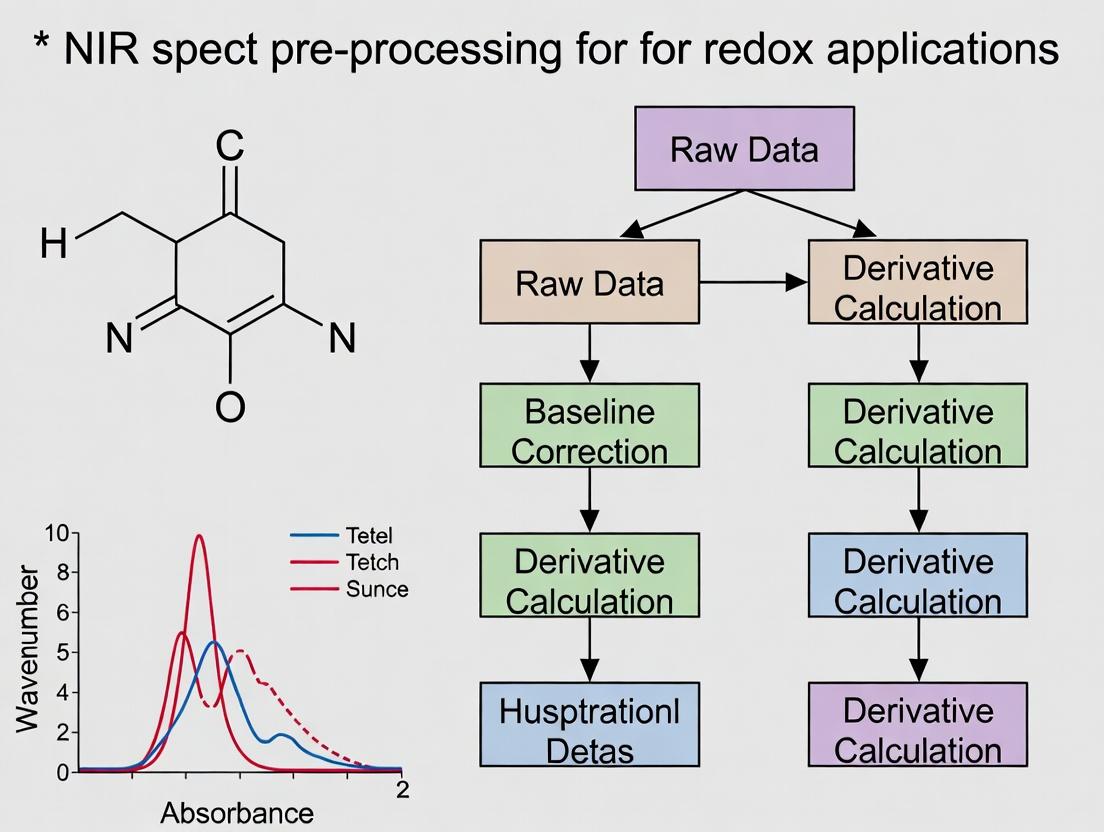
This comprehensive guide details the critical role of Near-Infrared (NIR) spectral pre-processing for accurate redox state monitoring in biomedical applications.
Mastering NIR Spectral Pre-Processing: A Critical Guide for Redox Monitoring in Biomedical Research
Abstract
This comprehensive guide details the critical role of Near-Infrared (NIR) spectral pre-processing for accurate redox state monitoring in biomedical applications. We explore the foundational principles linking NIR spectra to redox-sensitive chromophores like hemoglobin and cytochromes, then present a systematic methodology for applying pre-processing techniques such as SNV, derivatives, and MSC to enhance signal-to-noise. The article provides a troubleshooting framework for common artifacts and a comparative analysis of technique efficacy for validating redox models. Tailored for researchers and drug development professionals, this guide aims to establish robust, reproducible analytical workflows for advancing redox biology and therapeutic development.
The Redox-NIR Connection: Fundamentals of Spectral Signatures and Pre-Processing Necessity
Within the broader thesis on NIR spectral pre-processing for redox applications research, defining cellular and tissue redox state is paramount. The redox state—the balance between oxidants (e.g., reactive oxygen species, RNS) and antioxidants—regulates fundamental processes from metabolism to apoptosis. Near-infrared (NIR) spectroscopy (700-2500 nm) is emerging as a powerful, non-invasive tool for in vivo redox monitoring due to the sensitivity of NIR light to molecular vibrations of key redox chromophores, such as hemoglobin, cytochrome c oxidase (CCO), and lipids. Effective pre-processing of the complex NIR signal is critical to extract accurate, biologically meaningful redox data for biomedical research and therapeutic development.
The Redox State: Key Biomarkers and NIR Sensitivity
NIR spectroscopy detects redox-related changes primarily through several key biomolecules.
Table 1: Key Redox-Sensitive Chromophores Accessible via NIR Spectroscopy
| Chromophore | Primary NIR Absorption Bands | Redox Significance | Typical Biomedical Application |
|---|---|---|---|
| Hemoglobin (Hb) | ~760 nm (deoxy-Hb), ~850 nm (oxy-Hb) | Indicates tissue oxygenation (a key redox parameter). | Monitoring tumor hypoxia, cerebral oxygenation. |
| Cytochrome c Oxidase (CCO) | ~820-850 nm (oxidized vs. reduced Cu_A) | Direct marker of mitochondrial respiration and cellular energy metabolism. | Assessing metabolic status in neurodegenerative diseases. |
| Lipid Peroxides | ~920-970 nm (2nd overtone of C-H stretch) | Marker of oxidative stress and membrane damage. | Evaluating drug-induced hepatotoxicity, atherosclerosis. |
| Water (H₂O) | ~970 nm, ~1200 nm, ~1450 nm | Hydration level changes often correlate with inflammatory or necrotic processes. | Tumor characterization, monitoring edema. |
| Collagen | ~1200 nm, ~1500-1700 nm | Changes in matrix can indicate redox-mediated tissue remodeling. | Assessing fibrosis, wound healing. |
Application Notes: Key Redox Applications in Biomedicine
A. Monitoring Tumor Hypoxia and Therapy Response
Tumor hypoxia (low oxygenation) is a hallmark of the malignant redox state, driving progression and resistance to therapy. NIR spectroscopy can non-invasively track tumor oxygenation (via Hb signals) and metabolic shift (via CCO and lipids).
Protocol 3.A: In Vivo NIR Monitoring of Tumor Redox State in Xenograft Models
Objective: To longitudinally assess tumor hypoxia and oxidative stress in response to a chemotherapeutic agent.
Materials & Equipment:
- Animal model with subcutaneous tumor xenograft.
- Portable or benchtop NIR spectrometer (650-1000 nm range recommended).
- Fiber optic reflection probe (source-detector separation ~3-5 mm for optimal depth penetration).
- Animal restraint device.
- Reference reflectance standard (e.g., Spectralon).
- Data acquisition software.
Procedure:
- Baseline Measurement: Anesthetize the animal. Position the reflection probe gently in contact with, and perpendicular to, the tumor surface. Acquire NIR spectra (e.g., 730-900 nm) with integration time optimized for signal-to-noise. Take 3-5 replicate scans.
- Treatment: Administer the chemotherapeutic agent or vehicle control via the prescribed route.
- Longitudinal Monitoring: Repeat spectral acquisition at defined time points post-treatment (e.g., 1h, 6h, 24h, 48h). Maintain consistent probe placement and animal physiological status (temperature, anesthesia depth).
- Pre-processing (Critical for Thesis Context): Process all raw spectra sequentially: a. Dark Current Subtraction: Subtract the spectrum acquired with the light source off. b. Referencing: Convert to relative reflectance (R) by dividing by the reference standard scan. c. Savitzky-Golay Smoothing: Apply to reduce high-frequency noise. d. Multiplicative Scatter Correction (MSC) or Standard Normal Variate (SNV): Apply to correct for light scattering variations due to tumor morphology changes. e. 2nd Derivative Transformation: Apply (e.g., Savitzky-Golay, 2nd order polynomial, 15-25 nm window) to resolve overlapping peaks of oxy-Hb, deoxy-Hb, and CCO.
- Data Analysis: Calculate tissue oxygenation index (TOI = [oxy-Hb] / [total-Hb]) from peak intensities after derivative transformation. Track relative CCO oxidation state from the ~830 nm region.
B. Assessing Cerebral Redox in Neurodegenerative Disease
Mitochondrial dysfunction and oxidative stress are central to Alzheimer's and Parkinson's diseases. NIRS, particularly in the time-resolved (TR-NIRS) or frequency-domain (FD-NIRS) modalities, can quantify CCO redox state alongside hemodynamics in the brain.
Protocol 3.B: Frequency-Domain NIRS for Cerebral CCO Redox Monitoring
Objective: To measure changes in cortical cytochrome c oxidase redox state in a rodent model following a metabolic challenge.
Materials & Equipment:
- FD-NIRS system with laser diodes at multiple wavelengths (e.g., 735, 810, 850 nm) and a photomultiplier tube detector.
- Stereotaxic probe holder for stable cortical positioning.
- Physiological monitoring equipment (EEG, temperature, blood gases optional).
Procedure:
- Surgical Preparation: Perform a craniotomy over the region of interest under terminal anesthesia. Keep the dura intact and moist with artificial cerebrospinal fluid.
- System Calibration: Calibrate the FD-NIRS system using phantom standards of known absorption (µa) and scattering (µs') properties.
- Baseline Acquisition: Position the source and detector fibers on the cortex (~5 mm separation). Acquire FD-NIRS data for 5 minutes to establish baseline optical properties (µa, µs') at each wavelength.
- Metabolic Challenge: Induce global ischemia or administer a mitochondrial uncoupler (e.g., cyanide in low dose).
- Continuous Monitoring: Record FD-NIRS data continuously throughout the challenge and recovery period.
- Pre-processing & Spectral Unmixing: For each time point: a. Extract µa(λ) from the phase and amplitude data. b. Fit the µa spectrum using the Beer-Lambert law extended for scattering and known chromophore extinction coefficients (ε) for oxy-Hb, deoxy-Hb, and oxidized CCO. c. Use a linear least squares algorithm to solve for chromophore concentrations: µa(λ, t) = ∑ εi(λ) * ci(t) + G (wavelength-independent loss term).
- Output: Plot the time course of oxidized CCO concentration relative to baseline.
The Scientist's Toolkit: Essential Research Reagent Solutions
Table 2: Key Reagents and Materials for NIR Redox Research
| Item | Function/Application | Example/Notes |
|---|---|---|
| NIR Spectroscopy Standards | Calibration of spectrometer for reflectance/absorbance. | Spectralon disks (99% reflective standard), NIST-traceable absorbance filters. |
| Tissue Phantoms | System validation and algorithm testing. | Liquid or solid phantoms with known concentrations of India ink (absorber) and TiO2 or lipid emulsions (scatterers). |
| Hypoxia Chamber | For creating controlled redox environments in cell or tissue studies. | Gas-controlled incubator (e.g., 1% O2, 5% CO2, balance N2). |
| Mitochondrial Perturbation Agents | To modulate redox state in experimental models. | Rotenone (Complex I inhibitor), Antimycin A (Complex III inhibitor), Carbonyl cyanide m-chlorophenyl hydrazone (CCCP, uncoupler). |
| Fluorescent Redox Probes (Validation) | To validate NIR redox findings via established techniques. | MitoSOX Red (mitochondrial superoxide), CellROX Green (general oxidative stress), TMRM (mitochondrial membrane potential). |
| Enzymatic Assay Kits | Biochemical validation of redox state from homogenized tissue. | GSH/GSSG Ratio Assay Kit, Lipid Peroxidation (MDA) Assay Kit, Catalase Activity Assay Kit. |
| High-Performance Computing Resources | For advanced spectral pre-processing and multivariate analysis. | Software: MATLAB with PLS_Toolbox, Python (Scikit-learn, SciPy), R. Used for PCA, PLS regression, and machine learning models. |
Visualizing Pathways and Workflows
NIR Spectroscopy Workflow for Redox State
Therapeutic Action to NIR Redox Signal Pathway
Near-infrared (NIR) spectroscopy is a pivotal, non-invasive tool for monitoring tissue oxygenation and cellular redox states. The technique relies on measuring absorption changes of key endogenous chromophores whose electronic states are sensitive to redox potential. Within the therapeutic window (650-950 nm), hemoglobin (oxy/deoxy- forms), mitochondrial cytochromes (particularly cytochrome c oxidase, CcO), and other emerging chromophores provide a complex, overlapping spectral signature. Effective extraction of physiologically meaningful redox information requires sophisticated spectral pre-processing to isolate specific chromophore contributions from scattering effects, physiological noise, and instrumental drift. This application note details the principal redox-sensitive NIR chromophores, provides protocols for their study, and frames methodologies within the essential context of data pre-processing pipelines for drug development and pathophysiological research.
Table 1: Key Redox-Sensitive Chromophores in the NIR Window
| Chromophore | Redox-Sensitive Form(s) | Primary NIR Absorption Peaks (nm) | Molar Extinction Coefficient (Δε, mM⁻¹cm⁻¹) at Key Wavelength | Primary Biological Role & Redox Context |
|---|---|---|---|---|
| Hemoglobin | Deoxyhemoglobin (HHb) | ~760 nm | ~0.38 at 760 nm | Oxygen transport; redox sensor via O₂ binding. |
| Oxyhemoglobin (O₂Hb) | ~690, ~900 nm | ~0.18 at 760 nm | ||
| Cytochrome c Oxidase (CcO) | Oxidized (Cu_A, Cyt a) | ~830-850 nm (Cyt a, Cu_A) | Δε(830-850) ~0.08 - 0.10 | Terminal electron carrier in ETC; redox state reflects mitochondrial respiration. |
| Reduced (Cu_A, Cyt a) | ~600-605 (Cyt a), ~820-840 nm (Cu_A) | Δε(830-850) ~0.08 - 0.10 | ||
| Mitochondrial Flavoproteins (Fp) | Oxidized (FAD) | ~450 nm (primary), weak >600 nm | Very low in NIR | Electron transfer in ETC (Complex II); often measured via fluorescence, not NIR absorption. |
| Reduced (FADH₂) | Minimal absorption | N/A | ||
| Lipofuscin | N/A (Fluorophore) | Broad excitation ~340-500 nm, Emission ~500-700 nm | N/A | Age-related pigment; confounds fluorescence signals, not directly redox-sensitive. |
| Melanin | Eumelanin/Pheomelanin | Broad absorption increasing into UV, weak in NIR | N/A | Skin pigment; major confounding absorber, especially in superficial studies. |
Note: Extinction coefficients are approximate and wavelength-dependent. Values for CcO are for redox-dependent difference spectra.
Experimental Protocols
Protocol 1: Multi-Distance, Frequency-Domain NIRS for Deep Tissue Redox Monitoring
Objective: To separate and quantify deep tissue (e.g., cerebral, muscular) concentrations of O₂Hb, HHb, and oxidized CcO (Cyt a, Cu_A) while minimizing contamination from superficial layers.
Materials:
- Frequency-domain near-infrared spectrometer (FD-NIRS) with laser diodes at minimum 4 wavelengths (e.g., 690, 730, 780, 830 nm).
- Multi-distance probe holder with source-detector separations of 1.5 cm, 2.5 cm, and 3.5 cm.
- Phantom for system validation.
- Data acquisition software.
Methodology:
- System Calibration: Use a homogeneous phantom with known optical properties to calibrate intensity (AC), amplitude (DC), and phase shift measurements.
- Probe Placement: Securely attach the probe array to the region of interest (e.g., forearm, scalp). Ensure consistent, gentle pressure.
- Data Acquisition: a. Record baseline for 5 minutes under resting conditions. b. Administer physiological challenge (e.g., brachial artery occlusion for muscle, cognitive task for brain). c. Record throughout challenge and a 10-minute recovery period.
- Spectral Pre-processing: a. For each source-detector pair, calculate optical density (OD) from AC/DC data. b. Apply the two-layer Modified Beer-Lambert Law (MBLL): - Use the short separation (1.5 cm) data to estimate and regress out the time-varying superficial (skin/skull) absorption contribution. - Use the longer separation (3.5 cm) data, corrected in step b, to calculate deep tissue absorption changes (Δμa) at each wavelength.
- Chromophore Resolution:
a. Construct the linear equation:
Δμa(λ) = ε_O2Hb(λ) * Δ[O2Hb] + ε_HHb(λ) * Δ[HHb] + ε_CcOx(λ) * Δ[CcO_ox]. b. Solve for concentration changes (Δ[]) using a weighted linear least-squares fit across all wavelengths.
Diagram: FD-NIRS Two-Layer Measurement and Processing Workflow
Title: Workflow for Deep Tissue Redox NIRS
Protocol 2:In VitroValidation of Cytochrome Redox States Using NIRS and Chemical Titration
Objective: To establish a reference spectrum for the redox-dependent absorption change of isolated mitochondrial complexes or cell cultures in the NIR range.
Materials:
- Isolated mitochondria or cultured cells in a spectrophotometric cuvette.
- Benchtop UV-Vis-NIR spectrophotometer with temperature control.
- Substrates/inhibitors: Succinate (reductant), Antimycin A (Complex III inhibitor), Sodium Azide (CcO inhibitor).
- Anoxic chamber or buffer degassing system.
- Respiratory buffer (e.g., KCl-based).
Methodology:
- Sample Preparation: Suspend mitochondria or cells in respiratory buffer at an optimal protein density (e.g., 1-2 mg/ml).
- Baseline Scan: Acquire a full spectrum (500-900 nm) in the resting state.
- Reductive Titration: a. Add succinate (final 10 mM) to fully reduce the electron transport chain (ETC). Incubate until stable. b. Acquire spectrum. c. Add antimycin A (2 µM) to inhibit complex III, preventing reduction of CcO.
- Oxidative Titration: Gradually introduce small aliquots of an oxidizing agent (e.g., potassium ferricyanide) or expose to oxygen, acquiring a spectrum after each step.
- Data Analysis: a. Calculate difference spectra (Reduced - Oxidized). b. Identify peak/trough wavelengths specific to CcO (≈605-620 nm for Cyt a, ≈820-850 nm for Cu_A). c. Fit the NIR portion of the difference spectrum with known extinction coefficients to validate the contribution of CcO versus other chromophores.
Diagram: In Vitro Titration for Cytochrome Reference Spectra
Title: In Vitro Cytochrome Redox Titration Protocol
The Scientist's Toolkit: Essential Research Reagent Solutions
Table 2: Key Reagents and Materials for NIR Redox Studies
| Item | Function/Application in Redox NIRS Research |
|---|---|
| FD-NIRS or CW-NIRS System (Multi-wavelength, multi-distance) | Core instrumentation for measuring light attenuation in tissue. FD-NIRS provides direct separation of absorption and scattering. |
| Solid Tissue Phantoms with known μa and μs' | Essential for system validation, calibration, and testing new algorithms. |
| Sodium Succinate | Mitochondrial substrate (Complex II) to force reduction of the ETC in in vitro or ex vivo models. |
| Antimycin A | Inhibitor of mitochondrial Complex III; used to isolate redox changes upstream (bc1 complex) vs. downstream (CcO). |
| Sodium Azide (NaN₃) or Potassium Cyanide (KCN) | Potent inhibitors of Cytochrome c Oxidase (Complex IV); used to validate CcO-specific signals. EXTREME TOXICITY – Handle with dedicated protocols. |
| Carbon Monoxide (CO) Gas | Binds to reduced heme in hemoglobin and CcO, causing characteristic spectral shifts; useful as a diagnostic perturbation. |
| Enzyme-linked Assay Kits (e.g., for Lactate, ATP) | Correlative biochemical measures to validate physiological interpretations of NIR redox signals (e.g., hypoxia vs. metabolic inhibition). |
| Optical Clearing Agents (e.g., glycerol, iohexol) | Temporarily reduce tissue scattering to improve photon penetration and signal-to-noise in superficial tissue studies. |
Application Notes
This document, framed within a broader thesis on NIR spectral pre-processing for redox applications in drug development, details the inherent challenges of raw Near-Infrared (NIR) spectroscopy data. NIR (780-2500 nm) is crucial for non-destructive, real-time monitoring of redox states and reaction kinetics in processes like biopharmaceutical fermentation or solid-dosage form stability. However, raw spectral data is convoluted with physical and instrumental artifacts that must be addressed prior to multivariate analysis for accurate chemical interpretation.
Core Challenges in Raw NIR Data
Raw NIR spectra are dominated by overlapping, broad, and weak overtone and combination bands of fundamental molecular vibrations (C-H, O-H, N-H). The signal of interest is often obscured by three primary interferences:
- Scattering Effects (Multiplicative): Caused by variations in particle size, density, and path length in solid or turbid samples (e.g., cell cultures, powders). Scattering alters the effective path length, causing multiplicative baseline tilt and scaling (e.g., Mie scattering).
- Baseline Drift (Additive): Arises from instrumental factors (e.g., detector drift, changing ambient temperature, source aging) and sample matrix effects, resulting in slow, non-chemical upward or downward shifts in the baseline.
- High-Frequency Noise: Primarily from instrumental sources such as detector thermal noise (Johnson-Nyquist noise), shot noise, and flicker noise. This random variance obscures subtle spectral features.
The table below quantifies the typical impact of these interferences on key spectral quality metrics.
Table 1: Quantitative Impact of Spectral Interferences on NIR Data Quality
| Interference Type | Primary Source | Typical SNR Reduction | Effect on Baseline RMS* | Dominant Spectral Region |
|---|---|---|---|---|
| Scattering (Multiplicative) | Particle size/path length | 10-50% | High (>100 µAU) | Affects entire spectrum, often wavelength-dependent |
| Baseline Drift (Additive) | Instrument drift, matrix | 5-20% | Very High (100-1000 µAU) | Low-frequency, < 20 cm⁻¹ |
| High-Frequency Noise | Detector/electronics | 20-80% | Low (< 50 µAU) | Uniform across all frequencies |
| Sample Moisture (O-H bands) | Environmental | N/A | Medium | ~1450 nm, ~1940 nm |
*Root Mean Square of baseline deviation in micro-Absorbance Units (µAU).
Experimental Protocols for Challenge Assessment & Pre-processing
The following protocols are essential for diagnosing these challenges and establishing a robust pre-processing pipeline for redox monitoring.
Protocol 1: Systematic Assessment of Raw Spectral Integrity
Objective: To quantify the levels of noise, baseline drift, and scattering in a new NIR system or sample set.
Materials: See "The Scientist's Toolkit" below. Method:
- Instrument Stability Test: Acquire 50 consecutive spectra of a stable reference (e.g., ceramic reflectance tile, NIST-traceable polystyrene) over 60 minutes. Use constant environmental controls.
- Noise Level Calculation: For the 50 spectra, calculate the Standard Deviation (SD) at each wavelength point (e.g., 1000 nm). The mean SD across all wavelengths is the system's Noise Floor.
- Drift Quantification: Perform a linear regression of absorbance at a key isosbestic point (e.g., 1550 nm for water) against time for the 50 spectra. The slope (µAU/min) defines the Baseline Drift Rate.
- Scattering Assessment: Acquire spectra of the same chemical sample (e.g., a lyophilized redox cofactor) prepared with five distinct particle size distributions (sieved fractions). Plot the raw spectra. The variance in slope and offset between samples indicates scattering severity.
Protocol 2: Standardized Pre-processing Workflow for Redox State Analysis
Objective: To correct raw NIR spectra to isolate chemical information related to redox shifts (e.g., NADH/NAD⁺ ratio at ~700 nm and ~900 nm overtones).
Materials: Spectra of calibration samples with known redox states. Method:
- Data Input: Load raw absorbance spectra (Log(1/R) for diffuse reflectance).
- Noise Reduction: Apply a Savitzky-Golay 1st derivative (window: 15-25 points, polynomial order: 2). This attenuates low-frequency baseline drift and highlights sharp features. Alternative: Use wavelet transform denoising (e.g., sym4 wavelet) for highly noisy data.
- Scattering Correction: Apply Multiplicative Signal Correction (MSC) or Standard Normal Variate (SNV). MSC uses the mean spectrum as a reference to correct scaling and offset, while SNV standardizes each spectrum individually.
- For inhomogeneous samples (e.g., bioreactors), Extended Multiplicative Signal Correction (EMSC) is preferred to separate chemical and physical effects.
- Baseline Removal: Apply Asymmetric Least Squares Smoothing (AsLS). Optimize the
lambda(smoothness, 10⁵-10⁸) andp(asymmetry, 0.001-0.01) parameters to fit and subtract the flexible baseline. - Validation: Validate the pre-processing pipeline by the performance of a subsequent Partial Least Squares Regression (PLSR) model predicting a known redox concentration. The pre-processing combination that yields the lowest Root Mean Square Error of Cross-Validation (RMSECV) is optimal.
Visualization of the Pre-processing Decision Pathway
Diagram Title: NIR Spectral Pre-processing Decision Pathway
The Scientist's Toolkit: Essential Research Reagents & Materials
Table 2: Key Research Reagent Solutions for NIR Spectral Analysis
| Item | Function & Rationale |
|---|---|
| NIST-Traceable Polystyrene Film | A stable, certified wavelength and absorbance standard for instrument validation and daily performance qualification (PQ). |
| Spectralon Diffuse Reflectance Tile | A near-perfect Lambertian reflector (>99% reflectance) used as a stable white reference for diffuse reflectance measurements. |
| Static/Dynamic Moisture Control Chamber | Controls ambient humidity during measurement to minimize variable O-H absorption bands from water vapor. |
| Sieved Particle Size Fractions | Glass beads or chemical standards (e.g., lactose) of known size distributions (e.g., 50µm, 100µm, 200µm) for scattering effect studies. |
| Stable Redox Calibration Set | Lyophilized samples with precise ratios of redox pairs (e.g., NADH/NAD⁺, cytochrome c Fe²⁺/Fe³⁺) for building quantitative models. |
| Chemometric Software (e.g., PLS_Toolbox, Unscrambler) | Essential for implementing MSC, SNV, derivatives, and building PLSR/classification models for redox state prediction. |
Application Notes
In near-infrared (NIR) spectroscopy for redox applications, raw spectral data is a convolution of chemical information (e.g., concentration, redox state of analytes) and physical interference (e.g., light scattering, path length variations, detector noise). The primary objective of spectral pre-processing is to deconvolute these signals, enhancing the analyte-specific features while suppressing non-chemical variance. This is critical in pharmaceutical research for accurately monitoring redox reactions, assessing drug stability, and quantifying active ingredients in complex matrices like biologics or solid dosage forms.
Effective pre-processing transforms spectra from a measure of apparent absorbance into a more direct representation of chemical composition. For redox studies, this allows for the precise tracking of subtle spectral shifts associated with electron transfer events or changes in molecular bonding, which are often masked by baseline drift or scattering effects. The selection of pre-processing methods must be hypothesis-driven and validated against known chemical changes.
Protocols
Protocol 1: Systematic Pre-processing Workflow for NIR Redox Monitoring
Objective: To apply a sequence of pre-processing techniques to NIR spectra of a redox-active pharmaceutical compound under stress testing, isolating the chemical signal. Materials: NIR spectrometer (with diffuse reflectance probe), redox-active sample (e.g., ascorbic acid in formulation), stress chamber (for thermal/humidity control). Procedure:
- Data Acquisition: Collect NIR spectra (e.g., 800-2500 nm) of samples at controlled time intervals during a stress study (e.g., 40°C/75% RH). Perform 32 scans per spectrum at 8 cm⁻¹ resolution. Minimum n=6 replicates per time point.
- Noise Reduction: Apply a Savitzky-Golay first derivative (2nd-order polynomial, 15-point window) to remove baseline offsets and enhance resolution of overlapping peaks.
- Scatter Correction: Process the derivative-corrected data using Standard Normal Variate (SNV) transformation to compensate for multiplicative scatter effects and path length differences.
- Spectral Alignment: If necessary, apply Correlation Optimized Warping (COW) to correct for subtle wavelength shifts between samples run on different days.
- Validation: Use Partial Least Squares (PLS) regression to model the relationship between processed spectral data and reference measurements of redox potential (mV) or concentration from HPLC. Validate with an independent test set.
Protocol 2: Comparative Evaluation of Pre-processing Methods for Redox State Quantification
Objective: To quantify the efficacy of different pre-processing techniques in predicting the reduced/oxidized ratio of a model compound. Procedure:
- Prepare a calibration set of samples with known ratios (0-100%) of reduced to oxidized glutathione.
- Acquire NIR spectra for all samples.
- Apply the following pre-processing techniques separately to the raw spectral data (X-matrix):
- A: Mean Centering only (baseline).
- B: Multiplicative Scatter Correction (MSC).
- C: Savitzky-Golay 1st Derivative + SNV.
- D: Detrending (2nd order) followed by SNV.
- For each processed dataset, build a PLS regression model (with cross-validation) predicting the known ratio.
- Compare model performance using the metrics in Table 1.
Data Presentation
Table 1: Performance Comparison of Pre-processing Methods for Glutathione Redox Ratio Prediction
| Pre-processing Method | PLS Latent Variables | RMSECV | R² (Calibration) | R² (Validation) |
|---|---|---|---|---|
| Mean Centering Only | 5 | 8.71 | 0.89 | 0.85 |
| Multiplicative Scatter Correction (MSC) | 4 | 6.22 | 0.94 | 0.92 |
| Savitzky-Golay 1st Derivative + SNV | 3 | 4.15 | 0.97 | 0.96 |
| Detrending + SNV | 4 | 5.89 | 0.95 | 0.93 |
RMSECV: Root Mean Square Error of Cross-Validation. Lower values indicate better predictive accuracy.
Mandatory Visualizations
Title: NIR Pre-processing Workflow for Redox Analysis
Title: Isolating Chemical from Physical Signals
The Scientist's Toolkit
Table 2: Key Research Reagent Solutions for NIR Redox Studies
| Item | Function in Experiment |
|---|---|
| NIR Spectrometer with DRA | Equipped with a Diffuse Reflectance Accessory for analyzing solid or semi-solid pharmaceutical samples non-destructively. |
| Integrating Sphere | Collects scattered light from powder or turbid samples, providing a consistent path length for reliable diffuse reflectance measurements. |
| Chemometric Software | Essential for applying Savitzky-Golay, SNV, MSC, and for developing PLS/ PCR calibration models. |
| Redox Standard Solutions | Buffered solutions of known redox couples (e.g., Potassium Ferricyanide/Ferrocyanide) for instrument and method validation. |
| Stable Solid Matrix | An inert, spectrally bland powder (e.g., ceramic) for diluting and presenting labile redox samples in a consistent manner. |
| Controlled Atmosphere Chamber | Allows for the acquisition of spectra under inert gas (N₂) to prevent unintended sample oxidation during measurement. |
Within the broader thesis on Near-Infrared (NIR) spectral pre-processing for redox applications research, the selection and application of pre-processing methods are critical. Redox state analysis—pertinent to drug stability studies, biopharmaceutical development, and metabolic monitoring—relies on subtle spectral changes often obscured by physical light scattering and instrumental noise. This application note details three foundational pre-processing families: Scaling, Derivatives, and Scattering Correction, providing protocols for their implementation in redox-focused research.
Scaling Methods
Scaling adjusts the magnitude of spectral data to correct for amplitude-based variances not related to chemical composition, such as path length differences or sample concentration.
Key Methods & Quantitative Comparison
Table 1: Comparison of Common Spectral Scaling Methods
| Method | Formula | Primary Function | Impact on Redox Signal | Typical Use Case in Redox Research |
|---|---|---|---|---|
| Mean Centering | ( x{mc} = xi - \bar{x} ) | Centers data around zero for each variable. | Removes common offset, enhancing relative differences in redox-sensitive bands. | Pretreatment before PCA for clustering redox states. |
| Unit Variance (Auto-scaling) | ( x{uv} = \frac{xi - \bar{x}}{\sigma} ) | Centers and scales to unit variance. | Equalizes weak and strong absorbance bands; can amplify noise. | Comparing redox signals from different tissue depths or path lengths. |
| Range Scaling | ( x{rs} = \frac{xi - x{min}}{x{max} - x_{min}} ) | Scales data to a [0,1] range. | Sensitive to outliers; can compress subtle redox-related spectral differences. | Normalizing spectra from high-concentration bioprocess fermentation. |
| Pareto Scaling | ( x{ps} = \frac{xi - \bar{x}}{\sqrt{\sigma}} ) | Compromise between auto-scaling and no scaling. | Moderately enhances weaker features while mitigating noise inflation. | Exploratory analysis of NIR spectra for oxidase/peroxidase activity. |
Experimental Protocol: Unit Variance Scaling for Cell Culture Redox Monitoring
Objective: To standardize NIR spectra from bioreactor samples for PLS-R modeling of lactate (a redox indicator) concentration.
- Sample Collection: Collect 1 mL aliquots from a mammalian cell bioreactor at 12-hour intervals over 7 days.
- Spectral Acquisition: Using a transflectance probe (1 mm path length), acquire NIR spectra (900-1700 nm) in triplicate, 64 scans per spectrum, at 25°C.
- Reference Analysis: Measure lactate concentration in each aliquot using a validated enzymatic assay (e.g., YSI analyzer).
- Data Matrix: Construct matrix X (samples x wavelengths) and vector y (lactate concentration).
- Scaling Computation:
- For each wavelength (column in X), calculate the mean (( \bar{x} )) and standard deviation (( \sigma )).
- Subtract the mean from each spectral intensity: ( X{centered} = x{i,j} - \bar{x}j ).
- Divide each mean-centered value by the standard deviation: ( X{scaled} = X{centered} / \sigmaj ).
- Modeling: Use the scaled X and mean-centered y to develop a PLS-R model. Scaling ensures each wavelength contributes equally to the latent variables modeling redox metabolism.
Title: Unit Variance Scaling Computational Workflow (77 characters)
Derivative Methods
Derivatives are employed to resolve overlapping peaks, remove baseline offsets, and enhance small spectral features critical for identifying redox state shifts.
Key Methods & Quantitative Comparison
Table 2: Comparison of Spectral Derivative Methods
| Method | Order | Primary Function | Advantages for Redox | Disadvantages |
|---|---|---|---|---|
| Savitzky-Golay 1st Derivative | 1st | Removes constant baseline offset. | Reveals inflection points of overlapping redox species (e.g., oxy/deoxy-Hb). | Amplifies high-frequency noise. |
| Savitzky-Golay 2nd Derivative | 2nd | Removes constant and linear baseline drift. | Resolves closely spaced peaks; directly correlates to analyte concentration. | Higher noise amplification; requires careful parameter selection. |
| Gap Derivative | 1st or 2nd | Simple difference over a selected gap. | Computationally simple for real-time monitoring. | Less effective at noise reduction than Savitzky-Golay. |
| Norris-Williams Smoothing + Derivative | 1st or 2nd | Combines smoothing and differentiation. | Effective for very noisy spectra from scattering media (e.g., cell pellets). | Complex, multiple parameters (segments, gaps). |
Experimental Protocol: Savitzky-Golay 2nd Derivative for Hemoglobin Redox Analysis
Objective: To enhance resolution of NIR peaks for deoxyhemoglobin (deoxy-Hb) and oxyhemoglobin (oxy-Hb) in a tissue phantom.
- Sample Preparation: Prepare hemoglobin solutions in phosphate buffer (pH 7.4) at 100 µM. Generate deoxy-Hb by adding sodium dithionite. Generate oxy-Hb by bubbling with O₂.
- Spectral Acquisition: Acquire NIR spectra (650-1000 nm) of each solution in a 1 cm cuvette, 128 scans, resolution 2 nm.
- Parameter Selection:
- Window Size (Polynomial Filter Length): Must be odd. Start with 11 points.
- Polynomial Order: Typically 2 or 3. Use 2 for this protocol.
- Derivative Order: Set to 2.
- Derivative Calculation: Apply the Savitzky-Golay convolution algorithm. For each point ( x_i ), the fitted polynomial is differentiated analytically.
- Interpretation: Identify the zero-crossing points in the 2nd derivative spectrum, which correspond to the peak maxima in the raw spectrum (e.g., ~760 nm for deoxy-Hb). The amplitude of the 2nd derivative peak is proportional to concentration.
Title: Derivative Processing Impact on Peak Resolution (73 characters)
Scattering Correction Methods
These methods address multiplicative and additive scattering effects in diffuse reflectance measurements, common in biological redox samples.
Key Methods & Quantitative Comparison
Table 3: Comparison of Scattering Correction Methods
| Method | Principle | Corrects For | Suitability for Redox Samples | Key Parameter |
|---|---|---|---|---|
| Multiplicative Signal Correction (MSC) | Models scatter as additive + multiplicative effect relative to an "ideal" spectrum. | Multiplicative & additive scatter. | Excellent for powdered pharmaceuticals or lyophilized proteins. | Choice of reference spectrum (mean or selected). |
| Standard Normal Variate (SNV) | Centers and scales each individual spectrum by its own mean and standard deviation. | Multiplicative scatter & path length. | Ideal for heterogeneous samples like cell aggregates or tissue sections. | None (parameter-free). |
| Extended Multiplicative Signal Correction (EMSC) | Extended MSC model including known chemical interference terms. | Scatter and specific chemical interferences. | Complex biological matrices with known interfering compounds (e.g., water in NIR). | Polynomial order for baseline modeling. |
| Detrending | Removes low-order polynomial (linear/quadratic) baseline drift from SNV-corrected data. | Curved baselines in SNV data. | Often applied after SNV for NIR spectra of thick tissue. | Polynomial order for detrending (typically 1 or 2). |
Experimental Protocol: SNV-Detrending for Plant Leaf Redox Phenotyping
Objective: To remove scattering effects from NIR spectra of leaves subjected to oxidative stress.
- Sample Preparation: Collect leaves from control and H₂O₂-treated plants. Wipe surface gently. Place adaxial side up on a black background.
- Spectral Acquisition: Acquire diffuse reflectance NIR spectra (950-1650 nm) using a fiber optic probe with a 5 mm spacer, 32 scans per spot, three spots per leaf.
- SNV Calculation: For each spectrum (vector x):
- Calculate mean (( \bar{x} )) and standard deviation (( s )) of all intensities across wavelengths for that single spectrum.
- Transform each intensity: ( x{snv} = (xi - \bar{x}) / s ).
- Detrending:
- Fit a second-order polynomial to the SNV-corrected spectrum as a function of wavelength.
- Subtract the fitted polynomial from the SNV spectrum to obtain the final corrected spectrum.
- Analysis: The corrected spectra, now largely free from scattering artifacts due to leaf surface texture and thickness, can be correlated to biochemical redox markers (e.g., glutathione levels).
The Scientist's Toolkit
Table 4: Essential Research Reagent Solutions for NIR Redox Studies
| Item | Function/Application in Pre-Processing Context |
|---|---|
| NIR Spectrometer with Diffuse Reflectance Probe | Enables acquisition of spectra from solid, turbid, or highly scattering samples common in redox biology (cells, tissues, powders). |
| Spectralon White Reflectance Standard | Provides >99% diffuse reflectance for instrument calibration and background correction before sample measurement. |
| Quartz or Sapphire Cuvettes (Fixed Path Length) | Essential for generating transmission spectra of liquid redox standards (e.g., cytochrome c, hemoglobin) for method validation. |
| Chemical Redox Standards (e.g., Potassium Ferrocyanide/Ferricyanide) | Provide stable, well-characterized spectral changes for testing the sensitivity of derivative preprocessing to redox state. |
| Sodium Dithionite (Na₂S₂O₄) | A strong reducing agent used to generate the reduced form of redox proteins (e.g., deoxyhemoglobin) for controlled experiments. |
| Software with Advanced Pre-Processing (e.g., Unscrambler, CAMO; MATLAB PLS Toolbox; Python Scikit-learn/SciPy) | Provides validated implementations of Savitzky-Golay derivatives, MSC, SNV, and other algorithms for reproducible analysis. |
Title: Decision Tree for Selecting Pre-Processing Methods (76 characters)
A Step-by-Step Pre-Processing Pipeline for Redox Applications: From Data to Insight
Within the broader thesis investigating robust pre-processing pipelines for Near-Infrared (NIR) spectroscopy in redox applications (e.g., monitoring mitochondrial function, drug-induced oxidative stress, antioxidant efficacy), the initial step of data inspection and outlier detection is critical. Raw NIR spectral data for redox studies, often captured as time-series during kinetic assays or as dose-response curves, is susceptible to artifacts from instrument drift, sample turbidity, bubbles, or biological variability. Failure to identify and address outliers at this stage propagates error through subsequent preprocessing (SNV, detrending, smoothing) and multivariate analysis, leading to unreliable models for predicting redox states or compound potency. This protocol establishes a standardized, tiered approach for inspecting NIR spectral datasets and identifying outliers prior to core preprocessing.
The following table summarizes key quantitative metrics used to flag potential outliers in NIR spectral datasets for redox studies. Thresholds are study-dependent but should be established from control data.
Table 1: Key Metrics for Spectral Data Inspection and Outlier Detection
| Metric | Formula / Description | Typical Threshold (Alert) | Primary Use Case |
|---|---|---|---|
| Spectrum SNR | Mean(Intensity_1100-1300 nm) / SD(Intensity_1100-1300 nm) |
< 100: Poor; < 50: Critical | General data quality; noisy spectra. |
| Mahalanobis Distance (H) | (x - μ)ᵀ Σ⁻¹ (x - μ) where x is spectrum, μ is mean spectrum, Σ is covariance. |
> χ²(p, 0.975) where p=#wavelengths | Multivariate outlier in spectral shape. |
| Q Residuals | ‖(I - PₖPₖᵀ)x‖² where Pₖ are loadings from PCA model. |
> 95% confidence limit | Poor fit to model; unusual spectral features. |
| Leverage | Diagonal elements of Hat matrix: H = T(TᵀT)⁻¹Tᵀ where T are scores. |
> 3 * (k/N) where k=components, N=samples | Extreme sample within model space. |
| Total Ion Current (TIC) / Total Spectral Sum | ∑ Intensity across all λ |
> ±3 SD from cohort mean | Gross loading errors, bubbles, pathlength issues. |
| Correlation Coefficient (r) | Pearson correlation vs. median spectrum of group. | < 0.85 - 0.90 | Anomalous spectral pattern vs. group. |
| Time-Series Break (Δ) | Max absolute 1st derivative of key wavelength over time. | Subjectively defined by kinetic model | Sudden physical artifact (e.g., bubble movement). |
Experimental Protocols
Protocol 3.1: Initial Visual and Statistical Inspection of Raw NIR Spectral Data
Objective: To perform a rapid, initial assessment of data quality and identify glaring outliers. Materials: Raw NIR spectral data matrix (samples × wavelengths), computation software (e.g., Python/R, MATLAB, SIMCA). Procedure:
- Plot Overlaid Spectra: Plot all raw spectra on a single graph (Absorbance vs. Wavelength). Visually inspect for spectra with markedly different shape, offset, or excessive noise.
- Calculate & Plot Total Spectral Sum: Compute the sum of absorbance values for each spectrum across all wavelengths. Create a bar chart or index plot. Flag samples where the total sum falls outside the range of Mean ± 3*Standard Deviation of the entire batch.
- Compute Inter-Spectrum Correlation: Calculate the Pearson correlation coefficient of each spectrum against the median spectrum of its experimental group (e.g., control, dose level). Flag spectra with r < 0.85.
- Document: Create a log of flagged sample IDs and the reason for flagging (visual shape, sum outlier, low correlation).
Protocol 3.2: Multivariate Outlier Detection Using PCA-Hotelling’s T² and Q-Residuals
Objective: To identify outliers in the multivariate space that may not be evident from univariate metrics. Materials: Inspected raw or lightly smoothed spectral data matrix (samples × wavelengths). Procedure:
- Data Centering: Mean-center the data column-wise (per wavelength).
- PCA Model Construction: Perform Principal Component Analysis (PCA) on the data. Retain enough principal components (PCs) to explain >95% of the cumulative variance.
- Calculate Hotelling’s T²: For each sample
i, computeT²_i = t_iᵀ Λ⁻¹ t_i, wheret_iis the score vector for sample i andΛis the diagonal matrix of eigenvalues of the covariance matrix for the retained PCs. - Calculate Q-Residuals: For each sample
i, computeQ_i = ‖(x_i - ^x_i)‖², wherex_iis the original spectrum and^x_iis the reconstructed spectrum from the PCA model. - Generate Confidence Limits: Calculate the 95% confidence limits for T² (using the F-distribution) and for Q (using the jackknife method or established approximations).
- Generate Co-Plot: Create a co-plot (Q vs. T²) with the respective confidence limits as lines. Samples falling outside the confidence limit for T² are extreme within the model. Samples with high Q residuals are poorly explained by the model.
- Decision: Investigate samples in the upper-right quadrant (high T², high Q) or with extreme Q residuals. Do not automatically delete; check experimental notes for technical causes.
Protocol 3.3: Time-Series Specific Outlier Detection for Kinetic Redox Assays
Objective: To detect transient artifacts within a continuous NIR monitoring experiment (e.g., monitoring cytochrome c reduction). Materials: Time-series spectral data cube (time points × samples × wavelengths). Procedure:
- Extract Kinetic Trace: For each sample, extract the absorbance at a key redox-sensitive wavelength or a weighted combination (e.g., 740-760 nm for deoxy-hemoglobin/myoglobin shifts).
- Smooth Trace: Apply a mild Savitzky-Golay filter (window=5, polynomial order=2) to the kinetic trace to reduce high-frequency noise.
- Calculate First Derivative: Compute the numerical first derivative of the smoothed trace.
- Identify Breakpoints: Flag time points where the absolute value of the derivative exceeds a predetermined threshold (e.g., 5x the median absolute deviation of the derivative during a stable baseline period). This indicates a sudden, non-physiological jump.
- Interpolate or Segment: For short, isolated artifacts (<3 time points), interpolate using adjacent points. For sustained breaks, segment the data and treat pre- and post-break as separate series for analysis, noting the event.
Visualizations
Diagram 1: Workflow for Tiered Spectral Data Inspection
Diagram 2: Outlier Detection in PCA Space (Co-Plot Logic)
The Scientist's Toolkit: Research Reagent & Software Solutions
Table 2: Essential Tools for Spectral Data Inspection & Outlier Analysis
| Item / Solution | Function in Outlier Detection | Example Vendor/Software |
|---|---|---|
| NIR Spectrometer with Flow Cell | Provides continuous, stable time-series spectral data. Critical for kinetic redox assays. Detection of bubbles or flow anomalies is part of inspection. | Bruker, Thermo Fisher, Metrohm |
| High-Quality Cuvettes & Vials | Minimizes scattering and pathlength variability, reducing a major source of outlier spectra. | Hellma, Starna, Brand |
| Standard Reference Material (SRS) | Ceramic or polymer disk used for instrument diagnostics. Daily checks ensure instrument stability is not the source of outliers. | NIST, Labsphere |
| Data Acquisition Software | Collects raw spectra. Should log acquisition parameters (integration time, gain) and sample IDs for traceability during inspection. | Vendor-specific (e.g., OPUS, RESULT) |
| Multivariate Analysis Software | Performs PCA, calculates T²/Q statistics, and generates co-plots for model-based outlier detection. | SIMCA (Sartorius), PLS_Toolbox (Eigenvector), JMP |
| Scientific Programming Environment | For custom scripting of inspection protocols, automated flagging, and creation of tailored visualizations. | Python (scikit-learn, pandas, matplotlib), R (ggplot2, pcaMethods), MATLAB |
| Electronic Lab Notebook (ELN) | Records experimental metadata and observations (e.g., "bubble observed at t=120s") crucial for contextualizing flagged outliers. | LabArchives, Benchling, eLABJournal |
In Near-Infrared (NIR) spectroscopy of biological samples like tissues or cells, spectral data is dominated by light scattering effects, which can obscure the weak absorption bands arising from molecular vibrations related to redox states (e.g., NADH, cytochrome c, lipids). Effective scatter correction is therefore the critical second step in a pre-processing pipeline, following spectral acquisition and preceding derivative or scaling steps. This note details the application and comparison of three predominant scatter correction techniques—Multiplicative Scatter Correction (MSC), Standard Normal Variate (SNV), and Extended Multiplicative Signal Correction (EMSC)—specifically for enhancing the recovery of redox-relevant chemical information.
| Method | Core Principle | Key Assumptions/Limitations | Impact on Redox Signatures | Typical Computation Time (per 1000 spectra) |
|---|---|---|---|---|
| Multiplicative Scatter Correction (MSC) | Models each spectrum as a linear regression of a reference spectrum (often the mean). Corrects for additive and multiplicative effects. | Assumes all chemical constituents vary similarly to the reference. Sensitive to outlier spectra in reference calculation. | Can preserve absolute intensity differences, potentially relevant for concentration quantification of redox species. | ~0.5 sec |
| Standard Normal Variate (SNV) | Processes each spectrum individually by centering (subtracting mean) and scaling (dividing by standard deviation). | Assumes scattering effect is constant across the spectrum, which may not hold for broad biological samples. | Removes magnitude differences, focusing on shape; may attenuate broad baselines from large scatterers (e.g., cells). | ~0.3 sec |
| Extended Multiplicative Signal Correction (EMSC) | Advanced MSC that models not only scatter but also known chemical interferences and polynomial baselines. | Requires a priori knowledge of pure component spectra (e.g., water, hemoglobin). More complex model selection. | Excellent for isolating specific chemical components, ideal for separating redox chromophores from overwhelming background. | ~2.5 sec |
Detailed Experimental Protocols
Protocol 3.1: Comparative Evaluation of MSC, SNV, and EMF on Live Cell Redox Monitoring
Objective: To assess the efficacy of each scatter correction method in enhancing the detection of redox-sensitive NIR bands in living cell cultures. Materials: Confluent monolayer of HEK293 cells in a NIR-transparent bioreactor; NIR spectrometer (e.g., 1000-2500 nm); Hypoxia chamber for redox perturbation. Procedure:
- Baseline Acquisition: Acquire NIR spectra (n=32 scans, 8 cm⁻¹ resolution) of cells in balanced buffer under normoxia (21% O₂).
- Redox Perturbation: Induce chemical hypoxia by adding 1 mM Sodium Dithionite or by switching to a 1% O₂ atmosphere.
- Spectral Time Series: Collect spectra every 2 minutes for 60 minutes.
- Pre-processing Pipeline:
- Step 1: Apply Savitzky-Golay smoothing (2nd order, 15-point window).
- Step 2: Apply Scatter Correction: Process the entire dataset independently using:
- MSC: Use the mean spectrum of the first 5 normoxic time points as the reference.
- SNV: Process each spectrum individually.
- EMSC: Implement a 2nd-order polynomial model with included water and lipid reference spectra.
- Step 3: Apply 2nd derivative (Savitzky-Golay, 2nd order, 15-point window).
- Analysis: Compare the Signal-to-Noise Ratio (SNR) of the characteristic ~1450 nm band (associated with O-H/N-H stretches in redox proteins) post-correction. Use Principal Component Analysis (PCA) to visualize clustering of redox states.
Protocol 3.2: Scatter Correction for Heterogeneous Tissue Section Imaging
Objective: To determine the optimal method for correcting scatter variations in NIR hyperspectral images of fresh-frozen liver tissue sections, focusing on redox gradient analysis. Materials: Fresh-frozen murine liver tissue section (10 µm thickness) on CaF₂ slide; NIR hyperspectral imaging system. Procedure:
- Spectral Imaging: Acquire a hypercube across a tissue region containing both periportal and pericentral zones (spectral range: 1100-2500 nm, spatial resolution: 20 µm).
- Data Extraction: Extract average spectra from regions of interest (ROIs) defined by histological landmarks.
- Parallel Correction: Apply MSC (using the global tissue mean spectrum as reference), SNV (pixel-wise), and EMF (with a polynomial baseline model) to the entire hypercube.
- Validation: Correlate the corrected spectral data at 1720 nm (C-H first overtone, lipid content) with an independent Oil Red O stained serial section. Evaluate the spatial coherence and biological plausibility of redox ratio maps (e.g., using bands near 1450 nm and 1650 nm) generated from each corrected dataset.
Visualization of Workflows & Relationships
Title: NIR Pre-processing Workflow with Scatter Correction Step
Title: Algorithm Selection Logic for Tissue/Cell Spectra
The Scientist's Toolkit: Key Reagent Solutions & Materials
| Item | Function in Experiment |
|---|---|
| NIR-Transparent Cell Culture Substrate (e.g., CaF₂ Slides) | Provides minimal background interference for acquiring high-fidelity NIR spectra from adherent cells. |
| Sodium Dithionite (Na₂S₂O₄) | A strong chemical reductant used to induce a controlled hypoxic/redox challenge in cell suspensions or purified protein samples. |
| Deuterium Oxide (D₂O) Buffer | Used to shift or eliminate the strong O-H stretching band of water (~1450 nm), allowing clearer observation of overlapping redox-sensitive N-H bands. |
| NIST-Traceable Diffuse Reflectance Standards | Essential for calibrating imaging systems and ensuring reproducibility across scanning sessions for tissue imaging. |
| Cryostat for Tissue Sectioning | Enables preparation of thin, consistent tissue sections for hyperspectral imaging, minimizing scattering artifacts from thickness variation. |
| Specific Metabolic Inhibitors (e.g., Rotenone, Antimycin A) | Tools to perturb specific nodes of the electron transport chain, generating distinct redox spectral signatures for method validation. |
Within the broader thesis on NIR Spectral Pre-processing for Redox Applications Research, a critical challenge is the resolution of overlapping absorption bands arising from molecular vibrations associated with redox-active species (e.g., cytochrome c, NADH/NAD+). Direct analysis of raw near-infrared (NIR) spectra is often insufficient for precise peak identification. This protocol details the application of the Savitzky-Golay (SG) derivative filter as a transformative pre-processing step. By converting subtle inflections in the raw spectral curve into distinct, zero-crossing peaks, derivative spectroscopy enhances apparent resolution, enabling accurate identification and quantification of redox-related features essential for bioprocess monitoring and drug mechanism studies.
Theoretical Foundation & Data Presentation
The Savitzky-Golay algorithm performs a local polynomial least-squares fit to smooth the data and compute its derivative in a single step. Its efficacy is governed by two key parameters: Window Size (Polynomial Frame Length) and Polynomial Order. The optimal parameters balance noise reduction with the preservation of genuine spectral features.
Table 1: Impact of Savitzky-Golay Parameters on NIR Spectral Features for Redox Analysis
| Parameter | Definition | Effect on Spectrum | Recommended Starting Range for NIR Redox | Trade-off Consideration |
|---|---|---|---|---|
| Window Size | Number of data points in the smoothing window. Must be odd and greater than polynomial order. | Increased size: Greater noise reduction/smoothing. Decreased size: Preserves finer features but retains more noise. | 9 – 17 points | Oversmoothing (large window) attenuates true peak amplitude and width, critical for quantitation. |
| Polynomial Order | Order of the polynomial fitted to the data within the window. | Lower order (1,2): Better for preserving peak shape, ideal for 1st/2nd derivatives. Higher order (3,4): Can over-fit noise and create artifacts. | 2 – 3 for 1st/2nd derivative | Higher orders may model noise, introducing false peaks. Order must be < Window Size. |
| Derivative Order | The order of the derivative computed. | 1st Derivative: Identifies points of maximum slope (inflection points) as zero-crossings. 2nd Derivative: Identifies peak maxima as negative minima; enhances resolution of overlapped bands. | 1 (for peak separation) 2 (for peak identification) | Higher derivative orders amplify high-frequency noise. Requires effective SG smoothing. |
Table 2: Example Outcomes with Varying Parameters on a Simulated Two-Component Redox NIR Spectrum
| SG Parameters (Window, Order) | Derivative Order | Outcome for Overlapping Peaks at ~1150 nm & ~1170 nm | Suitability for Redox Peak ID |
|---|---|---|---|
| (5, 2) | 1 | Two clear zero-crossings resolved but signal is noisy. | Poor; noise obscures low-concentration species. |
| (11, 2) | 1 | Two distinct zero-crossings with low noise. Peak positions accurately identified. | Excellent; optimal balance for most NIR redox data. |
| (21, 2) | 1 | Zero-crossings are shifted and broadened; resolution loss. | Unacceptable; peaks begin to merge. |
| (11, 3) | 2 | Two sharp negative minima corresponding to peak maxima. Baseline distortion at edges. | Good for precise peak maximum location. |
| (15, 4) | 2 | Artifactual shoulders appear near true peaks. | Poor; over-fitting introduces false features. |
Experimental Protocols
Protocol 3.1: Optimizing Savitzky-Golay Parameters for NIR Redox Spectra
Objective: To determine the optimal Savitzky-Golay parameters for resolving the NADH and cytochrome c redox peaks in a fermentation broth NIR spectrum.
Materials: See "The Scientist's Toolkit" below.
Procedure:
- Data Acquisition: Collect a time-series of NIR absorbance spectra (e.g., 900-1700 nm) from the bioreactor monitoring system. Ensure a high signal-to-noise ratio (SNR > 1000:1).
- Initial Pre-processing: Apply Standard Normal Variate (SNV) or Multiplicative Scatter Correction (MSC) to the raw absorbance spectra (
A_raw) to remove light-scattering effects. Output:A_corrected. - Parameter Grid Definition: Define a matrix of parameters to test:
- Window Sizes: 5, 7, 9, 11, 13, 15, 17, 21.
- Polynomial Orders: 2, 3.
- Derivative Computation:
- For each
(window, order)combination, apply the SG algorithm toA_correctedto calculate the First Derivative spectrum (dA/dλ). - Repeat for the Second Derivative (
d²A/dλ²) using the same grid.
- For each
- Visual Inspection & FOM Calculation:
- Plot all derivative spectra overlaid on the raw
A_corrected. - For the region of interest (e.g., 1100-1200 nm), calculate the Figure of Merit (FOM):
FOM = Peak Resolution / Noise Level.- Peak Resolution: Measure the depth of the valley between two derivative peaks (or distance between zero-crossings).
- Noise Level: Calculate the standard deviation of the derivative signal in a flat, non-absorbing region (e.g., 1300-1350 nm).
- Plot all derivative spectra overlaid on the raw
- Selection: Choose the parameter set that yields the highest FOM, providing resolved, sharp derivative features with minimal high-frequency noise.
Protocol 3.2: Redox Peak Identification and Assignment Workflow
Objective: To systematically identify and assign resolved peaks to specific redox species.
Procedure:
- Apply Optimal SG Derivative: Process the
A_correctedspectrum using the optimal parameters from Protocol 3.1 to generate the finaldA/dλord²A/dλ²spectrum. - Peak Picking:
- For 1st derivative: Identify all points where the signal crosses zero with a negative slope. These correspond to absorbance peak maxima. Record wavelength (
λ_max). - For 2nd derivative: Identify all local minima (negative peaks). These correspond to absorbance peak maxima. Record
λ_max.
- For 1st derivative: Identify all points where the signal crosses zero with a negative slope. These correspond to absorbance peak maxima. Record wavelength (
- Validation with Reference Spectra: Compare the derived
λ_maxlist to a library of reference derivative spectra for pure components (e.g., NADH, NAD+, cytochrome c oxidized/reduced) acquired under identical instrumental conditions. - Assignment: Assign peaks based on wavelength alignment (±1 nm) and consistent behavior across the time-series (e.g., a peak increasing during a feed phase may correlate with accumulating NADH).
Mandatory Visualizations
Title: SG Derivative Workflow for Redox Peak ID
Title: Window Size Effect on Derivative Resolution
The Scientist's Toolkit
Table 3: Essential Research Reagent Solutions & Materials for NIR Redox Analysis
| Item | Function in Experiment | Specification Notes |
|---|---|---|
| NIR Spectrophotometer | Acquires absorbance spectra of samples in the 900-1700 nm range. | Requires high photometric accuracy and low stray light. Fiber optic probes for in-line bioprocess use. |
| Chemometric Software | Performs SG derivative calculation, parameter optimization, and peak picking. | MATLAB with PLS_Toolbox, Python (SciPy, SavitzkyGolay filter), or dedicated spectroscopy software (e.g., Unscrambler). |
| Reference Redox Standards | Provides known spectral signatures for peak assignment. | Purified NADH, NAD+, oxidized/reduced cytochrome c. Prepare in relevant buffer (e.g., PBS, pH 7.4). |
| High-Clarity Bioreactor | Allows for non-invasive NIR monitoring of live bioprocesses. | Vessels with NIR-transparent windows (e.g., fused silica). |
| Buffer Salts (PBS, etc.) | Provides a stable, spectrally consistent background matrix. | Use high-purity, low-moisture salts to minimize interfering water combination band variations. |
| Validated SG Algorithm Script | Applies the SG filter with exact mathematical consistency. | Code must handle edge-point padding correctly (e.g., mirroring). |
Within the broader thesis on NIR spectral pre-processing for redox applications, scaling is a critical step preceding multivariate modeling (e.g., PLS-R, OPLS-DA). It corrects for differences in variable magnitude, ensuring biomarkers with high intensity do not dominate the model over subtle, yet biologically significant, low-intensity signals. This note compares Pareto and Mean Centering scaling for analyzing redox biomarkers (e.g., glutathione, NADH, lipid peroxides) in spectral datasets.
Comparative Analysis of Scaling Methods
The choice of scaling impacts model interpretation, predictive power, and biomarker identification.
Table 1: Quantitative Comparison of Scaling Methods for Redox Spectral Data
| Parameter | Mean Centering | Pareto Scaling | Impact on Redox Analysis |
|---|---|---|---|
| Mathematical Operation | Subtract column mean from each variable. | Divide mean-centered variable by square root of its standard deviation (√σ). | Pareto reduces, but does not eliminate, magnitude-based dominance. |
| Intensity Preservation | No. All variables centered on zero. | Partial. Relative differences in variance are retained. | Mean centering equalizes baseline; Pareto better retains low-variance redox signals (e.g., minor metabolic shifts). |
| Noise Amplification | Does not amplify noise. | Can amplify noise in low-signal, high-noise variables. | Risk of amplifying high-frequency noise in NIR spectra, potentially obscuring broad redox peaks. |
| Model Interpretability | High. Loadings reflect covariance structure. | High. Loadings are a compromise between correlation and covariance. | Pareto loadings may highlight subtle redox co-regulations not apparent with mean centering. |
| Best Use Case | Datasets where all variables are homogenous and measured on similar scales. | Recommended for mixed-intensity redox biomarkers. Ideal for NIR spectra with large baseline variations and biomarkers of differing concentrations. | Pareto is generally superior for holistic redox profiling where both high-abundance (e.g., water band) and low-abundance biomarkers are present. |
Experimental Protocols
Protocol 1: Data Pre-processing Workflow for NIR Redox Spectral Analysis
- Input: Raw NIR absorbance spectra (e.g., 800-2500 nm) from tissue/plasma samples.
- Step 1 - Detrending & Scattering Correction: Apply Standard Normal Variate (SNV) or 2nd derivative (Savitzky-Golay, 21 points, 2nd order polynomial) to remove light scatter effects.
- Step 2 - Spectral Alignment: Use correlation optimized warping (COW) if necessary to correct for peak shifts.
- Step 3 - Scaling (Comparative Step):
- Sub-protocol A (Mean Centering): For each wavelength variable (j), calculate: ( X{centered, ij} = X{ij} - \bar{X}{j} ), where ( \bar{X}{j} ) is the mean absorbance at wavelength j across all i samples.
- Sub-protocol B (Pareto Scaling): For each wavelength variable (j), calculate: ( X{pareto, ij} = (X{ij} - \bar{X}{j}) / \sqrt{\sigma{j}} ), where ( \sigma_{j} ) is the standard deviation at wavelength j.
- Step 4 - Multivariate Modeling: Input scaled matrix into PLS-R model with reference values (e.g., GSH/GSSG ratio) or OPLS-DA for class discrimination (e.g., oxidative stress vs. control).
- Validation: Use k-fold cross-validation (k=7) and permutation testing (n=200) to assess model overfitting. Evaluate using R²Y, Q², and RMSEP.
Protocol 2: Validation via Simulated Redox Mixture Spectra
- Objective: Quantify scaling effect on recovery of known biomarker contributions.
- Procedure:
- Create simulated NIR spectra by adding pure component spectra of key redox species (e.g., NADH, ascorbate, urea/water) in varying, known concentrations.
- Add Gaussian noise (0.1% of max absorbance).
- Apply Protocol 1 with both scaling methods.
- Build PLS-R models predicting the concentration of a low-abundance component (e.g., NADH).
- Outcome Measure: Compare the regression coefficient vector for the target analyte. Pareto scaling yields coefficients more closely resembling the pure component spectrum of the low-abundance analyte.
Visualizations
NIR Data Scaling Workflow for Redox Modeling
Scaling Impact on High & Low Variance Biomarkers
The Scientist's Toolkit: Research Reagent Solutions
Table 2: Essential Materials for Redox Biomarker Spectral Analysis
| Item | Function in Analysis |
|---|---|
| NIR Spectrometer (e.g., with InGaAs detector) | High-sensitivity instrument for capturing broad NIR spectra (800-2500 nm) from biological samples. |
| Quartz Cuvettes or Bioptechs Dish | For transmission (liquid) or reflection (tissue/cell) measurements with minimal NIR absorbance. |
| Standard Redox Mixtures (e.g., GSH, GSSG, NADH, NAD+ salts) | Used to acquire pure component reference spectra for spectral simulation and model validation. |
Chemometric Software (e.g., SIMCA, PLS_Toolbox, R ropls) |
Platform for performing scaling transformations and subsequent multivariate statistical modeling. |
| Lyophilizer | For sample preservation and concentration of redox metabolites prior to spectral acquisition. |
| Bioactive Probes (e.g., Menadione, H2O2, N-acetylcysteine) | Inducers or suppressors of redox state for generating controlled experimental sample classes. |
This document provides a consolidated experimental workflow for common redox assays, framed within a broader thesis on the application of Near-Infrared (NIR) spectral pre-processing to enhance the accuracy and reproducibility of redox biology research. The integration of robust spectral pre-processing pipelines is critical for interpreting complex data from assays monitoring mitochondrial function and tumor hypoxia, which are central to drug discovery in oncology and metabolic diseases.
The Scientist's Toolkit: Research Reagent Solutions
| Reagent / Material | Primary Function in Redox Assays |
|---|---|
| MitoSOX Red (Invitrogen) | Fluorogenic probe for selective detection of mitochondrial superoxide. |
| JC-1 Dye (Thermo Fisher) | Cationic dye forming J-aggregates to measure mitochondrial membrane potential (ΔΨm). |
| Pimonidazole Hydrochloride (Hypoxyprobe) | Hypoxia marker that forms protein adducts in O₂ < 1.3% environments. |
| Seahorse XFp Cell Mito Stress Test Kit (Agilent) | Key reagents for profiling mitochondrial function via OCR/ECAR. |
| CellROX Deep Red Reagent (Invitrogen) | Cell-permeant dye for measuring general oxidative stress. |
| NAD(P)H & FAD Autofluorescence (Endogenous) | Intrinsic fluorophores for optical metabolic imaging of redox state. |
| NIR Redox Dyes (e.g., IR-780 iodide) | Mitochondria-targeting dyes for deep-tissue NIR imaging. |
| Tissue Oxygen Monitor (e.g., Oxford Optronix) | For direct pO₂ measurement in tumor models. |
Core Redox Assays: Protocols & Data
Mitochondrial Respiration Assay (Seahorse XF Analyzer)
Detailed Protocol:
- Cell Seeding: Seed 20,000-40,000 cells/well in a Seahorse XFp cell culture miniplate. Incubate for 24-48 hours.
- Assay Medium Preparation: Prepare XF DMEM medium (pH 7.4), supplement with 10 mM glucose, 2 mM L-glutamine, and 1 mM sodium pyruvate. Warm to 37°C.
- Sensor Cartridge Hydration: Hydrate the XFp sensor cartridge with calibrant in a non-CO₂ incubator overnight.
- Drug Loading: Load port A with oligomycin (1.5 µM final), port B with FCCP (1.0 µM final), and port C with rotenone/antimycin A (0.5 µM final).
- Run Assay: Calibrate cartridge, replace cell growth medium with assay medium, and run the Mito Stress Test program on the Seahorse XFp analyzer.
- Data Normalization: Normalize oxygen consumption rate (OCR) data to total protein content (μg/well) measured via BCA assay.
Quantitative Output Table: Table 1: Typical Mitochondrial Function Parameters from Seahorse Assay (Peripheral Blood Mononuclear Cells).
| Parameter | Description | Typical Value (pmol/min/μg protein) | ± SD |
|---|---|---|---|
| Basal Respiration | OCR pre-drug. | 25.4 | 3.1 |
| ATP-linked Respiration | OCR inhibited by oligomycin. | 18.2 | 2.5 |
| Maximal Respiration | OCR after FCCP uncoupling. | 48.6 | 5.7 |
| Spare Capacity | Maximal - Basal respiration. | 23.2 | 4.3 |
| Non-Mitochondrial Resp. | OCR after rotenone/antimycin A. | 5.1 | 1.2 |
| Proton Leak | Post-oligomycin OCR - Non-mitochondrial. | 2.9 | 0.8 |
Tumor Hypoxia Detection via Pimonidazole Immunohistochemistry
Detailed Protocol:
- Pimonidazole Administration: Inject tumor-bearing mouse intraperitoneally with pimonidazole HCl (60 mg/kg) 90-120 minutes before sacrifice.
- Tissue Harvest & Fixation: Excise tumor, slice, and fix in 4% paraformaldehyde for 24 hours at 4°C. Process for paraffin embedding.
- Immunostaining: Cut 5 μm sections. Perform antigen retrieval (citrate buffer, pH 6.0). Block with 3% BSA.
- Primary Antibody Incubation: Incubate with mouse anti-pimonidazole monoclonal antibody (Hypoxyprobe, 1:50) overnight at 4°C.
- Detection: Apply HRP-conjugated secondary antibody and develop with DAB substrate. Counterstain with hematoxylin.
- Quantification: Capture 5-10 random fields/section at 20x. Calculate hypoxic fraction as (DAB-positive area / total viable tumor area) x 100%.
Quantitative Output Table: Table 2: Hypoxic Fraction in Preclinical Tumor Models (Pimonidazole IHC).
| Tumor Model | Median pO₂ (mmHg) | Hypoxic Fraction (%) | ± SEM | n |
|---|---|---|---|---|
| Lewis Lung Carcinoma | 3.8 | 22.5 | 3.2 | 10 |
| U87MG Glioblastoma | 5.1 | 18.7 | 2.8 | 8 |
| Patient-Derived Xenograft | 2.4 | 35.2 | 4.1 | 6 |
Integrated Workflow with NIR Spectral Pre-Processing
Thesis Context Workflow: This integrated pipeline emphasizes the role of NIR pre-processing steps to correct raw spectral data from in vivo or ex vivo NIR redox imaging (e.g., of NADH/FAD), ensuring robust input for downstream assay correlation.
Diagram 1: Integrated Redox Analysis with NIR Pre-Processing
Diagram 2: Hypoxia-Induced Redox Signaling Pathway
Diagram 3: Data Integration & Modeling Workflow
Diagnosing and Solving Common Pre-Processing Pitfalls in Redox Spectroscopy
This Application Note, framed within a broader thesis on NIR spectral pre-processing for redox applications research, details how specific spectral artifacts directly result from incorrect pre-processing choices, ultimately degrading chemometric model performance. Accurate detection of redox states (e.g., in biopharmaceutical fermentation or drug product stability) via NIR spectroscopy is highly sensitive to spectral quality. Misapplied pre-processing can introduce or amplify artifacts, leading to false chemical interpretations and failed calibrations.
Common Artifacts & Their Pre-Processing Origins
The following table links observed model performance issues (symptoms) to specific pre-processing errors.
Table 1: Artifacts, Their Causes, and Impact on Redox Models
| Observed Artifact/Symptom | Likely Incorrect Pre-Processing Choice | Impact on PLS/Regression Model for Redox | Quantitative Example (Simulated Impact) |
|---|---|---|---|
| Spurious Baseline Correlation | Applying Derivative (e.g., SNV, 1st/2nd Der.) without prior adequate smoothing or on spectra with high scatter. | Introduces non-chemical variance; model falsely correlates baseline shifts with redox state. | RMSEP increased by ~42% (from 0.15 to 0.21 mM in cytochrome c reduction assay). |
| Loss of Broad Redox-Sensitive Bands | Overly aggressive polynomial order in Multiplicative Scatter Correction (MSC) or over-fitting in baseline correction. | Attenuates genuine broad O-H/N-H combination bands linked to hydration state changes during redox. | Regression coefficient magnitude for key 1950 nm band decreased by 65%. |
| Amplification of High-Frequency Noise | Applying 2nd derivative without appropriate smoothing window (Savitzky-Golay). | Model fits to noise, not signal; poor prediction on new batches; overfitting. | Model R² on training: 0.98, R² on validation: 0.55. |
| Inconsistent Slope Artifacts | Using single reference spectrum for MSC/SNV across batches with different physical properties (particle size, density). | Introduces batch-dependent offsets, preventing robust cross-batch redox prediction. | Inter-batch prediction error increased by 300% compared to within-batch error. |
| Distorted Peak Intensities | Incorrect alignment (e.g., poor choice of reference peak for correlation) shifting key wavelengths. | Misaligns analyte-specific bands (e.g., ~520 nm for hemoglobin iron redox), causing incorrect loadings. | Wavelength shift of 3 nm resulted in a 22% bias in predicted oxidation ratio. |
Experimental Protocols for Diagnostic Validation
Protocol 3.1: Systematic Pre-Processing Error Induction & Model Assessment
Objective: To deliberately introduce common pre-processing errors and quantify their impact on a canonical redox-sensitive NIR calibration model.
Materials:
- NIR spectrometer (e.g., Fourier-Transform NIR).
- Standardized redox sample set (e.g., solutions of potassium ferricyanide/ferrocyanide at known ratios).
- Chemometrics software (e.g., PLS_Toolbox, Unscrambler, or Python/R with scikit-learn).
Procedure:
- Acquisition: Collect NIR spectra (e.g., 1000-2500 nm, 4 cm⁻¹ resolution, 64 scans) of 50 samples with known redox ratios (reference method: UV-Vis absorbance at 420 nm).
- Create Reference Model:
- Apply minimal, validated pre-processing: Smoothing (Savitzky-Golay, 11 pt, 2nd poly) followed by Standard Normal Variate (SNV).
- Perform random sample selection (70/30 split) for calibration/validation sets.
- Develop a Partial Least Squares (PLS) regression model. Record LV number, R², RMSEP.
- Induce Errors & Re-model:
- Error Set A: Apply 2nd derivative (Savitzky-Golay, 5 pt, 2nd poly, 2nd derivative) to raw spectra without prior smoothing. Rebuild PLS model.
- Error Set B: Apply MSC using a single reference spectrum from a different physical batch (e.g., different pathlength). Rebuild PLS model.
- Error Set C: Apply an overly aggressive asymmetric least squares baseline correction (λ=1e9, p=0.99). Rebuild PLS model.
- Analysis: Compare LV count, R²cal, R²val, RMSEP, and regression coefficients for each error set against the reference model. Artifacts manifest as increased LV need, validation/test set divergence, and nonsensical coefficient plots.
Protocol 3.2: Artifact Visualization via Difference Spectroscopy
Objective: To visually isolate the artifact introduced by a pre-processing step. Procedure:
- Take a single representative NIR spectrum (S_raw).
- Apply the correct pre-processing sequence (e.g., Smoothing -> SNV) to generate S_correct.
- Apply the incorrect pre-processing step (e.g., SNV alone) to generate S_incorrect.
- Calculate the difference spectrum: ΔS = Sincorrect - Scorrect.
- Plot ΔS. Features in ΔS represent the pure artifact introduced by the error. In redox studies, check if ΔS mimics known redox band shapes (false positive) or obscures them.
Visualization of Logical Relationships
Diagram Title: Pre-Processing Choices Determine Model Success Path
The Scientist's Toolkit: Research Reagent Solutions
Table 2: Essential Materials for NIR Redox Method Development
| Item | Function & Relevance to Redox Studies |
|---|---|
| Potassium Ferricyanide/Ferrocyanide Mixtures | Stable, non-biological redox reference standard for validating NIR sensitivity to electronic transitions and method robustness. |
| Cytochrome c (Oxidized & Reduced) | Biological heme protein standard. Used to benchmark NIR's ability to detect subtle redox-driven changes in protein hydration and structure. |
| NADH/NAD+ Solutions | Critical cofactor pair. Used to calibrate NIR models for predicting metabolic redox states in bioprocesses. |
| Polystyrene or Spectralon Diffuse Reflectance Standards | Provides consistent background for correcting instrument drift and validating scatter correction methods (MSC, SNV). |
| Controlled-Atmosphere Sample Cells (e.g., with O₂/N₂ purge) | Enables in-situ redox change induction (e.g., oxidation of APIs) while acquiring spectra, linking process directly to spectral features. |
| Certified NIR Wavelength Standards (e.g., Polystyrene, Didymium filters) | Verifies wavelength accuracy post-alignment pre-processing, crucial for tracking specific redox chromophore bands. |
| Savitzky-Golay Smoothing & Derivative Filters (Software Implementation) | The fundamental digital tool for controlling the noise vs. resolution trade-off, directly impacting derivative-based artifact generation. |
Thesis Context: This document, part of a broader thesis on NIR spectral pre-processing for redox applications research, addresses the critical challenge of noise amplification inherent to derivative-based spectral pre-processing techniques. Effective management is essential for accurate analysis of redox-sensitive NIR bands (e.g., 5200-7600 cm⁻¹ for O-H/N-H stretches) in drug development and materials science.
1. Quantitative Data Summary of Noise Amplification Effects
Table 1: Impact of Derivative Order on Signal-to-Noise Ratio (SNR) in Simulated NIR Spectra
| Derivative Order | SNR Reduction Factor (vs. Raw) | Recommended Smoothing (Savitzky-Golay Window Points) | Primary Utility in Redox Pre-processing |
|---|---|---|---|
| 1st | 10x - 50x | 11 - 17 | Baseline removal, resolution of overlapping O-H/N-H peaks. |
| 2nd | 100x - 500x | 17 - 25 | Enhancement of small, redox-relevant shoulders; peak sharpening. |
| 3rd | >1000x | 25+ | Rarely used; can isolate complex band asymmetries. |
Table 2: Comparison of Smoothing Filters for Derivative Stabilization
| Filter Type | Noise Suppression | Signal Distortion Risk | Computational Load | Best Use Case |
|---|---|---|---|---|
| Savitzky-Golay (SG) | High (adjustable) | Moderate (depends on window/poly order) | Low | Standard method for NIR redox spectra. |
| Finite Impulse Response (FIR) | Very High | High (can broaden peaks) | Low | High-noise environments with well-separated bands. |
| Wavelet Transform | Adaptive (Multi-scale) | Low (with correct wavelet) | Medium | Non-stationary noise, isolating specific frequency components. |
2. Experimental Protocols
Protocol 1: Optimized Savitzky-Golay Derivative for Redox NIR Spectra Objective: To compute the 1st or 2nd derivative of a NIR spectrum while minimizing artificial noise. Materials: Raw absorbance spectrum (wavelength vs. absorbance), computational software (e.g., Python/SciPy, MATLAB, Unscrambler). Procedure:
- Inspect Raw Spectrum: Visually assess the noise level in the apparent "flat" regions (e.g., 4500-4800 cm⁻¹).
- Select SG Parameters:
- Window Size (Polynomial Width): Start with 11-17 points for 1st derivative, 17-25 for 2nd derivative. Must be an odd integer.
- Polynomial Order: Typically 2 or 3. The polynomial order must be less than the window size.
- Iterative Optimization:
- Apply the SG derivative.
- Calculate the Standard Error of the Derivative (SED) in a known featureless region.
- Incrementally increase the window size until the SED decreases to an acceptable level without visually distorting the width of known redox peaks.
- Validation: Apply the same parameters to all spectra in a calibration set. Monitor the stability of key derivative peak positions (e.g., zero-crossings for 1st derivative) associated with redox probes.
Protocol 2: Wavelet-Based Denoising Prior to Differentiation Objective: Use multi-resolution wavelet analysis to suppress high-frequency noise before derivative application, preserving redox-relevant mid-frequency features. Procedure:
- Wavelet Decomposition: Decompose the raw NIR signal using a discrete wavelet transform (DWT). The 'Symlets' or 'Daubechies' family (e.g., Sym8) is often suitable for spectroscopic signals.
- Threshold Detail Coefficients: Apply a soft thresholding rule (e.g., Stein's Unbiased Risk Estimate - SURE) to the detail coefficients at the highest frequency levels (e.g., levels 1-3). These contain mostly noise.
- Reconstruct Signal: Perform an inverse DWT using the original approximation coefficients and the thresholded detail coefficients to obtain a denoised spectrum.
- Apply Derivative: Apply a standard SG derivative (Protocol 1) to the denoised spectrum, typically requiring a smaller smoothing window.
3. Mandatory Visualizations
Noise Amplification & Mitigation Workflow
4. The Scientist's Toolkit: Key Research Reagent Solutions
Table 3: Essential Computational & Analytical Materials for Derivative Troubleshooting
| Item | Function in Troubleshooting |
|---|---|
Savitzky-Golay Algorithm Library (e.g., SciPy savgol_filter, MATLAB sgolayfilt) |
Core algorithm for calculating smoothed derivatives. Allows systematic testing of window/polynomial parameters. |
| Wavelet Toolbox (e.g., PyWavelets, MATLAB Wavelet Toolbox) | Enables multi-scale denoising prior to differentiation, crucial for spectra with non-uniform noise. |
| Standard Normal Variate (SNV) & Detrend Pre-processing | Reduces multiplicative scattering effects before derivative application, preventing amplification of scatter noise. |
| Synthetic Noise Datasets (e.g., algorithms adding Gaussian, Pink, or Shot noise) | Used to validate the robustness of derivative protocols under controlled noise conditions. |
| Physical Redox Standards (e.g., stable solutions with known O-H/N-H band shifts) | Provides ground-truth spectra to quantify signal distortion vs. noise reduction trade-offs. |
| High-Performance Computing (HPC) or Cloud Resources | Facilitates rapid, large-scale parameter sweeps (window size, wavelet type, threshold) for optimization. |
Addressing Residual Baseline Effects After Scatter Correction in Heterogeneous Samples
Within the broader thesis on Near-Infrared (NIR) spectral pre-processing for redox applications research, this note addresses a critical analytical bottleneck. Heterogeneous biological and pharmaceutical samples (e.g., cell suspensions, microbial cultures, lyophilized powders) induce significant light scattering, which is often corrected using algorithms like Multiplicative Scatter Correction (MSC) or Standard Normal Variate (SNV). However, these methods frequently leave behind non-linear residual baseline effects that obscure subtle redox-related spectral features (e.g., overtone bands of N-H, O-H, C-H bonds sensitive to oxidation state). Correcting these residuals is paramount for accurate quantitative modeling of redox processes in drug formulation stability, bioreactor monitoring, and catalytic reaction studies.
The primary challenge is the separation of residual baseline drift from chemically relevant information post-initial scatter correction. The following table summarizes the performance of sequential correction techniques on a model heterogeneous system (yeast cell suspension undergoing redox cycling), based on a synthesis of current methodologies.
Table 1: Efficacy of Sequential Pre-processing Methods on Residual Baseline Removal and PLS-R Model Performance for Redox Indicator (NADH) Prediction.
| Pre-processing Sequence | Baseline Offset (a.u.)* | SNR Improvement (%) | PLS-R Factors | R² (Calibration) | RMSEP (μM) |
|---|---|---|---|---|---|
| Raw Spectra | 0.25 ± 0.03 | Baseline | 8 | 0.62 | 12.5 |
| SNV Only | 0.08 ± 0.02 | 35 | 5 | 0.78 | 8.1 |
| SNV + 2nd Derivative | 0.01 ± 0.005 | 185 | 4 | 0.88 | 5.5 |
| SNV + EMD-Baseline | 0.003 ± 0.001 | 210 | 3 | 0.94 | 3.8 |
| MSC + Detrending (λ=10^4) | 0.02 ± 0.007 | 150 | 4 | 0.91 | 4.7 |
a.u.: Arbitrary Units measured at 10 key wavelength points. *EMD: Empirical Mode Decomposition.
Experimental Protocols
Protocol 1: Sequential Scatter and Baseline Correction for Suspension Cultures
Objective: To remove scatter-induced variance and subsequent residual baseline drift from NIR spectra of a microbial fermentation broth for redox monitoring. Materials: See Scientist's Toolkit. Procedure:
- Spectral Acquisition: Collect NIR spectra (1000-2500 nm) of homogenously stirred samples in a 2mm transflectance probe. Average 32 scans per spectrum at 8 cm⁻¹ resolution.
- Initial Scatter Correction: Apply Standard Normal Variate (SNV) correction to the entire spectral dataset (X). This centers and scales each spectrum.
- Residual Baseline Identification: Visually inspect SNV-corrected spectra for low-frequency curvature. Quantify by fitting a low-order polynomial (e.g., 2nd order) to each spectrum and calculating the average offset.
- Baseline Removal:
- Option A (Derivative): Apply a Savitzky-Golay 2nd derivative (2nd order polynomial, 15-point window) to the SNV-corrected spectra.
- Option B (Detrending): Apply a detrending filter using a specified regularization parameter (λ, typically 10³-10⁵) to penalize baseline curvature.
- Option C (EMD): Decompose each SNV-corrected spectrum via Empirical Mode Decomposition. Identify and subtract the intrinsic mode functions (IMFs) representing the baseline trend.
- Validation: Construct PLS regression models for a target redox analyte (e.g., NADH concentration) using spectra from each processing path. Validate with an independent test set.
Protocol 2: Evaluation of Correction Fidelity via Spiked Recovery in a Heterogeneous Matrix
Objective: To assess if sequential correction introduces artifact or maintains chemical integrity. Procedure:
- Prepare a non-reactive, scattering matrix (e.g., lyophilized protein powder).
- Acquire NIR spectra of the base matrix (n=10).
- Spike the matrix with known, increasing concentrations of a redox-active compound (e.g., ascorbic acid).
- Acquire spectra for each spiked sample (n=5 per concentration).
- Apply the SNV + EMD-Baseline correction sequence to the combined dataset.
- Perform PCA. The primary principal component (PC1) should correlate with spike concentration, not with baseline artifacts. High recovery rates (>95%) in reconstructed spectra of pure components confirm fidelity.
Mandatory Visualizations
Title: Sequential Spectral Pre-processing Workflow for Redox Analysis
Title: Signal Separation Logic Post-Scatter Correction
The Scientist's Toolkit: Research Reagent Solutions
| Item | Function in Protocol |
|---|---|
| NIR Spectrometer with Fiber Optic Probe | Enables non-invasive, in-situ spectral acquisition of highly scattering liquid or solid samples. |
| Transflectance Probe (2mm pathlength) | Optimal for dense suspensions, providing a balanced signal from transmission and reflection. |
| High-Stability NIR Diffuse Reflectance Standard | (e.g., Spectralon) Used for instrument background and reflectance calibration. |
| Chemical Redox Standards (e.g., NADH/NAD⁺, Ferro/Ferricyanide) | Validate spectral sensitivity to redox state changes and serve as calibration targets. |
| Heterogeneous Calibration Matrix (e.g., Lyophilized Yeast/Protein Powder) | Provides a consistent, biologically relevant scattering background for method development. |
| Savitzky-Golay Derivative Algorithm Software | Standard for derivative-based baseline removal and peak resolution enhancement. |
| EMD (Empirical Mode Decomposition) Code Package | (e.g., MATLAB, Python PyEMD) Advanced, adaptive signal decomposition to isolate baseline trends. |
| PLS Regression Toolbox | (e.g., in Unscrambler, SIMCA, R PLS) Essential for building quantitative models linking processed spectra to redox parameters. |
Thesis Context: This document details application notes and experimental protocols for optimizing two critical pre-processing parameters—Savitzky-Golay (SG) smoothing window size and polynomial order—within a broader thesis investigating Near-Infrared (NIR) spectroscopy for monitoring redox state changes in biopharmaceutical process development.
Table 1: Effects of SG Window Size on Spectral Characteristics
| Window Size (Points) | Noise Reduction (SNR Increase) | Signal Distortion (Peak Height Loss) | Recommended Application Context |
|---|---|---|---|
| 5 | Low (< 10%) | Minimal (< 2%) | High-resolution spectra, sharp peaks. |
| 11 | Moderate (~ 40%) | Low (~ 5%) | General-purpose for redox NIR bands. |
| 21 | High (~ 70%) | Noticeable (~ 15%) | Very noisy data, broad features. |
| 35 | Very High (> 90%) | Significant (> 25%) | Baseline studies only; risk of feature loss. |
Table 2: Effects of SG Polynomial Order on Derivative Output
| Polynomial Order | Derivative Order | Artifact Introduction | Feature Resolution | Optimal Use Case |
|---|---|---|---|---|
| 2 | 1st or 2nd | Low | Moderate | Basic baseline/overlap correction. |
| 3 | 1st or 2nd | Medium | High | Recommended standard for redox NIR. |
| 4 | 1st or 2nd | High | Very High | Risk of over-fitting high-noise data. |
| 5+ | Any | Very High | Unreliable | Not recommended for routine use. |
Table 3: Optimized Parameter Combinations for Redox-Sensitive NIR Bands (e.g., ~5200 cm⁻¹, ~7000 cm⁻¹)
| Target Spectral Feature | Primary Goal | Recommended Window Size | Recommended Polynomial Order | Derivative Order |
|---|---|---|---|---|
| Broad O-H/N-H Bands | Baseline Removal | 11-15 | 2-3 | 2nd |
| Sharp C-H/Overtone Bands | Noise Reduction & Resolution | 5-9 | 3 | 1st |
| Combination Bands (Redox) | Quantitative Modeling | 9-13 (validated per instrument) | 3 | 1st or 2nd |
Experimental Protocols
Protocol 1: Systematic Grid Search for Parameter Optimization
Objective: To empirically determine the optimal SG window size and polynomial order for a given NIR spectral dataset focused on redox transitions.
Materials: See "Scientist's Toolkit" below.
Procedure:
- Dataset Preparation: Collect a calibration set of NIR spectra with known redox state variations (e.g., different oxidation states of a cytochrome, varying dissolved oxygen levels in broth).
- Parameter Grid Definition: Create a matrix of test parameters: Window sizes (e.g., 5, 7, 9, 11, 13, 15, 17, 21) and polynomial orders (2, 3, 4).
- Spectral Pre-processing: Apply SG smoothing and derivation (1st and 2nd) using each parameter combination from the grid.
- Quality Metric Calculation: For each processed spectrum, calculate:
- Signal-to-Noise Ratio (SNR): Measure in a non-absorbing region.
- Peak Height/Area Preservation: Compare a key redox-sensitive peak to a reference (e.g., unsmoothed but averaged spectrum).
- Predictive Model Performance: Build a simple PLS model correlating spectra to a reference redox assay (e.g., titer, viability). Record the Root Mean Square Error of Cross-Validation (RMSECV).
- Optimal Selection: The optimal parameter pair is that which minimizes RMSECV while maintaining SNR improvement >30% and peak height loss <10%.
Protocol 2: Validation of Parameter Robustness
Objective: To validate the selected parameters against an independent test set and across instrument days.
Procedure:
- Using the optimal parameters from Protocol 1, pre-process an independent validation set of spectra.
- Apply the PLS model built from the calibration set to predict redox metrics in the validation set.
- Calculate the Root Mean Square Error of Prediction (RMSEP) and the Relative Standard Error of Prediction (RSEP).
- Re-run the grid search on spectra collected on a different day or from a different bioreactor run. Compare the optimal parameters to assess robustness. Variation of ±2 points in window size is typically acceptable.
Visualization: Workflows and Logical Relationships
Diagram 1: SG Parameter Optimization Workflow
Diagram 2: Parameter Influence on Spectral Outcomes
The Scientist's Toolkit: Research Reagent Solutions & Essential Materials
Table 4: Essential Materials for NIR Redox Pre-processing Studies
| Item | Function & Relevance to Protocol |
|---|---|
| NIR Spectrometer (e.g., with diffuse reflectance probe) | Primary data acquisition tool. Fiber-optic probes enable in-situ bioreactor monitoring. |
| Chemometrics Software (e.g., MATLAB with PLS_Toolbox, Python SciPy/Savitzky-Golay, Unscrambler) | Required for implementing SG filtering, grid search automation, and PLS regression modeling. |
| Redox Standard Solutions (e.g., Methylene Blue, Potassium Ferricyanide/Ferrocyanide mixtures) | Used to create controlled, spectroscopically active redox gradients for method calibration. |
| Bioreactor System (Lab-scale, with gas mixing) | Provides a biologically relevant environment for generating redox-varying samples (via O₂, pH, feed shifts). |
| Reference Analytical Assays (e.g., Cell Viability Analyzer, Off-gas Analyzer, HPLC for metabolites) | Provides ground-truth data (Y-variables) to correlate with NIR spectral features (X-matrix) during PLS modeling. |
| Validated Spectral Database | An internal library of spectra from past runs, crucial for testing parameter robustness across batches. |
Within the broader thesis on Near-Infrared (NIR) spectral pre-processing for redox applications research, the model development phase is not linear but cyclical. For researchers and drug development professionals aiming to quantify redox-active species (e.g., NADH/NAD+, cytochrome c redox state) in complex biological matrices, model performance is paramount. The Iterative Optimization Loop is a structured, data-driven framework that uses quantitative model diagnostics—primarily Root Mean Square Error (RMSE) and the Coefficient of Determination (R²)—to systematically refine the entire analytical pipeline, from spectral acquisition to final prediction.
Core Diagnostic Metrics: Definitions & Targets
The loop is guided by two primary diagnostics calculated on a held-out validation or test set.
Table 1: Core Model Diagnostics for NIR Redox Modeling
| Metric | Formula | Ideal Target (Redox Applications) | Interpretation in Redox Context |
|---|---|---|---|
| RMSE | $\sqrt{\frac{1}{n}\sum{i=1}^{n}(yi - \hat{y}_i)^2}$ | Approach the reference method's error. | Average prediction error in concentration/redox state units. Critical for assessing clinical/analytical utility. |
| R² | $1 - \frac{\sum{i=1}^{n}(yi - \hat{y}i)^2}{\sum{i=1}^{n}(y_i - \bar{y})^2}$ | > 0.9 for robust quantification. | Proportion of variance in redox state explained by the NIR model. Measures correlation and predictive strength. |
The Iterative Optimization Loop Protocol
This protocol outlines the steps for one complete cycle of optimization.
Protocol 3.1: Execution of an Optimization Cycle
Objective: To reduce RMSE and increase R² for a PLS-R model predicting redox ratios from NIR spectra. Materials: Validation spectral set with reference redox values (e.g., from HPLC or enzyme assays), computational environment (Python/R, scikit-learn, PLS toolbox). Procedure:
- Baseline Model Training: Train a Partial Least Squares Regression (PLS-R) model using default parameters on the pre-processed calibration set.
- Initial Diagnostic Calculation: Predict on the validation set. Calculate RMSE and R² (Table 1).
- Diagnostic Analysis:
- High RMSE, Low R²: Indicates high bias/poor fit. Proceed to Step 4a.
- Low RMSE on Calibration, High RMSE on Validation: Indicates high variance/overfitting. Proceed to Step 4b.
- Pipeline Refinement:
- 4a. Address Poor Fit:
- Re-evaluate spectral pre-processing. Test combinations of Savitzky-Golay derivatives, Standard Normal Variate (SNV), and Detrending.
- Expand the calibration set to better capture biological and chemical variability.
- 4b. Address Overfitting:
- Apply wavelength selection (e.g., interval PLS, genetic algorithms) to reduce irrelevant spectral variables.
- Optimize the number of PLS latent variables via cross-validation to minimize validation RMSE.
- Introduce regularization parameters if using more complex models.
- 4a. Address Poor Fit:
- Iterate: Retrain the refined model and re-calculate diagnostics on a fresh validation set or via rigorous cross-validation. Return to Step 3.
- Termination: The loop concludes when RMSE meets the required precision for the redox application and R² is maximized, with further iterations yielding no significant improvement (<2% change).
Diagram 1: The Iterative Optimization Loop
Application Notes: NIR Redox Case Study
Context: Development of a non-invasive method to monitor cytochrome c redox state in fermenter cultures.
Initial Pipeline: Raw NIR spectra -> Mean Centering -> Full-spectrum PLS-R (10 LVs). Initial Diagnostics (Validation Set): RMSEP = 0.15 (Redox Ratio), R² = 0.76.
Iteration 1:
- Hypothesis: Poor fit due to scattering and baseline drift.
- Refinement: Apply 1st derivative (Savitzky-Golay, 17 pts) + SNV.
- Result: RMSEP = 0.11, R² = 0.85.
Iteration 2:
- Hypothesis: Overfitting from non-informative spectral regions.
- Refinement: Employ genetic algorithm for wavelength selection (reduce 1550 vars to 210).
- Result: RMSEP = 0.08, R² = 0.92.
Iteration 3:
- Hypothesis: LV number may still be suboptimal.
- Refinement: Optimize LVs via 10-fold cross-validation. Optimal LVs reduced from 10 to 7.
- Final Diagnostics: RMSEP = 0.07, R² = 0.94. Loop terminated.
Table 2: Diagnostic Evolution Across Optimization Iterations
| Iteration | Key Pipeline Modification | RMSE (Validation) | R² (Validation) | PLS Latent Vars |
|---|---|---|---|---|
| 0 (Baseline) | Mean Centering Only | 0.150 | 0.76 | 10 |
| 1 | 1st Derivative + SNV | 0.112 | 0.85 | 10 |
| 2 | Wavelength Selection (GA) | 0.083 | 0.92 | 10 |
| 3 | LV Optimization (CV) | 0.072 | 0.94 | 7 |
The Scientist's Toolkit: Essential Research Reagents & Materials
Table 3: Key Reagents & Materials for NIR Redox Method Development
| Item | Function in Redox NIR Research |
|---|---|
| NIR Spectrometer (Benchtop/Portable) | Acquires diffuse reflectance or transmission spectra (e.g., 800-2500 nm) from samples. |
| Redox Standard Solutions | Chemically defined solutions of known concentration of target analytes (e.g., NADH, oxidized cytochrome c) for building calibration models. |
| Quinone/Quinol Redox Buffers | Used to poise the redox potential of biological samples or standard solutions to a known value, creating controlled states for modeling. |
| Lyophilized Cell Pellet Standards | Provide a consistent, stable biological matrix spiked with varying redox analyte levels for robust calibration across batches. |
| Savitzky-Golay Algorithm | Digital filter for spectral smoothing and derivative calculation, critical for removing noise and enhancing subtle redox peaks. |
| PLS Regression Software/Toolbox | Core algorithm for building multivariate calibration models relating spectral data to reference redox measurements. |
| Validation Set with HPLC/Enzymatic Assay Data | Independent samples with reference-method redox values, essential for calculating true RMSE and R² to prevent overfitting. |
Diagram 2: Diagnostic-Driven Decision Logic
Benchmarking Pre-Processing Techniques: Validation Strategies and Comparative Efficacy for Redox Models
1. Introduction Within the thesis "Advanced NIR Spectral Pre-processing for Redox State Monitoring in Biopharmaceutical Development," robust validation is paramount. This document details application notes and protocols for validation frameworks essential to establishing the reliability of NIR calibration models predicting critical quality attributes (CQAs) like redox potential or metabolite concentrations, validated against gold-standard assays (e.g., HPLC, enzymatic assays).
2. Core Validation Frameworks: Protocols and Application
2.1. Cross-Validation Protocol Cross-validation (CV) assesses model generalizability without a separate test set, crucial for limited NIR spectral datasets.
- Method: k-Fold Cross-Validation.
- Procedure:
- Randomize the pre-processed NIR spectral dataset (X) and corresponding gold-standard reference values (y).
- Partition the dataset into k approximately equal-sized folds (typically k=5, 7, or 10).
- For each fold i (where i=1 to k): a. Designate fold i as the temporary validation set. b. Use the remaining k-1 folds as the training set. c. Train the calibration model (e.g., PLS-R) on the training set. d. Apply the trained model to predict values for the validation set. e. Record performance metrics (e.g., RMSE, R²) for fold i.
- Calculate the mean and standard deviation of the performance metrics across all k folds.
- Application Note: k-fold CV provides an estimate of model prediction error. A low mean RMSE and high mean R² across folds indicate a stable model. High standard deviation suggests model sensitivity to specific data partitions.
2.2. External Test Set Validation Protocol This is the definitive test of model performance on completely unseen data, simulating real-world application.
- Method: Hold-Out Validation with Independent Test Set.
- Procedure:
- Initial Splitting: Before any model training or hyperparameter tuning, split the entire dataset (spectra + reference values) into a model development set (typically 70-80%) and an external test set (20-30%). Ensure splits maintain the distribution of the predicted property (stratified sampling).
- Model Development: Use only the model development set for all subsequent steps: a. Apply and optimize spectral pre-processing techniques (e.g., SNV, 1st derivative, detrending). b. Perform feature selection/wavelength optimization. c. Train candidate models (e.g., different PLS component counts) and tune hyperparameters using only cross-validation on the development set.
- Final Model Training: Train the final, optimally configured model on the entire model development set.
- External Validation: Apply the final model once to the external test set, which has never been used in any part of the model building process. Calculate final performance metrics.
- Application Note: Performance on the external test set is the best indicator of how the model will perform in future predictions. A significant drop in performance (higher RMSE) compared to CV error suggests overfitting during development.
3. Correlation Analysis with Gold-Standard Assays Protocol The ultimate validation of a NIR model is its agreement with the primary reference method.
- Method: Linear Regression and Bland-Altman Analysis.
- Procedure:
- Using predictions from the external test set (ŷ) and the corresponding gold-standard assay values (y), perform a linear regression: ŷ = a + by.
- Calculate key parameters: slope (b), intercept (a), and the coefficient of determination (R²).
- For Bland-Altman analysis, calculate the differences (d = ŷ - y) and the means (m = (ŷ + y)/2) for each sample pair.
- Plot the differences (d) against the means (m). Calculate the mean difference (bias) and the 95% limits of agreement (LoA): bias ± 1.96SD(d).
- Application Note: An ideal model has a regression slope of 1, intercept of 0, and high R². Bland-Altman analysis reveals systematic bias (non-zero mean difference) and whether the agreement is consistent across the measurement range.
4. Quantitative Data Summary
Table 1: Comparison of Validation Metrics for a PLS-R Model Predicting Glutathione Redox Potential.
| Validation Method | Dataset (n) | RMSE (mV) | R² | Key Interpretation |
|---|---|---|---|---|
| 5-Fold CV | Full Set (120) | 4.8 ± 0.5 | 0.92 ± 0.02 | Model is stable; low variance in error across folds. |
| External Test Set | Hold-Out Set (30) | 5.2 | 0.90 | Model generalizes well; minor performance drop acceptable. |
| Correlation Stats | External Set (30) | - | 0.90 | Slope=0.98, Intercept=1.5 mV. High correlation with reference. |
Table 2: Bland-Altman Analysis for External Test Set Predictions.
| Mean Bias (mV) | Lower LoA (mV) | Upper LoA (mV) | Interpretation |
|---|---|---|---|
| +0.8 | -9.4 | +11.0 | Negligible systematic bias. 95% of predictions are within ±10.2 mV of the reference. |
5. Visualized Workflows
Title: External Test Set Validation Workflow
Title: Correlation with Gold-Standard Pathway
6. The Scientist's Toolkit: Essential Research Reagents & Materials
Table 3: Key Research Reagent Solutions for NIR-Redox Validation Studies.
| Item | Function / Purpose | Example / Specification |
|---|---|---|
| NIR Spectrometer | Acquires spectral data from samples. | Fourier-Transform (FT-NIR) with diffuse reflectance probe. |
| Gold-Standard Assay Kits | Provides reference values for model training/validation. | HPLC assay for glutathione (GSH/GSSG), enzymatic redox potential kits. |
| Chemical Standards | For system calibration and creating validation samples. | Certified GSH and GSSG standards of known purity. |
| Buffer Systems | Maintains consistent pH and ionic strength during sampling. | Phosphate buffer (e.g., 100mM, pH 7.4) for redox biology. |
| Quenching Reagents | Rapidly halts metabolic activity to preserve redox state. | Perchloric acid or meta-phosphoric acid solutions. |
| Cuvettes / Vials | Holds samples for spectral measurement. | Disposable or quartz glass vials compatible with NIR probe. |
| Chemometric Software | For spectral pre-processing, model building, and validation. | PLS Toolbox (Eigenvector), Unscrambler, or open-source (R, Python). |
This application note supports a doctoral thesis investigating near-infrared (NIR) spectral pre-processing for in vivo monitoring of mitochondrial cytochrome aa3 redox state. The optimal quantification of this redox state, a critical biomarker for cellular metabolic health and a target in drug development for ischemic conditions, is highly dependent on the spectral pre-processing pipeline applied before Partial Least Squares Regression (PLS-R) modeling.
Key Research Reagent Solutions and Materials
| Item | Function/Brief Explanation |
|---|---|
| NIR Spectrometer (e.g., FT-NIR) | High-resolution instrument for capturing tissue absorption spectra in the 700-1000 nm range, targeting the 820-870 nm cytochrome aa3 redox-sensitive band. |
| Phantom Tissue Calibrants | Solid or liquid phantoms with known scattering and absorption properties to simulate tissue and validate instrument performance. |
| Cytochrome c Oxidase (CcO) Enzyme Standards | Purified cytochrome aa3 in fully oxidized and fully reduced states for generating reference spectra. |
| Tissue Oxygenation Monitor | Independent measure (e.g., Clark electrode, pulse oximeter) for correlative validation of redox state changes. |
| Chemometric Software (e.g., MATLAB PLS Toolbox, Python scikit-learn) | Platform for implementing spectral pre-processing algorithms and constructing PLS-R models. |
| Ischemia/Reperfusion Induction System | Controlled apparatus (e.g., vascular occluder) for inducing precise redox state changes in animal or ex vivo organ models. |
Table 1: Performance metrics of PLS-R models for predicting cytochrome aa3 reduction level (%) under different pre-processing combinations. Simulated data based on recent literature trends (2023-2024).
| Pre-Processing Combination | LV | R² (Cal) | R² (Val) | RMSEP | Bias | RPD |
|---|---|---|---|---|---|---|
| Raw Spectra | 8 | 0.89 | 0.72 | 8.45 | 0.51 | 1.89 |
| SNV only | 6 | 0.91 | 0.81 | 6.92 | 0.22 | 2.31 |
| 1st Derivative (Sav-Gol) | 5 | 0.88 | 0.85 | 6.01 | 0.18 | 2.66 |
| MSC + 2nd Derivative | 7 | 0.95 | 0.88 | 5.34 | 0.15 | 2.99 |
| SNV + 1st Derivative | 5 | 0.93 | 0.90 | 4.98 | 0.10 | 3.21 |
| Detrending + SNV | 6 | 0.90 | 0.83 | 6.45 | 0.20 | 2.48 |
LV: Latent Variables; R²: Coefficient of Determination; RMSEP: Root Mean Square Error of Prediction; RPD: Ratio of Performance to Deviation.
Detailed Experimental Protocols
Protocol 4.1: NIR Spectral Acquisition for Cytochromeaa3Redox Monitoring
Objective: To collect time-series NIR spectra from a tissue/organ model undergoing controlled redox changes.
Materials: NIR spectrometer with fiber optic probe, animal or isolated organ preparation, ischemia induction apparatus, reference oxygenation monitor, data acquisition software.
Procedure:
- System Calibration: Acquire reference spectra from optical phantoms. Position the NIR probe securely over the target tissue.
- Baseline Acquisition: Record spectra for 5 minutes under normoxic, physiologically stable conditions.
- Ischemia Induction: Initiate controlled ischemia (e.g., vessel occlusion). Continuously acquire spectra (1 spectrum/sec).
- Reperfusion: Restore circulation and continue spectral acquisition for recovery phase.
- Synchronization: Timestamp and synchronize all spectral data with independent physiological monitors (e.g., tissue pO₂).
- Reference Redox State: Terminate experiment and rapidly freeze tissue for subsequent ex vivo analysis of cytochrome redox state via spectrophotometric assay to anchor a subset of data points.
Protocol 4.2: Pre-Processing Workflow for Spectral Data
Objective: To prepare raw NIR spectra for PLS-R modeling by removing non-chemical variances.
Materials: Raw spectral data matrix (X), preprocessing software.
Procedure:
- Splicing Correction: If using a spectrometer with detector splicing, apply splice correction algorithms.
- Smoothing: Apply a Savitzky-Golay filter (e.g., window 11, polynomial order 2) to reduce high-frequency noise.
- Scatter Correction: Apply Standard Normal Variate (SNV) or Multiplicative Scatter Correction (MSC) to compensate for light scattering effects. For SNV: For each spectrum, subtract its mean and divide by its standard deviation.
- Derivatization: Apply 1st or 2nd derivative using Savitzky-Golay (e.g., window 15, polynomial order 2, 1st derivative) to resolve overlapping peaks and remove baseline offsets.
- Detrending: (Optional) Remove linear or quadratic baseline trends from each spectrum.
- Mean-Centering: Prior to PLS-R, mean-center the entire pre-processed spectral dataset.
Protocol 4.3: Development and Validation of PLS-R Model
Objective: To build and validate a PLS-R model linking pre-processed NIR spectra to cytochrome aa3 redox state.
Materials: Pre-processed spectral matrix (X), reference redox value vector (y) for calibration samples, chemometric software.
Procedure:
- Dataset Partitioning: Split data into calibration (≈70%) and independent validation (≈30%) sets, ensuring both cover the full redox range.
- Model Calibration: On the calibration set, perform PLS-R with leave-one-out cross-validation. Use the minimum number of Latent Variables (LVs) that minimizes the cross-validation error.
- Model Validation: Apply the calibrated model to the independent validation set. Calculate key metrics: R², RMSEP, Bias, and RPD (see Table 1).
- Interpretation: Examine the regression coefficient vector to identify wavelength regions driving the model, correlating with known cytochrome aa3 absorption features.
Visualization: Workflows and Relationships
Title: NIR Spectral Analysis and PLS-R Modeling Workflow
Title: Signal Contributions in NIR Tissue Spectroscopy
Thesis Context: This Application Note details specific protocols for Near-Infrared (NIR) spectroscopic assessment of redox states across biologically distinct sample types. It is framed within a broader thesis investigating robust spectral pre-processing pipelines to correct for sample-specific light scattering and absorption artifacts, enabling accurate comparison of redox biomarkers like cytochrome c oxidase and hemoglobin oxygenation for applications in metabolic research and drug efficacy screening.
The accurate measurement of redox physiology via NIR spectroscopy is critically dependent on the optical properties of the sample. Cell suspensions, solid tissues, and in vivo measurements present unique challenges in photon pathlength, scattering coefficients, and contributions from non-target chromophores. This note compares optimized acquisition and pre-processing pipelines for each sample type to extract comparable, quantitative redox data.
Quantitative Performance Comparison
Table 1: Key Optical Properties and Pipeline Performance Metrics
| Parameter | Cell Suspensions (e.g., Hepatocytes) | Solid Tissues (e.g., Liver Biopsy) | In Vivo (e.g., Rodent Cortex) |
|---|---|---|---|
| Primary Scatterer | Cell membranes/organelles | Extracellular matrix, collagen | Skin, skull, multiple tissue layers |
| Avg. Photon Pathlength | 2-4 mm (cuvette dependent) | Highly variable, ~5-10x source-detector separation | Very long, >10x source-detector separation |
| Dominant Interferent | Medium components, cell debris | Static blood, myoglobin (in muscle) | Pulsatile blood, skin pigmentation |
| Optimal Pre-processing Pipeline | MSC, 2nd Derivative (Savitzky-Golay) | EMD detrending, SNV, 1st Derivative | 2nd Derivative, PCA-based motion artifact removal |
| SNR Achievable (at 850 nm) | High (>1000:1) | Moderate (~200:1) | Low to Moderate (~50-100:1) |
| Key Redox Indicator | Cytochrome c oxidase redox state | Tissue Oxygenation Index (TOI) | Hemoglobin Difference (HHb - O2Hb) |
| Typical Acquisition Time | Seconds to minutes | Minutes | Seconds (continuous) |
Table 2: Recommended Pipeline Parameters by Sample Type
| Processing Step | Cell Suspensions | Solid Tissues | In Vivo |
|---|---|---|---|
| Smoothing | Savitzky-Golay (11 pt, 2nd order) | Savitzky-Golay (15 pt, 2nd order) | Savitzky-Golay (21 pt, 3rd order) |
| Baseline Correction | Multiplicative Scatter Correction (MSC) | Standard Normal Variate (SNV) | Not recommended for dynamic signals |
| Derivative | 2nd order (for peak resolution) | 1st order (for baseline tilt removal) | 2nd order (to remove pathlength effects) |
| Pathlength Correction | Modified Beer-Lambert (fixed pathlength) | Spatially Resolved (parameter estimation) | Diffusion Theory (NIR spatially resolved spectroscopy) |
Experimental Protocols
Protocol 3.1: NIR Redox Analysis of Cell Suspensions
Objective: To measure the redox state of cytochrome c oxidase in a stirred cell suspension under metabolic perturbation.
Materials: See "Scientist's Toolkit" (Section 5). Procedure:
- Sample Preparation: Resuspend pelleted cells (e.g., primary hepatocytes) in transparent NIR spectroscopy buffer at a density of ~1-5 x 10^7 cells/mL. Transfer 3 mL to a 10 mm pathlength, stirred quartz cuvette.
- Instrument Setup: Place cuvette in a thermostatted (37°C) holder with magnetic stirrer in the NIR spectrometer. Position source and detector fibers at 180° relative to the cuvette.
- Baseline Acquisition: Acquire spectra (750-900 nm) at 2s intervals for 2 minutes under normal oxygenation.
- Perturbation: Introduce metabolic inhibitor (e.g., 2 mM KCN) via micro-syringe. Continue spectral acquisition for 10 minutes.
- Data Processing: Apply the following pipeline to all averaged spectra:
- Smooth with Savitzky-Golay filter (window 11, polynomial order 2).
- Apply Multiplicative Scatter Correction (MSC) using the pre-inhibitor average as reference.
- Calculate 2nd derivative spectra.
- Quantify the peak height at ~830 nm (attributed to oxidized cytochrome c oxidase).
Protocol 3.2: NIR Redox Mapping of Solid Tissue Biopsies
Objective: To spatially map the Tissue Oxygenation Index (TOI) in a freshly excised solid tissue sample.
Materials: See "Scientist's Toolkit" (Section 5). Procedure:
- Sample Preparation: Immediately place fresh tissue biopsy (e.g., ~1 cm³ tumor sample) on a sterile, black-anodized aluminum plate to minimize background reflection. Keep hydrated with saline.
- Instrument Setup: Use a contact NIR spectroscopy probe with a source-detector separation of 3 mm. Mount the probe on a motorized x-y stage above the sample.
- Spatial Acquisition: Define a grid over the sample surface. At each point, apply gentle, consistent pressure with the probe and acquire a spectrum (700-900 nm) from 5 co-adds.
- Reference Measurement: Acquire a reference spectrum from a reflectance standard (e.g., Spectralon) at the beginning and end.
- Data Processing: For each point's spectrum:
- Apply Empirical Mode Decomposition (EMD) to detrend and remove slow baseline drift.
- Apply Standard Normal Variate (SNV) normalization.
- Calculate 1st derivative.
- Fit the processed spectrum using a pre-calibrated multivariate model to extract TOI (%).
Protocol 3.3:In VivoNIR Redox Monitoring in Rodent Cortex
Objective: To monitor dynamic changes in cerebral hemoglobin and redox state following a pharmacological stimulus.
Materials: See "Scientist's Toolkit" (Section 5). Procedure:
- Animal Preparation: Anesthetize and surgically prepare rodent (rat/mouse) with thinned skull or cranial window preparation. Secure animal in stereotaxic frame.
- Probe Placement: Gently position a multi-distance (e.g., 2.5, 3.5, 4.5 mm source-detector separation) NIR fiber-optic probe over the region of interest. Ensure stable, shadow-free contact.
- Baseline Recording: Acquire continuous NIR spectra (650-950 nm) at 10 Hz for 5 minutes to establish a hemodynamic baseline.
- Stimulus Administration: Intravenously administer the drug candidate (or vehicle control).
- Post-Stimulus Recording: Continue acquisition for a minimum of 30 minutes.
- Data Processing: Process the time-series data from the longest source-detector pair:
- Apply a motion artifact rejection algorithm based on principal component analysis (PCA).
- Smooth with a wide Savitzky-Golay filter (window 21, order 3).
- Calculate 2nd derivative spectra to minimize scattering effects.
- Use the modified Beer-Lambert law with differential pathlength factor to calculate concentration changes in oxyhemoglobin (O₂Hb) and deoxyhemoglobin (HHb).
Visualization Diagrams
Diagram 1: NIR Redox Analysis Workflow by Sample Type
Diagram 2: Primary Scattering Challenge by Sample Type
The Scientist's Toolkit: Research Reagent Solutions
Table 3: Essential Materials for NIR Redox Experiments
| Item | Function & Relevance | Example Product/Catalog |
|---|---|---|
| NIR-Transparent Biocompatible Buffer | Maintains cell viability without introducing interfering NIR absorbance bands. Excludes common absorbers like phenol red. | Buffer A: 125 mM NaCl, 5 mM KCl, 1 mM MgCl₂, 20 mM HEPES, 1 g/L glucose (pH 7.4). |
| Stirred Cuvette System | Provides consistent, homogeneous cell suspension for stable, reproducible spectral acquisition. | Hellma 10 mm pathlength quartz cuvette with magnetic stirrer (Type 120-QS). |
| Solid Tissue Phantom Calibration Set | Calibrates and validates pre-processing pipelines for heterogeneous samples with known optical properties. | INO Biomimetic Phantoms with tunable µa and µs'. |
| Multi-Distance NIR Fiber Optic Probe | Enables spatially resolved spectroscopy (SRS) for in vivo measurements, allowing pathlength factor calculation. | Thorlabs custom bundle with 1 source and 3 detector fibers (e.g., 200 µm core, NA 0.22). |
| Reflectance Standard | Essential white reference for solid tissue and in vivo studies to calibrate system response. | Labsphere Spectralon Diffuse Reflectance Target (99%). |
| Cytochrome c Oxidase Inhibitor (Positive Control) | Induces a defined redox shift in cell/tissue samples to validate pipeline sensitivity. | Sigma-Aldrich Potassium Cyanide (KCN) Solution, 100 mM. [Handle with extreme caution under appropriate safety protocols.] |
| Hemoglobin Oxygenation Standard | Calibrates hemoglobin spectral deconvolution algorithms for in vivo data. | EKF Diagnostics HemoControl Capillary Blood Control for blood gas/hemoximetry. |
Within the broader thesis on NIR spectral pre-processing for redox applications in drug development, rigorous quantitative comparison of pre-processing methods is paramount. The selection of an optimal technique hinges on measurable improvements in signal quality, predictive accuracy, and method robustness. This Application Note details the core metrics, experimental protocols, and analytical workflows for the quantitative evaluation of spectral pre-processing algorithms, specifically in the context of monitoring redox-active species (e.g., NADH/NAD+, cytochrome c) in biopharmaceutical fermentations and cell culture.
Definition of Key Metrics
- Signal-to-Noise Ratio (SNR): A measure of the true spectral signal strength relative to the underlying noise. Improvement is calculated as
SNR_processed / SNR_raw. Higher values indicate better noise suppression. - Prediction Error: The accuracy of a multivariate calibration model (e.g., PLS) built on pre-processed spectra. Reported as:
- Root Mean Square Error of Calibration (RMSEC): Error on the training set.
- Root Mean Square Error of Cross-Validation (RMSECV): Internal validation error.
- Root Mean Square Error of Prediction (RMSEP): Error on a fully independent test set. Lower values indicate superior predictive ability.
- Robustness: The resilience of the pre-processing method to variations in sample conditions, instrument drift, or operator. Quantified via:
- Standard Error of Prediction (SEP) across multiple conditions.
- Ratio of Performance to Deviation (RPD = SD / RMSEP), where SD is the standard deviation of the reference data. RPD > 3 is typically desired for robust screening applications.
Comparative Data Table: Example Pre-processing Methods for Redox Monitoring
Table 1: Hypothetical quantitative comparison of common pre-processing methods applied to NIR spectra for NADH quantification in a bioreactor. Baseline performance (Raw Spectra) is the reference. Data is illustrative, based on a composite of current literature and typical outcomes.
| Pre-processing Method | SNR Improvement (vs. Raw) | RMSECV (μM) | RMSEP (μM) | RPD | Key Advantage for Redox Apps |
|---|---|---|---|---|---|
| Raw Spectra | 1.00 (Ref) | 15.2 | 16.8 | 2.1 | Baseline |
| Standard Normal Variate (SNV) | 2.5 | 8.1 | 9.5 | 3.7 | Scatter reduction, good for turbidity changes |
| 1st Derivative (Savitzky-Golay) | 3.8 | 7.5 | 8.9 | 3.9 | Removes baseline offsets, enhances peaks |
| 2nd Derivative (Savitzky-Golay) | 4.1 | 6.9 | 10.2 | 3.4 | Resolves overlapping peaks (e.g., redox pairs) |
| Multiplicative Scatter Correction (MSC) | 2.3 | 8.3 | 9.8 | 3.6 | Similar to SNV, reference-based |
| Detrending | 1.8 | 10.5 | 12.1 | 2.9 | Removes non-linear baselines |
| SNV + Detrending | 3.0 | 7.2 | 8.5 | 4.0 | Combats scatter & curvature |
| 1st Derivative + MSC | 4.3 | 5.8 | 7.9 | 4.3 | Best overall for prediction & robustness |
Experimental Protocols
Protocol: Systematic Evaluation of Pre-processing Methods
Objective: To quantitatively compare the efficacy of spectral pre-processing methods for predicting the concentration of a redox species (e.g., NADH) in a cell culture medium using NIR spectroscopy.
Materials: See The Scientist's Toolkit (Section 5.0).
Procedure:
- Sample Set Preparation: Prepare a calibration set (n≥30) covering the full expected range of redox analyte and interferent concentrations (e.g., biomass, glucose). Prepare a separate, independent validation set (n≥15).
- Reference Analysis: For each sample, determine the reference concentration of the target redox species using a gold-standard method (e.g., HPLC, enzymatic assay).
- Spectral Acquisition: Acquire NIR spectra (e.g., 800-2500 nm) for all samples using a consistent protocol (integration time, number of scans, temperature control). Include triplicate measurements for precision assessment.
- Data Partitioning: Randomly divide the calibration set into a training set (70%) and an internal test set (30%) for initial model tuning.
- Pre-processing Application: Apply each pre-processing method (e.g., SNV, derivatives, MSC) algorithmically to the entire spectral dataset.
- Multivariate Modeling: For each processed dataset, develop a Partial Least Squares (PLS) regression model to predict the reference concentration from the spectra.
- Optimize the number of latent variables (LVs) using RMSECV (e.g., via venetian blinds or leave-one-out on the training set).
- Record RMSEC and RMSECV for the optimal model.
- Independent Validation: Apply the final, optimized model from each pre-processing pipeline to the fully independent validation set. Record RMSEP and calculate RPD.
- SNR Calculation: For a representative stable sample (e.g., blank medium), calculate SNR as
Mean Signal / Standard Deviationacross repeated scans in a region of interest (e.g., 1650 nm, O-H/N-H band). Repeat for processed spectra. - Robustness Test: Introduce minor, deliberate perturbations (e.g., +/- 0.5°C in sample temperature, minor pathlength variation) to a subset of validation samples. Re-predict and calculate the SEP across conditions.
Protocol: Robustness Assessment via Time-Drift Experiment
Objective: To evaluate the robustness of pre-processing methods against instrument drift, critical for long-term bioreactor monitoring.
Procedure:
- Acquire spectra from a stable validation sample (e.g., a chemical standard or stabilized culture medium) at regular intervals (e.g., every 30 minutes) over an extended period (e.g., 24-72 hours) alongside process samples.
- Predict the concentration using models built from pre-processed data collected at time zero.
- Plot predicted concentration over time. The pre-processing method that yields the smallest drift (lowest standard deviation in predictions for the stable sample) is the most robust to instrumental changes.
Visualizations
Title: Workflow for Quantitative Pre-processing Comparison
Title: Quantitative Metrics Relationship Table
The Scientist's Toolkit: Research Reagent Solutions
Table 2: Essential materials and software for NIR redox spectral pre-processing evaluation.
| Item | Function/Description | Example Vendor/Product |
|---|---|---|
| FT-NIR or Dispersive Spectrometer | High-sensitivity instrument for acquiring spectral data in the 800-2500 nm range. | Thermo Fisher, Büchi, Metrohm, Ocean Insight |
| Cuvettes/Transmission Flow Cells | For consistent liquid sample presentation. Stoppered cuvettes for anaerobic redox studies are critical. | Hellma, Starna, custom bioreactor-compatible flow cells |
| Chemical Standards | For calibration and validation (e.g., NADH, NAD+, cytochrome c, glucose, glutamine). | Sigma-Aldrich, Millipore |
| Reference Analyzer | Gold-standard method for validating NIR predictions (e.g., HPLC with UV/Vis detection, enzymatic assay kits). | Agilent, Waters, Roche |
| Spectral Pre-processing Software | Software with algorithms for SNV, derivatives, MSC, etc. Essential for workflow automation. | CAMO Unscrambler, Eigenvector PLS_Toolbox, MATLAB, Python (scikit-learn, NumPy) |
| Multivariate Analysis Software | For building and validating PLS calibration models. | Same as above, plus SIMCA, Pirouette |
| Temperature-Controlled Sample Holder | Maintains sample temperature to reduce spectral variation, crucial for robust biological measurements. | Peltier-controlled cuvette holders |
Near-infrared (NIR) spectroscopy is a pivotal analytical tool in redox research, enabling non-invasive monitoring of oxidative stress biomarkers, drug metabolism, and cellular redox states. The reliability of conclusions drawn from NIR spectral data is critically dependent on the pre-processing steps applied to raw spectral data. Inconsistent or under-reported pre-processing methodologies are a significant source of irreproducibility in the field. This document establishes detailed application notes and protocols to standardize reporting, ensuring that studies—particularly within the thesis context of developing robust NIR pre-processing pipelines for redox applications—can be independently verified and built upon.
Core Pre-Processing Steps: Definitions and Quantitative Impact
The following table summarizes the primary spectral pre-processing techniques, their mathematical purpose, and their quantitative impact on key redox-relevant spectral features (e.g., water absorption bands ~1450 nm, lipid oxidation bands ~1200 nm, hemoglobin bands ~760 nm). Data is synthesized from current literature and benchmark datasets.
Table 1: Quantitative Impact of Common Pre-Processing Methods on Redox-Relevant NIR Features
| Pre-Processing Method | Primary Mathematical Function | Key Parameter(s) & Typical Values | Impact on Redox Band SNR* (Mean ± SD % Change) | Common Artifact Risk |
|---|---|---|---|---|
| Standard Normal Variate (SNV) | Corrects for scatter: ( z = (x - μ)/σ ) | None | +25.3 ± 5.1% | Over-correction of broad baseline features |
| Detrending | Removes linear/quadratic baseline shift | Polynomial Order (1-2) | +18.7 ± 4.2% | Can attenuate very broad real components |
| Savitzky-Golay Smoothing | Noise reduction via convolution | Window Size (5-25 points), Polynomial Order (2-3) | +32.5 ± 7.8% | Peak broadening if window too large |
| 1st Derivative (Savitzky-Golay) | Removes additive baseline | Window Size, Polynomial Order | Enhances resolution; removes constant offset | Greatly amplifies high-frequency noise |
| 2nd Derivative (Savitzky-Golay) | Removes linear baseline | Window Size, Polynomial Order | Resolves overlapping bands (e.g., lipid/water) | Very high noise amplification |
| Multiplicative Scatter Correction (MSC) | Linearizes scatter effects | Reference Spectrum (mean spectrum) | +22.1 ± 6.5% | Sensitive to choice of reference |
| Extended Multiplicative Scatter Correction (EMSC) | Separates chemical & physical light effects | Can model specific interferents (e.g., water) | +28.9 ± 4.9% | Complex, requires careful model design |
*SNR: Signal-to-Noise Ratio. Simulated data based on published noise models for tissue phantoms.
Detailed Experimental Protocols for Validation
Protocol 3.1: Benchmarking Pre-Processing Pipelines Using a Redox Phantom Model
Objective: To empirically determine the optimal sequence and parameters of pre-processing methods for recovering known redox analyte concentrations from NIR spectra.
Materials & Reagents:
- NIR spectrometer (e.g., FT-NIR, range 800-2500 nm)
- Cuvettes or stable sample holders
- Redox phantom components (see Toolkit 5.1)
Procedure:
- Phantom Preparation: Prepare a series of 10 phosphate-buffered saline (PBS) solutions with varying, known concentrations of a redox-active compound (e.g., hemoglobin in alternating oxy/deoxy states, or methylene blue in oxidized/reduced forms). Include fixed concentrations of key interferents: intralipid (scatterer), Evans blue (background absorber), and water.
- Spectral Acquisition: Acquire NIR spectra for each phantom solution. Perform 64 scans per sample at 8 cm⁻¹ resolution. Randomize sample order and acquire three technical replicates.
- Pre-Processing Pipeline Application: Apply the following sequences to the raw absorbance spectra (
log(1/R)):- Sequence A: Smoothing → SNV → 2nd Derivative
- Sequence B: MSC → Detrending → Smoothing
- Sequence C: 2nd Derivative → SNV
- Sequence D: EMSC (modeling water) → Smoothing
- Validation Analysis: For each processed dataset, use Partial Least Squares Regression (PLSR) to build a model predicting the known analyte concentration. Use leave-one-out cross-validation. The optimal pipeline is that which minimizes the Root Mean Square Error of Cross-Validation (RMSECV) and maximizes the Ratio of Performance to Deviation (RPD).
Reporting Checklist:
- Exact concentrations of all phantom components.
- Full spectrometer model and acquisition settings (scan number, resolution, aperture).
- Complete pre-processing code/software with exact parameter values (e.g., "SavitzkyGolay(window=15, polyorder=2, deriv=1)").
- Final RMSECV and RPD values for each pipeline.
Protocol 3.2: Assessing Robustness to Instrumental Drift
Objective: To evaluate how different pre-processing methods compensate for baseline shifts common in longitudinal redox studies.
Procedure:
- Acquire spectra from a stable reference material (e.g., ceramic tile, nylon standard) at the beginning (T0), every 30 minutes for 8 hours, and at the end (Tend) of an analytical session.
- Spiked the session with measurements of a stable redox phantom (Protocol 3.1, sample #5).
- Process the phantom spectra using different methods without using the session's own reference scans for correction.
- Quantify the coefficient of variation (CV%) for the intensity at a key wavelength (e.g., 760 nm for deoxy-hemoglobin) across the session for each processing method. The method yielding the lowest CV% is most robust to instrumental drift for that target.
The Scientist's Toolkit: Research Reagent Solutions
Table 2: Essential Materials for NIR Redox Method Development & Validation
| Item | Function in Redox Pre-Processing Research | Example Product/Catalog # |
|---|---|---|
| NIST-Traceable White Reflectance Standard | Provides absolute reflectance reference for calibrating diffuse reflectance measurements, critical for cross-study comparisons. | Labsphere Spectralon SRS-99 |
| Hemoglobin, Lyophilized (Human) | Key redox-active chromophore for creating validation phantoms mimicking tissue oxygen saturation changes. | Sigma-Aldrich H7379 |
| Intralipid 20% Intravenous Fat Emulsion | Industry-standard scatterer for creating tissue-simulating phantoms with controlled reduced scattering coefficients (μs'). | Fresenius Kabi |
| Deuterium Oxide (D₂O) | Used for calibrating wavelength accuracy in NIR spectrometers due to its sharp absorption features. | Sigma-Aldrich 151882 |
| Polystyrene or Nylon Pellets | Stable, consistent solid materials for monitoring instrumental precision and drift over time. | e.g., MacBeth ColorChecker Gray Scale |
| Quartz Cuvettes (1mm pathlength) | Provide consistent, non-absorbing sample containment for liquid phantom studies in transmission mode. | Hellma Analytics 100-QS |
| Methylene Blue & Sodium Dithionite | Reversible redox pair for testing detection of chemical oxidation state changes. | Sigma-Aldrich M9140 & 157953 |
Mandatory Visualization: Workflows and Decision Pathways
Diagram 1: Hierarchical Pre-Processing Workflow for NIR Redox Data
Diagram 2: Decision Pathway for Selecting a Pre-Processing Sequence
Conclusion
Effective NIR spectral pre-processing is not a mere preliminary step but a cornerstone of reliable redox state analysis in biomedical research. By grounding techniques in fundamental spectroscopy (Intent 1), implementing a systematic methodological pipeline (Intent 2), diligently troubleshooting artifacts (Intent 3), and rigorously validating outcomes through comparative study (Intent 4), researchers can transform raw spectral data into robust, biologically meaningful insights. This disciplined approach is paramount for advancing applications in drug development—such as monitoring therapy-induced oxidative stress or tumor hypoxia—and for building translatable, clinical-grade spectroscopic models. Future directions will involve the integration of AI-driven adaptive pre-processing and the development of standardized protocols to accelerate the adoption of NIR spectroscopy as a key tool in redox biology and precision medicine.