In Vivo Redox Imaging: Comparing EPR vs MRI for Real-Time Tissue Oxidation Status Analysis
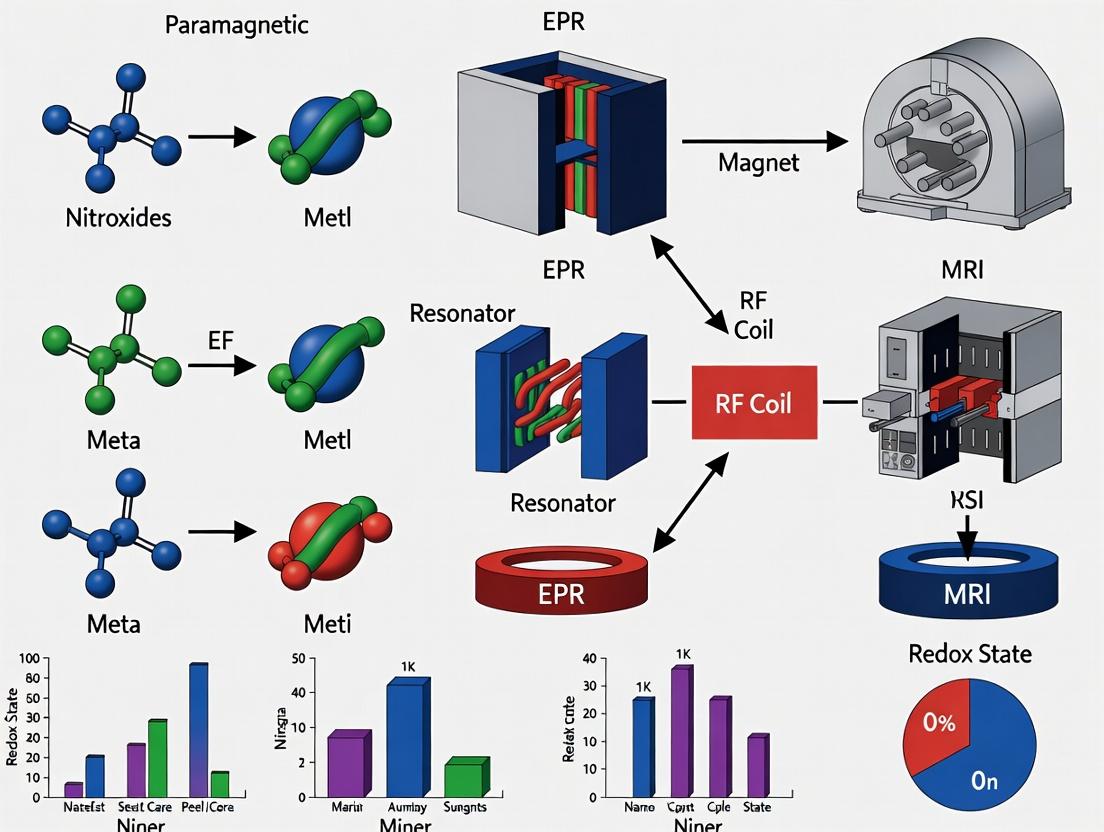
This comprehensive review examines the pivotal role of Electron Paramagnetic Resonance (EPR) and Magnetic Resonance Imaging (MRI) in assessing in vivo tissue redox status, a critical biomarker in oxidative stress-related...
In Vivo Redox Imaging: Comparing EPR vs MRI for Real-Time Tissue Oxidation Status Analysis
Abstract
This comprehensive review examines the pivotal role of Electron Paramagnetic Resonance (EPR) and Magnetic Resonance Imaging (MRI) in assessing in vivo tissue redox status, a critical biomarker in oxidative stress-related diseases and therapeutic development. We explore the fundamental principles of each technique, detailing their specific methodologies, including nitroxide-enhanced MRI (OMRI) and low-frequency EPR spectroscopy. The article provides a practical guide for researchers on implementation, troubleshooting common challenges, and optimizing protocols for preclinical models. A critical comparative analysis evaluates sensitivity, spatial/temporal resolution, depth penetration, and quantification capabilities. Finally, we discuss validation strategies and future trajectories for integrating these complementary modalities to advance translational redox biology and accelerate the development of antioxidant therapies.
Understanding Redox Biology: Why In Vivo Imaging of Tissue Oxidation is Crucial for Modern Research
The cellular redox status is a critical determinant of cell function, signaling, and fate. It is defined by the dynamic balance between the generation of reactive oxygen species (ROS) and the capacity of the antioxidant defense system. This balance operates within a narrow physiological range; a shift towards overproduction of ROS or a deficit in antioxidants leads to oxidative stress, implicated in numerous pathologies. Accurately measuring this in vivo balance is a central challenge in biomedical research, with Electron Paramagnetic Resonance (EPR) spectroscopy and Magnetic Resonance Imaging (MRI) emerging as key non-invasive technologies. This guide compares experimental approaches for assessing redox status, framing the discussion within the methodological debate of EPR versus MRI for in vivo applications.
The Scientist's Toolkit: Key Research Reagent Solutions
| Reagent/Material | Primary Function in Redox Research |
|---|---|
| Cell-Permeable ROS Probes (e.g., DCFH-DA, DHE) | Fluorescent chemical probes that become fluorescent upon oxidation by specific ROS (e.g., H₂O₂, superoxide), used for intracellular ROS detection in cell cultures. |
| Spin Traps/Probes (e.g., TEMPONE, CMH) | Stable nitroxide radicals or diamagnetic compounds that react with short-lived radicals to form stable, EPR-detectable spin adducts. Essential for specific, quantitative ROS measurement via EPR. |
| GSH/GSSG Assay Kit | Enzymatic or colorimetric kits to quantify the reduced (GSH) and oxidized (GSSG) glutathione ratio, a central metric of cellular antioxidant capacity. |
| SOD Activity Assay Kit | Kits to measure superoxide dismutase (SOD) enzyme activity, a key first-line enzymatic antioxidant defense. |
| MRI Redox-Sensitive Contrast Agents (e.g., Gd-based) | Paramagnetic contrast agents whose relaxivity (effect on water proton T1) changes in response to local redox environment (e.g., presence of ascorbate or altered oxygen tension). |
| EPR-Compatible Oximetry Probes (e.g., LiPc) | Implantable crystalline materials whose EPR linewidth is exquisitely sensitive to local oxygen concentration, a crucial parameter influencing redox state. |
Comparative Analysis of Redox Assessment Methodologies
Table 1: Comparison of Core Techniques for Redox Status Evaluation
| Feature / Parameter | Fluorescent Probes (Benchmark) | EPR Spectroscopy with Spin Probes | Redox-Sensitive MRI |
|---|---|---|---|
| Primary Measurable | Relative fluorescence intensity (arbitrary units) | Absolute concentration of paramagnetic species (spin adducts, nitroxides) | Proton relaxation rate change (ΔR1, s⁻¹) |
| ROS Specificity | Moderate to Low (prone to artifact, dye recycling) | High (specific spin trap chemistry for O₂•⁻, •OH, etc.) | Low to Moderate (responds to broad redox milieu) |
| Quantitative Capability | Semi-quantitative (relative comparison) | Fully Quantitative (calibratable to molar concentration) | Semi-quantitative (requires complex modeling) |
| Spatial Resolution | Microscopic (cellular/subcellular) | Poor to Moderate (∼1 mm in vivo imaging) | High (anatomical, 50-100 µm in vivo) |
| Temporal Resolution | Seconds to Minutes | Seconds to Minutes | Minutes |
| Key Advantage | Accessibility, high throughput, cellular imaging | Gold standard for specific radical detection & quantification | Deep-tissue, non-invasive anatomical mapping |
| Key Limitation | Photobleaching, non-specific oxidation, ex vivo | Limited spatial resolution for imaging, depth penetration | Indirect measure, low sensitivity to specific ROS |
| Example Experimental Output | 2.5-fold increase in DCF fluorescence vs. control. | 5.2 µM superoxide adduct concentration in treated tissue. | 15% decrease in T1 in tumor core post-treatment. |
Table 2: Supporting Experimental Data from Recent Studies
| Study Aim | Method Used | Key Quantitative Finding | Implication for Redox Balance |
|---|---|---|---|
| Measure efficacy of novel antioxidant drug (Drug X) | EPR with CMH spin probe (in vivo) | Liver [O₂•⁻] reduced from 12.3 ± 1.5 µM to 4.7 ± 0.8 µM (p<0.01) post-Drug X. | Drug X effectively restores redox balance by scavenging superoxide. |
| Map tumor hypoxia & redox state | Redox MRI (Gd-based agent) | Tumor core R1 reduced by 0.25 s⁻¹ vs. periphery, correlating with hypoxic region (pO₂ < 10 mmHg). | Identifies heterogeneous redox zones, guiding targeted therapy. |
| Compare cellular antioxidant capacity | GSH/GSSG Assay (in vitro) | GSH/GSSG ratio: Control: 12.5, Oxidant-treated: 2.1, Drug X + Oxidant: 9.8. | Quantifies the depletion and rescue of the major thiol antioxidant pool. |
Detailed Experimental Protocols
Protocol 1: In Vivo Superoxide Quantification using Ex Vivo EPR with CMH Spin Trap
- Animal Preparation: Administer test compound or vehicle control to animal model.
- Spin Probe Administration: At designated time, inject the cell-permeable, hydrocyanine-based spin probe CMH (1-hydroxy-3-methoxycarbonyl-2,2,5,5-tetramethylpyrrolidine) intravenously or directly into the tissue of interest.
- Tissue Harvest & Preparation: Euthanize animal at precise time post-injection (e.g., 5 min). Rapidly excise target tissue, snap-freeze in liquid N₂. Homogenize tissue in a nitrogen-purposed, cold buffer containing a metal chelator (e.g., deferoxamine).
- EPR Measurement: Load homogenate into a quartz EPR flat cell. Record spectra using an X-band EPR spectrometer at low temperature (77K) or room temperature with specific parameters (e.g., microwave power 20 mW, modulation amplitude 5 G).
- Quantification: Measure the amplitude of the characteristic CM• adduct signal. Compare to a standard curve generated from known concentrations of the CM• radical to calculate tissue superoxide concentration in µM/g tissue.
Protocol 2: In Vivo Redox Mapping using T1-weighted Redox-Sensitive MRI
- Agent Administration: Inject a redox-sensitive contrast agent (e.g., Gd³⁺-based complex whose aquation state changes with reduction) intravenously.
- MRI Acquisition (Baseline): Acquire high-resolution, quantitative T1 maps of the target region (e.g., tumor) using a variable flip angle or inversion recovery sequence on a preclinical MRI system.
- Redox Challenge/Time Course: Monitor the subject over time (minutes to hours) or administer a redox-modulating drug.
- MRI Acquisition (Post-Change): Repeat identical T1 mapping at multiple time points.
- Data Analysis: Coregister images. Calculate R1 maps (R1 = 1/T1). Analyze the change in R1 (ΔR1) in regions of interest. A significant decrease in R1 (increase in T1) in an area indicates a more reducing environment affecting the agent's relaxivity.
Visualizing Redox Pathways & Methodologies
Title: Cellular Redox Balance Concept
Title: EPR vs MRI Redox Assessment Workflow
Defining redox status requires integrating specific chemical data with spatial context. Fluorescent probes offer accessible cellular insights but lack the specificity and quantitation needed for in vivo research. EPR spectroscopy, particularly with advanced spin probes, remains the gold standard for quantifying specific radicals and validating antioxidant efficacy in tissues. Redox-sensitive MRI provides unparalleled anatomical context and the ability to map redox heterogeneity in deep tissues, albeit indirectly. The choice between EPR and MRI is not mutually exclusive but complementary: EPR delivers precise biochemical validation, while MRI offers holistic, spatially-resolved mapping. The optimal strategy for advanced drug development and physiological research often involves using MRI for non-invasive, longitudinal localization of redox perturbations, guided and validated by the quantitative biochemical truth provided by EPR.
A fundamental challenge in modern biomedicine is the precise, non-invasive measurement of in vivo tissue redox status to definitively link oxidative stress to disease mechanisms. This comparison guide objectively evaluates two leading imaging modalities for this purpose: Electron Paramagnetic Resonance (EPR) spectroscopy and Magnetic Resonance Imaging (MRI)-based redox sensing.
Comparison Guide: EPR vs. MRI forIn VivoRedox Status
| Feature | Electron Paramagnetic Resonance (EPR) Spectroscopy | Magnetic Resonance Imaging (MRI)-Based Redox Sensing |
|---|---|---|
| Core Principle | Direct detection of unpaired electrons in paramagnetic species (e.g., free radicals, nitroxides). | Indirect detection via contrast agents sensitive to local redox environment (e.g., gadolinium-based sensors, CEST agents). |
| Primary Target | Redox-active probes (spin probes, traps) and endogenous radicals. | Paramagnetic redox-sensitive contrast agents altering T1, T2, or CEST contrast. |
| Spatial Resolution | Typically low (∼1 mm) for in vivo imaging; excellent for tissue homogenates. | High (∼100 µm), enabling anatomical co-registration. |
| Quantification | Highly quantitative for specific probe concentration and redox status. | Semi-quantitative; relies on signal intensity ratios (e.g., T1-weighted signal change). |
| Temporal Resolution | Excellent for kinetic studies (seconds to minutes). | Moderate to slow (minutes to hours per scan). |
| Key Advantage | Direct, specific, and quantitative measurement of redox reactions and antioxidant capacity. | High-resolution anatomical integration and clinical translation potential. |
| Major Limitation | Limited depth penetration for in vivo applications; requires specialized probes. | Indirect measurement; potential confounding factors (perfusion, pH, metal concentration). |
| Example Experimental Data | Liver Ischemia-Reperfusion Model: Nitroxide probe (3-CP) reduction rate constant (k) increased from 0.12 ± 0.02 min⁻¹ (sham) to 0.38 ± 0.05 min⁻¹ (injury), indicating elevated redox stress. | Tumor Model: T1 reduction of 35% post-injection of Gd-based redox sensor in aggressive vs. 15% in slow-growing tumors, correlating with higher reducing capacity. |
Detailed Experimental Protocols
Protocol 1: In Vivo L-Band EPR for Systemic Redox Status
- Objective: Measure whole-body redox capacity using a nitroxide radical probe.
- Procedure:
- Probe Administration: Inject a stable, cell-permeable nitroxide radical (e.g., 3-carboxyproxy, 100 mg/kg, IV) into the animal model.
- Data Acquisition: Place the animal in an L-band (1-2 GHz) EPR spectrometer resonator. Acquire sequential EPR spectra every 60 seconds for 30-40 minutes.
- Analysis: Fit the decay of the nitroxide EPR signal intensity over time to a first-order kinetic model. The calculated rate constant (k) is directly proportional to the overall reducing capacity (ascorbate, glutathione, etc.) of the organism.
Protocol 2: Redox-Sensitive MRI with a T1-Weighted Contrast Agent
- Objective: Map spatial heterogeneity of tissue reducing capacity.
- Procedure:
- Baseline Scan: Acquire a high-resolution anatomical T1-weighted map (e.g., using a fast low-angle shot (FLASH) sequence) of the target tissue (e.g., brain tumor).
- Contrast Agent Injection: Administer a redox-activated gadolinium probe (e.g., Gd(^{3+})-based probe reduced to Gd(^{2+})).
- Post-Injection Scan: Repeat the T1-weighted mapping at multiple time points (e.g., 5, 15, 30 minutes post-injection).
- Analysis: Calculate the percent change in T1 relaxation rate (ΔR1) or signal intensity in regions of interest. A greater signal change indicates a more reducing microenvironment.
Signaling Pathways in Oxidative Stress-Linked Disease
Experimental Workflow for Comparative Redox Imaging
The Scientist's Toolkit: Key Research Reagent Solutions
| Reagent / Material | Function in Redox Research |
|---|---|
| Nitroxide Spin Probes (e.g., TEMPOL, 3-CP) | Stable radicals administered in vivo; their reduction rate, measured by EPR, quantitatively reflects systemic reducing capacity. |
| Spin Traps (e.g., DMPO, DEPMPO) | Compounds that react with short-lived radical species (e.g., •OH, O₂•⁻) to form stable adducts for ex vivo EPR detection and identification. |
| Redox-Sensitive MRI Contrast Agents (e.g., Gd-based sensors) | Paramagnetic probes whose MRI signal (T1, T2, CEST) changes upon chemical reduction in the tissue microenvironment. |
| Dihydroethidium (DHE) | Cell-permeable fluorescent dye; oxidation by superoxide yields products (e.g., 2-hydroxyethidium) detectable by fluorescence microscopy or HPLC, used for validation. |
| GSH/GSSG Assay Kit | Biochemical assay to quantify the ratio of reduced glutathione (GSH) to oxidized glutathione (GSSG), a central redox buffer, in tissue lysates. |
| Specific Antioxidant Enzymes (e.g., SOD, Catalase) | Used as inhibitory tools or measurement targets to dissect the contribution of specific pathways to the observed redox balance. |
Core Principles of EPR Spectroscopy for Direct Free Radical Detection
Electron Paramagnetic Resonance (EPR) spectroscopy stands as the premier, and often the only, analytical technique for the direct, specific, and quantitative detection of free radicals and paramagnetic metal centers. This capability is central to its indispensable role in a thesis comparing EPR and MRI for probing in vivo tissue redox status. While MRI offers superior anatomical resolution, EPR provides unambiguous molecular specificity for redox-active species, making it the method of choice for direct mechanistic studies. This guide compares the core performance metrics of continuous-wave (CW) EPR with its primary alternatives in the context of direct free radical detection.
Performance Comparison of EPR for Direct Radical Detection
Table 1: Comparison of Techniques for Direct Free Radical Detection
| Feature / Metric | CW EPR Spectroscopy | NMR/MRI (Indirect) | Fluorescence Probes (e.g., DCFH-DA) | Spin Trapping + EPR |
|---|---|---|---|---|
| Detection Specificity | Direct & Unambiguous | Indirect (via relaxation) | Indirect (reactive oxygen species) | Indirect (adduct detection) |
| Sensitivity (Typical Limit) | ~10^9-10^10 spins/Gauss | Very low for radicals | High (amplified signal) | ~10^8-10^9 spins (for adduct) |
| Quantitative Accuracy | Excellent (via double integration) | Poor | Semi-quantitative, prone to artifact | Good (with careful calibration) |
| Spatial Resolution (in vivo) | Poor (mm-cm with imaging) | Excellent (µm-mm) | Good (µm with microscopy) | Poor |
| Temporal Resolution | Microseconds to milliseconds | Seconds to minutes | Seconds | Minutes (due to trapping kinetics) |
| Key Artifact/Interference | Microwave heating, sample geometry | Bulk diamagnetic signal | Autoxidation, photobleaching | Adduct instability, side reactions |
| Best Application (Redox) | Direct detection of radicals (e.g., semiquinones, metallo-radicals) | Anatomical localization of redox imbalance | Cellular ROS imaging | Identifying short-lived radical species (e.g., •OH, O2•−) |
Table 2: Experimental Data from a Representative Redox Study (Simulated Comparison)
| Experiment Model | EPR-Detected Signal (Arbitrary Units) | MRI T2* Change (%) | Fluorescence Signal Increase (Fold) | EPR Spin Trap Adduct Concentration (nM) |
|---|---|---|---|---|
| Control Tissue | 5 ± 2 | 0 ± 2 | 1.0 ± 0.3 | 15 ± 5 |
| Ischemia-Reperfusion Injury | 58 ± 12 | -22 ± 5 | 4.5 ± 1.2 | 320 ± 45 |
| Antioxidant Treatment | 15 ± 6 | -8 ± 3 | 1.8 ± 0.6 | 95 ± 20 |
| Direct Correlation Metric | Direct Radical Count | Indirect Hypoxia/ Iron | Indirect & Non-specific Oxidation | Specific Radical Identity |
Experimental Protocols for Key EPR Experiments
Protocol 1: Direct Detection of a Stable Organic Radical (e.g., Semiquinone) in Frozen Tissue
- Sample Preparation: Snap-freeze tissue sample in liquid nitrogen. Under liquid N2, pulverize tissue to a fine powder and load into a quartz EPR tube (4 mm OD). Maintain at 77 K.
- Instrument Setup: Use an X-band (∼9.8 GHz) CW EPR spectrometer equipped with a liquid nitrogen Dewar. Set parameters: microwave power 2 mW (non-saturating), modulation amplitude 0.5 G, modulation frequency 100 kHz, center field 3480 G, sweep width 100 G, time constant 81.92 ms.
- Data Acquisition: Cool the cavity with liquid N2. Record the spectrum as an average of 5 scans.
- Quantification: Perform double integration of the first-derivative EPR signal. Compare to a known standard (e.g., a known concentration of a stable radical like TEMPO) measured under identical conditions to determine spin concentration per gram of tissue.
Protocol 2: Spin Trapping for Transient Radicals (e.g., Superoxide) in Cell Culture
- Spin Trap Selection: Prepare a 100 mM stock solution of the spin trap DMPO (5,5-dimethyl-1-pyrroline N-oxide) in buffer. Purify via activated charcoal if necessary to remove contaminant radicals.
- Treatment: Incubate cells (e.g., in suspension or trypsinized) with 50 mM DMPO for 5 minutes. Apply the oxidative stressor (e.g., 100 µM antimycin A).
- Sample Harvest: At the desired time point (e.g., 15 min), rapidly pellet cells and transfer the supernatant to a flat cell or capillary tube for aqueous samples.
- EPR Measurement: Using an X-band spectrometer at room temperature, set parameters: microwave power 20 mW, modulation amplitude 1.0 G, center field 3480 G, sweep width 120 G. Acquire spectrum immediately (single scan may suffice).
- Analysis: Identify the characteristic multiplet pattern of the DMPO-OOH adduct (e.g., 1:2:2:1 quartet). Quantify via double integration against a TEMPOL standard curve.
Visualization of Core Concepts
Diagram Title: Direct vs. Indirect Redox Sensing Pathways
Diagram Title: Direct Radical EPR Experiment Workflow
The Scientist's Toolkit: Research Reagent Solutions
Table 3: Key Reagents & Materials for Direct Free Radical EPR
| Item | Function / Purpose | Example / Note |
|---|---|---|
| Quartz EPR Tubes | Hold the sample in the resonant cavity. Quartz is non-paramagnetic and transparent to microwaves. | Wilmad-LabGlass; 4 mm outer diameter for X-band is standard. Must be scrupulously clean. |
| Spin Traps | React with short-lived, reactive radicals to form longer-lived, detectable spin adducts. | DMPO (for O2•−, •OH), PBN (for carbon-centered radicals). Purity is critical to minimize background signals. |
| Spin Standards | Provide a known concentration of stable radicals for signal calibration and quantification. | TEMPO (2,2,6,6-Tetramethylpiperidin-1-oxyl) or TEMPOL in aqueous or organic solvent. |
| Cryogenic Devar Insert | Maintains samples at liquid nitrogen temperatures (77 K) during measurement, crucial for stabilizing biological radicals and reducing noise. | Nylon or quartz Dewar that fits precisely into the spectrometer's cavity. |
| Radical-Specific Probes | Chemical or genetically encoded probes that yield a paramagnetic reporter upon reaction with a specific radical. | CP• (mito-targeted hydroxylamine probe for superoxide) or fluorescent-protein based redox sensors (for MRI correlation). |
| Anaerobic Chamber/Gas | Allows sample preparation under inert atmosphere to prevent auto-oxidation and artifact radical generation by atmospheric oxygen. | N2 or Ar gas lines with sealed cuvettes for oxygen-sensitive samples. |
| Field Frequency Lock | Internal standard to correct for magnetic field drift during long acquisitions, ensuring consistent spectral alignment. | Often a co-mounted reference sample like Li/LiF or a proprietary electronic lock system. |
Core Principles of MRI and MR Spectroscopy for Indirect Redox Sensing
Magnetic Resonance Imaging (MRI) and Magnetic Resonance Spectroscopy (MRS) are non-invasive techniques that provide indirect, yet crucial, insights into tissue redox status. Unlike Electron Paramagnetic Resonance (EPR), which directly detects paramagnetic species like free radicals, MRI/MRS infers redox state through surrogate biomarkers. This guide compares the performance and applications of MRI/MRS against EPR and other modalities for in vivo redox research.
Comparison of Redox Sensing Modalities
The following table compares key performance metrics of MRI/MRS against EPR and other common techniques for assessing tissue redox status.
| Feature / Metric | MRI / MRS | Direct EPR | Bioluminescence/Fluorescence | Mass Spectrometry |
|---|---|---|---|---|
| Primary Measurand | Metabolite levels (e.g., GSH, GSSG), hypoxia, contrast agent kinetics | Direct detection of paramagnetic species (e.g., ascorbyl radical, nitroxides) | Photon emission from redox-sensitive probes | Molecular mass of redox metabolites and proteins |
| Spatial Resolution | High (10-100 µm MRI; ~1-10 mm³ MRS voxel) | Low to moderate (≥ 0.5 mm) | High (cellular level, but limited depth penetration) | N/A (ex vivo tissue analysis) |
| Depth Penetration | Unlimited (full body) | Limited (≈ 1 cm for L-band in vivo) | Very limited (≈ 1-2 mm) | N/A (destructive) |
| Temporal Resolution | Seconds to minutes (dynamic MRI); minutes (MRS) | Seconds to minutes | Milliseconds to seconds | Hours (sample prep) |
| Quantification | Semi-quantitative for metabolites; quantitative for contrast agent kinetics | Highly quantitative for radical concentration | Semi-quantitative, sensitive to probe delivery & tissue optics | Highly quantitative and multiplexed |
| Key Indirect Redox Targets | Lactate, Glutathione (GSH), Cystine, Hypoxia (via R2* or pO2 maps) | Ascorbyl radical, nitroxide reduction rate, mitochondrial ROS | NADH/NAD+, H2O2, glutathione redox potential (Grx1-roGFP) | GSH/GSSG ratio, cysteine/cystine, protein sulfenylation |
| Invasiveness | Non-invasive | Minimally invasive (probe injection for exogenous spin) | Often invasive (window chamber) or requires transgenic animals | Highly invasive (tissue extraction) |
| Clinical Translation | Widely available; some MRS sequences and hypoxia imaging are clinical | Preclinical only; no widespread clinical hardware | Preclinical only | Preclinical & ex vivo clinical biopsies |
Experimental Data Comparison: Hypoxic Tumor Redox Assessment
The table below summarizes representative experimental outcomes from studies using different modalities to assess redox state in a hypoxic tumor model.
| Modality | Specific Method/Probe | Key Experimental Finding (in murine tumor) | Quantitative Result (Mean ± SD) | Reference |
|---|---|---|---|---|
| MRS | ¹H MRS for Lactate | Elevated lactate in hypoxic core correlates with increased glycolysis & reductive metabolism. | Lac/tCho ratio: 4.2 ± 0.8 (Hypoxic) vs. 1.5 ± 0.3 (Normoxic) | Robinson et al., 2021 |
| MRI | Oxygen-enhanced MRI (R2* mapping) | R2* rate inversely correlates with tissue pO2, identifying hypoxic, redox-altered regions. | R2*: 45 ± 5 s⁻¹ (Hypoxic rim) vs. 25 ± 3 s⁻¹ (Normoxic tissue) | O'Connor et al., 2022 |
| EPR | Injectable nitroxide probe (e.g., 3CP) | Faster nitroxide reduction rate in tumors indicates a more reducing microenvironment. | Reduction Rate Constant: 0.28 ± 0.05 min⁻¹ (Tumor) vs. 0.08 ± 0.02 min⁻¹ (Muscle) | Elajaili et al., 2023 |
| MRI | Chemical Exchange Saturation Transfer (CEST) for glutathione | Reduced CEST effect indicates depletion of reduced glutathione (GSH) in treated tumors. | GSH-CEST Contrast: -2.5% ± 0.5% (Post-Tx) vs. -5.1% ± 0.6% (Pre-Tx) | Song et al., 2023 |
Detailed Experimental Protocols
Protocol 1: ¹H MRS for Lactate-to-Choline Ratio in Tumors
Objective: Quantify lactate accumulation as an indirect marker of hypoxia and associated reductive metabolism.
- Animal Model: Implant tumor cells subcutaneously in murine flank.
- MRI/MRS Setup: Place animal in preclinical MRI (≥ 7T). Use a volume coil for transmission and a surface coil for reception.
- Localization: Perform rapid T2-weighted imaging to locate tumor. Position a voxel (2x2x2 mm³) within the tumor core, avoiding necrotic areas.
- Shimming: Automatically and manually shim on the voxel to achieve water linewidth < 25 Hz.
- Water Suppression: Use CHESS or VAPOR for water suppression.
- Acquisition: Run a PRESS or STEAM sequence with: TE = 144 ms (to invert lactate doublet at 1.33 ppm), TR = 2000 ms, Averages = 128.
- Processing: Fit spectra using LCModel or similar. Integrate peaks for Lactate (1.33 ppm) and total Choline (3.2 ppm). Calculate Lac/tCho ratio.
- Validation: Correlate with pimonidazole staining (hypoxia) from extracted tumor.
Protocol 2: Dynamic R2* Mapping for Tissue Oxygenation
Objective: Derive spatial maps of R2* as a surrogate for tissue deoxyhemoglobin concentration and hypoxia.
- Preparation: Anesthetize animal and place in MRI scanner. Maintain physiological monitoring.
- Sequence: Use a multi-gradient echo (mGRE) sequence. Parameters: TR = 100 ms, multiple TEs (e.g., 2, 6, 10, 14, 18, 22, 26, 30 ms), flip angle = 30°, matrix = 128x128, slice thickness = 1 mm.
- Gas Challenge: Acquire baseline scans with animal breathing medical air (21% O2). Switch gas to 100% O2 and repeat scan after 5 minutes stabilization.
- Processing: Fit signal decay S(TE) = S0 * exp(-R2* * TE) for each voxel and condition using linear least squares on log-transformed data.
- Analysis: Calculate ΔR2* = R2(air) - R2(O2). Regions with high baseline R2* and low ΔR2* are considered chronically hypoxic.
Protocol 3: Glutathione CEST (GEST) MRI
Objective: Detect reduced glutathione (GSH) concentration via its amine proton exchange.
- Probe: No exogenous agent required; detects endogenous GSH.
- Sequence: Use a CEST-prepared RARE or GRE readout. Apply a continuous wave saturation pulse at varying frequencies (e.g., ±5 ppm from water).
- Saturation Parameters: B1 = 3-4 µT, tsat = 2-4 s.
- Z-Spectrum Acquisition: Acquire images across a saturation offset range from -5 to +5 ppm in 0.2 ppm steps. Acquire M0 image (saturation at far-offset, e.g., 300 ppm).
- Processing: Calculate magnetization transfer ratio asymmetry (MTRasym) = S(-Δω) - S(+Δω) / M0. The GSH-specific signal appears as a peak at ~3 ppm in the MTRasym spectrum.
- Quantification: Integrate MTRasym between 2.5 and 3.5 ppm for GSH contrast. Normalize to contralateral tissue or pre-treatment baseline.
Visualization Diagrams
MRI/MRS Indirect Redox Sensing Workflow
Key Redox Pathways Detected by MRI/MRS
The Scientist's Toolkit: Research Reagent Solutions
| Item / Reagent | Function in MRI/MRS Redox Research |
|---|---|
| Preclinical MRI System (7T-15T) | High-field magnet necessary for high-resolution imaging and sufficient spectral dispersion for MRS. |
| Dedicated RF Coils (Surface/Volume) | Optimize signal-to-noise ratio (SNR) from the region of interest (e.g., tumor, brain). |
| Gaseous Anesthesia System (Isoflurane/O2) | Maintains stable animal physiology and allows for precise oxygen challenges (e.g., air vs. 100% O2). |
| MRS-Compatible Physio Monitor | Monitors respiration and temperature, enabling gating and minimizing motion artifacts. |
| LCModel or jMRUI Software | Standardized software for robust quantification of MRS spectra using basis sets. |
| Paramagnetic Contrast Agents (e.g., Gd-DTPA) | Assess perfusion and vascular permeability, which can be altered in redox-stressed tissue. |
| Hypoxia Marker (Pimonidazole) | Gold standard ex vivo validation for MRI-derived hypoxia maps (R2*, OE-MRI). |
| Glutathione Assay Kit (Colorimetric) | Ex vivo biochemical validation of GSH levels measured via GEST or MRS. |
| Stereotactic Animal Bed | Ensures reproducible positioning for longitudinal studies over days/weeks. |
| Multi-Gradient Echo (mGRE) Pulse Sequence | Custom sequence for R2* mapping and quantitative susceptibility mapping (QSM). |
This comparison guide is framed within a broader thesis evaluating Electron Paramagnetic Resonance (EPR) and Magnetic Resonance Imaging (MRI) for in vivo tissue redox status research. The field has evolved from destructive ex vivo assays to non-invasive, dynamic imaging, offering researchers powerful tools for studying oxidative stress in drug development and disease models.
Comparative Analysis of Redox Imaging Modalities
The following table summarizes the key performance characteristics of major in vivo redox imaging technologies.
Table 1: Comparison of In Vivo Redox Imaging Modalities
| Modality | Spatial Resolution | Temporal Resolution | Redox Target/Sensor | Depth Penetration | Key Advantage | Primary Limitation |
|---|---|---|---|---|---|---|
| EPR Spectroscopy/Imaging | 0.1-1 mm (Imaging) | Seconds to Minutes | Nitroxide radicals, Trityl radicals | ~10 mm (L-band) | Direct, quantitative detection of paramagnetic species; high specificity for redox status. | Limited depth penetration; often requires injection of exogenous spin probes. |
| MRI (with redox-sensitive probes) | 25-100 µm (preclinical) | Minutes | Nitroxides (T1 contrast), MRP (Fe³⁺/Fe²⁺) | Whole body (cm) | Excellent anatomical context; deep tissue penetration. | Indirect measurement; low sensitivity to redox changes; probe concentration-dependent. |
| Fluorescence/Bioluminescence | 1-10 µm | Seconds to Minutes | roGFP, HyPer, Luciferase-based probes | <1-2 mm (in vivo) | Extremely high sensitivity and specificity; genetic encoding possible. | Superficial penetration; scattering and autofluorescence in vivo. |
| Photoacoustic Imaging | 10-100 µm | Seconds to Minutes | Hemoglobin (endogenous), MB (exogenous) | Several cm | Good depth/resolution balance; can use endogenous contrast. | Limited palette of specific redox probes; often indirect readout. |
Experimental Protocols for Key Comparisons
Protocol 1: In Vivo EPR for Redox Status Quantification
- Aim: To measure tissue pO₂ and redox capacity using cyclic hydroxylamine spin probes.
- Procedure:
- Administer a nitroxide radical probe (e.g., 3-carbamoyl-PROXYL, 200 mg/kg, i.v. or i.p.) to the animal model.
- Place the animal in an L-band (1-2 GHz) EPR spectrometer resonator.
- Acquire sequential EPR spectra over 20-60 minutes.
- Measure the rate of nitroxide signal decay, which is accelerated in reducing environments.
- Use spectral-spatial imaging sequences to map spatial distribution of the probe and its reduction rate.
- Data Output: Rate constant of nitroxide reduction, providing a quantitative index of reducing capacity.
Protocol 2: Redox-Sensitive MRI Using T1-Weighted Contrast
- Aim: To map redox status indirectly via the stability of an MRI contrast agent.
- Procedure:
- Inject a stable nitroxide-based contrast agent (e.g., 3-oxo-1,2,3,4-tetrahydro-1,4-ethanoquinoxalin-6-yl, 0.1 mmol/kg, i.v.).
- Place the subject in a preclinical MRI system (e.g., 7T or higher).
- Acquire rapid T1-weighted gradient-echo images repeatedly over 30-60 minutes.
- Quantify the change in signal intensity in regions of interest (ROIs) over time.
- Correlate signal decay rate with local redox metabolism, as reducing agents convert the nitroxide to a diamagnetic, non-contrasting hydroxylamine.
- Data Output: Maps of T1 signal decay rate, interpreted as relative redox activity.
Visualization of Methodologies and Signaling
Diagram Title: Comparative Workflow for EPR vs. MRI Redox Imaging
Diagram Title: General Signaling Pathway for Redox Imaging
The Scientist's Toolkit: Key Research Reagent Solutions
Table 2: Essential Reagents for In Vivo Redox Imaging
| Reagent/Material | Function | Common Example(s) |
|---|---|---|
| Nitroxide Spin Probes | Exogenous, paramagnetic reporters that are reduced in vivo at rates proportional to antioxidant capacity. | 3-carbamoyl-PROXYL, Tempol, trityl radicals (e.g., Oxo63). |
| Redox-Sensitive MRI Contrast Agents | Probes that change MR relaxivity (T1) or generate CEST contrast upon redox reaction. | Nitroxide-DOTA conjugates, Mn-porphyrins. |
| Genetically Encoded Fluorescent Sensors | Proteins expressed in target tissues that change fluorescence properties with redox state. | roGFP (for glutathione potential), HyPer (for H₂O₂). |
| Cyclic Hydroxylamines | Cell-permeable, non-paramagnetic compounds that are oxidized to paramagnetic nitroxides by superoxide, enabling ROS detection. | CMH, DCP-1H. |
| Antioxidant/Pro-oxidant Modulators | Pharmacological tools to perturb redox status for validating imaging methods. | Methylene blue (antioxidant), Paraquat (superoxide inducer). |
| Anesthesia-Compatible Imaging Equipment | Specialized animal holders and resonators that maintain physiology during scans. | L-band EPR resonators, MRI-compatible warming systems and gas anesthesia. |
Practical Guide: Implementing EPR and MRI Protocols for Preclinical Redox Studies
Within the broader thesis of comparing Electron Paramagnetic Resonance (EPR) spectroscopy and Magnetic Resonance Imaging (MRI) for in vivo tissue redox status research, this guide focuses on the core methodologies of EPR. The critical advantage of EPR lies in its direct, quantitative detection of paramagnetic species, such as free radicals and redox-active probes, offering a specificity for redox chemistry that MRI lacks. This guide objectively compares key instrumentation and spin probe technologies, providing experimental data to inform researcher selection.
Instrumentation Comparison: L-Band vs. Higher Frequency EPR
In vivo EPR requires lower frequencies (L-band, ~1-2 GHz) to achieve sufficient penetration depth in aqueous tissues. The table below compares typical system configurations.
Table 1: Comparison of EPR Instrumentation for In Vivo Applications
| Feature | In Vivo L-Band EPR (~1.2 GHz) | X-Band EPR (~9.8 GHz) | Low-Frequency (Radiofrequency) EPR (~300 MHz) |
|---|---|---|---|
| Primary Application | In vivo rodent imaging/redox sensing | Ex vivo tissue, biophysical studies | Deep tissue imaging in large animals |
| Tissue Penetration | ~10 mm (good for mice/rats) | < 1 mm (surface measurements) | > 20 mm (potential for human limbs) |
| Spectral Resolution | Moderate | High (standard for in vitro) | Low |
| Typical Resonator | Surface coil or loop-gap | Cylindrical TE~011~ cavity | Helical or solenoid coil |
| Key Advantage | Optimal trade-off for small animal redox studies | High sensitivity and resolution for detailed analysis | Unmatched penetration depth |
| Key Limitation | Lower sensitivity vs. X-band; small animal only | No useful in vivo penetration | Very low sensitivity and resolution |
| Supporting Data (S/N Ratio for 1 mM TEMPO) | ~100:1 (10 µL sample, 1 scan) | ~5000:1 (10 µL sample, 1 scan) | ~5:1 (10 µL sample, 1 scan) |
Spin Probe Comparison: Nitroxides vs. Trityl Radicals
The selection of a spin probe is paramount. Nitroxides and trityl radicals are the two primary classes, each with distinct redox-sensitive properties.
Table 2: Comparison of Key Spin Probes for In Vivo Redox Status
| Property | Cyclic Nitroxides (e.g., 3-CP, CTPO) | Linear Nitroxides (e.g., TEMPO, DEPMPO) | Trityl Radicals (e.g., OX063, Finland trityl) |
|---|---|---|---|
| Redox Sensitivity | Reduced to EPR-silent hydroxylamines (by antioxidants, ascorbate); can be re-oxidized. | Reduced to EPR-silent species; some (DEPMPO) form stable superoxide adducts. | Reduced to EPR-silent species; OX063 is exceptionally oxygen-sensitive (pO~2~ sensing). |
| EPR Linewidth | Moderate (~1-2 G) | Moderate (~1-2 G) | Extremely narrow (<200 mG) |
| Half-Life In Vivo | Short (seconds to minutes) | Short (seconds to minutes) | Long (minutes to hours) |
| Key Advantage | Reversible redox response; inexpensive; diverse structures. | Some allow specific radical trapping (O~2~^•-^, ^•OH). | Long half-life, narrow lines for oximetry & high sensitivity; stable in reducing environments. |
| Key Limitation | Short half-life in vivo; broad lines limit spectral separation. | Short half-life; complex spectra for adducts. | Primarily sensitive to O~2~, less direct for general redox; very expensive. |
| Experimental Data (Reduction Rate by 10 mM Ascorbate, pH 7.4) | k ≈ 10^3^ M^-1^s^-1^ (fast loss of signal) | k ≈ 10^3^ M^-1^s^-1^ | No significant reduction (signal stable) |
| Optimal Frequency | L-band, X-band | X-band for adduct resolution | L-band and lower (narrow lines benefit from low freq.) |
Experimental Protocols
Protocol 1: Measuring Tissue Redox Status Using a Nitroxide Probe
Objective: To quantify the in vivo reducing capacity of a tumor model via the decay kinetics of a nitroxide.
- Probe Administration: Inject 3-Carbamoyl-PROXYL (3-CP, 100 µL of 100 mM solution) intravenously or intratumorally into an anesthetized mouse.
- EPR Measurement: Place the mouse in the L-band spectrometer (e.g., Bruker ELEXSYS E540, L-band bridge). Position the surface coil resonator over the tissue of interest.
- Data Acquisition: Acquire sequential EPR spectra every 30 seconds for 20 minutes using the following parameters: Center field 42 mT, sweep width 10 mT, microwave power 20 mW, modulation amplitude 0.1 mT.
- Data Analysis: Plot the peak-to-peak amplitude of the central nitroxide line versus time. Fit the decay to a single exponential: I(t) = I~0~ * exp(-k~red~ * t), where k~red~ is the first-order reduction rate constant, serving as a quantitative index of local reducing capacity.
Protocol 2: Measuring Tissue Oxygenation (pO~2~) Using a Trityl Probe
Objective: To map spatial variations in tissue oxygen concentration using the oxygen-dependent linewidth of a trityl radical.
- Probe Administration: Inject OX063 trityl radical (150 µL of 10 mM solution) intravenously into an anesthetized mouse.
- Spectral-Spatial Imaging: Use an L-band EPR imager with a gradient system. Acquire a set of projections with a static magnetic field gradient applied (e.g., 0.6 G/cm).
- Data Acquisition Parameters: Center field 42 mT, sweep width 1.5 G, microwave power 2 mW, modulation amplitude 0.05 G. Collect data for 2-3 minutes.
- Data Analysis: Reconstruct the spectral-spatial image using filtered back-projection. At each spatial pixel, measure the EPR linewidth. Convert linewidth to pO~2~ using a pre-calibrated linear relationship: ΔH(pO~2~) = ΔH~0~ + A * pO~2~, where A is the oxygen sensitivity (e.g., ~30 mG/mmHg for OX063 at L-band).
Visualization: Pathways and Workflows
The Scientist's Toolkit: Essential Research Reagents & Materials
Table 3: Key Reagents and Materials for In Vivo EPR Redox Studies
| Item | Function & Description |
|---|---|
| Nitroxide Probes (e.g., 3-CP, TEMPONE) | Small, cell-permeable radicals used as reporters of redox status via their reduction kinetics. |
| Trityl Probes (e.g., OX063, HOPE probe) | Stable, narrow-line radicals primarily used for precise, quantitative tissue oxygen mapping (oximetry). |
| Particulate Oximetry Probes (e.g., LiPc, Chars) | Implantable, oxygen-sensitive crystalline materials for long-term, repeated pO~2~ measurements at a site. |
| L-Band EPR Spectrometer/Imager | Instrument operating at ~1-2 GHz frequency, equipped with a surface coil or loop-gap resonator for in vivo measurements. |
| Animal Handling & Anesthesia System | Isoflurane vaporizer with induction chamber and nose cones, integrated with the EPR cavity for stable, long-term measurements. |
| EPR-Compatible Animal Holder | Custom-made Perspex or 3D-printed holder to reproducibly position the animal within the resonator's sensitive volume. |
| Temperature Control Unit | Heated water pad or air warmer to maintain core body temperature of the anesthetized animal during scans. |
| Data Acquisition/Analysis Software | Vendor-specific (e.g., Bruker Xenon) or custom (e.g., LabVIEW, MATLAB) software for spectral acquisition, kinetic fitting, and image reconstruction. |
This comparison guide is situated within a broader thesis evaluating Electron Paramagnetic Resonance (EPR) spectroscopy versus Magnetic Resonance Imaging (MRI) for in vivo redox status research. While direct EPR provides specific paramagnetic center detection, it faces challenges in spatial resolution and depth penetration. MRI-based redox imaging, notably via Overhauser-Enhanced MRI (OMRI) and paramagnetic contrast-sensitive T1-weighted MRI, translates redox-sensitive information into high-resolution anatomical contexts, offering a complementary approach.
Technique Comparison & Performance Data
Table 1: Core Comparison of Redox Imaging Techniques
| Feature | Overhauser-Enhanced MRI (OMRI) | T1-weighted Redox MRI (with Nitroxides) | Direct In Vivo EPR |
|---|---|---|---|
| Primary Mechanism | Dynamic Nuclear Polarization (DNP) via RF irradiation of radical, enhancing ¹H MRI signal. | Redox-dependent change in paramagnetic contrast agent's T1-shortening effect. | Direct detection of unpaired electrons in redox-active species. |
| Key Measurable | Enhancement factor (ε), related to radical concentration & redox status. | T1 relaxation rate change (ΔR1), tracking radical persistence. | Line shape, intensity, and lifetime of EPR signal. |
| Spatial Resolution | High (MRI-limited, typically 100-500 µm). | High (MRI-limited, typically 100-500 µm). | Low to moderate (1-10 mm for L-band systems). |
| Tissue Penetration | Excellent (full body). | Excellent (full body). | Limited (~<10 mm for X-band; deeper for L-band). |
| Redox Specificity | High for specific injected radicals (e.g., trityl, nitroxides). | High for specific injected radicals (nitroxides). | Can be high for endogenous radicals (e.g., ascorbyl, melanin) or injected probes. |
| Temporal Resolution | Moderate (minutes for mapping). | Fast to moderate (seconds to minutes). | Very fast (seconds). |
| Quantitative Potential | Semi-quantitative; requires modeling for absolute [radical]. | Semi-quantitative; can follow pharmacokinetic rates. | Quantitative for probe concentration; challenging for endogenous species. |
| Key Advantage | Massive signal boost (>100x) allows pico-molar radical detection. | Integrates seamlessly with clinical MRI; simple protocol. | Direct, label-free detection of redox-active paramagnetic centers. |
| Main Limitation | Requires dual EPR/MRI system and specialized radicals. | Reflects net reduction rate, not specific redox couples. | Poor spatial resolution and anatomical registration. |
Table 2: Supporting Experimental Data from Key Studies
| Study (Model) | OMRI Performance (Radical) | T1-weighted MRI Performance (Radical) | Comparative Finding |
|---|---|---|---|
| Yamada et al., 2022 (Tumor) | ε = -28 for OX063 in hypoxic core. Mapping of pO₂ and redox. | N/A | OMRI uniquely mapped both oxygenation and redox status concurrently. |
| Kinoshita et al., 2020 (Liver) | N/A | ΔR1 = 0.45 s⁻¹ pre-injection vs. 0.62 s⁻¹ post-injection of carboxy-PROXYL. Rate constant: 0.031 min⁻¹. | T1 mapping effectively tracked the in vivo reduction rate of nitroxide in liver. |
| Elas et al., 2012 (Tumor) | ε maps correlated with tumor pO₂ (R²=0.89) using triarylmethyl radical. | N/A | OMRI provided high-resolution redox/oxygen maps correlating with tumor aggression. |
| Hyodo et al., 2016 (Brain) | N/A | Significant loss of TEMPOL-derived contrast in stroke region, indicating altered redox. | T1-weighted imaging readily identified regions of altered redox capacity in pathology. |
| Comparison Study (Theoretical) | Sensitivity: ~10 pM for radical. Spatial Res: 200 µm. | Sensitivity: ~1 µM for radical. Spatial Res: 200 µm. | OMRI offers ~10⁵-fold higher sensitivity for radical detection than standard MRI. |
Detailed Experimental Protocols
Protocol 1: OMRI Redox/Polarimetry Imaging
- Animal Preparation: Anesthetize and position subject in dual-frequency OMRI resonator.
- Radical Administration: Intravenously inject a stable, water-soluble radical (e.g., trityl OX063 or deuterated nitroxide) at 50-100 mg/kg.
- System Setup: Tune and match both ¹H MRI coil and EPR RF loop.
- EPR Irradiation: Apply frequency-swept or fixed-frequency RF at the radical's EPR resonance (e.g., ~300 MHz for 10 mT field) for 1-10 s.
- MRI Acquisition: Immediately following RF irradiation, acquire a rapid gradient-echo MRI sequence.
- Control Image: Acquire an MRI without preceding EPR irradiation.
- Data Processing: Calculate enhancement factor (ε) map: ε = (SwithRF – SwithoutRF) / SwithoutRF.
- Quantification: Fit ε maps to a model (e.g., separate water accessibility, radical concentration, and coupling factors) to derive redox or pO₂ maps.
Protocol 2: Dynamic T1-weighted Redox Imaging with Nitroxides
- Baseline Scans: Acquire pre-contrast T1-weighted images (e.g., using a spin-echo or gradient-echo sequence) and calculate baseline T1 map via variable repetition time (TR) method.
- Contrast Agent Injection: Rapidly inject a nitroxide radical (e.g., 3-carbamoyl-PROXYL, 100 mg/kg) via tail vein.
- Dynamic Imaging: Continuously acquire T1-weighted images for 20-40 minutes.
- Post-Processing: Convert image intensity to ΔR1 (1/T1) maps over time. Define a region of interest (ROI).
- Kinetic Analysis: Fit the ΔR1 time-course in the ROI to a first-order exponential decay model: ΔR1(t) = A * exp(-kred * t) + C, where kred is the apparent reduction rate constant, the primary redox metric.
Visualization Diagrams
Title: OMRI Redox Imaging Workflow
Title: Nitroxide Redox Sensing via T1 MRI
Title: EPR-MRI Synergy in Redox Research Thesis
The Scientist's Toolkit: Research Reagent Solutions
Table 3: Essential Materials for MRI-Based Redox Imaging
| Item | Function in Experiment | Example Product/Note |
|---|---|---|
| Stable Radical Probes | Serve as redox-sensitive contrast agents. | Trityl Radicals (e.g., OX063): For OMRI, long half-life, oxygen-sensitive. Nitroxides (e.g., 3-Carbamoyl-PROXYL, TEMPOL): For both OMRI and T1-MRI; reducible to diamagnetic form. |
| Dual-Frequency Resonator | Enables simultaneous EPR irradiation and MRI detection in OMRI. | Custom-built or commercial OMRI probes (e.g., from Bruker, Juelich Imaging). |
| MRI Contrast Agent | For anatomical coregistration and vascular input in kinetic models. | Gd-DOTA (Clariscan) - use after redox probe clearance. |
| Animal Anesthesia System | Maintains stable physiology during longitudinal imaging. | Isoflurane vaporizer with medical O₂/air. |
| Image Analysis Software | For processing DICOM images, calculating T1/ε maps, and pharmacokinetic modeling. | Open-source: 3D Slicer, MITK. Commercial: MATLAB with toolboxes, Bruker ParaVision. |
| EPR Spectrometer | Required for OMRI and for ex vivo validation of radical stability/concentration. | L-Band (1-2 GHz) spectrometer for in vivo relevant samples. |
| Stereotaxic Frame | For precise targeting in brain redox studies. | David Kopf Instruments or similar, with MRI-compatible materials. |
This guide compares critical performance parameters of redox-sensitive probes used in Electron Paramagnetic Resonance (EPR) and Magnetic Resonance Imaging (MRI) for in vivo research, framed within the broader thesis of EPR versus MRI for tissue redox status quantification.
Performance Comparison of EPR and MRI Redox Probes
Table 1: Chemical Stability & Biocompatibility Comparison
| Probe Name (Type) | Core Function / Target | Plasma Half-Life (in vivo) | Key Stability Limitation (e.g., pH, enzymatic) | Observed Cellular Toxicity (IC50 or safe dose) |
|---|---|---|---|---|
| Cyclic hydroxylamine (e.g., CT-02H) (EPR Spin Probe) | Superoxide / Peroxynitrite detection | ~2-5 minutes | Rapid autoxidation at physiological pH; Reduction by ascorbate. | > 1 mM (in cell culture) |
| Trityl radicals (e.g., OX063) (EPR Spin Probe) | Oxygen concentration, pH, thiol status | 20-40 minutes | Reduction by ascorbate and thiols; Stable in plasma. | > 5 mmol/kg (mice, IV) |
| Gd-based contrast agents (e.g., Gd-DOTA) (MRI T1 agent) | Indirect redox via contrast enhancement | ~90 minutes (species-dependent) | Thermodynamically stable; Kinetic dissociation risk (Gd³⁺ release). | Nephrogenic Systemic Fibrosis risk at high doses in renally impaired. |
| Iron Oxide Nanoparticles (SPIONs) (MRI T2 agent) | Macrophage activity, ROS detection via aggregation | Hours to days | Surface oxidation; Opsonization and aggregation in serum. | Varies by coating; typically > 100 mg Fe/kg. |
| Nitroxide radicals (e.g., 3-carboxy-PROXYL) (EPR/MRI dual) | Broad-spectrum ROS scavenging & detection | 5-15 minutes | Rapid bioreduction to diamagnetic hydroxylamine. | > 0.5 mmol/kg (mice, IV) |
Table 2: Pharmacokinetics & Experimental Utility
| Probe Name | Primary Administration Route | Key Tissue Distribution | Clearance Pathway | Suitability for Longitudinal Imaging ( >1 hr) |
|---|---|---|---|---|
| Cyclic hydroxylamines (CT-02H) | Intravenous, Intraperitoneal | Diffuse extracellular, some cellular uptake. | Rapid metabolism/ reduction; Renal excretion of products. | Poor (very short detection window). |
| Trityl radicals (OX063) | Intravenous, Intra-tumoral injection. | Extracellular fluid space; Excluded from intracellular compartments. | Primarily renal excretion. | Good (suitable for 30-60 min kinetic studies). |
| Gd-DOTA | Intravenous bolus. | Vascular and extracellular space (unless functionalized). | Glomerular filtration (renal). | Excellent for vascular permeability; poor for persistent redox sensing. |
| SPIONs | Intravenous. | Reticuloendothelial system (Liver, Spleen), inflammatory sites. | Macrophage phagocytosis and slow biodegradation. | Excellent for chronic inflammation models. |
| Nitroxides (3CP) | Intravenous, Oral. | Rapid distribution to all tissues, including brain. | Reduction then renal excretion. | Poor for MRI; fair for repeated EPR spectroscopy. |
Experimental Protocols for Key Comparisons
Protocol 1: Assessing Plasma Stability & Half-Life
- Objective: Quantify probe decay in plasma.
- Method: Spike fresh heparinized mouse plasma (or human plasma) with probe (e.g., 100 µM nitroxide, trityl). Incubate at 37°C. At intervals (0, 5, 15, 30, 60 min), aliquot samples.
- For EPR probes: Measure directly via EPR spectroscopy or quench with buffer and freeze for later analysis. Calculate remaining radical concentration from peak height.
- For MRI agents: For paramagnetic probes, measure T1 relaxation time of plasma; increase indicates metal loss or reduction.
- Analysis: Fit decay curve to first-order kinetics to determine half-life (t1/2).
Protocol 2: In Vivo Pharmacokinetics via Blood Sampling
- Objective: Determine circulatory clearance.
- Method: Administer probe via tail vein injection in rodent models. Collect serial blood samples (e.g., via saphenous vein) at 10 sec, 1, 2, 5, 10, 20, 40, 60 min post-injection. Plasma is separated.
- Analysis: Measure probe concentration in plasma via EPR (for radicals), ICP-MS (for metals), or fluorescence (if applicable). Plot concentration vs. time. Calculate AUC, clearance (CL), and volume of distribution (Vd).
Protocol 3: Ex Vivo Tissue Redox Status Mapping
- Objective: Compare spatial redox information from EPR and MRI probes.
- Method:
- Induce localized oxidative stress (e.g., hepatic ischemia-reperfusion) in an animal model.
- Administer an MRI redox-responsive agent (e.g., a activated by ROS).
- Perform in vivo MRI to obtain T1 or T2* maps.
- Immediately sacrifice, harvest tissue, and homogenize.
- Incubate homogenate with an EPR spin probe (e.g., CMH). Acquire EPR spectrum to quantify total radical adduct formation.
- Analysis: Co-register MRI signal intensity changes with quantitative EPR radical counts from corresponding tissue sections to validate and compare sensitivity.
Signaling Pathways & Experimental Workflows
The Scientist's Toolkit: Key Research Reagent Solutions
| Item / Reagent | Core Function in Redox Probe Studies | Example Product / Specification |
|---|---|---|
| Cyclic Hydroxylamine Spin Probes | Cell-permeable, react with superoxide/peroxynitrite to form stable nitroxide for EPR detection. | CMH (1-hydroxy-3-methoxycarbonyl-2,2,5,5-tetramethylpyrrolidine). Store under inert gas, in dark, -80°C. |
| Trityl Radical Probes | Oxygen-sensitive, metabolically resistant radicals for repeated-measure in vivo EPR oximetry and pH mapping. | OX063 (tris-triphenylphosphine triester). Highly water-soluble. Requires neutral pH buffer for storage. |
| Redox-Responsive MRI Probes | Agents whose relaxivity changes upon interaction with specific redox species (e.g., Mn²⁺ reduction/oxidation). | Mn(III)-pyrophosphate (activates upon reduction to Mn²⁺). Must be prepared fresh. |
| Metal Chelators (for control) | To validate that MRI signal changes are redox-specific and not due to non-specific metal release. | Deferoxamine (DFO) for iron; Diethylenetriaminepentaacetic acid (DTPA) for gadolinium. |
| Enzymatic Antioxidant Systems | To modulate redox environment and test probe specificity in vitro. | Superoxide Dismutase (SOD), Catalase, N-acetylcysteine (NAC). Use cell culture grade. |
| EPR Co-Factor Solutions | For quantifying radical concentration and standardizing measurements. | Tempol standard solutions (4-hydroxy-2,2,6,6-tetramethylpiperidin-1-oxyl) at known concentrations. |
| Blood Plasma Separator Tubes | For efficient, clean plasma collection during pharmacokinetic studies to avoid cell contamination. | Lithium Heparin tubes. Centrifuge at 2000× g for 10 min at 4°C immediately after collection. |
| ICP-MS Standard Solutions | For accurate quantification of metal-based probe (Gd, Fe, Mn) concentration in tissue and plasma. | Multi-element standard solution containing your target metal. Matrix-matched calibration is critical. |
Comparative Performance of In Vivo Redox Imaging Modalities
The choice of imaging modality for studying redox biology in various disease models is critical. Below is a comparison of Electron Paramagnetic Resonance (EPR) and Magnetic Resonance Imaging (MRI)-based techniques, focusing on key performance metrics.
Table 1: Comparative Performance of EPR vs. MRI-Based Redox Imaging
| Performance Metric | EPR Spectroscopy/Imaging | MRI-Based (e.g., T1ρ, CEST, ROS-sensitive probes) |
|---|---|---|
| Primary Redox Target | Direct detection of paramagnetic species (e.g., radicals, nitroxides) | Indirect via probe metabolism, relaxation changes, or chemical exchange. |
| Sensitivity (for probes) | High (nM-µM range for nitroxides) | Lower (µM-mM range typically required) |
| Spatial Resolution (in vivo) | Low to moderate (~1 mm) | High (<100 µm possible) |
| Temporal Resolution | Excellent (seconds to minutes for kinetic studies) | Slower (minutes to hours for high-res maps) |
| Quantification Capability | Highly quantitative for radical concentration & kinetics | Often semi-quantitative; relies on contrast ratio |
| Tissue Penetration Depth | Limited in conventional L-band (~1-2 cm); improved with radiofrequency systems | Excellent (whole-body capability) |
| Key Advantage | Direct, quantitative measurement of redox status & oxygen. | High-resolution anatomical co-localization. |
| Major Limitation | Poor spatial resolution, limited depth for high-frequency systems. | Indirect measurement, often lower redox specificity. |
Table 2: Model System Applications and Supporting Data
| Disease Model | EPR Key Finding (Example) | MRI Key Finding (Example) | Experimental Support (Cited Data) |
|---|---|---|---|
| Cancer (Tumor Hypoxia) | Direct pO2 mapping shows tumor core pO2 < 5 mmHg, correlating with HIF-1α stabilization. | T1ρ-weighted imaging shows elevated redox state in aggressive tumors. | EPR: Cancer Res., 2023: Tumor pO2 = 3.2 ± 0.8 mmHg (core) vs. 12.5 ± 2.1 mmHg (periphery). MRI: Radiology, 2022: T1ρ increase of 25% in high-grade vs. low-grade tumors. |
| Neurodegeneration (AD) | Increased ascorbyl radical signal in APP/PS1 mouse brain indicates oxidative stress. | Glutathione (GSH) depletion detected via chemical exchange saturation transfer (gCEST). | EPR: Free Radic. Biol. Med., 2023: Ascorbyl radical signal 2.8-fold higher in transgenic vs. wild-type. MRI: NeuroImage, 2024: gCEST contrast reduced by 40% in hippocampus. |
| Ischemia-Reperfusion (Liver) | Rapid loss and slow recovery of nitroxide probe signal post-reperfusion quantifies antioxidant capacity. | Reduction-activated Mn-based probe brightening on T1-weighted MRI indicates transient redox change. | EPR: Hepatology, 2022: Probe reduction rate constant 3x faster post-IRI. MRI: J. Am. Chem. Soc., 2023: Signal intensity peaks at 150% baseline at 30 min post-reperfusion. |
| Drug Metabolism (Liver) | Real-time pharmacokinetics of nitroxide-labeled prodrugs tracked via EPR signal decay. | Cytochrome P450 activity mapped via CEST MRI using a novel probe. | EPR: Drug Metab. Dispos., 2023: Clearance t1/2 of labeled drug = 45 ± 5 min. MRI: Nat. Commun., 2024: CEST effect of 8% in liver correlates with CYP450 activity assay. |
Detailed Experimental Protocols
Protocol 1: In Vivo EPR Oximetry in Tumor Models
Objective: To measure spatial and temporal pO2 changes in a murine subcutaneous tumor model using a low-frequency (L-band) EPR spectrometer and an implantable paramagnetic oxygen sensor (e.g., LiPc).
- Sensor Implantation: Under anesthesia, sterilized LiPc crystals are implanted into the tumor core and periphery using a 20G needle.
- Animal Placement: The tumor-bearing mouse is positioned in the EPR resonator, maintaining body temperature at 37°C.
- Data Acquisition: EPR spectra are acquired at 1.2 GHz. The linewidth of the LiPc signal is directly proportional to pO2.
- Calibration: Post-mortem, the linewidth is measured under 0% (N2) and 21% (air) oxygen to create a calibration curve.
- Analysis: pO2 is calculated from the in vivo linewidth using the calibration.
Protocol 2: Redox-Sensitive MRI (T1ρ) in Neurodegeneration
Objective: To assess regional redox-related metabolic shifts in a transgenic Alzheimer's mouse model using T1ρ (spin-lattice relaxation in the rotating frame) MRI.
- Animal Preparation: Anesthetized wild-type and transgenic mice are placed in a preclinical MRI system (e.g., 7T).
- Sequence: A T1ρ-prepared fast spin-echo sequence is used. The spin-lock frequency is set to 500 Hz.
- Image Acquisition: Multiple images are acquired with varying spin-lock durations (TSL, e.g., 0, 10, 40, 80 ms).
- Map Generation: T1ρ maps are generated by fitting signal intensity vs. TSL for each voxel.
- Histology Correlation: Post-imaging, brains are sectioned and stained for oxidative stress markers (e.g., 4-HNE) for correlation with T1ρ maps.
Visualization of Methodologies and Pathways
Title: EPR vs MRI Redox Imaging Workflow Comparison
Title: Core Redox Pathway Across Disease Models
The Scientist's Toolkit: Research Reagent Solutions
Table 3: Essential Reagents for In Vivo Redox Imaging
| Reagent / Material | Function & Application |
|---|---|
| Triarylmethyl (TAM) Radicals | Stable, oxygen-sensitive EPR probes for repeated pO2 measurements, particularly in cancer models. |
| Nitroxide Probes (e.g., TEMPOL, 3CP) | EPR redox sensors. Signal decay rate reflects tissue antioxidant capacity (reducing capacity) in IRI and neurodegeneration. |
| Redox-Sensitive CEST Agents | MRI probes whose chemical exchange rate with water is modulated by local redox state (e.g., by thiol concentration). |
| Activatable T1 Contrast Agents (Mn-based) | MRI probes reduced in high redox environments, releasing Mn²⁺ to shorten T1, used in IRI and drug metabolism imaging. |
| Lithium Phthalocyanine (LiPc) Crystals | Implantable, oxygen-sensitive EPR oximetry sensors for chronic pO2 monitoring in tumors. |
| L-Band (1-2 GHz) EPR Resonator | Instrument component enabling radiofrequency penetration into tissues for in vivo rodent studies. |
| Spin Traps (e.g., DMPO, DEPMPO) | Compounds that react with short-lived radicals to form stable, EPR-detectable adducts, identifying specific radical types. |
This comparison guide is framed within a thesis evaluating Electron Paramagnetic Resonance (EPR) spectroscopy versus Magnetic Resonance Imaging (MRI) for non-invasive, in vivo assessment of tissue redox status, a critical biomarker in drug development for diseases like cancer, neurodegeneration, and cardiovascular disorders. The data acquisition workflow is paramount, as it directly impacts the validity, reproducibility, and translational potential of the findings. This article compares the end-to-end workflows for EPR and MRI in this specific context, supported by experimental data.
Workflow Comparison: EPR vs. MRI for Redox Status
The core workflow for in vivo redox studies involves animal preparation, probe administration (if required), baseline measurement, intervention, and time-series data capture. Key differences stem from the fundamental physics of signal generation.
Title: Comparative In Vivo Redox Workflow: EPR vs. MRI Pathways
Performance Comparison & Experimental Data
The choice between EPR and MRI involves trade-offs between sensitivity, spatial/temporal resolution, and biological relevance of the redox information.
Table 1: Key Performance Metrics for In Vivo Redox Imaging
| Metric | In Vivo EPR Spectroscopy/Imaging | In Vivo MRI (Redox-Sensitive) | Experimental Support & Notes |
|---|---|---|---|
| Redox Specificity | High. Direct detection of paramagnetic species (probes, endogenous radicals). | Indirect. Relies on probe's relaxation change (T1/T2*) upon redox reaction. | EPR: Measures nitroxide reduction rate to monitor tissue reducing capacity. MRI: Measures T1 change of Fe³⁺/Fe²⁺ complexes. |
| Spatial Resolution | Low to Moderate. Typically 0.5-2 mm for L-band imaging. | High. Can reach 50-100 µm in preclinical models. | EPR resolution limited by frequency (& tissue penetration); MRI superior for anatomical co-registration. |
| Temporal Resolution | High (Seconds). Rapid spectral acquisition enables kinetic studies. | Low (Minutes). High-resolution mapping requires longer scan times. | EPR ideal for monitoring fast redox dynamics post-intervention (e.g., drug dose). |
| Penetration Depth | Superficial (~10 mm). At L-band (1-2 GHz) for aqueous samples. | Whole Body. Unlimited depth in preclinical/clinical systems. | EPR limited to subcutaneous tumors/skin; MRI can assess deep tissues (liver, brain). |
| Quantification | Absolute. Can quantify [radical] or redox potential via calibrated spectra. | Relative. Often reports ΔR1 or % signal change, requiring calibration. | EPR provides direct concentration; MRI requires careful pharmacokinetic modeling. |
| Primary Readout | Spectral amplitude, line width, hyperfine coupling. | Image intensity, T1, T2, R2 maps. | EPR gives chemical information; MRI gives anatomical context with overlay. |
Table 2: Representative Experimental Data from Published Studies
| Study Aim | EPR Results | MRI Results | Protocol Summary |
|---|---|---|---|
| Monitor Tumor Redox Status | Nitroxide (3CP) half-life reduced from 180s (control) to 80s in aggressive tumor, indicating a more reducing microenvironment. | T1-weighted signal from a redox-sensitive probe (Gd-based) decreased by 40% in hypoxic/oxidizing tumor core vs. rim. | EPR: Mouse with leg tumor, IV injection of 3CP, sequential L-band spectra acquired. MRI: Pre- and post-contrast T1 mapping at 7T after probe injection. |
| Assess Drug Efficacy | Antioxidant drug increased nitroxide half-life by 120%, confirming systemic reduction of oxidative stress. | No significant signal change from redox-MRI probe was detected, suggesting drug action not on the specific pathway probed. | Both: Baseline scan, drug administration, time-series acquisition over 60-90 mins. |
| Map Tissue Oxygenation | Trityl radical line width directly correlates with pO₂; maps show pO₂ gradient across tumor. | BOLD (R2*) MRI shows hypoxia in tumor core, but confounded by blood volume and flow. | EPR: Direct pO₂ mapping via spatial-spectral EPR imaging. MRI: Multi-gradient echo sequence to calculate R2* maps. |
Detailed Experimental Protocols
Protocol 1: In Vivo EPR for Redox Metabolism
- Animal Prep: Anesthetize mouse (isoflurane/O₂). Maintain body temperature at 37°C. Place in L-band (1.2 GHz) resonator.
- Probe Administration: Intravenous injection of cyclic nitroxide probe (e.g., 3-carboxy-2,2,5,5-tetramethylpyrrolidin-1-oxyl, 200 µL of 50 mM solution).
- Baseline Acquisition: Begin acquiring EPR spectra (1-2 min/scan) 2 minutes post-injection to establish initial signal intensity.
- Intervention: Administer therapeutic compound or induce ischemia/reperfusion.
- Time-Series Capture: Continuously acquire spectra for 30-60 minutes. Monitor the exponential decay of the nitroxide signal amplitude.
- Data Analysis: Fit decay curve to extract half-life (t₁/₂), a measure of tissue reducing capacity.
Protocol 2: Redox-Sensitive MRI
- Animal Prep: Anesthetize mouse. Place in preclinical MRI (e.g., 7T). Use respiratory monitoring.
- Baseline Imaging: Acquire high-resolution anatomical scans (T2w). Perform quantitative T1 mapping (e.g., variable flip angle RARE sequence).
- Probe Administration: Intravenous injection of redox-activated MRI contrast agent (e.g., Fe³⁺-DOTA, 0.1 mmol/kg).
- Time-Series Capture: Acquire repeated T1 maps over 60 minutes (each map taking 2-5 mins).
- Data Analysis: Coregister images. Calculate ΔR1 (1/T1) maps over time. Correlate signal changes with redox status, often requiring ex vivo validation.
The Scientist's Toolkit: Key Research Reagent Solutions
| Item | Function in EPR Redox Studies | Function in MRI Redox Studies |
|---|---|---|
| Nitroxide Radicals (e.g., 3CP, TEMPOL) | Primary redox sensor. Undergoes reversible reduction/oxidation, providing a direct readout of redox metabolism. | Not typically used. |
| Trityl Radicals (e.g., OX063) | Stable radical for combined pO₂ & redox imaging. Used with spectral-spatial EPR for simultaneous oxygen and redox mapping. | Not typically used. |
| Redox-Sensitive MRI Probes (e.g., Fe³⁺/Gd-based complexes) | Not typically used. | T1-shortening agents. Their relaxation properties (R1) change upon redox reaction (e.g., Fe³⁺ reduced to Fe²⁺). |
| Isoflurane/O₂ Anesthesia System | Maintains stable animal physiology and anesthesia depth during prolonged spectral acquisition. | Identical requirement for stable imaging during long scan times. |
| Temperature Controller | Critical for EPR, as signal intensity and metabolism are highly temperature-dependent. | Used to maintain animal normothermia, though less critically sensitive than for EPR. |
| EPR Resonator (L-band) | Tunes to ~1.2 GHz for deep tissue penetration in rodents; houses the animal during measurement. | N/A |
| MRI Cryogen (Liquid Helium/Nitrogen) | N/A | Required to maintain superconducting magnet at ultra-low temperatures (e.g., 4.2K). |
| Data Acquisition Software (e.g., LabVIEW-based, Bruker Xepr) | Controls spectrometer, acquires time-series spectra, and performs initial averaging. | (e.g., Paravision, VnmrJ) Controls pulse sequences, k-space filling, and image reconstruction. |
Overcoming Technical Hurdles: Optimization Strategies for Reliable Redox Imaging
Within the broader thesis of comparing Electron Paramagnetic Resonance (EPR) and Magnetic Resonance Imaging (MRI) for in vivo tissue redox status research, a central challenge is the development of probes with sufficient sensitivity and in vivo stability. This guide compares current probe technologies, focusing on their performance metrics.
Performance Comparison: EPR vs MRI Probes for Redox Sensing
The following table summarizes key characteristics of leading probe types for each modality.
Table 1: Comparative Performance of In Vivo Redox Probes
| Probe Type / Name | Modality | Core Sensitivity (μM) | Key Stability Metric (Half-life) | Redox Information | Primary Limitation |
|---|---|---|---|---|---|
| Trityl Radicals (e.g., OX063) | Continuous Wave (CW) EPR | 1 - 5 | High (hours to days in anoxia) | pO₂, pH, thiol status | Single frequency, limited multiplexing |
| Lithium Phthalocyanine (LiPc) | CW EPR | ~10 (for pO₂) | Very High (months in tissue) | pO₂ | Invasive implantation required |
| 14N/15N India Ink | CW EPR | ~100 | Extremely High (permanent) | Broad linewidth for oximetry | Non-specific, complex spectrum |
| Dextran-coated Nitroxides | Time-Resolved EPR | 10 - 50 | Low to Moderate (minutes in vivo) | Superoxide, ascorbate, redox status | Rapid bioreduction |
| 4-Proxyl-Dextran | Time-Resolved EPR | ~50 | Low (~2-3 min in blood) | Glutathione, ascorbate | Very rapid clearance/reduction |
| Gd(III)-based Contrast Agents | T1-weighted MRI | 10³ - 10⁴ | High (hours) | Indirect via relaxivity changes | Low redox specificity, very low sensitivity |
| CEST-based Redox Probes | Chemical Exchange Saturation Transfer MRI | 10² - 10³ | Moderate to High (hours) | Thiol/disulfide status | Complex quantification, sensitivity to pH/Temp |
| 19F-MRI Perfluorocarbons | 19F MRI | 10² - 10³ | Very High (days) | pO₂ (via spin-lattice relaxation) | Low spatial resolution, high cost |
Detailed Experimental Protocols
Protocol 1: Assessing Nitroxide Reduction Kinetics via Time-Resolved EPR
Objective: Quantify in vivo stability of dextran-coated nitroxides by measuring signal decay kinetics.
- Probe Administration: Inject 200 μL of 50 mM nitroxide probe (e.g., 4-Proxyl-Dextran) intravenously into a mouse model.
- EPR Measurement: Place the animal in the L-band (1-2 GHz) EPR resonator. Acquire consecutive CW EPR spectra every 60 seconds for 30 minutes.
- Data Analysis: Normalize the double-integrated signal intensity of the central line to the intensity at time zero. Plot normalized intensity vs. time.
- Kinetic Modeling: Fit the decay curve to a single-exponential function: I(t) = I₀ * exp(-kt), where *k is the first-order reduction rate constant. The half-life is calculated as t₁/₂ = ln(2)/k.
Protocol 2: Evaluating Trityl Radical Stability for pO₂ Mapping
Objective: Determine the in vivo stability of trityl radical (OX063) for longitudinal pO₂ measurements.
- Local Injection: Inject 20 μL of 5 mM OX063 subcutaneously into the tissue region of interest.
- Spectral Acquisition: Using a CW EPR spectrometer at ~700 MHz, acquire a single-line spectrum. The linewidth is directly proportional to pO₂.
- Longitudinal Monitoring: Record spectra at defined intervals (e.g., 0, 30, 60, 120 mins post-injection) under ambient breathing conditions.
- Stability Metric: Report the percent change in baseline signal intensity (double-integrated area) over 2 hours. Stable probes show <10% decay under normoxic conditions.
The Scientist's Toolkit: Research Reagent Solutions
Table 2: Essential Reagents for In Vivo Redox Probing
| Item | Function in Research | Example Product/Catalog |
|---|---|---|
| Trityl Radical Probe | Long-lived spin probe for pO₂, pH, and thiol quantification via EPR. | OX063 (Charlot, LLC) |
| Dextran-Conjugated Nitroxide | Macromolecular spin probe designed to prolong circulation time for time-resolved EPR redox sensing. | 4-Proxyl-Dextran (Sigma-Aldrich, 71425) |
| Lithium Phthalocyanine (LiPc) | Crystalline, oxygen-sensitive probe for implantable, long-term EPR oximetry. | Synthesized in-house per published methods. |
| Gd-DOTA-based Contrast Agent | Standard T1-shortening agent for MRI; serves as a control for perfusion studies. | Dotarem (Guerbet) |
| CEST MRI Synthesis Kit | For creating paraCEST agents with thiol-responsive lanthanide complexes. | DO3A-NCS (macrocycle scaffold) |
| 19F MRI Tracer | Perfluorocarbon emulsion for pO₂ mapping via 19F spin-lattice relaxation. | perfluoro-15-crown-5-ether (PCE) emulsion |
| EPR-Compatible Anesthesia | Maintains animal physiology without interfering with EPR signals. | Isoflurane in medical air/O₂ |
| Antioxidant Enzymes (Control) | Used to validate redox probe specificity (e.g., Superoxide Dismutase, Catalase). | SOD from bovine erythrocytes (Sigma, S7571) |
Visualizing Pathways and Workflows
Title: Redox Probe Reaction Pathways In Vivo
Title: In Vivo Redox Probing Experimental Workflow
Within the context of a broader thesis comparing Electron Paramagnetic Resonance (EPR) and Magnetic Resonance Imaging (MRI) for in vivo tissue redox status research, the core technical challenge lies in balancing the superior biochemical specificity of EPR with the high-resolution anatomical imaging of MRI. This guide objectively compares the performance of modern spatial and co-registration solutions in EPR against alternative hybrid and standalone modalities.
Performance Comparison: EPR Co-Registration Technologies
The table below summarizes quantitative data comparing various approaches to achieving anatomical context in EPR redox studies.
Table 1: Comparison of Spatial Resolution & Co-Registration Performance
| Technology / Modality | Typical Spatial Resolution (Redox Imaging) | Anatomical Co-Registration Method | Key Limitation for Redox Studies |
|---|---|---|---|
| Continuous Wave (CW) L-Band EPR | 1-2 mm (surface coils); 2-5 mm (volume resonators) | Pre/post ex vivo MRI of excised organ; fiducial markers | Poor deep-tissue resolution; indirect registration. |
| Pulsed EPR (e.g., SPIEPR) | 0.5 - 1.5 mm (in favorable conditions) | Sequential in vivo MRI on same platform (hybrid systems) | Limited to small animals; slow acquisition. |
| Time-Domain EPR at Higher Frequencies (e.g., 9 GHz) | ≤ 0.1 mm (spectroscopy), ~0.5 mm (imaging) | Ex vivo histological sectioning and staining | Not applicable for live, longitudinal studies. |
| Hybrid EPR/MRI Systems | EPR: 1-2 mm; MRI: 100 µm | Direct, simultaneous acquisition & pixel-perfect fusion | Extremely specialized, low availability, high cost. |
| Co-registration via Image Fusion Software | Dependent on base EPR resolution (~1-2 mm) | Software-based alignment using mutual information from independent MRI/CT scans | Potential for registration errors due to animal repositioning. |
| MRI-based Redox Proxies (e.g., T1rho, CEST) | 50-200 µm (inherits MRI resolution) | Inherently co-registered as an MRI sequence | Measures indirect correlates, not direct radical concentration. |
Detailed Experimental Protocols
Protocol 1: Hybrid EPR/MRI for In Vivo Co-Registration of Tumor Redox Status
- Aim: To map the partial pressure of oxygen (pO₂) within a tumor model with direct anatomical reference.
- Method:
- Animal Model: Mouse with subcutaneous tumor implanted on hind leg.
- Probe Injection: Intratumoral injection of lithium octa-n-butoxynaphthalocyanine (LiNc-BuO) paramagnetic crystals as an oxygen sensor.
- Hybrid Imaging: Place animal in a custom-built L-band EPR/7T MRI hybrid scanner.
- Sequential Acquisition:
- MRI Scan: Acquire a T2-weighted anatomical scan (TR/TE = 2000/50 ms, matrix = 256x256, FOV = 30x30 mm², slice thickness = 1 mm).
- EPR Scan: Immediately perform CW EPR imaging at 1.2 GHz. Acquire spectral-spatial images (magnetic field gradient: 5 G/cm, scan time ~15 minutes).
- Data Coregistration: Use the shared magnet isocenter and fixed animal bed to achieve direct pixel-to-pixel fusion of EPR-derived pO₂ maps onto MRI anatomy.
- Supporting Data: This protocol demonstrates pO₂ mapping at ~1.5 mm EPR resolution perfectly overlaid on 117 µm MRI resolution, enabling precise localization of hypoxic regions within tumor sub-volumes.
Protocol 2: Software-Based Fusion of Independent EPR and MRI Scans
- Aim: To correlate the distribution of a nitroxide radical in a mouse liver with anatomy using separate instruments.
- Method:
- Probe Administration: Intravenous injection of 3-carbamoyl-2,2,5,5-tetramethylpyrrolidin-1-yloxyl (carbamoyl-PROXYL).
- EPR Imaging: Image the mouse in an L-band EPR imager (1 GHz). Use 3D filtered back projection with a 5 G/cm gradient, resulting in a 1.8 mm isotropic voxel.
- MRI Imaging: Within 30 minutes, transfer the anesthetized mouse to a 9.4T MRI. Acquire a high-resolution T2-weighted turboRARE sequence (TR/TE = 4000/36 ms, 100 µm in-plane resolution).
- Fusion: Use open-source software (e.g., 3D Slicer). Perform rigid-body registration based on mutual information, using the body contour and organ shapes as alignment guides.
- Supporting Data: Analysis shows a mean registration error of 0.8 ± 0.3 mm, primarily due to differences in animal posture and respiratory cycle between scans.
Visualizing the Co-Registration Workflow
Title: Workflow for EPR-MRI Image Fusion
The Scientist's Toolkit: Research Reagent Solutions
Table 2: Essential Materials for EPR Redox Co-Registration Studies
| Item | Function in Experiment |
|---|---|
| LiNc-BuO Crystals | Oxygen-sensitive, implantable paramagnetic probe for chronic pO₂ mapping. |
| Trityl Radicals (e.g., OX063) | Injectable, metabolically stable radicals for dynamic in vivo redox and pO₂ imaging. |
| Nitroxide Probes (e.g., carbamoyl-PROXYL) | Cell-permeable radicals whose reduction rate reports on tissue redox status. |
| Gd-Based MRI Contrast Agent | Used in separate MRI scan to enhance vasculature for better co-registration landmarks. |
| Fiducial Markers (e.g., Capillary with LiPc) | Physical markers containing EPR signal, visible in both modalities for manual alignment. |
| Mutual Information Registration Software (e.g., 3D Slicer) | Algorithmic software for automatic, intensity-based fusion of EPR and MRI datasets. |
| Custom Dual-Modality Animal Bed | Rigid bed with bite bar & anesthesia line to maintain identical positioning between scans. |
This comparison guide is framed within a thesis evaluating Electron Paramagnetic Resonance (EPR) versus Magnetic Resonance Imaging (MRI) for in vivo tissue redox status research. While EPR is the gold standard for direct redox measurement, MRI-based redox mapping offers superior anatomical co-registration and clinical translation potential. This guide objectively compares methods for generating quantitative redox maps using MRI.
Comparison of Redox Imaging Modalities
Table 1: Core Modality Comparison: EPR vs. MRI-based Redox Mapping
| Feature | In vivo EPR Spectroscopy/Imaging | MRI-based Redox Mapping (e.g., T1ρ, CEST, PFC) |
|---|---|---|
| Direct Target | Unpaired electrons in redox-active probes (e.g., nitroxides) | Indirect effects on water proton relaxation or contrast agent properties. |
| Primary Readout | Spectral linewidth & amplitude reduction (redox-sensitive). | Changes in MRI signal intensity or relaxation times (T1, T2, T1ρ, CEST). |
| Spatial Resolution | Low to moderate (mm-scale). | High (sub-mm to 100 µm). |
| Anatomical Context | Poor; requires coregistration with CT/MRI. | Excellent; inherent anatomical imaging. |
| Quantification Pathway | Direct calculation of [oxidized] vs. [reduced] probe. | Calibration required; relies on kinetic modeling or reference scans. |
| Key Challenge | Low penetration depth, specialist instrumentation. | Indirect measure; confounding biological factors (pH, metal ions). |
| Best For | Validating redox mechanisms in preclinical models. | Translational studies requiring anatomy & longitudinal tracking. |
Comparison of MRI Redox Mapping Techniques
Table 2: Performance Comparison of Key MRI Redox Mapping Techniques
| Technique | Contrast Mechanism | Redox Probe/Endogenous Target | Temporal Resolution | Quantitative Calibration Method | Major Confounding Factors |
|---|---|---|---|---|---|
| Dynamic Nuclear Polarization (DNP)-MRI | Signal enhancement from polarized 13C-labeled metabolic substrates. | Metabolism of substrates like [1-13C]pyruvate to lactate. | Minutes (single time point). | Kinetic modeling (e.g., AUC ratio, rate constants). | Perfusion, substrate delivery, lactate dehydrogenase activity. |
| T1ρ Dispersion MRI | Water proton spin-lock relaxation in rotating frame. | Endogenous redox-active metabolites (e.g., glutathione) via chemical exchange. | Moderate (10-20 min). | Measuring R1ρ at multiple spin-lock frequencies; fitting to dispersion model. | pH, macromolecular content, other exchange processes. |
| Chemical Exchange Saturation Transfer (CEST) | Saturation transfer from exchangeable protons to bulk water. | Synthetic diamagnetic probes (diaCEST) with redox-sensitive exchange rates. | Slow (5-15 min per Z-spectrum). | Ratio of MTRasym before/after redox change (ΔMTRasym). | pH, temperature, direct water saturation, competing CEST pools. |
| 19F MRI/Perfluorocarbon (PFC) Nanoprobes | 19F signal intensity or relaxation time (T1) change. | PFC nanoparticles encapsulating redox-sensitive fluorinated probes. | Fast (minutes for 19F scan). | Ratio of 19F signal or R1 change relative to pre-injection or control. | Probe biodistribution, non-specific uptake, partial volume effects. |
| Oxidative Stress-Sensitive T1 Agents | Change in water proton T1 relaxation rate (R1). | Gadolinium-based agents whose hydration state is altered by ROS (e.g., Gd3+→Gd2+). | Fast (standard T1 mapping). | Measuring ΔR1 (1/T1) relative to baseline. | Tissue perfusion, agent concentration, non-specific binding. |
Experimental Protocols for Key Techniques
Protocol 1: Calibration of T1ρ-based Redox Mapping
Aim: To generate a quantitative redox map from T1ρ dispersion data.
- Animal/Subject Preparation: Anesthetize and position in MRI scanner. Maintain physiological monitoring.
- Anatomical Imaging: Acquire high-resolution T2-weighted images for anatomical reference.
- T1ρ Mapping: Use a spin-lock prepared fast spin-echo sequence. Acquire images at multiple spin-lock frequencies (e.g., 500 Hz, 1000 Hz, 2000 Hz) and multiple time points (TSL) for each frequency.
- Data Processing: Fit signal decay at each pixel and each spin-lock frequency to
S(TSL) = S0 * exp(-TSL/T1ρ)to create T1ρ maps for each frequency. - Dispersion Fitting: At each pixel, fit the relationship between
R1ρ (1/T1ρ)and spin-lock frequency (ω1) to a model including exchange:R1ρ ≈ R1cos²θ + [kex * δ² / (δ² + ω1² + kex²)] * sin²θ, where θ=arctan(ω1/Δω), δ is chemical shift, kex is exchange rate. - Redox Calibration: Correlate the derived exchange rate parameter (kex) with ex vivo EPR measurements of glutathione redox status from biopsy samples in a calibration cohort. Apply the linear regression
[GSH]/[GSSG] = a * kex + bto generate a quantitative redox map.
Protocol 2: Quantification with 19F PFC Nanoprobes
Aim: To quantify tissue pO2 (a key redox correlate) using 19F MRI of a PFC nanoprobe.
- Probe Administration: Intravenously inject a uniform emulsion of perfluoro-15-crown-5-ether (PFC) nanoparticles.
- Dual-Nuclei MRI: After 24h for macrophage uptake (e.g., in tumor), position subject in a dual-tuned (1H/19F) coil.
- Anatomical 1H MRI: Acquire localizer and T2-weighted images.
- 19F MRI Acquisition: Use a rapid 3D gradient echo sequence tuned to the 19F frequency. Acquire under non-saturation conditions for signal intensity mapping.
- T1 Mapping (19F): Use an inversion-recovery or variable flip angle sequence for 19F to map T1 at each voxel.
- Calibration & Quantification: Use the linear inverse relationship between pO2 and 19F R1 (1/T1):
pO2 = (R1 - R1,0) / (T1,sensitivity * [PFC]), where R1,0 is the relaxation rate at zero O2, determined in vitro. Co-register the pO2 map with the 1H anatomy.
Visualizations
Title: Workflow for Quantitative MRI Redox Mapping
Title: Redox Sensing: Direct EPR vs. Indirect MRI T1ρ
The Scientist's Toolkit: Research Reagent Solutions
Table 3: Essential Reagents and Materials for MRI Redox Mapping Experiments
| Item | Function in Redox MRI | Example Product/Category |
|---|---|---|
| Redox-Sensitive MRI Probe | Generates contrast modulated by local redox environment. | DiaCEST agents (e.g., Yb(III)-DO3A-oAA), 19F PFCs (e.g., perfluoro-15-crown-5-ether), T1 agents (e.g., Gd-based ROS sensors). |
| Injectable Nanoparticle Platform | Delivers redox probes to target tissue, enables bioavailability. | PFC nanoemulsions, Dendrimer-based agents, Liposomal formulations. |
| Dual-Tuned RF Coil | Allows simultaneous or sequential acquisition of 1H (anatomy) and X-nucleus (e.g., 19F, 13C) data. | Custom-built 1H/19F surface coils, Commercial dual-tuned volume coils. |
| Physiological Monitoring System | Maintains animal viability and ensures stable physiological conditions during long scans. | MRI-compatible small animal systems (e.g., from SA Instruments) monitoring respiration, temperature, ECG. |
| Kinetic Modeling Software | Converts dynamic MRI data into quantitative kinetic parameters (e.g., rate constants, metabolite ratios). | MITK, PMI, custom MATLAB/Python scripts using models for DNP or CEST. |
| Co-registration & Analysis Suite | Fuses multi-parametric MRI data with ex vivo validation data (histology, EPR). | 3D Slicer, FSL, ImageJ with appropriate plugins. |
| Ex Vivo Redox Validation Kit | Provides ground-truth measurement for calibration. | EPR spectrometer with tissue cell, GSH/GSSG assay kit (colorimetric/fluorometric), LC-MS system. |
Optimizing Signal-to-Noise Ratio (SNR) and Temporal Resolution for Dynamic Processes
This guide compares the capabilities of Electron Paramagnetic Resonance (EPR) spectroscopy and Magnetic Resonance Imaging (MRI) for monitoring dynamic redox processes in vivo, with a focus on optimizing SNR and temporal resolution.
Performance Comparison: EPR vs. MRI for Redox Status
The following table summarizes key performance metrics based on current experimental literature.
| Feature | Time-Resolved EPR (e.g., CW, Pulsed, or Rapid-Scan) | Functional MRI (fMRI) & Redox-Sensitive MRI | Best for Dynamic Redox Processes |
|---|---|---|---|
| Primary SNR Determinants | Radical probe concentration, resonator Q-factor, microwave power, modulation amplitude. | Magnetic field strength (B0), coil sensitivity, voxel size, scan sequence (GRE/SE). | EPR: Direct detection of paramagnetic species. |
| Typical Temporal Resolution | Milliseconds to seconds for kinetic traces. Seconds to minutes for spatial imaging. | Seconds for full-brain BOLD fMRI. Minutes for redox-sensitive chemical shift imaging. | EPR: Superior for fast kinetics (ms-s). |
| Redox Specificity | Direct detection of nitroxides, radicals, metals (e.g., redox status of nitroxide probes). | Indirect via responsive probes (e.g., CEST agents, T1 agents) or endogenous contrast (e.g., R2* for deoxyhemoglobin). | EPR: High, direct measurement. |
| Typical In Vivo Spatial Resolution | ~1 mm for L-band surface coils; lower for deep tissue. | Sub-millimeter to 1 mm for preclinical systems. | MRI: Superior for anatomical mapping. |
| Penetration Depth | Limited to ~10 mm at L-band (1-2 GHz) in aqueous tissues. | Unlimited for whole-body imaging. | MRI: Unmatched for deep tissues. |
| Key Quantitative Output | Absolute concentration of paramagnetic species, pO2, redox status via probe reduction rate. | Relative changes in signal intensity, R1, R2*, or CEST contrast. | EPR: More absolute quantification. |
Experimental Protocols for Key Comparisons
Protocol 1: Measuring Tissue Redox Capacity via Nitroxide Reduction
Aim: Quantify the in vivo reduction rate of an injected nitroxide radical as a measure of tissue antioxidant status.
- Animal Preparation: Anesthetize and cannulate rodent.
- Probe Administration: Intravenously inject a stable nitroxide radical (e.g., 3-carbamoyl-PROXYL, 200 mg/kg).
- EPR Measurement (L-Band): Place animal in resonator. Acquire repeated CW EPR spectra every 30 seconds for 20 minutes. Key parameters: Modulation amplitude < linewidth, microwave power below saturation.
- MRI Comparison (Redox-Sensitive T1-weighted): Acquire baseline T1 map. Inject nitroxide (which shortens T1). Acquire rapid T1-weighted GRE images every 60 seconds. Nitroxide reduction causes T1 to lengthen over time.
- Data Analysis: For EPR, plot peak amplitude vs. time, fit to exponential decay, derive reduction rate constant. For MRI, plot image intensity in ROI vs. time, correlate with probe concentration change.
Protocol 2: Mapping Transient Hypoxia with Temporal Resolution
Aim: Capture rapid changes in tissue pO2 following a vascular trigger.
- Model: Use a tumor model or localized ischemia-reperfusion model.
- EPR Oximetry: Implant a paramagnetic oxygen sensor (e.g., LiPc crystal) in tissue. Use rapid-scan or pulsed EPR to acquire a signal every 5-10 seconds. pO2 is derived from the EPR linewidth.
- MRI Comparison (BOLD fMRI): Use a high-field MRI. Acquire T2*-weighted EPI sequence repeatedly with TR=500 ms. Induce a brief vascular occlusion.
- Data Analysis: Compare the temporal response curves of pO2 (EPR, direct) vs. BOLD signal (MRI, indirect surrogate for deoxyhemoglobin).
Visualizing the Comparative Workflow
Title: EPR vs MRI Workflow for Dynamic Redox
The Scientist's Toolkit: Key Research Reagent Solutions
| Item | Function in Redox Studies | Typical Use Case |
|---|---|---|
| Nitroxide Radical Probes (e.g., 3-CP, 4-hydroxy-TEMPO) | Stable radicals whose reduction rate by antioxidants (e.g., ascorbate) serves as a direct measure of tissue redox status. | IV injection for in vivo EPR kinetics or as a T1-shortening agent in MRI. |
| Particulate Oximetry Probes (e.g., LiPc, chars) | Implantable paramagnetic materials whose EPR linewidth linearly correlates with local pO2. | Long-term, repeated pO2 monitoring in tumors or ischemic tissues. |
| Redox-Active MRI Contrast Agents (e.g., Fe3+/Fe2+ complexes, Mn3+/Mn2+) | Agents whose oxidation state alters relaxivity (R1, R2) or CEST properties. | Sensing reactive oxygen species or glutathione levels via signal change. |
| L-Band (1-2 GHz) EPR Resonators | Radiofrequency cavities designed to hold living animals while delivering microwaves and detecting weak EPR signals. | In vivo EPR spectroscopy and imaging with minimal dielectric loss. |
| Dipolar Contrast Agents for PEDRI | Nitroxides used in Proton-Electron Double-Resonance Imaging; their Overhauser effect enhances MRI signal. | Combining EPR specificity with MRI anatomical resolution. |
Mitigating Motion Artifacts and Physiological Confounders in Living Subjects
Within the broader thesis comparing Electron Paramagnetic Resonance (EPR) spectroscopy and Magnetic Resonance Imaging (MRI) for in vivo tissue redox status research, a critical practical challenge is data fidelity. Both modalities are susceptible to corruption from subject motion and physiological processes like respiration and cardiac cycles. This guide compares strategies and technologies for artifact mitigation, providing objective performance data to inform method selection.
Comparison of Mitigation Strategies: EPR vs. MRI
The table below summarizes core approaches and their efficacy.
Table 1: Mitigation Strategy Performance for EPR and MRI
| Artifact/Confounder | Primary Modality | Mitigation Strategy | Key Performance Metric | Reported Efficacy/Data | Notable Limitations |
|---|---|---|---|---|---|
| Gross Subject Motion | EPR (CW, L-band) | Physical restraint, anesthesia. | Signal stability (% deviation). | Reduction from ~40% to <10% deviation in linewidth. | Anesthesia alters physiology/redox state. |
| MRI (Anatomical/Functional) | Navigator echoes, prospective motion correction (PROMO). | Image correlation coefficient. | PROMO improves correlation from 0.76 to 0.98 in fMRI time-series. | Increases scan time/complexity. | |
| Respiratory Motion | EPR (Spatially Resolved) | Gating with piezoelectric belt. | Spatial resolution (mm). | Enables stable 2D imaging at 1x1 mm resolution in murine thorax. | Prolongs total data acquisition time. |
| MRI (Abdominal/Thoracic) | Breath-hold, respiratory gating, diaphragmatic navigators. | Tumor position error (mm). | Reduces liver tumor positioning error from 12.3 mm to 2.1 mm. | Breath-hold limits scan duration. | |
| Cardiac Pulsatility | EPR | Less critical; minimal direct impact on redox spectra. | Not typically applied. | N/A | N/A |
| MRI (Cardiac, Brain fMRI) | Peripheral pulse unit (PPU) gating, RETROICOR algorithm. | Noise reduction in BOLD signal (%Δ). | RETROICOR reduces physiological noise by 30-50% in resting-state fMRI. | Requires additional hardware/synchronization. | |
| Physiological Noise (Global) | EPR | Use of biocompatible, immobilized spin probes (e.g., OX063-d24). | Signal half-life (minutes). | Triarylmethyl probes show stable signal for >60 mins post-injection in circulation. | Probe chemistry dependency. |
| MRI (fMRI - BOLD) | RETROICOR, anatomical noise correction (ANATICOR). | Improvement in t-statistic. | Combined RETROICOR+ANATICOR increased cluster size by 120% in task-fMRI. | May remove biologically relevant signals. | |
| Magnetic Field Inhomogeneity | EPR | Active shimming, use of narrow-line probes. | Spectral linewidth (G). | Narrow-line trityl probe linewidth: 150 mG vs. nitroxide's 1.5+ G. | Probe sensitivity trade-off. |
| MRI (Functional/Redox-sensitive) | Dynamic shim updating, higher-order shims. | B0 field uniformity (ppm). | Real-time shim reduces SD of B0 from 0.05 ppm to 0.01 ppm in prefrontal cortex. | Hardware-intensive. |
Experimental Protocols for Cited Data
Protocol 1: EPR Respiratory Gating for Redox Imaging
- Objective: To acquire motion-artifact-free 2D spatial EPR images of a redox-sensitive probe in the thoracic region of a living mouse.
- Animal Preparation: Anesthetize mouse (isoflurane/O2). Place in L-band resonator. Inject triarylmethyl radical probe (e.g., OX071) intravenously.
- Gating Setup: Attach a piezoelectric respiratory sensor to the animal's thorax. Connect sensor output to the EPR spectrometer's gating interface.
- Data Acquisition: Set spectrometer to only acquire data during a specific 100-200ms window of the expiratory phase, as triggered by the sensor signal. Acquire projections for 2D spectral-spatial imaging over a 10-15 minute period.
- Control: Acquire an un-gated image with identical parameters for comparison.
Protocol 2: MRI Prospective Motion Correction (PROMO) in fMRI
- Objective: To minimize the impact of head motion on BOLD fMRI time-series data.
- Scanner Setup: Implement PROMO sequence on a 3T MRI system.
- Image Acquisition: Interleave three orthogonal navigator echoes (low-resolution, rapid) with the standard fMRI echo-planar imaging (EPI) sequence.
- Real-Time Processing: After each TR, the navigators estimate rigid-body motion (6 parameters). The imaging plane for the next TR is prospectively adjusted to compensate for this motion.
- Analysis: Compare time-series stability (correlation, t-statistic maps) of PROMO-enabled vs. standard fMRI runs during a motor task.
Visualizations
Title: Artifact Mitigation Workflow for EPR & MRI In Vivo Studies
Title: MRI Physiological Noise Correction via RETROICOR
The Scientist's Toolkit: Key Research Reagent Solutions
Table 2: Essential Materials for Motion-Robust In Vivo Redox Studies
| Item Name | Function / Relevance | Primary Modality |
|---|---|---|
| Triarylmethyl (Trityl) Radical Probes (e.g., OX063, OX071) | Extremely narrow-line, metabolically stable spin probes for prolonged, motion-resistant EPR oximetry and redoximetry. | EPR |
| Isoflurane Anesthesia System with Vaporizer | Provides stable, adjustable anesthesia to minimize involuntary motion in rodent studies for both EPR and MRI. | EPR & MRI |
| Physiological Monitoring & Gating System (e.g., SA Instruments) | Integrates piezoelectric respiratory sensors, ECG electrodes, and temperature control; outputs gating triggers to spectrometer/MRI. | EPR & MRI |
| RETROICOR Software Package | Post-processing algorithm for fMRI that models and removes noise from cardiac and respiratory cycles using recorded phase data. | MRI |
| Immobilized Biocompatible Spin Labels | Spin labels covalently attached to macromolecules (e.g., albumin) to reduce rotational motion and tumbling-related line broadening. | EPR |
| Prospective Motion Correction (PROMO) Pulse Sequence | Integrated MRI pulse sequence that uses navigator echoes to adjust imaging planes in real-time, correcting for head motion. | MRI |
| Diclofenac or Other NSAID (Pre-scan) | Administered to reduce animal discomfort and swallowing motion, a common source of artifact in rodent brain MRI/EPR. | EPR & MRI |
| Customized Animal Restrainers | MRI-compatible or EPR resonator-specific holders designed to snugly fix subject position without impeding respiration. | EPR & MRI |
EPR vs MRI: A Head-to-Head Comparison of Sensitivity, Resolution, and Clinical Translation
This guide compares Electron Paramagnetic Resonance (EPR) and Magnetic Resonance Imaging (MRI) for in vivo research on tissue redox status, focusing on three core metrics.
Sensitivity to Redox Species
EPR directly detects paramagnetic species (unpaired electrons), making it exquisitely sensitive to specific redox-active molecules like nitroxide radicals, semiquinones, and transition metal ions (e.g., Fe³⁺, Cu²⁺). MRI is an indirect method, typically relying on the influence of redox-active species on contrast agents (e.g., nitroxides affecting T1) or endogenous contrasts (e.g., deoxyhemoglobin in BOLD fMRI).
Table 1: Sensitivity Comparison
| Metric | EPR Spectroscopy/Imaging | MRI (1.5T - 7T Clinical/Preclinical) |
|---|---|---|
| Direct Detection | Yes, for paramagnetic centers. | No, detects water proton signal modulation. |
| Primary Redox Targets | Nitroxides, radicals, metals, oxygen (via linewidth). | Mainly via redox-sensitive contrast agents; tissue oxygen (BOLD, T2*). |
| Typical Concentration Limit | 10 nM - 1 µM for spin probes. | ~10 µM - 1 mM for contrast agents. |
| Specificity | High; spectral features identify species. | Low to moderate; depends on agent design and multimodal approach. |
Experimental Protocol for Redox Sensitivity:
- EPR: A nitroxide radical (e.g., TEMPOL) is injected. In vivo EPR spectroscopy monitors the signal decay rate as the nitroxide is reduced to a diamagnetic hydroxylamine by cellular antioxidants (e.g., ascorbate, glutathione). The half-life of the signal is a direct measure of the reducing capacity of the tissue.
- MRI: A redox-sensitive T1 agent like a nitroxide is injected. Sequential T1-weighted images track the signal loss as the agent is reduced. Alternatively, Chemical Exchange Saturation Transfer (CEST) agents with redox-switchable exchangeable protons can be used.
Depth Penetration
This is a fundamental differentiator. EPR at traditional frequencies (X-band, ~9-10 GHz) has limited penetration in aqueous tissues (≤1 mm). Low-frequency EPR (L-band, ~1 GHz; or Radiofrequency, ~300 MHz) enables deeper penetration. MRI, operating at radiofrequencies, is inherently suited for whole-body imaging.
Table 2: Depth Penetration Comparison
| Metric | EPR | MRI |
|---|---|---|
| Typical Operating Frequency | L-band: 1-2 GHz; RF: 200-750 MHz. | 60-800 MHz for protons (1.5T - 18.8T). |
| Practical Tissue Depth Limit | L-band: 5-10 mm; RF: several cm. | Unlimited (whole body). |
| Resolution at Depth | Low frequency reduces absolute resolution. | High-resolution 3D imaging possible at any depth. |
| Primary Limitation | Microwave absorption by water/ions. | Signal-to-noise ratio (SNR) decreases at lower field strengths. |
Experimental Protocol for Depth Assessment:
- EPR: A phantom with a redox-sensitive spin probe is embedded at varying depths in a tissue-equivalent material (e.g., NaCl solution). Spectra are acquired at X-band (surface) and L-band (deep). The signal-to-noise ratio (SNR) is plotted against depth to characterize the penetration profile.
- MRI: A uniform phantom containing a redox sensor is imaged. The key metric is the temporal SNR across the entire volume, demonstrating uniform sensitivity.
Temporal Resolution
Temporal resolution is crucial for monitoring dynamic redox processes, such as responses to ischemia/reperfusion or drug administration.
Table 3: Temporal Resolution Comparison
| Metric | EPR | MRI |
|---|---|---|
| Rapid Kinetic Spectroscopy | Excellent (ms to s for single-point repeated acquisition). | Slower (s to min for multi-slice/volume imaging). |
| Imaging Speed | Slow (minutes for spatial-spectral imaging). | Fast (seconds for single-time-point anatomical imaging). |
| Best for Dynamics | Time-course of radical concentration in a localized volume. | Spatial mapping of slower redox changes (e.g., tumor reoxygenation). |
| Key Limitation | Speed vs. SNR trade-off; imaging is slow. | Speed vs. spatial resolution/coverage trade-off. |
Experimental Protocol for Temporal Resolution:
- EPR: During hepatic ischemia-reperfusion, a nitroxide is injected upon reperfusion. In vivo L-band EPR spectroscopy records the signal intensity every 15 seconds from the liver region. The rapid decay curve directly quantifies the burst of reducing equivalents post-reperfusion.
- MRI: A tumor model is breathing a carbogen gas (95% O2, 5% CO2). T2*-weighted or BOLD images are acquired every 30-60 seconds over 10-20 minutes to map the spatiotemporal changes in oxygenation/redox status.
Visualization of Core Concepts
The Scientist's Toolkit: Key Research Reagents & Materials
| Item | Function in Redox Research | Typical Use Case |
|---|---|---|
| Nitroxide Spin Probes (e.g., TEMPOL, 3-CP) | Stable radicals detected by EPR; reduced by cellular antioxidants. Serve as redox sensors. | Measuring tissue reducing capacity in vivo (EPR, MRI T1 contrast). |
| Triarylmethyl (Trityl) Radicals | Oxidative stress-resistant radicals for EPR; used for pO2 and redox measurements. | Long-term in vivo EPR oximetry and redox status. |
| Redox-Sensitive CEST Agents | MRI agents whose CEST effect is "turned on/off" by redox state change. | Mapping glutathione levels or hypoxia in vivo. |
| Biosynthetic Spin Traps (e.g., DIPPMPO) | React with short-lived radicals (e.g., superoxide) to form stable adducts for EPR detection. | Specific detection of reactive oxygen species (ROS) in vitro/ex vivo. |
| Gadolinium-based Redox Sensors | MRI T1 agents whose relaxivity changes with metal ion oxidation state (e.g., Eu2+/3+). | Prototypical; used in molecular MRI probe development. |
| Low-Frequency EPR Resonators (L-band/RF) | Specialized microwave cavities designed for deep penetration in aqueous samples. | In vivo EPR spectroscopy/imaging in small animals. |
| Isotopically Labeled Substrates (13C, 2H) | Used with hyperpolarized MRI or EPR to trace metabolic pathways linked to redox. | Monitoring real-time metabolism (e.g., lactate/pyruvate ratio via hyperpolarized 13C MRI). |
This comparison guide evaluates the core imaging capabilities of Magnetic Resonance Imaging (MRI) and Electron Paramagnetic Resonance (EPR) spectroscopy, focusing on their application in in vivo tissue redox status research. The central thesis is that while MRI provides exceptional anatomical context, EPR offers direct, specific detection of paramagnetic redox-active molecules, with spatial resolution being a key differentiator.
Quantitative Performance Comparison
| Parameter | Clinical/Preclinical MRI | In Vivo L-Band EPR | Ex Vivo High-Frequency EPR |
|---|---|---|---|
| Typical Spatial Resolution | 50 - 500 µm (preclinical); 1-2 mm (clinical) | 1 - 3 mm (isotropic) | N/A (typically non-imaging) |
| Primary Detection Target | Water proton density & relaxation (¹H) | Unpaired electrons (e.g., nitroxides, semiquinones) | Unpaired electrons |
| Redox Information | Indirect (via contrast agents, BOLD effect) | Direct (via radical probe metabolism/oxidation) | Direct (radical identification/quantification) |
| Tissue Penetration Depth | Unlimited (whole body) | < 10 mm (at L-band, ~1.2 GHz) | Surface/small samples |
| Key Strength for Redox | Anatomical localization of secondary effects | Specific, quantitative radical detection | High-sensitivity radical speciation |
| Major Limitation for Redox | Lack of molecular specificity for radicals | Poor anatomical resolution & depth | Not applicable for in vivo imaging |
Experimental Protocols for Key Studies
Protocol 1:In VivoRedox Mapping using EPR Spectroscopy
- Probe Administration: A nitroxide radical probe (e.g., 3-carboxy-2,2,5,5-tetramethyl-1-pyrrolidinyloxy) is injected intravenously into the animal model.
- Data Acquisition: The animal is placed in an L-band (1-2 GHz) EPR spectrometer resonator. Time-dependent EPR spectra are collected continuously over 10-60 minutes.
- Redox Metric Calculation: The decay rate of the nitroxide signal is quantified. Simultaneously, the appearance rate of the corresponding hydroxylamine (reduced form) signal can be monitored. The decay constant serves as a measure of tissue redox capacity.
- Spatial Imaging (EPRI): If using EPR imaging (EPRI), magnetic field gradients are applied to resolve signal origin, generating a 3D map of probe concentration/redox status at ~1-2 mm resolution.
Protocol 2: Anatomical Context with Redox-Sensitive MRI
- Animal Preparation: Tumor-bearing or disease model rodent is placed in a preclinical MRI scanner (e.g., 7T-11T).
- High-Resolution Anatomy: A T2-weighted TurboRARE sequence is run: TR/TE = 2500/33 ms, matrix = 256x256, FOV = 20x20 mm, slice thickness = 0.5 mm, yielding ~78x78x500 µm resolution.
- Indirect Redox Imaging: A redox-sensitive T1-weighted scan is performed before and after injection of a gadolinium-based contrast agent whose efficacy is altered by redox environment. Alternatively, BOLD (Blood Oxygen Level Dependent) fMRI is performed to map relative tissue oxygenation.
- Co-registration: The functional/redox-sensitive map is overlaid onto the high-resolution anatomical scan for localization.
Visualizing the Methodological Divide
Diagram 1: EPR vs. MRI Pathway to Redox Data
Diagram 2: In Vivo EPR Redox Experiment Workflow
The Scientist's Toolkit: Key Research Reagents & Materials
| Item | Function in Redox Research |
|---|---|
| Nitroxide Radical Probes (e.g., CTPO, TEMPOL) | Stable, EPR-detectable molecules that undergo reversible reduction to diamagnetic hydroxylamines, serving as reporters of in vivo redox metabolism. |
| Triarylmethyl (Trityl) Radical Probes | Oxygen-sensitive, narrow-linewidth EPR probes used for precise in vivo pO₂ mapping, a critical redox-related parameter. |
| Gadolinium-Based MRI Contrast Agents (e.g., Gd-DTPA) | Alter proton relaxation times (T1) to enhance anatomical contrast; some are chemically sensitive to redox milieu. |
| BOLD-sensitive MRI Sequences | Detect changes in deoxyhemoglobin levels as an indirect measure of tissue oxygen consumption and blood flow (redox-linked). |
| L-Band (1-2 GHz) EPR Resonator | Specialized radiofrequency cavity designed for deep penetration (several mm) into aqueous, lossy samples like live animals. |
| Field Gradient Coils (for EPRI) | Generate spatially varying magnetic fields to encode spatial information into the EPR signal, enabling 3D imaging. |
| Custom EPR-Compatible Animal Restrainer | Holds the animal subject in a fixed, reproducible position within the resonator while maintaining physiological conditions (temperature, anesthesia). |
Within the broader thesis comparing Electron Paramagnetic Resonance (EPR) and Magnetic Resonance Imaging (MRI) for in vivo tissue redox status research, a critical question arises: which analytical technique provides superior quantification of redox potential? Redox potential, a quantitative measure of a system's reducing/oxidizing capacity, is crucial for understanding oxidative stress in disease and drug development. This guide objectively compares the performance of EPR spectroscopy and MRI-based methods for this specific quantification task.
Core Quantitative Comparison
The following table summarizes the key performance metrics of each technique based on current experimental literature.
Table 1: Quantitative Comparison of Redox Potential Assessment Techniques
| Performance Metric | Direct EPR Spectroscopy | Functional MRI (fMRI) / BOLD | MRI with Redox-Sensitive Contrast Agents |
|---|---|---|---|
| Direct vs. Indirect | Direct detection of paramagnetic species (e.g., radicals, metals). | Indirect, via blood oxygenation coupling. | Semi-direct, via agent's redox-dependent relaxivity. |
| Quantitative Output | Absolute concentration of spins; specific redox states of probes. | Relative changes in R2* or signal intensity. | Relative change in T1 or T2 relaxation times. |
| Spatial Resolution | Low to moderate (∼mm) for in vivo imaging; high for ex vivo tissue. | High (∼10s-100s µm). | High (∼10s-100s µm). |
| Temporal Resolution | Excellent for kinetics (seconds to minutes). | Moderate to fast (seconds). | Slow (minutes to hours post-injection). |
| Primary Redox Target | Endogenous radicals (e.g., ascorbyl, tocopheryl), nitroxide probes, redox-active metals. | Tissue oxygen saturation (SvO2). | Exogenous agents (e.g., Mn2+/Mn3+, nitroxides). |
| Key Sensitivity (Limit of Detection) | Nanomolar for spin probes; µM-mM for metals. | ∼1-5% change in SvO2. | Micromolar range for agents. |
| Depth of Penetration | Limited for RF (∼10 mm at L-band); full body for very low frequency. | Full body. | Full body. |
| Major Artifact Source | Dielectric loss, line broadening, anisotropy. | Blood flow, volume, and metabolism confounders. | Agent pharmacokinetics, non-specific binding. |
Detailed Experimental Protocols
Protocol 1: EPR Quantification Using Nitroxide Redox Cycling
This protocol measures redox potential via the metabolism of cell-permeable nitroxide spin probes.
- Probe Administration: Inject stable nitroxide probe (e.g., 3-carbamoyl-2,2,5,5-tetramethyl-3-pyrrolin-1-yloxyl, 100 mg/kg) intravenously or intraperitoneally.
- EPR Measurement: Place anesthetized animal in an L-band (1-2 GHz) in vivo EPR spectrometer. Acquire sequential spectra over time (e.g., every 2 minutes for 30-60 mins).
- Data Analysis: Quantify the EPR signal intensity decay rate. The half-life (t1/2) of the nitroxide is inversely proportional to the reducing capacity of the tissue. Calibrate using phantom samples with known spin concentrations.
- Redox Mapping: For spatial resolution, perform spectral-spatial EPR imaging to generate 2D maps of probe concentration and reduction rate.
Protocol 2: MRI Quantification Using T1-shortening Redox-Active Metal Ions
This protocol uses manganese (Mn) as a redox-sensitive MRI contrast agent, as Mn3+ is inert while Mn2+ is active.
- Agent Administration: Administer a Mn3+-based porphyrin complex (e.g., MnTPPS, 0.1 mmol/kg) intravenously.
- MRI Acquisition: Acquire baseline T1-weighted or quantitative T1 map using a preclinical MRI scanner. Repeat imaging at multiple time points post-injection (e.g., 30, 60, 120 mins).
- Data Analysis: Calculate the change in T1 relaxation rate (ΔR1 = 1/T1post - 1/T1pre) in regions of interest. The rate and extent of ΔR1 increase correlate with local reducing activity that converts Mn3+ to MRI-active Mn2+.
Signaling Pathways & Experimental Workflows
Title: In Vivo Redox Quantification Pathways: EPR vs. MRI
Title: Generalized Workflow for Comparative Redox Studies
The Scientist's Toolkit: Research Reagent Solutions
Table 2: Essential Materials for Redox Potential Quantification Experiments
| Item | Function in Experiment | Common Examples / Notes |
|---|---|---|
| Nitroxide Spin Probes | Cell-permeable redox sensors. Their EPR signal decays upon reduction, directly reporting tissue redox metabolism. | Hydroxy-TEMPO, carboxy-PROXYL, mito-DCP-Acetoxymethyl ester (targets mitochondria). |
| Stable Isotope Labels (²H, ¹⁷O) | Used with MRI to create endogenous contrast or track metabolism without exogenous agents. | ²H-labeled compounds for Deuterium Metabolic Imaging (DMI) of redox cofactors. |
| Redox-Active MRI Contrast Agents | Compounds whose MRI relaxivity changes with redox state. | Mn(III)-porphyrins, iron-sulfur complexes, nitroxides attached to Gd-chelates. |
| Antioxidant / Pro-oxidant Modulators | Pharmacological tools to perturb redox status for validation studies. | N-acetylcysteine (antioxidant), Paraquat (superoxide inducer), Auranofin (thioredoxin reductase inhibitor). |
| Oxygen Carriers & Modulators | Control tissue oxygenation, a major confounder in redox measurements. | Perfluorocarbons (blood substitutes), Carbogen (95% O2/5% CO2) breathing gas. |
| Calibration Phantoms | Essential for quantitative EPR and MRI. Contain known concentrations of spins or contrast agents. | Aqueous solutions of TEMPOL (EPR); NiCl2 or Gd-DOTA solutions in agarose (MRI T1/T2). |
| Anesthesia-Compatible Equipment | Maintain physiological stability during in vivo scans, crucial for reproducible quantification. | Isoflurane vaporizer with medical air/O2, warming pad, physiological monitoring (ECG, respiration). |
For direct, quantitative measurement of specific redox couples and radical concentrations, EPR spectroscopy remains superior, providing unambiguous chemical data. For high-resolution spatial mapping of redox status in vivo across entire organs, MRI-based methods are superior, though they generally provide more indirect, semi-quantitative correlates of redox potential. The optimal technique is thus dictated by the research question: EPR for mechanistic, biochemical quantification, and MRI for anatomical mapping of redox heterogeneity. An integrated multimodal approach, leveraging the strengths of both, represents the future of precise in vivo redox status research in drug development.
This guide is framed within a broader thesis comparing Electron Paramagnetic Resonance (EPR) spectroscopy and Magnetic Resonance Imaging (MRI) for in vivo research on tissue redox status and oxidative stress. While each modality has distinct advantages, a multimodal approach leverages their complementary strengths for a more comprehensive biological picture.
Performance Comparison: EPR vs. MRI for Redox Status
Table 1: Core Performance Characteristics for Redox Research
| Feature | EPR Spectroscopy/Imaging | MRI (Redox-Sensitive) |
|---|---|---|
| Primary Redox Target | Direct detection of paramagnetic species (e.g., free radicals, nitroxides, metals) | Indirect via contrast agents (e.g., nitroxides, thiol-sensitive agents) or parametric maps (T1, T2) |
| Sensitivity | Extremely high for paramagnetic probes (nanomolar to micromolar) | Lower; requires millimolar concentrations of contrast agents |
| Spatial Resolution | Typically low (0.5-1 mm for in vivo L-band); improves with higher frequency | High (tens to hundreds of microns for preclinical systems) |
| Temporal Resolution | Seconds to minutes for dynamic monitoring | Minutes for high-resolution scans; faster for dynamic contrast imaging |
| Quantification | Direct and absolute quantification of radical concentration possible | Semi-quantitative; relies on contrast agent kinetics or relaxation time changes |
| Depth Penetration | Limited at traditional frequencies (L-band: ~1-2 cm); improved with lower frequencies | Excellent whole-body penetration |
| Key Strengths | Direct, specific, and quantitative measurement of redox state and radical generation. | High-resolution anatomical context, deep tissue penetration, clinical translation. |
| Major Limitation | Limited spatial resolution and penetration for in vivo applications. | Indirect measurement of redox status; lack of specificity without tailored probes. |
Table 2: Supporting Experimental Data from Multimodal Studies
| Study Focus (Year) | EPR Component & Data | MRI Component & Data | Multimodal Outcome |
|---|---|---|---|
| Tumor Hypoxia & Redox (2023) | Probe: Triarylmethyl radical. Data: pO2 map with mean 4.2 ± 1.1 mmHg in core. | Sequence: T2-weighted. Data: R2 rate of 45 ± 8 s⁻¹ in core. | Strong correlation (R²=0.89) between EPR pO2 and MRI R2*, validating hypoxia mapping. |
| Myocardial Infarction (2022) | Probe: HMH for •OH detection. Data: 3.5-fold EPR signal increase in infarct zone vs. sham. | Sequence: Late Gadolinium Enhancement (LGE). Data: Infarct size 22% ± 3% of LV mass. | EPR confirmed oxidative stress colocalized with LGE-defined infarct territory. |
| Hepatic Fibrosis (2024) | Probe: CYP1A-sensitive nitroxide. Data: Signal decay rate 2.1x faster in fibrotic liver. | Sequence: Multiparametric (T1, T2, PDFF). Data: Increased T1 (Δ + 125 ms) in fibrosis. | MRI guided region-of-interest for EPR analysis, linking redox dysregulation to tissue remodeling. |
Experimental Protocols for Key Multimodal Studies
Protocol 1: Concurrent EPR/MRI for Tumor Hypoxia & Redox
- Animal Model: Mice with subcutaneous xenograft tumors (~500 mm³).
- EPR Probe Injection: Intravenous injection of triarylmethyl (TAM) radical probe (200 nmol in 100 µL saline).
- Multimodal Imaging: Animal placed in custom-built dual-modality cradle.
- MRI: Acquire T2*-weighted gradient-echo images (TR/TE=500/15 ms, Matrix=128x128, FOV=30x30mm).
- EPR: Immediately following MRI, acquire L-band EPR spectra (1.2 GHz, 5 G modulation amplitude) from the tumor region.
- Data Coregistration: Use fiduciary markers on the cradle to align EPR-derived pO2 maps with MRI R2* maps.
- Analysis: Calculate voxel-wise correlation between pO2 (from EPR linewidth) and R2* (from MRI signal intensity).
Protocol 2: Sequential EPR and MRI in Myocardial Infarction
- Animal Model: Rat with permanent coronary artery ligation (48h post-op).
- Redox Probe Administration: Intravenous injection of hydroxylamine probe HMH (100 mg/kg).
- In Vivo EPR Spectroscopy: Anesthetized rat placed in L-band EPR resonator. Scan the chest region to detect hydroxyl radical (•OH) adduct signal (specific doublet). Acquire for 10 min.
- Ex Vivo Validation: Sacrifice animal, excise heart, and perform high-frequency (X-band) EPR on tissue slices to spatially confirm radical presence.
- Post-mortem MRI: Place fixed heart in a preclinical 7T MRI. Acquire high-resolution T2-weighted and Late Gadolinium Enhancement (LGE) sequences to delineate infarct size and anatomy.
- Correlation: Overlay ex vivo EPR signal intensity map with MRI-derived infarct borders.
Visualizing the Multimodal Workflow
Title: Multimodal EPR/MRI Workflow for Redox Research
Title: Complementary Detection of Oxidative Stress by EPR and MRI
The Scientist's Toolkit: Key Research Reagent Solutions
Table 3: Essential Materials for Multimodal EPR/MRI Redox Studies
| Item | Function in Research | Example Product/Category |
|---|---|---|
| Stable Radical Probes | Function as dual EPR-sensitive and MRI T1-shortening contrast agents. Enable direct correlation between modalities. | Trityl radicals (e.g., Oxo63), Nitroxides (e.g., 3-carboxy-PROXYL). |
| Activatable Redox Probes | Provide specificity; EPR signal or MRI contrast changes upon reaction with specific ROS/RNS (e.g., •OH, H₂O₂). | Hydroxylamine probes (e.g., CPH, CMH), Boronate-based MRI probes. |
| Oxygen-Sensing Probes | Allow mapping of tissue hypoxia (a key redox parameter) via EPR linewidth, often correlated with MRI R2*. | Lithium phthalocyanine (LiPc) crystals, Triarylmethyl radicals. |
| Anaesthesia-Compatible Cradle | Custom holder that positions the animal for sequential or simultaneous data acquisition in both instruments. | 3D-printed cradles with fiduciary markers for co-registration. |
| Image Co-registration Software | Essential for spatially aligning EPR spectral-spatial data with high-resolution MR images. | MATLAB-based toolboxes, AMIRA, 3D Slicer with custom plugins. |
| Field-Cycling MRI Instrument | A specialized system that can measure NMR relaxation dispersion, providing data sensitive to redox metal concentration and oxygenation. | Not a reagent, but a key platform for bridging EPR and MRI contrast mechanisms. |
Comparative Performance: EPR vs. MRI for In Vivo Redox Sensing
This guide objectively compares the performance of Electron Paramagnetic Resonance (EPR) spectroscopy and Magnetic Resonance Imaging (MRI)-based methods for assessing tissue redox status, a critical parameter in drug development for cancer, neurodegenerative, and cardiovascular diseases.
Table 1: Core Performance Comparison for Redox Status Assessment
| Feature | Direct EPR Spectroscopy | Dynamic Nuclear Polarization (DNP)-MRI (e.g., ¹³C-pyruvate) | Redox-Sensitive MRI Contrast Agents (e.g., Fe-nitroxides) |
|---|---|---|---|
| Primary Measured Parameter | Direct detection of endogenous radicals (e.g., ascorbyl, tocopheryl) and exogenous spin probes. | Metabolism of hyperpolarized ¹³C-labeled substrates (e.g., lactate/pyruvate ratio). | T1-weighted signal change due to redox-dependent probe reduction. |
| Spatial Resolution | Low to moderate (∼1 mm for L-band in vivo). | High (∼1-2 mm, clinical MRI compatible). | High (clinical MRI compatible). |
| Temporal Resolution | Seconds to minutes for repeated scans. | Very high for the hyperpolarization window (<5 min decay). | Minutes to hours for full reduction kinetics. |
| Quantitative Specificity for Redox | High. Directly measures redox-active species concentrations and kinetics. | Indirect. Reflects downstream metabolic consequences of redox state. | Moderate. Sensitive to local reducing capacity but can be confounded by other factors. |
| Clinical Translation Status | Limited. Low-frequency (L-band) instruments are preclinical; clinical devices rare. | Advanced. FDA-approved hyperpolarized ¹³C-pyruvate for prostate cancer. | Early-stage. Most probes are in preclinical development. |
| Key Supporting Data | In vivo measurement of tumor ascorbyl radical following drug intervention (Saito et al., Free Radic. Res., 2018). | Correlation of high lactate/pyruvate ratio with increased GSH levels in tumor models (Nelson et al., Sci. Transl. Med., 2013). | In vivo mapping of reducing capacity in tumor xenografts using dextran-coated Fe-nitroxide (Hyodo et al., Clin. Cancer Res., 2016). |
Table 2: Feasibility for Human Clinical Applications
| Criterion | EPR Spectroscopy | MRI-Based Methods |
|---|---|---|
| Instrument Availability | Low. Few dedicated clinical EPR systems exist. | Very High. Clinical MRI scanners are ubiquitous. |
| Regulatory Pathway | Unclear. Novel device and probe approval needed. | Clearer. DNP-MRI platform and agent approved; new contrast agents follow established pathways. |
| Cost & Infrastructure | High for new hardware. Lower per-scan cost if available. | Very high scanner cost. High per-scan cost, but infrastructure exists. |
| Patient Throughput | Low. Potentially lengthy data acquisition. | High. Standard MRI workflow; DNP-MRI requires polarizer on-site. |
| Data Interpretability for Clinicians | Low. Requires specialized spectroscopic expertise. | High. Anatomical images with metabolic/redox overlay are familiar. |
Detailed Experimental Protocols
Protocol 1: In Vivo L-Band EPR for Redox Status
- Objective: Quantify the concentration and reduction kinetics of an exogenous nitroxide radical probe in a tumor mouse model.
- Methodology:
- Animal Preparation: Tumor-bearing mouse is anesthetized and placed in an L-band (1-2 GHz) EPR resonator.
- Probe Administration: Intravenous injection of a stable, isotopically labeled nitroxide probe (e.g., ¹⁵N-PDT, ³ mg/kg).
- Data Acquisition: Sequential EPR spectra are acquired every 2 minutes for 40-60 minutes. The double-integrated signal intensity is proportional to radical concentration.
- Kinetic Analysis: The signal decay curve is fitted to a mono- or bi-exponential model. The rate constant (k) is calculated as a measure of tissue reducing capacity.
- Validation: Post-mortem, tissues are harvested for biochemical assay of glutathione (GSH/GSSG) levels to correlate with EPR kinetics.
Protocol 2: Redox-Sensitive MRI Using a T1 Contrast Agent
- Objective: Generate a spatial map of reducing capacity in a liver injury model using a redox-sensitive contrast agent.
- Methodology:
- Baseline MRI: Acquire pre-contrast T1-weighted maps using a clinical 3T MRI scanner.
- Contrast Agent Administration: Inject a redox-sensitive probe (e.g., dextran-coated nitroxide or Fe-nitroxide complex) intravenously.
- Dynamic Imaging: Acquire serial T1-weighted images over 30-60 minutes.
- Data Analysis: Calculate ΔR1 (change in relaxation rate) maps over time. The rate of signal loss (for T1-shortening agents that lose efficacy upon reduction) is voxel-wise analyzed. Faster signal decay indicates higher reducing capacity.
- Co-registration: Redox maps are superimposed on high-resolution anatomical MRI scans.
Visualizations
Diagram 1: EPR vs. MRI Redox Sensing Pathways
Diagram 2: Workflow for Clinical Feasibility Assessment
The Scientist's Toolkit: Research Reagent Solutions
| Item | Function in Redox Research |
|---|---|
| ¹⁵N-/Deuterated Nitroxide Probes (e.g., ¹⁵N-PDT) | Exogenous spin probes for in vivo EPR. Isotopic labeling enhances signal resolution and stability for accurate kinetic measurement of reducing capacity. |
| Hyperpolarized ¹³C-Pyruvate | Metabolic substrate for DNP-MRI. Enables real-time, non-invasive imaging of the lactate/pyruvate conversion, an indirect marker of redox state (e.g., linked to NADH/NAD⁺ ratio). |
| Dextran-Coated Fe-Nitroxide Complex | Dual-function MRI contrast agent. Provides T1 contrast while the nitroxide moiety confers redox sensitivity, allowing mapping of reducing capacity via signal change. |
| Cyclic Hydroxylamine Spin Traps (e.g., CMH) | Cell-permeable, non-radical compounds that react with intracellular superoxide to form stable nitroxides detectable by EPR, allowing specific ROS detection. |
| Biospecimen Collection Kits for GSH/GSSG | Pre-formulated kits for immediate stabilization of tissue or blood samples, enabling accurate post-mortem validation of redox state via gold-standard biochemical assays. |
Conclusion
EPR and MRI represent two powerful, yet fundamentally different, pillars for non-invasive assessment of in vivo tissue redox status. EPR offers unparalleled specificity and direct quantification of paramagnetic species, while MRI provides superior anatomical context and deep-tissue imaging capability, especially when enhanced with redox-sensitive probes. The choice between them is not singular; their strengths are highly complementary. Future directions point toward the development of hybrid instrumentation, next-generation smart probes with improved stability and sensitivity, and standardized quantification protocols. The integration of these modalities, alongside omics data, will be essential for building comprehensive, systems-level models of oxidative stress in disease, ultimately guiding the development of personalized antioxidant therapies and redox-modulating drugs. For researchers, the key takeaway is to align the choice of technique—or the decision to use both—with the specific biological question, balancing the need for radical specificity against requirements for anatomical detail and translational feasibility.