Click PEGylation for Western Blot Analysis of Thiol Redox State: A Comprehensive Protocol and Troubleshooting Guide
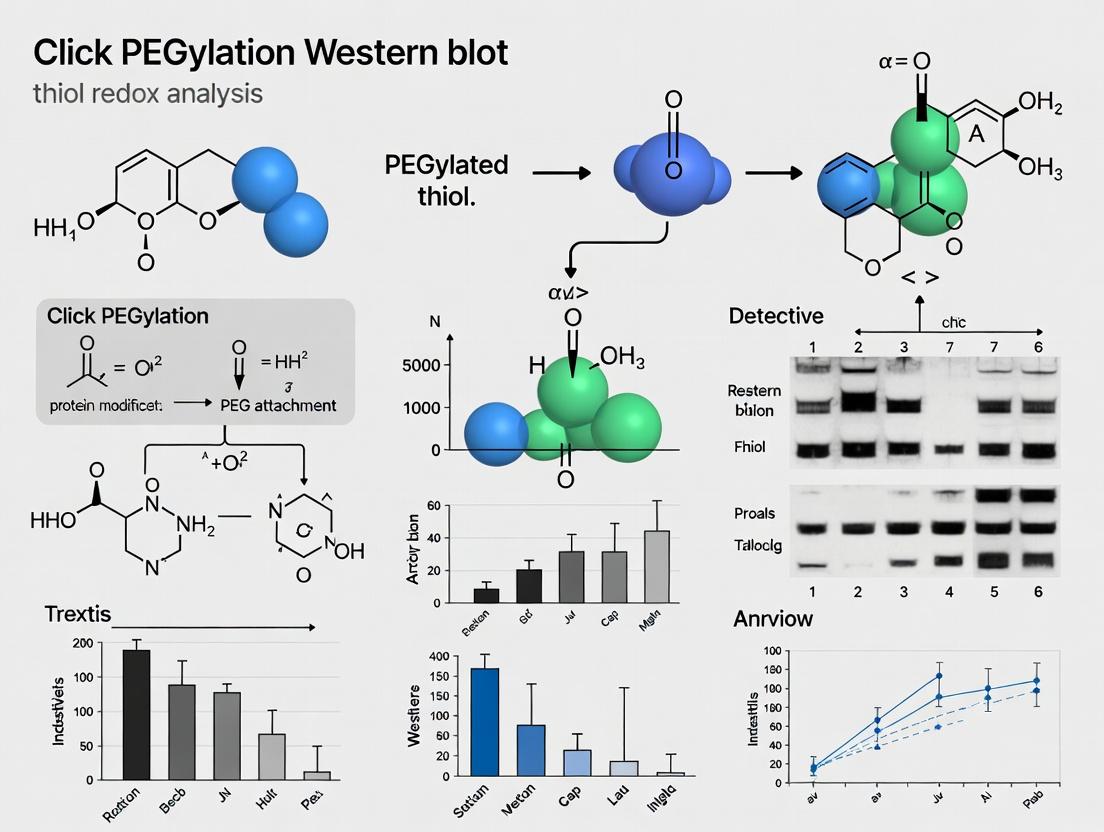
This article provides a detailed, step-by-step guide for researchers and drug development professionals on using Click PEGylation chemistry combined with Western blotting to analyze protein thiol redox states.
Click PEGylation for Western Blot Analysis of Thiol Redox State: A Comprehensive Protocol and Troubleshooting Guide
Abstract
This article provides a detailed, step-by-step guide for researchers and drug development professionals on using Click PEGylation chemistry combined with Western blotting to analyze protein thiol redox states. We cover the foundational principles of thiol modifications and Click chemistry, present a robust methodological workflow, address common troubleshooting issues and optimization strategies, and validate the technique against alternative methods. This protocol enables precise detection of cysteine oxidation status, a critical parameter in redox signaling, disease pathology, and therapeutic development.
Understanding Thiol Redox Biology and Click PEGylation: Core Concepts for Accurate Detection
The Critical Role of Cysteine Thiol Redox State in Signaling and Disease
Cysteine thiol redox modifications are central post-translational regulators of protein function, impacting cell signaling, metabolism, and disease pathogenesis. In the context of Click PEGylation Western blot thiol redox research, this field focuses on quantitatively detecting and characterizing specific, reversible cysteine oxidations (e.g., S-glutathionylation, S-nitrosylation, disulfides) within complex biological samples. The integration of "Click" chemistry with polyethyleneglycol (PEG)-based maleimide reagents enables precise, irreversible tagging of reduced thiols, allowing for high-resolution separation and immunoblot analysis of redox states. This approach is critical for validating drug targets in oxidative stress-associated diseases (cancer, neurodegenerative, cardiovascular) and for developing therapies aimed at modulating redox signaling nodes.
Table 1: Common Cysteine Redox Modifications and Their Biochemical Impact
| Redox Modification | Chemical Formula | Typical pKa of Target Cys | Key Regulatory Roles | Associated Disease Models |
|---|---|---|---|---|
| S-glutathionylation | Prot-S-SG | ~4-5 (upon microenvironment shift) | Anti-apoptotic signaling, metabolic regulation | Heart failure, Parkinson's |
| S-nitrosylation | Prot-S-NO | ~8.5 (often requires acid-base catalysis) | Vasodilation, mitochondrial function | Sepsis, Alzheimer's |
| Intra/Intermolecular Disulfide | Prot-S-S-Prot | Varies widely | Enzyme activation, structural stability | Cancer, Diabetes |
| Sulfenic Acid | Prot-SOH | <5 (transient) | H2O2 sensing, signaling relay | Aging, Inflammatory disorders |
Table 2: Performance Comparison of Thiol-Labeling Reagents for Click PEGylation
| Reagent | Mechanism | PEG Size (kDa) | Cell Permeability | Key Advantage | Recommended Application |
|---|---|---|---|---|---|
| Maleimide-PEG₅₋Biotin | Michael addition | 5 | Low (membrane-impermeant) | High specificity at pH 6.5-7.5; biotin for streptavidin detection | Surface protein thiol labeling |
| Iodoacetyl-PEG₁₀-Alkyne | Alkylation | 10 | Moderate | More stable thioether bond; alkyne for CuAAC Click chemistry | Total cellular proteome redox profiling |
| Methyl-PEG₁₂-Maleimide | Michael addition | 12 | Low | Minimal size interference, precise mass shift on blot | High-resolution Western blot shift assays |
Experimental Protocols
Protocol 1: Click PEGylation Western Blot for Detecting Reduced Protein Thiols Objective: To isolate and quantify the reduced (free thiol) pool of a specific protein under different redox conditions.
Materials & Reagents:
- Lysis Buffer: 50 mM HEPES, 150 mM NaCl, 1% Triton X-100, pH 7.4, supplemented with 50 mM N-ethylmaleimide (NEM) and 1x protease inhibitor cocktail.
- Labeling Reagent: Maleimide-PEG₁₀₋Alkyne (10 mM stock in DMSO).
- Click Chemistry Kit (CuSO₄, TBTA ligand, sodium ascorbate, Azide-PEG₃-Biotin).
- Streptavidin-HRP and standard Western blot materials.
Procedure:
- Sample Preparation & Blocking:
- Lyse cells/tissues in pre-chilled NEM-containing lysis buffer. Incubate 30 min on ice. NEM alkylates and blocks all pre-existing free thiols.
- Remove excess NEM via desalting column (e.g., Zeba Spin, 7kDa MWCO) equilibrated with lysis buffer without NEM.
Reduced Thiol Labeling:
- Incubate desalted protein lysate (1 mg/mL) with 500 µM Maleimide-PEG₁₀-Alkyne for 1 hour at room temperature, protected from light. This tags thiols reduced at the time of lysis.
- Terminate reaction with 10 mM β-mercaptoethanol.
Click Chemistry Conjugation:
- Perform Copper-Catalyzed Azide-Alkyne Cycloaddition (CuAAC) following kit instructions. React labeled lysate with Azide-PEG₃-Biotin (50 µM final) using CuSO₄ (1 mM), TBTA (100 µM), and sodium ascorbate (5 mM) for 30 min at RT.
- Precipitate proteins to remove reagents.
Streptavidin Capture & Detection:
- Resuspend protein pellet in SDS-PAGE sample buffer without reducing agent (DTT/TCEP).
- Perform Western blot.
- Transfer to PVDF, block, and probe with Streptavidin-HRP (1:5000) to detect total PEGylated/biotinylated proteins (reduced pool).
- Strip and re-probe with target protein antibody to assess total protein levels.
Protocol 2: Sequential Non-Reducucing/Reducing Diagonal Gel Electrophoresis for Disulfide Mapping Objective: To identify proteins forming intermolecular or intramolecular disulfides.
Procedure:
- Prepare samples in non-reducing Laemmli buffer (no DTT).
- Run 1D SDS-PAGE under non-reducing conditions. Excise entire lane.
- Incubate excised gel strip in Laemmli buffer with 100 mM DTT for 1 hour to reduce disulfides.
- Place reduced strip horizontally on top of a second SDS-PAGE gel and run under reducing conditions.
- Proteins that were linked by disulfides will shift off the diagonal and can be identified by Western blot or mass spectrometry.
The Scientist's Toolkit: Research Reagent Solutions
| Item | Function | Example Product/Catalog # |
|---|---|---|
| Membrane-Impermeant Maleimide (e.g., Maleimide-PEG₅-Biotin) | Selectively labels surface-exposed free thiols without penetrating cells, crucial for receptor studies. | Thermo Fisher, #21900B |
| Cell-Permeant Alkyne Tag (e.g., IAA-Alkyne) | Alkylates free thiols inside live cells for subsequent Click conjugation, enabling dynamic redox imaging. | Cayman Chemical, #16640 |
| Thiol Blocking Reagent (NEM or IAM) | Irreversibly alkylates free thiols to "freeze" the redox state at the moment of lysis. | Sigma, NEM #E3876 |
| Reducing Agent (TCEP) | Strong, non-thiol reducing agent cleaves disulfides; preferred over DTT as it does not contain thiols. | Thermo Fisher, #77720 |
| Azide-Biotin Conjugate | The "Click" partner for alkyne-tagged proteins, enabling streptavidin-based enrichment/detection. | Click Chemistry Tools, #A105P1 |
| Anti-Glutathione Antibody | Specifically detects S-glutathionylated proteins via Western blot without the need for PEGylation. | ViroGen, #101-A-100 |
Visualizations
Title: Thiol Redox Labeling and Detection Workflow
Title: Kinase Activity Regulated by Thiol Redox Switch
Limitations of Traditional Redox Proteomics and the Need for Direct Methods
Within the broader thesis on "Click PEGylation Western blot thiol redox research," this document addresses the critical methodological challenges in quantifying protein S-thiolations, such as S-glutathionylation and S-cysteinylation. Traditional, indirect methods rely on differential labeling of reduced vs. oxidized thiols, which introduces significant artifacts and limits biological relevance. This Application Note advocates for and details direct methods that specifically capture and quantify the modified species, ensuring accurate redox proteomic profiling essential for drug development in oxidative stress-related pathologies.
Limitations of Traditional Indirect Methods
Traditional redox proteomics (e.g., biotin switch techniques, differential alkylation) suffers from systematic errors that compromise data integrity.
Table 1: Quantitative Comparison of Redox Proteomics Method Limitations
| Limitation | Traditional Indirect Methods | Impact on Data | Quantitative Measure of Error |
|---|---|---|---|
| False Positives from Free Thiols | Incomplete blocking leads to mislabeling. | Overestimation of oxidized species. | Up to 30-40% false positive rate reported in complex lysates. |
| Incomplete Reduction of Modifications | Chemical reducers (e.g., DTT, TCEP) may not reduce all S-adducts. | Underestimation of true oxidation levels. | Reduction efficiency varies from 50-95% depending on adduct. |
| Protein Unfolding & Artifacts | Denaturing steps required for reagent access alter native state. | Loss of labile or transient redox modifications. | Can lead to >50% loss of specific modifications (e.g., S-nitrosylation). |
| Low Sensitivity & Dynamic Range | Multiple washing/transfer steps lead to sample loss. | Inability to detect low-abundance redox targets. | Dynamic range often limited to 1-2 orders of magnitude. |
| Throughput & Complexity | Multi-step, manual protocols. | Low reproducibility across labs. | Coefficient of variation often >25% for inter-lab studies. |
The Direct Method: Click PEGylation Western Blot for Direct Thiol Adduct Detection
This protocol bypasses reduction and labeling steps by using a bioorthogonal chemical reporter strategy. Endogenous S-glutathionylation is mimicked and detected via incubation with azide-containing glutathione (GSH-N3), followed by Click chemistry with a PEGylated alkyne reporter. This allows direct, modification-specific detection via anti-PEG Western blot.
Protocol 3.1: DirectIn SituProtein S-Thiolation Labeling
Objective: To incorporate an azide handle into protein S-thiol adducts within live cells. Reagents:
- Cell culture system of interest.
- GSH-N3 (Azide-functionalized Glutathione): Cell-permeable chemical reporter.
- Oxidant (e.g., Diamide, H₂O₂) or Inhibitor: To modulate redox state.
- Control: N-Ethylmaleimide (NEM) to block all free thiols. Procedure:
- Culture cells to 70-80% confluency in appropriate medium.
- Pre-treat cells with 1-10 mM NEM for 15 min (negative control) to alkylate free thiols.
- For experimental groups, replace medium with fresh medium containing 0.5-2 mM GSH-N3.
- Co-treat cells with your chosen redox-modulating agent (e.g., 0.5 mM Diamide for 30 min) to stimulate S-thiolation.
- After treatment, wash cells 3x with ice-cold PBS.
- Lyse cells in RIPA buffer supplemented with 20 mM NEM and protease inhibitors to "freeze" the redox state and block any newly exposed thiols.
- Clarify lysate by centrifugation (16,000 x g, 15 min, 4°C).
- Determine protein concentration. Proceed to Click PEGylation.
Protocol 3.2: Click Chemistry PEGylation
Objective: To conjugate a PEG-alkyne reporter to the incorporated GSH-N3 for detection. Reagents:
- Click Reaction Kit: Contains copper(II) sulfate, reducing agent (e.g., TCEP), and ligand (e.g., TBTA).
- PEG-Alkyne Reporter (e.g., 5kDa PEG-DBCO-Alkyne): High-molecular-weight tag for sensitive Western blot detection.
- Quenching Buffer: EDTA to stop reaction. Procedure:
- Prepare 1 mg of lysate per sample in 100 µL of PBS.
- Prepare fresh Click Reaction Master Mix:
- 10 µM PEG-Alkyne Reporter (final concentration).
- 1 mM CuSO₄ (final concentration).
- 1 mM TBTA ligand (from DMSO stock).
- 1 mM TCEP (freshly prepared).
- Add 100 µL of Master Mix to 100 µL of lysate. Vortex gently.
- Incubate reaction at room temperature for 1 hour with end-over-end mixing, protected from light.
- Quench the reaction by adding EDTA to a final concentration of 10 mM.
- Add 4X Laemmli sample buffer (non-reducing, without β-mercaptoethanol or DTT).
- Heat samples at 50°C for 5 min. DO NOT BOIL, to prevent PEG degradation.
Protocol 3.3: Non-Reducing SDS-PAGE and Anti-PEG Western Blot
Objective: To separate and directly visualize S-thiolated proteins. Procedure:
- Load samples onto a 4-12% Bis-Tris polyacrylamide gradient gel. Use a PEGylated protein ladder if available.
- Run SDS-PAGE under constant voltage (150V) for ~90 min using MOPS or MES buffer.
- Transfer proteins to PVDF membrane using standard wet transfer.
- Block membrane with 5% BSA in TBST for 1 hour.
- Incubate with primary Anti-PEG antibody (mouse or rabbit monoclonal, 1:5000) in blocking buffer overnight at 4°C.
- Wash 3x with TBST, 10 min each.
- Incubate with appropriate HRP-conjugated secondary antibody (1:10000) for 1 hour at RT.
- Wash 3x with TBST, develop with ECL reagent, and image.
- Crucial: Strip and re-probe the blot with standard loading control antibodies (e.g., anti-GAPDH, anti-β-actin) to normalize for total protein.
Diagram 1: Workflow Direct vs Indirect Redox Proteomics
Diagram 2: Click PEGylation Chemistry Mechanism
The Scientist's Toolkit: Key Research Reagent Solutions
Table 2: Essential Materials for Direct Click-PEGylation Redox Proteomics
| Reagent / Material | Function & Role in Experiment | Key Consideration / Tip |
|---|---|---|
| GSH-N₃ (Azide-Glutathione) | Cell-permeable chemical reporter. Mimics endogenous glutathionylation, introduces bioorthogonal azide handle for Click chemistry. | Ensure membrane permeability. Use fresh stocks. Validate concentration to avoid toxicity. |
| PEG-Alkyne (e.g., PEG-DBCO-Alkyne, 5kDa) | High-molecular-weight detection tag. Click reaction partner. Large size enables sensitive, gel-shift detectable anti-PEG Western. | Larger PEG (≥5kDa) improves blot sensitivity. DBCO allows copper-free click but is slower/costlier. |
| Click Chemistry Kit (CuSO₄, TBTA, TCEP) | Catalyzes the cycloaddition between azide (on protein) and alkyne (on PEG). TBTA ligand stabilizes Cu(I), enhancing reaction efficiency. | Critical for reproducibility. Use fresh TCEP. TBTA solubility in aqueous buffer is low; ensure proper DMSO stock mixing. |
| Anti-PEG Primary Antibody | Primary detection antibody for Western blot. Specifically binds the PEG tag conjugated to the protein of interest. | Monoclonal antibodies offer higher specificity. Check for species compatibility (mouse/rabbit). |
| N-Ethylmaleimide (NEM) | Thiol-alkylating agent. Used to "freeze" the redox state during lysis and block free thiols in control samples. | Must be present in lysis buffer. Prepare fresh in ethanol or water. Quench with excess DTT before downstream assays if needed. |
| Non-Reducing Sample Buffer | SDS-PAGE loading buffer WITHOUT β-mercaptoethanol or DTT. Preserves the disulfide bond in the S-thiol adduct during electrophoresis. | Crucial: Heating temperature should not exceed 50-60°C to prevent PEG degradation or adduct loss. |
| Diamide | Thiol-specific oxidant. Used as a positive control treatment to rapidly induce S-thiolation in experimental systems. | Use at low concentrations (0.1-1 mM) for short durations (15-30 min) to avoid excessive cytotoxicity. |
Click chemistry, specifically bioorthogonal conjugation, has revolutionized biomolecular labeling and modification. Within the context of PEGylation, Western blot analysis, and thiol redox research, these rapid, selective, and biocompatible reactions enable precise tagging and tracking of proteins under native conditions. This application note details the principles, protocols, and key reagents for implementing copper-catalyzed azide-alkyne cycloaddition (CuAAC) and strain-promoted azide-alkyne cycloaddition (SPAAC) in protein research.
Principles and Core Reactions
Click chemistry refers to a suite of high-yielding, modular reactions that proceed rapidly under mild, often physiological, conditions. Bioorthogonal reactions are a subset that proceed without interfering with native biological processes. The two most prominent reactions for protein conjugation are:
- CuAAC: Requires a copper(I) catalyst to ligate an azide and a terminal alkyne, forming a stable 1,2,3-triazole linkage.
- SPAAC: Utilizes a strained cyclooctyne (e.g., DBCO, BCN) reacting with an azide without cytotoxic copper, ideal for live-cell applications.
Table 1: Comparison of Primary Bioorthogonal Click Reactions
| Reaction | Reagent Pair | Catalyst | Rate Constant (M⁻¹s⁻¹) | Key Advantage | Primary Limitation |
|---|---|---|---|---|---|
| CuAAC | Azide + Terminal Alkyne | Cu(I) | 10 - 1000 | Fast kinetics; small functional groups | Copper cytotoxicity |
| SPAAC | Azide + Strained Cyclooctyne (e.g., DBCO) | None | 1 - 10 | No catalyst; excellent biocompatibility | Slower kinetics; larger probe size |
| Inverse Demand Diels-Alder | Tetrazine + Trans-Cyclooctene (TCO) | None | 10 - 100,000 | Extremely fast kinetics | Potential side reactions of TCO |
Application in Click PEGylation & Thiol Redox Profiling
In the context of PEGylation and thiol redox research, click chemistry enables site-specific modification of cysteine residues or introduced unnatural amino acids. A standard workflow involves:
- Thiol Labeling: Blocking or tagging reduced cysteine thiols with an azide-containing reagent (e.g., IAA-azide).
- Click Conjugation: Reacting the azide-tagged protein with a DBCO-PEG or Alkyne-PEG reagent.
- Analysis: Using click-compatible Western blot detection (e.g., streptavidin-HRP after biotin-alkyne click) to assess PEGylation efficiency or redox state via gel shift.
Experimental Protocols
Protocol 1: CuAAC forIn VitroProtein Labeling (Gel Shift Assay)
Objective: To conjugate an alkyne-functionalized PEG (Alkyne-PEG5k) to an azide-modified protein for analysis by SDS-PAGE.
Materials:
- Azide-modified protein (≥ 0.2 mg/mL)
- Alkyne-PEG5k
- CuAAC Reaction Buffer: 50 mM HEPES, pH 7.4, 150 mM NaCl
- Catalyst Solution: 2 mM CuSO₄, 10 mM THPTA ligand (mixed fresh)
- Reducing Agent: Sodium ascorbate (100 mM stock, fresh)
- SDS-PAGE loading buffer
Procedure:
- In a 1.5 mL tube, combine:
- 10 µL Azide-protein (2 µg)
- 5 µL Alkyne-PEG5k (10 mM stock in DMSO)
- 30 µL CuAAC Reaction Buffer
- Add 5 µL of the premixed CuSO₄/THPTA catalyst solution.
- Initiate the reaction by adding 5 µL sodium ascorbate stock (final conc. ~10 mM).
- Incubate at room temperature for 60 minutes with gentle shaking.
- Quench the reaction by adding 10 µL of 10x SDS-PAGE loading buffer and heating at 95°C for 5 min.
- Analyze by SDS-PAGE (4-20% gradient gel) and Coomassie staining. A successful conjugation yields a clear upward gel shift.
Protocol 2: SPAAC-Based PEGylation for Thiol Redox Western Blot
Objective: To profile protein S-palmitoylation or reversible cysteine oxidation using DBCO-PEG and click-Western blot.
Materials:
- Cell lysate in PBS with 50 mM N-ethylmaleimide (NEM) to block free thiols
- Hydroxylamine (HA) solution, pH 7.4 (for palmitoylation-specific depalmitoylation)
- DBCO-PEG3.4k-Biotin (or DBCO-PEG5k)
- Streptavidin-HRP conjugate
- Western blot reagents (membranes, blockers, developers)
Procedure:
- Thiol Reduction/Unmasking: Treat two aliquots of lysate (50 µg each) with or without HA (0.5 M final) for 1 hour at 37°C to cleave thioester linkages (e.g., palmitoyl groups).
- Click Labeling: Add DBCO-PEG3.4k-Biotin to both samples (100 µM final). Incubate at 4°C for 2 hours or overnight.
- SDS-PAGE and Transfer: Run samples on a non-reducing SDS-PAGE gel and transfer to PVDF membrane.
- Detection: Block membrane with 5% BSA in TBST. Incubate with Streptavidin-HRP (1:10,000 dilution) for 1 hour. Develop with ECL reagent.
- Analysis: Signals in the "+HA" lane indicate proteins that were originally S-acylated. Re-probe the blot with target protein antibodies for normalization.
The Scientist's Toolkit
Table 2: Essential Reagents for Click Chemistry in Bioorthogonal Conjugation
| Reagent | Function & Description | Example Product/Catalog # |
|---|---|---|
| Azido-modified Reagents | Introduces the azide handle for click reaction. Bioorthogonal and small. | Azidoacetic Acid (N3-CH2-COOH), Iodoacetamide-Azide (IAA-N3) |
| Alkyne-PEG | Polyethylene glycol reagent with terminal alkyne for CuAAC-mediated PEGylation. | mPEG-Alkyne (MW 5k) |
| DBCO-PEG | Strain-promoted cyclooctyne-PEG conjugate for copper-free, bioorthogonal PEGylation. | DBCO-PEG4-NHS Ester |
| BCN Reagents | Alternative strained alkyne (bicyclononyne) with fast SPAAC kinetics. | BCN-Sulfo-NHS Ester |
| Cu(I) Stabilizing Ligands | Reduces Cu(I) cytotoxicity and prevents protein oxidation/cross-linking in CuAAC. | TBTA, THPTA, BTTAA |
| Tetrazine Dyes | Extremely fast inverse-demand Diels-Alder partner for TCO-labeled biomolecules. | Cy3-Tetrazine |
| Biotin-Alkyne/DBCO | Enables sensitive detection of click conjugates via streptavidin blot or pull-down. | DBCO-PEG4-Biotin |
| Cell-Permeable Click Probes | Allows intracellular labeling in live cells (e.g., for glycan imaging). | Ac4ManNAz (Metabolic glycans) |
Diagrams
Title: Click-Based Thiol Redox Profiling Workflow
Title: Hierarchy of Bioorthogonal Reactions
Title: CuAAC Reaction Schematic
Within the broader thesis on Click PEGylation Western blot thiol redox research, this document details the mechanism and application of selective thiol tagging using PEG reagents. Click PEGylation refers to the use of bioorthogonal "click" chemistry to conjugate polyethylene glycol (PEG) polymers specifically to cysteine thiol (-SH) groups on proteins or peptides. This selective modification is a powerful tool for probing thiol redox states, protein function, and for creating therapeutic bioconjugates with improved pharmacokinetics. The core mechanism relies on the high nucleophilicity of the thiolate anion, which reacts selectively with specific electrophilic groups on functionalized PEG chains under controlled conditions.
Mechanism of Selective Thiol Tagging
The selectivity for cysteine residues is achieved through the choice of PEG reagent chemistry. The most common reactions include:
- Maleimide Chemistry: Maleimide-functionalized PEG reagents undergo Michael addition with thiols at physiological pH (6.5-7.5), forming a stable thioether bond. This reaction is highly selective for thiols over other nucleophilic amino acids like lysine.
- Vinyl Sulfone Chemistry: Similar to maleimide, PEG-vinyl sulfones react with thiols via Michael addition. They offer greater stability against retro-Michael reactions at neutral to basic pH compared to some maleimide adducts.
- Haloacetyl Chemistry: PEG reagents featuring iodoacetyl or bromoacetyl groups alkylate thiols, forming a thioether bond. Iodoacetamide is particularly reactive and specific under alkaline conditions (pH ~8.0).
- Disulfide Exchange: PEG-pyridyl disulfide reagents undergo rapid disulfide exchange with free thiols, forming a new disulfide-linked conjugate. This bond is reversible under reducing conditions, useful for certain probes.
The "Click" aspect often involves a second step where a tagged molecule is further conjugated via reactions like strain-promoted alkyne-azide cycloaddition (SPAAC) or inverse electron demand Diels-Alder (iEDDA), but the initial thiol tagging is the critical first step for selectivity.
Application Notes
Primary Applications in Thiol Redox Research
- Quantification of Free Thiols: Tagging free cysteine residues in proteins with a mass-tag PEG (e.g., 5 kDa PEG-maleimide) causes a discernible band shift in SDS-PAGE/Western blot, allowing visualization and semi-quantification of reduced (PEG-tagged) vs. oxidized (untagged) protein populations.
- Mapping Surface-Accessible Cysteines: Differentiates buried vs. solvent-exposed thiols, informing on protein folding and structure.
- Inhibiting Disulfide Bond Formation: Blocking free thiols with PEG prevents unwanted intermolecular aggregation during protein purification.
- Probing Conformational Changes: Changes in thiol accessibility upon ligand binding or stress can be monitored via PEGylation efficiency.
Key Advantages
- High Specificity: Minimal off-target labeling of amines (e.g., lysine) under optimized conditions.
- Modularity: PEG reagents available with various functional handles (fluorescent dyes, biotin, azides, DBCO) for downstream detection or enrichment.
- Mass Tagging: The significant mass addition of PEG provides a clear analytical handle for gel-based assays.
Table 1: Common PEG Reagents for Selective Thiol Tagging
| Reagent Chemistry | Typical Reaction pH | Reaction Time | Bond Formed | Key Advantage | Potential Limitation |
|---|---|---|---|---|---|
| Maleimide-PEG | 6.5 - 7.5 | 2 min - 2 hrs | Thioether | Extremely fast, high specificity | Susceptible to hydrolysis; can undergo retro reaction |
| Vinyl Sulfone-PEG | 7.5 - 8.5 | 30 min - 4 hrs | Thioether | More stable adduct than maleimide | Slower reaction rate |
| Iodoacetyl-PEG | 7.5 - 8.5 (avoid pH >9) | 1 hr - O/N | Thioether | Highly specific, stable adduct | Light-sensitive; can label other nucleophiles at high pH |
| Pyridyl Disulfide-PEG | 4.0 - 8.0 | 1 min - 1 hr | Disulfide | Rapid, reversible bond | Conjugate is cleaved by reducing agents (DTT, TCEP) |
Table 2: Impact of PEGylation on Protein Properties (Example Data)
| Protein | PEG Size (kDa) | Conjugation Site | Δ in Hydrodynamic Radius (%) | Δ in Serum Half-life (vs. native) | Retained Activity (%) |
|---|---|---|---|---|---|
| Lysozyme | 5 | Single Cys | ~35% increase | 4x longer | 85-95% |
| Interferon-α | 20 | Single Cys | ~80% increase | 20x longer | 45-55% |
| Fab Fragment | 40 | Engineered Cys | ~120% increase | 30x longer | >90% |
Experimental Protocols
Protocol 1: Labeling Free Protein Thiols for Redox Western Blot Analysis
Objective: To selectively tag reduced cysteine residues in a protein sample with maleimide-PEG for detection via band shift in SDS-PAGE/Western blot.
Materials:
- Protein sample in non-reducing, thiol-free buffer (e.g., 50 mM Tris, 150 mM NaCl, pH 7.2).
- 20 kDa Maleimide-PEG (Mal-PEG): Acts as the mass tag for free thiols.
- Positive Control: Reduced protein (pre-treated with 5 mM DTT, then desalted).
- Negative Control: Oxidized protein (pre-treated with 1 mM diamide or fully alkylated).
- N-Ethylmaleimide (NEM): Alkylating agent for quenching.
- Zeba Spin Desalting Columns (7K MWCO).
- Non-reducing SDS-PAGE sample buffer.
- 4-20% Tris-Glycine gel.
Method:
- Sample Preparation: Prepare three 50 µL aliquots of your protein (e.g., 1 mg/mL): Test, Reduced Control, Oxidized Control. Treat the Reduced Control with 5 mM DTT for 30 min at room temp (RT). Treat the Oxidized Control with 1 mM diamide for 15 min at RT.
- Desalting: Pass all three samples through separate desalting columns pre-equilibrated with reaction buffer (pH 7.2) to remove small molecules (DTT/diamide).
- PEGylation Reaction: To each sample, add a 10-fold molar excess of 20 kDa Mal-PEG from a fresh stock solution. Incubate at RT for 1 hour in the dark.
- Quenching: Stop the reaction by adding a 20-fold molar excess of NEM (over Mal-PEG) and incubate for 10 min.
- Analysis: Immediately mix an aliquot with non-reducing SDS-PAGE sample buffer (do not boil if analyzing oligomeric structures). Load samples onto a 4-20% gel. Run electrophoresis and perform Western blotting.
- Interpretation: A band shift corresponding to the addition of 20 kDa indicates the presence of free, reduced thiols in the sample. The Reduced Control should be fully shifted, the Oxidized Control unshifted, and the Test sample partially shifted depending on its redox state.
Protocol 2: Determining Labeling Efficiency & Stoichiometry
Objective: To quantify the number of PEG chains conjugated per protein molecule.
Materials:
- PEGylated protein from Protocol 1.
- Size-Exclusion High-Performance Liquid Chromatography (SEC-HPLC) system with UV/RI detectors.
- Trinitrobenzenesulfonic acid (TNBSA) assay kit (for lysine quantification if using thiol-specific chemistry).
- Ellman's Reagent (DTNB) for quantifying remaining free thiols.
Method (SEC-HPLC):
- Inject purified PEGylated protein onto an analytical SEC column (e.g., TSKgel G3000SW).
- Compare the chromatogram to the native protein. The PEGylated protein will elute earlier due to its increased hydrodynamic radius.
- Deconvolute peaks corresponding to unmodified, mono-PEGylated, and di-PEGylated species. The ratio of peak areas (UV detection) provides the distribution and average degree of labeling.
Method (DTNB Assay for Free Thiols):
- Treat a known concentration of PEGylated protein with excess DTNB in assay buffer (e.g., 0.1 M phosphate, pH 8.0).
- Measure absorbance at 412 nm after 15 min.
- Compare to a standard curve generated with L-cysteine. The decrease in free thiols relative to a reduced/denatured native protein sample indicates the number of thiols modified.
Visualizations
Title: Mechanism of Thiol PEGylation via Maleimide
Title: Workflow for Thiol Redox PEGylation Assay
The Scientist's Toolkit: Key Research Reagent Solutions
Table 3: Essential Reagents for Click Thiol PEGylation Experiments
| Reagent/Material | Function & Role in Experiment | Key Consideration |
|---|---|---|
| Maleimide-PEG (various MW) | The primary tagging reagent. Selective covalent modification of free thiols. | Choose MW (5-40 kDa) based on desired band shift. Ensure fresh stock in anhydrous DMSO or buffer. |
| Tris(2-carboxyethyl)phosphine (TCEP) | Reducing agent to reduce disulfide bonds for "total thiol" measurement. More stable than DTT at acidic pH. | Does not contain thiols, so doesn't interfere with maleimide. Must be desalted post-reduction. |
| N-Ethylmaleimide (NEM) | Small thiol-alkylating agent. Used to quench PEGylation reactions or to block free thiols in control experiments. | Highly membrane-permeable. Use fresh solution and quench promptly. |
| Diamide | Thiol-oxidizing agent. Used to artificially oxidize protein thiols for negative controls. | Concentration and time must be optimized to avoid over-oxidation. |
| Zeba Spin Desalting Columns | Rapid buffer exchange to remove reducing agents, salts, or excess small molecules prior to PEGylation. Critical step. | Select column size and MWCO appropriate for your protein. Pre-equilibrate with reaction buffer. |
| Non-Reducing SDS-PAGE Buffer | Sample buffer without β-mercaptoethanol or DTT. Preserves the PEG-thiol bond during electrophoresis. | Do not boil samples if analyzing non-covalent complexes, as heat + SDS may denature. |
| Iodoacetamide (IAA) | Alternative alkylating agent. Can be used for blocking or in differential labeling protocols (e.g., ICAT). | Light-sensitive. Reacts best at pH ~8.0 in the dark. |
| PEG-Vinyl Sulfone | Alternative to maleimide. Forms a more hydrolysismichael addition adduct. Useful for long-term stability studies. | Reaction is optimal at slightly higher pH (7.5-8.5). |
Why Western Blotting? Advantages of Combining Click PEGylation with Immunoblotting.
The combination of click chemistry-based PEGylation (Click PEGylation) with Western blotting provides a powerful, sensitive, and specific platform for analyzing protein thiol redox states. This application note details the rationale, protocols, and key advantages of this integrated approach within thiol redox research and drug development. By enabling the direct, covalent labeling of redox-sensitive cysteine residues with PEG reagents via bioorthogonal reactions, researchers can obtain quantitative, high-resolution data on protein oxidation status, disulfide bond formation, and S-nitrosylation, complementing traditional immunodetection.
Western blotting remains the gold standard for protein-specific detection, quantification, and characterization. Its integration with Click PEGylation—wherein polyethylene glycol (PEG) chains modified with click-compatible handles (e.g., azide or alkyne) are selectively attached to reduced protein thiols—creates a shift in molecular weight detectable by immunoblotting. This shift is a direct readout of the redox state of specific cysteines. Within a thesis on thiol redox, this method is critical for functional proteomics, moving beyond mere protein abundance to assess its functional, redox-modified state.
Key Advantages of the Combined Approach
- High Specificity: Click chemistry (e.g., CuAAC or SPAAC) provides bioorthogonal, efficient labeling of target thiols, minimizing non-specific background.
- Direct Functional Readout: Shifts in gel mobility directly correlate with the number of labeled (i.e., reduced) cysteines per protein molecule.
- Multiplexing Potential: Sequential probing with antibodies allows detection of total protein and its redox state from the same blot.
- Compatibility: Seamlessly integrates into standard SDS-PAGE and Western blot workflows.
- Quantitative Data: Enables calculation of the fraction of reduced vs. oxidized protein populations.
Application Notes: Quantitative Insights
The method yields critical quantitative data on thiol redox states. The table below summarizes typical data outputs and their interpretation.
Table 1: Quantitative Data Outputs from Click PEGylation Western Blotting
| Data Parameter | Description | Typical Measurement | Interpretation |
|---|---|---|---|
| Molecular Weight Shift (ΔMW) | Difference between PEGylated and non-PEGylated protein bands. | ~5-10 kDa per PEG moiety (e.g., PEG-5kDa). | Indicates the number of accessible/reduced cysteine residues labeled. |
| Redox Fraction (%) | (Intensity of shifted band) / (Total protein intensity) x 100. | 0-100%. | Proportion of protein molecules in a reduced (labelable) state under experimental conditions. |
| EC50 for Oxidants/Reductants | Concentration of agent required to achieve 50% change in Redox Fraction. | e.g., H2O2 EC50 = 50 µM. | Quantifies protein susceptibility to redox modification. |
| Labeling Efficiency | Ratio of observed shift to theoretical maximum shift. | Often >80% with optimized protocols. | Validates the efficiency of the click PEGylation reaction. |
Detailed Experimental Protocol
Protocol 1: Sample Preparation and Thiol Blocking
Objective: To freeze the native redox state and block free thiols.
- Lysis: Lyse cells/tissue in ice-cold lysis buffer (e.g., 50 mM Tris-HCl, pH 7.4, 150 mM NaCl, 1% NP-40) supplemented with 50 mM N-ethylmaleimide (NEM) and protease inhibitors. NEM alkylates and blocks all free thiols present at the moment of lysis.
- Clarification: Centrifuge at 16,000 x g for 15 min at 4°C. Collect supernatant.
- Desalting: Pass lysate through a desalting column (e.g., Zeba Spin Column, 7K MWCO) equilibrated with NEM-free lysis buffer to remove excess NEM and small molecules. Protein concentration should be determined (e.g., via BCA assay).
Protocol 2: Reduction of Target Disulfides and Click PEGylation
Objective: To selectively reduce specific oxidized cysteine pools (e.g., disulfides) and label them.
- Selective Reduction: Treat 50 µg of desalted protein with a selective reducing agent.
- For general disulfide reduction: Use 1-10 mM Tris(2-carboxyethyl)phosphine (TCEP), pH 7.0, for 30 min at room temperature (RT).
- For S-nitrosothiols (SNOs): Use 0.1-1 mM Ascorbate + 0.05 mM CuCl (for Cu+-mediated reduction) or low-dose UV photolysis.
- Click PEGylation: Immediately add clickable PEG reagent (e.g., PEG5kDa-azide or -DBCO) to a final concentration of 1-2 mM. For CuAAC, add: 1 mM CuSO4, 2 mM ligand (e.g., TBTA), and 2 mM sodium ascorbate (fresh). Incubate for 1-2 hours at RT with gentle mixing.
- Reaction Quench: Add 10 mM EDTA to chelate copper and stop the reaction.
Protocol 3: Western Blot Analysis
Objective: To separate and detect PEGylated vs. non-PEGylated species.
- SDS-PAGE: Load quenched samples onto a pre-cast gradient (4-20%) or appropriate % polyacrylamide gel. A high-percentage gel may better resolve large MW shifts.
- Electroblotting: Transfer proteins to a PVDF membrane using standard wet or semi-dry transfer protocols.
- Immunodetection:
- Block: Block membrane with 5% non-fat milk in TBST for 1 hour.
- Primary Antibody: Incubate with target protein-specific antibody (e.g., anti-Actin, 1:5000) in blocking buffer overnight at 4°C.
- Wash & Secondary: Wash 3x with TBST, incubate with HRP-conjugated secondary antibody (1:10000) for 1 hour at RT.
- Develop: Use enhanced chemiluminescence (ECL) substrate and image with a digital chemiluminescence imager.
- Densitometry: Use software (ImageJ, Image Lab) to quantify band intensities for both shifted (PEGylated/reduced) and unshifted (oxidized) populations. Calculate the Redox Fraction (see Table 1).
The Scientist's Toolkit: Essential Reagents & Materials
Table 2: Key Research Reagent Solutions
| Item | Function & Rationale |
|---|---|
| N-Ethylmaleimide (NEM) | Irreversible thiol-alkylating agent. Used during lysis to "freeze" the native redox state by blocking all free thiols. |
| Clickable PEG Reagent (e.g., mPEG-azide, 5 kDa) | The labeling moiety. Provides a large, detectable mass shift upon conjugation to target thiols via click chemistry. |
| Tris(2-carboxyethyl)phosphine (TCEP) | A strong, thiol-specific, and air-stable reducing agent. Selectively reduces disulfide bonds to free thiols for subsequent labeling. |
| CuSO4 / TBTA / Sodium Ascorbate | Catalyst system for Copper(I)-Catalyzed Azide-Alkyne Cycloaddition (CuAAC). TBTA ligand stabilizes Cu(I), enhancing reaction efficiency and reducing copper-induced protein damage. |
| Desalting Spin Columns (7K MWCO) | Critical for removing excess small-molecule reagents (NEM, DTT, etc.) between steps to prevent interference with downstream reactions. |
| Anti-Target Protein Antibody | Provides the specificity of the Western blot, allowing detection of the protein of interest among the complex lysate. |
| HRP-Conjugated Secondary Antibody & ECL Substrate | Enables sensitive chemiluminescent detection of the primary antibody, visualizing both PEGylated and non-PEGylated bands. |
Visualizing Workflows and Pathways
Diagram 1: Click PEGylation Western Blot Workflow
Diagram 2: Thiol State Detection Logic
Step-by-Step Protocol: From Sample Preparation to Click PEGylation Western Blot
Within the broader research thesis on "Click PEGylation Western blot thiol redox research," precise reagent selection is paramount. This work investigates the redox state of protein thiols, where maleimide chemistry selectively labels reduced cysteine residues. Subsequent PEGylation via click chemistry (CuAAC or copper-free) allows for a mass shift detectable by western blot, enabling the quantification of reduced vs. oxidized protein pools. The choice of the bifunctional linker (Maleimide-PEG-Alkyne/Azide) and the corresponding click detection kit directly impacts labeling efficiency, sensitivity, and experimental success.
Research Reagent Solutions Toolkit
The following table details essential materials for Click PEGylation thiol redox experiments.
| Item | Function in Experiment |
|---|---|
| Maleimide-PEGₙ-Alkyne | Bifunctional linker. Maleimide covalently bonds to reduced protein cysteine (-SH). PEG spacer reduces steric hindrance. Alkyne enables CuAAC click reaction with an azide detection tag. |
| Maleimide-PEGₙ-Azide | Alternative bifunctional linker. Maleimide targets reduced thiols. Azide enables copper-free click chemistry with a dibenzocyclooctyne (DBCO) detection tag or CuAAC with an alkyne tag. |
| CuAAC Click Detection Kit | Typically contains a fluorescent or biotin-azide tag, CuSO₄, a copper reductant (e.g., sodium ascorbate), and a stabilizing ligand (e.g., TBTA, BTTAA). Enables efficient conjugation to the alkyne group. |
| Copper-Free Click Kit | Contains a DBCO-labeled detection tag (fluorophore or biotin). Reacts with azide groups via strain-promoted azide-alkyne cycloaddition (SPAAC), eliminating copper-induced protein damage/background. |
| Blocking Agent (e.g., Cysteine, NEM) | Cysteine quenches unreacted maleimide. N-ethylmaleimide (NEM) blocks free thiols in control experiments. |
| Non-Reducing Sample Buffer | Preserves the native redox state of cysteine residues during protein sample preparation for SDS-PAGE. |
| Streptavidin-HRP / Fluorescent Antibody | Detection reagent for biotin-clicked or directly fluorescently tagged proteins via western blot or in-gel fluorescence. |
Quantitative Comparison of Linker & Kit Options
Table 1: Comparison of Maleimide-PEG Linker Attributes
| Attribute | Maleimide-PEGₙ-Alkyne | Maleimide-PEGₙ-Azide |
|---|---|---|
| Click Chemistry Type | Copper-Catalyzed (CuAAC) | Copper-Free (SPAAC) or CuAAC (if tag is alkyne) |
| Typical PEG Length (n) | 2000 Da (≈ 45 units), 5000 Da | 2000 Da, 5000 Da |
| Key Advantage | Standard, high reaction rate (CuAAC). Wider variety of commercial azide detection tags. | Copper-free option avoids metal-induced protein damage/background. Faster for in vivo applications. |
| Key Limitation | Copper can cause protein degradation/aggregation. Requires optimization of Cu⁺ stabilization. | DBCO tags (for SPAAC) are larger, more expensive, and may react slower than CuAAC. |
| Optimal For | In vitro assays, fixed cells, high-sensitivity detection where copper can be carefully controlled. | Sensitive proteins, live-cell studies, or when simplifying protocols by removing copper steps. |
Table 2: Comparison of Click Chemistry Detection Kits (Representative Examples)
| Kit Type | Example Components | Typical Incubation | Pros | Cons |
|---|---|---|---|---|
| CuAAC Kit | Biotin-PEG₃-Azide, CuSO₄, BTTAA ligand, Sodium Ascorbate | 1 hr, RT | Highest kinetic rate, maximized signal, cost-effective. | Copper may quench fluorescence or cause degradation. Requires optimization. |
| Copper-Free Kit | Biotin-DBCO or TAMRA-DBCO | 2 hrs, RT or 4°C | Simple one-component add; biocompatible; no metal artifacts. | Slower reaction kinetics; DBCO reagents are less stable long-term. |
| Fluorescent Azide Kit (CuAAC) | AF488-/Cy5-Azide, CuSO₄, reducing agent, ligand | 1 hr, RT, in dark | Direct, antibody-free detection. Multiplexing possible. | Subject to copper-related issues; direct labeling may be less sensitive than biotin amplification. |
Detailed Experimental Protocols
Protocol A: Protein Thiol Labeling and Click PEGylation for Western Blot
Objective: To label reduced cysteine residues on a protein of interest with Maleimide-PEG-Alkyne, conjugate a biotin tag via CuAAC, and detect the mass shift via streptavidin-HRP western blot.
I. Thiol Labeling with Maleimide-PEG-Alkyne
- Prepare Protein Sample: Incubate your purified protein or cell lysate (in PBS, pH 7.0-7.4, without reducing agents like DTT/β-Me) with 10-100 µM Maleimide-PEG₂₀₀₀-Alkyne for 30 minutes at room temperature or 4°C for 1 hour.
- Quench Reaction: Add a 10x molar excess of L-cysteine (vs. maleimide) and incubate for 15 minutes to quench unreacted maleimide.
- Cleanup: Desalt the protein using a Zeba spin desalting column (7K MWCO) into PBS or a copper-compatible buffer (e.g., with chelators removed) to remove excess linker and cysteine.
II. Copper-Catalyzed Azide-Alkyne Cycloaddition (CuAAC)
- Reaction Setup: To the labeled protein, add the following components from a CuAAC kit in order:
- Biotin-PEG₃-Azide (final conc. 50 µM).
- Ligand (e.g., BTTAA, final conc. 100 µM).
- CuSO₄ (final conc. 1 mM).
- Freshly prepared sodium ascorbate (final conc. 5 mM) to reduce Cu²⁺ to Cu⁺.
- Incubation: Mix gently and incubate for 60 minutes at room temperature with mild agitation.
- Termination & Cleanup: Add EDTA (final conc. 10 mM) to chelate copper ions. Desalt again or precipitate the protein before SDS-PAGE.
III. Detection via Western Blot
- SDS-PAGE: Run the clicked protein sample under non-reducing conditions to preserve the PEG-biotin modification.
- Transfer & Blocking: Transfer to PVDF membrane. Block with 5% BSA in TBST for 1 hour.
- Probe: Incubate with Streptavidin-HRP (1:10,000 in blocking buffer) for 1 hour.
- Wash & Develop: Wash 3x with TBST, then apply chemiluminescent substrate and image. The PEGylated protein will appear at a higher molecular weight (~+2-5 kDa shift).
Protocol B: Control Experiment for Redox Specificity
Objective: To confirm that labeling is specific to reduced thiols.
- Oxidized Control: Treat a duplicate protein sample with 10 mM hydrogen peroxide (H₂O₂) or diamide for 30 minutes prior to Step I. This oxidizes cysteines, preventing maleimide binding.
- Blocked Control: Pre-treat another sample with 10 mM N-ethylmaleimide (NEM) for 30 minutes before adding Maleimide-PEG-Alkyne. NEM alkylates all free thiols, blocking subsequent labeling.
- Proceed: Process all samples (test, oxidized control, blocked control) in parallel through Protocol A. Specific labeling will be absent or greatly diminished in the control lanes.
Diagrams
Diagram 1: Thiol Redox Click PEGylation Workflow
Diagram 2: CuAAC vs Copper-Free Click Chemistry
In the broader thesis investigating thiol redox dynamics via Click PEGylation Western blot, the initial lysis step is the most critical determinant of experimental validity. The labile nature of cysteine oxidation states (e.g., S-glutathionylation, S-nitrosylation, disulfide bonds) means that improper sample preparation irreversibly alters the native redox proteome. This application note details the protocols and considerations essential for preserving these states for downstream click chemistry conjugation and immunoblot analysis.
Key Challenges & Quantitative Impact
Artifactual oxidation or reduction during lysis can be introduced via multiple vectors. The following table summarizes the quantitative impact of common lysis variables on redox state preservation, based on current literature.
Table 1: Impact of Lysis Variables on Redox Artifact Generation
| Variable | Condition Tested | Measured Outcome (Artifact Increase) | Key Finding |
|---|---|---|---|
| Buffer pH | pH 6.5 vs. pH 8.0 | Sulfenic acid (SOH) formation | ~40% lower SOH at pH 6.5 vs pH 8.0 in model proteins |
| Chelating Agents | 1 mM EDTA vs. None | Metal-catalyzed oxidation (Carbonyls) | 70% reduction in protein carbonyl formation |
| Alkylating Agent | 50 mM IAM, added at t=0 vs. t=5 min post-lysis | Global S-glutathionylation loss | >50% loss of native modification with 5-minute delay |
| Temperature | Ice-cold (4°C) vs. Room Temp (25°C) | Protein disulfide scrambling | 3-fold increase in scrambled disulfides at 25°C |
| Physical Lysis | Dounce vs. Sonication (15s pulse) | Sample heating & artifactual S-nitrosothiol decay | ΔT +12°C with sonication; correlates with 35% RSNO loss |
| Detergent | 1% CHAPS vs. 1% SDS | Thiol accessibility & alkylation efficiency | Alkylation efficiency drops to <60% with SDS vs. >95% with CHAPS |
Detailed Protocols
Protocol A: Recommended Lysis for Cytosolic/Membrane Redox Proteomics
Objective: To rapidly quench cellular activity and alkylate free thiols while maintaining native oxidized states.
- Pre-chill Equipment & Reagents: Keep all buffers, tubes, and centrifuges at 0-4°C.
- Prepare Lysis Buffer (Argon-sparged, ice-cold):
- 50 mM HEPES, pH 6.5-7.0 (minimizes thiolate anion formation)
- 150 mM NaCl
- 1 mM EDTA (chelates redox-active metals)
- 0.1% CHAPS or 1% Triton X-100 (mild, non-thiol-containing detergent)
- Immediately before use, add:
- 50 mM N-Ethylmaleimide (NEM) or 50 mM Iodoacetamide (IAM) (alkylating agent)
- 1x Protease/Phosphatase Inhibitor Cocktail (EDTA-free if using metal-dependent enzymes)
- 10 μM Catalase, 100 μM Sodium Pyruvate (scavenges H₂O₂)
- Rapid Cell Lysis:
- For adherent cells: Decant media, rinse swiftly with cold PBS (+100 μM diethylenetriaminepentaacetic acid - DTPA), and immediately add lysis buffer (500 μL per 10⁷ cells).
- Scrape cells on ice and transfer lysate to a pre-chilled microtube.
- Vortex 10 seconds, then incubate on ice for 15-30 minutes with gentle inversion every 5 minutes.
- Clarification: Centrifuge at 16,000 x g for 15 minutes at 4°C. Transfer supernatant (cleared lysate) to a new pre-chilled tube.
- Immediate Processing: Proceed directly to protein concentration determination and Click PEGylation. Do not freeze-thaw lysates before alkylation/click reaction.
Protocol B: Lysis for Specific Labile Modifications (e.g., S-Nitrosylation)
Modification to Protocol A:
- Alkylating Agent: Replace NEM/IAM with 0.2-1.0 mM Methyl methanethiosulfonate (MMTS) for 5 minutes on ice. This reversibly blocks free thiols.
- Add Specific Quenchers: Include 1-10 mM N-Ethylmaleimide (NEM) after MMTS blocking and S-nitrosothiol detection/reduction to trap newly reduced thiols.
- Use HEN Buffer Base: For dedicated S-nitrosylation studies, use HEPES (25-100 mM, pH 7.7), EDTA (1 mM), Neocuproine (0.1 mM) as buffer base. Neocuproine is a specific Cu(I) chelator that prevents copper-mediated decomposition of S-nitrosothiols.
Visualization: Experimental Workflow
Title: Workflow for Redox Proteomics Sample Preparation
The Scientist's Toolkit: Essential Research Reagent Solutions
Table 2: Key Reagents for Redox-Preserving Lysis
| Reagent | Function & Critical Property | Example Product/Catalog Consideration |
|---|---|---|
| Alkylating Agents | Irreversibly block free thiols to prevent disulfide scrambling. Must be added instantly. | N-Ethylmaleimide (NEM), Iodoacetamide (IAM). Ensure high purity, prepare fresh in ethanol/DMSO. |
| Metal Chelators | Inhibit Fenton chemistry and metal-catalyzed oxidation. | EDTA (general), DTPA (stronger), Neocuproine (Cu⁺ specific for SNO studies). Use EDTA-free inhibitor cocktails if needed. |
| Thiol-Free Detergents | Solubilize membranes without contributing redox-active thiols or reacting with alkylators. | CHAPS, Triton X-100, Digitonin. Avoid β-mercaptoethanol, DTT, or thiol-containing detergents. |
| Radical Scavengers | Quench reactive oxygen species generated during homogenization. | Catalase (H₂O₂), Sodium Pyruvate (H₂O₂), Deferoxamine (·OH). |
| Acidifying Buffers | Maintain sub-neutral pH to suppress thiol deprotonation (-S⁻ formation), reducing spontaneous oxidation. | HEPES, MES, pH 6.5-7.0. Avoid Tris at high pH (>8.0) during lysis. |
| Reversible Blockers | Temporarily protect free thiols for sequential analysis of specific modifications (e.g., SNO). | Methyl methanethiosulfonate (MMTS). Allows subsequent reduction and trapping of specific pools. |
| Click Chemistry Reagents | For downstream detection: Polyethylene glycol (PEG) maleimide or alkyne/azide tags for bioorthogonal labeling of preserved oxidized thiols. | PEG-maleimide (e.g., 5kDa), Azido-biotin, DBCO-PEG4-aldehyde for click PEGylation Western. |
Introduction Within the context of a thesis on Click PEGylation Western blot thiol redox research, the precise blocking of free thiol (-SH) groups is a critical foundational step. Uncontrolled thiol reactivity leads to disulfide scrambling, artefactual bands, and inaccurate quantification of redox states or conjugation efficiency. This application note details the optimization of the initial alkylation step using iodoacetamide (IAM) and N-ethylmaleimide (NEM), providing protocols and data to ensure complete, irreversible thiol blockade prior to downstream Click PEGylation or electrophoretic analysis.
Quantitative Data Summary: Alkylating Agent Comparison
Table 1: Key Properties of Common Thiol-Alkylating Agents
| Agent | Mechanism | Optimal pH | Reaction Time | Key Advantage | Key Consideration |
|---|---|---|---|---|---|
| Iodoacetamide (IAM) | Nucleophilic substitution, adds -CO-NH-CH2- group. | 8.0 - 8.5 (in dark) | 30 min, RT | Compatible with MS; charges unchanged. | Can modify lysines at high pH/prolonged incubation. |
| N-Ethylmaleimide (NEM) | Michael addition, adds -NH-CO-CH-CH2-C2H5. | 6.5 - 7.5 | 15 min, RT | Faster, more specific for thiols. | Adds hydrophobic moiety, may alter migration. |
| Methyl methanethiosulfonate (MMTS) | Disulfide exchange, adds -S-S-CH3 group. | Neutral | 5-10 min, RT | Small, reversible modification. | Reversibility can be a drawback for permanent blockade. |
Table 2: Optimization Results for Complete Thiol Blockade in Cell Lysates
| Condition | Alkylating Agent | Concentration | Incubation | Residual Thiol Activity (Assay) | Suitability for Click PEGylation |
|---|---|---|---|---|---|
| Standard | IAM | 20 mM | 30 min, RT, dark | < 5% | Good |
| Enhanced | IAM | 50 mM | 30 min, RT, dark | < 1% | Excellent |
| Standard | NEM | 10 mM | 15 min, RT | < 3% | Good |
| Enhanced | NEM | 20 mM | 15 min, RT | < 1% | Excellent |
| Incomplete | IAM | 5 mM | 10 min, RT | ~25% | Poor (high background) |
Experimental Protocols
Protocol 1: Optimized Alkylation of Protein Lysates with Iodoacetamide Objective: To irreversibly alkylate free thiols for downstream redox Western blot or Click PEGylation. Materials: Lysis Buffer (50 mM Tris-HCl, pH 8.0, 150 mM NaCl, 1% NP-40), 500 mM IAM stock in water (freshly prepared, kept in dark), 100 mM NEM stock in ethanol, 2x Non-Reducing Laemmli Sample Buffer. Procedure:
- Prepare clarified cell lysate in ice-cold lysis buffer without any reducing agents (e.g., DTT, β-mercaptoethanol).
- Determine protein concentration. Use 50-100 µg of protein per sample for analysis.
- Alkylation: To the lysate, add 1/10 volume of 500 mM IAM stock for a final concentration of 50 mM. Mix thoroughly.
- Incubate for 30 minutes at room temperature in the dark.
- Quenching: Add a 1.5x molar excess of DTT (vs. IAM) or 10 mM final concentration of cysteine to quench any unreacted IAM. Incubate 5 min.
- Proceed with Click PEGylation reaction or mix 1:1 with 2x Non-Reducing Laemmli Buffer for SDS-PAGE.
Protocol 2: Rapid Alkylation with N-Ethylmaleimide (NEM) Objective: Faster alkylation at near-physiological pH. Procedure:
- Prepare lysate in a pH 7.0-7.5 buffer (e.g., 50 mM HEPES, pH 7.4, 150 mM NaCl).
- Add 100 mM NEM stock to a final concentration of 20 mM.
- Incubate for 15 minutes at room temperature.
- Quench with 20 mM final concentration of DTT for 5 min.
- Proceed to downstream applications.
Visualizations
Diagram Title: Workflow for Thiol Blockade Prior to Analysis
Diagram Title: Thiol Alkylation Reaction Mechanisms
The Scientist's Toolkit: Key Research Reagent Solutions
Table 3: Essential Materials for Thiol Blocking Experiments
| Reagent/Material | Function & Importance |
|---|---|
| Iodoacetamide (IAM), >99% | Primary alkylating agent. High purity minimizes side reactions. Always prepare fresh. |
| N-Ethylmaleimide (NEM), >98% | Fast, thiol-specific alkylating agent. Ethanol stock improves stability. |
| HEPES or Tris Buffers | Maintain optimal alkylation pH (7.4 for NEM, 8.0-8.5 for IAM). |
| Protease Inhibitor Cocktail (EDTA-free) | Prevents proteolysis without chelating agents that may affect metal-dependent click chemistry. |
| Non-Reducing Lysis Buffer | Extracts proteins while preserving native redox state of cysteines. |
| Dimethyl Sulfoxide (DMSO), anhydrous | Common solvent for click chemistry reagents (e.g., PEG-azides). |
| Copper(II) Sulfate & TBTA Ligand | Catalytic system for Cu(I)-catalyzed Azide-Alkyne Cycloaddition (CuAAC) in Click PEGylation. |
| PEG-Azide (e.g., 5kDa PEG) | Functional polymer for thiol-targeted conjugation post-alkylation of desired residues. |
| Anti-PEG or Tag-specific Antibodies | For detection of PEGylation efficiency via Western blot. |
Application Notes
This protocol details a method for the controlled reduction and site-specific PEGylation of reversibly oxidized cysteine residues in proteins, enabling precise analysis of thiol redox states within the context of western blot-based Click PEGylation research. The approach integrates sequential, chemistry-specific reduction of distinct oxidative modifications (e.g., disulfides, S-nitrosothiols (SNO), sulfenic acids) with bioorthogonal click chemistry for tagging, thereby allowing for the detection, quantification, and functional analysis of specific redox proteoforms.
Core Principle: Different reversible oxidative modifications exhibit varying susceptibility to selective reducing agents. By applying these agents sequentially, specific redox pools can be unmasked and subsequently labeled with a poly(ethylene glycol) (PEG) reagent via strain-promoted alkyne-azide cycloaddition (SPAAC), inducing a quantifiable gel mobility shift detectable by western blot.
Table 1: Selective Reducing Agents for Cysteine Oxidations
| Redox Modification | Selective Reducing Agent | Typical Working Concentration | Incubation Time & Temperature | Key Notes |
|---|---|---|---|---|
| Disulfide (S-S) | Tris(2-carboxyethyl)phosphine (TCEP) | 1-20 mM | 10-30 min, RT or 37°C | Acid-stable, metal-free, stronger than DTT. |
| S-Nitrosothiol (SNO) | Ascorbate / CuCl | 1-5 mM / 10-100 µM | 30-60 min, RT in dark | Cu⁺ catalyzes SNO-specific reduction. Use chelators (e.g., EDTA) to control specificity. |
| Sulfenic Acid (-SOH) | Arsenite (AsIII) | 1-5 mM | 30-60 min, RT | Requires vicinal dithiols for reaction; labels trapped dimedone derivatives can be used alternatively. |
| General Reduction | Dithiothreitol (DTT) | 5-100 mM | 10-30 min, RT or 37°C | Reduces disulfides and some other modifications non-specifically. |
Table 2: Click PEGylation Reagents & Performance
| Reagent Name | Reactive Group | PEG Size (kDa) | Detection Method | Typical Labeling Efficiency |
|---|---|---|---|---|
| PEG₅₋Azide (e.g., mPEG-N₃) | Azide | 5, 10, 20, 40 | Gel shift (Anti-PEG WB) | >70% (model proteins) |
| DBCO-PEG₅₋Biotin | Dibenzocyclooctyne (DBCO) | 5, 10 | Streptavidin-HRP, Gel Shift | High (~80-90%) due to fast SPAAC kinetics. |
| BCN-PEG₅ | Bicyclononyne (BCN) | 5 | Gel shift, Fluorescence if conjugated | High, comparable to DBCO. |
Experimental Protocols
Protocol 1: Sequential Reduction and Click PEGylation for Western Blot
I. Cell Lysate Preparation (Under Non-Reducing Conditions)
- Harvest: Rapidly lyse cells in ice-cold lysis buffer (e.g., HEPES 50 mM pH 7.4, NaCl 150 mM, 1% NP-40) supplemented with 50 mM N-ethylmaleimide (NEM) to alkylate free thiols. Include protease/phosphatase inhibitors. Vortex.
- Incubate: Keep on ice for 15-30 min.
- Clarify: Centrifuge at 16,000 x g for 15 min at 4°C. Transfer supernatant to a new tube.
- Desalt: Pass lysate through a Zeba Spin Desalting Column (7K MWCO) pre-equilibrated with NEM-free lysis buffer to remove excess NEM and small molecules. Proceed immediately.
II. Controlled Sequential Reduction Perform each reduction step in a separate aliquot of lysate.
- Disulfide Reduction: To one aliquot, add TCEP (pH adjusted to ~7.0) to a final concentration of 5 mM. Incubate at 37°C for 15 min.
- S-Nitrosothiol Reduction: To another aliquot, add a freshly prepared mixture of CuCl (50 µM final) and sodium ascorbate (1 mM final) in the presence of EDTA (0.1 mM). Incubate at RT in the dark for 45 min.
- (Optional) Sulfenic Acid Reduction: Treat an aliquot with sodium arsenite (2 mM final) for 60 min at RT.
- Control: Maintain one aliquot with no added reductant.
III. Thiol Labeling with Alkyne/Azide Handle
- Immediately after each reduction step, add the thiol-reactive probe IA-PEG₄-Alkyne (or IA-PEG₄-Azide) to a final concentration of 100 µM from a fresh 10 mM DMSO stock.
- Incubate at RT for 90 min in the dark with gentle mixing.
IV. Click PEGylation (SPAAC)
- Quench: Add 2 mM NEM (final) to the labeling reaction to cap any remaining free thiols. Incubate 10 min.
- Click Reaction: Add DBCO-PEG₅ (e.g., 10 kDa) or BCN-PEG₅ to a final concentration of 200 µM.
- Incubate: Rotate at 4°C for 2 hours or overnight for maximum conjugation.
- Precipitate: Add 4 volumes of cold acetone, incubate at -20°C for 1 hour, and pellet protein at 15,000 x g for 15 min at 4°C. Wash pellet with cold 80% acetone. Air dry.
V. Western Blot Analysis
- Resuspend protein pellets in non-reducing Laemmli sample buffer (without β-mercaptoethanol or DTT).
- Resolve by SDS-PAGE (use gradient or long-run gels for optimal shift resolution).
- Transfer to PVDF membrane.
- Probe with:
- Primary Antibodies: Target protein-specific antibody AND/OR Anti-PEG antibody (e.g., monoclonal [PEG-B-47]).
- Secondary Antibodies: HRP-conjugated anti-mouse/anti-rabbit.
- Develop with ECL. The PEGylated species will appear as a discrete, higher molecular weight band or smear above the unmodified band.
Protocol 2: In-Gel Fluorescence Detection of Click-PEGylated Proteins
Follow Protocol 1 through Step IV (Click Reaction). Before acetone precipitation:
- Use a DBCO or BCN reagent conjugated to a fluorophore (e.g., DBCO-Cy5).
- After the click reaction, add reducing Laemmli buffer, boil, and run SDS-PAGE.
- Image the gel directly using a fluorescence scanner at the appropriate wavelength before western transfer or staining.
The Scientist's Toolkit: Research Reagent Solutions
| Reagent / Material | Function & Rationale |
|---|---|
| N-Ethylmaleimide (NEM) | Thiol-alkylating agent. Irreversibly blocks all free thiols at the start of the experiment to "freeze" the native redox state. |
| Tris(2-carboxyethyl)phosphine (TCEP) | Selective, strong, and metal-free reducing agent for disulfide bonds. Preferred over DTT for its stability and lack of reactive byproducts. |
| CuCl / Ascorbate | Metal-catalyzed reduction system specific for S-nitrosothiols (SNOs). Ascorbate reduces Cu²⁺ to Cu⁺, which selectively reduces SNO. |
| IA-PEG₄-Alkyne (Iodoacetamide-PEG₄-Alkyne) | Thiol-reactive probe. The iodoacetamide group covalently labels newly reduced cysteine thiolates. The PEG₄ spacer reduces steric hindrance, and the terminal alkyne enables subsequent click chemistry. |
| DBCO-PEG₅ (10 kDa) | Click chemistry reagent. The dibenzocyclooctyne (DBCO) group reacts rapidly and specifically with azides via copper-free SPAAC. The large PEG moiety provides a clear gel shift for western blot detection. |
| Anti-PEG Antibody (Mouse mAb) | Enables immunodetection of PEGylated proteins on western blots, essential for confirming labeling efficiency and visualizing shifted bands. |
| Zeba Spin Desalting Columns | Rapidly remove small-molecule inhibitors (like NEM) and change buffer conditions without diluting the protein sample, critical for sequential chemistry steps. |
| Non-Reducing Sample Buffer | Preserves the PEGylation state during SDS-PAGE by omitting thiol-based reducing agents like DTT or β-mercaptoethanol. |
Visualizations
Within the broader thesis on Click PEGylation Western blot thiol redox research, analyzing PEGylated proteins presents unique challenges. Polyethylene glycol (PEG) conjugation alters protein molecular weight, charge, and antigenicity, complicating standard Western blot procedures. This application note details optimized protocols for SDS-PAGE, transfer, and immunodetection of PEGylated species, crucial for assessing conjugation efficiency, stability, and redox state in therapeutic protein development.
Key Challenges & Considerations
- Band Shifts & Smearing: PEG increases apparent molecular weight, often causing broad, diffuse bands.
- Transfer Efficiency: Large PEG polymers can hinder protein migration from gel to membrane.
- Antibody Recognition: PEGylation can mask epitopes, reducing primary antibody binding.
- Redox State Analysis: Monitoring thiol-specific PEGylation requires non-reducing/reducing gel comparisons.
Detailed Protocols
Protocol 1: Modified SDS-PAGE for PEGylated Proteins
Objective: To achieve optimal resolution of PEGylated and non-PEGylated protein species. Reagents: Bis-Tris or Tris-Glycine gels (4-12%), PEG-specific protein ladder, MOPS or MES SDS running buffer. Method:
- Sample Preparation: Dilute protein samples in standard Laemmli buffer. For redox analysis: Prepare parallel samples with and without β-mercaptoethanol (e.g., 5% v/v). Do not boil samples >70°C to prevent PEG-related aggregation.
- Gel Loading: Load 10-20 µg of protein per lane. Include a PEGylated protein ladder and an unmodified protein control.
- Electrophoresis: Run at constant voltage (125-150V) for ~90 minutes in MOPS/SDS buffer. Stop before the dye front runs off to retain high-MW PEGylated species. Tip: Lower acrylamide % gels (e.g., 8-10%) improve migration of heavily PEGylated proteins.
Protocol 2: Optimized Semi-Dry Transfer for PEG Polymers
Objective: To efficiently transfer high molecular weight PEG-protein conjugates. Reagents: PVDF membrane (0.45 µm), transfer buffer (48 mM Tris, 39 mM Glycine, 20% Methanol, 0.0375% SDS), filter paper. Method:
- Membrane Activation: Pre-wet PVDF membrane in 100% methanol for 1 min, then equilibrate in transfer buffer.
- Gel Equilibration: Soak gel in transfer buffer for 5 minutes.
- Transfer Stack Assembly: On the semi-dry blotter anode, assemble: 3 layers buffer-soaked filter paper, PVDF membrane, gel, 3 layers filter paper. Roll out all bubbles meticulously.
- Transfer: Transfer at constant current (2.5 mA/cm² of gel) for 45-60 minutes. Adding 0.01-0.0375% SDS to the buffer enhances transfer of PEGylated proteins. Note: For thick PEGylated proteins >100 kDa, consider wet transfer at 4°C overnight.
Protocol 3: Immunodetection with Epitope Retrieval
Objective: To detect PEGylated proteins despite epitope masking. Reagents: TBS-T (Tris-buffered saline with 0.1% Tween-20), blocking buffer (5% BSA in TBS-T), primary antibody (anti-protein or anti-PEG), HRP-conjugated secondary antibody. Method:
- Blocking: Block membrane in 5% BSA/TBS-T for 1 hour at RT.
- Primary Antibody Incubation: Incubate with anti-target protein antibody (1:1000-2000) or anti-PEG antibody (e.g., anti-PEG 20kDa, 1:5000) in blocking buffer overnight at 4°C.
- Epitope Retrieval (If Needed): If signal is weak, after transfer, incubate membrane in 0.2% glutaraldehyde in PBS for 15-30 min to fix PEG-antigen, or use mild antigen retrieval buffers.
- Washing: Wash 3x for 5 min each with TBS-T.
- Secondary Antibody: Incubate with appropriate HRP-conjugated secondary (1:5000) in blocking buffer for 1 hour at RT.
- Detection: Use enhanced chemiluminescence (ECL) substrate. Use a long-exposure setting (1-10 min) to capture faint, high-MW PEGylated bands.
Data Presentation
Table 1: Impact of PEGylation on Apparent Molecular Weight in SDS-PAGE
| Protein (Theoretical MW) | PEGylation Size | Expected MW Shift | Observed Apparent MW (Bis-Tris Gel) | Band Appearance |
|---|---|---|---|---|
| Lysozyme (14.3 kDa) | 20 kDa Linear | +20 kDa (~34 kDa) | 38-45 kDa | Broad, diffuse |
| Fab Fragment (50 kDa) | 40 kDa Branched | +40 kDa (~90 kDa) | 110-130 kDa | Smear |
| IgG (150 kDa) | 30 kDa per chain | +60 kDa (~210 kDa) | 250-300 kDa | Sharp, shifted |
Table 2: Optimization of Transfer Conditions for PEGylated Proteins
| Transfer Method | Buffer Additive | Transfer Time/Conditions | Efficiency for >100 kDa PEG-Protein | Notes |
|---|---|---|---|---|
| Semi-Dry | None | 1 hr, 2.5 mA/cm² | Low (30-40%) | Poor recovery of large conjugates |
| Semi-Dry | 0.0375% SDS | 45 min, 2.5 mA/cm² | High (70-80%) | Optimal for most applications |
| Wet Tank | 0.01% SDS | Overnight, 4°C, 35V | Very High (>90%) | Best for very large conjugates |
Visualization: Workflow and Analysis Pathways
Title: Western Blot Workflow for PEGylated Protein Analysis
Title: Click PEGylation Redox Analysis via Western Blot
The Scientist's Toolkit: Essential Research Reagents
| Reagent/Material | Function & Rationale |
|---|---|
| Bis-Tris or Tris-Glycine Gels (4-12%) | Provides stable pH during electrophoresis, crucial for resolving modified proteins and minimizing PEG-artifacts. |
| PEG-Specific Protein Ladder | Contains PEGylated protein standards for accurate apparent MW estimation of conjugates. |
| MOPS/MES SDS Running Buffer | Preferred over Tris-Glycine-SDS for sharper resolution of proteins in the 10-200 kDa range, where most PEGylations occur. |
| PVDF Membrane (0.45 µm) | Superior protein binding capacity for retaining large PEGylated conjugates compared to nitrocellulose. |
| Transfer Buffer with 0.0375% SDS | Critical additive to facilitate elution of hydrophobic PEG-protein complexes from gel to membrane. |
| Anti-PEG Primary Antibodies | Enables direct detection of the PEG polymer, independent of protein epitope masking. Essential for quantifying total conjugate. |
| Anti-Target Protein Antibodies | Validates protein identity and can assess epitope shielding post-PEGylation. |
| Enhanced Chemiluminescence (ECL) Substrate | High-sensitivity detection required for low-abundance, high-MW PEGylated species. |
| β-Mercaptoethanol or DTT | Reducing agent for parallel gel analysis to probe thiol-specific PEGylation and redox state. |
Application Notes
This document details protocols for analyzing thiol redox states via Click PEGylation Western blot, focusing on the quantitative interpretation of band shifts. This work supports a thesis on mapping reversible oxidative protein modifications in therapeutic development.
Key Principle: Electrophoretic mobility shifts induced by covalent modification of reduced cysteine thiols with Polyethylene Glycol (PEG)-maleimide reagents allow for the detection of redox changes. A "click" chemistry step may be incorporated for further tagging or enrichment.
Quantitative Data Interpretation:
- Band Shift Magnitude: Correlates directly with the molecular weight of the conjugated PEG moiety. Multiple modified cysteines cause a laddering effect.
- Band Intensity Ratio: The proportion of shifted vs. unshifted band quantifies the redox occupancy of specific protein cysteine residues.
- Densitometry: Essential for converting gel images into quantitative data on reduced vs. oxidized species.
Table 1: Key Quantitative Parameters in Click PEGylation Redox Blot Analysis
| Parameter | Description | Typical Measurement Method | Interpretation |
|---|---|---|---|
| % Reduced Species | Fraction of protein in the reduced (PEG-modified) state. | (Intensity of shifted band) / (Total protein intensity) x 100 | Higher percentage indicates a more reduced cellular redox environment for that target. |
| % Oxidized Species | Fraction of protein in the oxidized (unmodified) state. | (Intensity of unshifted band) / (Total protein intensity) x 100 | Higher percentage indicates oxidation or disulfide bond formation. |
| Shift Index | Ratio of shifted to unshifted band intensity. | Intensity(shifted) / Intensity(unshifted) | A direct ratio; >1 indicates predominantly reduced. |
| Redox Potential (Relative) | Log-transformed ratio of reduced:oxidized. | log10(Intensity(shifted)/Intensity(unshifted)) | Provides a linear scale for comparing changes across experiments. |
Experimental Protocols
Protocol 1: Sample Preparation and Click PEGylation for Redox Blotting
Objective: To alkylate reduced, reactive cysteine thiols in intact cells or lysates with a functionalized PEG reagent, preserving the native redox state.
Materials:
- Cell culture or tissue samples.
- Lysis Buffer: 50 mM Tris-HCl (pH 7.5), 150 mM NaCl, 1% NP-40, 0.1% SDS, 1x protease inhibitor cocktail. Critical: Include 50 mM N-ethylmaleimide (NEM) or 50 mM iodoacetamide (IAM) to alkylate and block free thiols post-lysis, unless performing in-gel PEGylation.
- PEGylation Reagent: Methoxy-PEG-maleimide (e.g., 5 kDa or 10 kDa). For click chemistry, use PEG reagents containing an azide or alkyne handle (e.g., PEG5k-maleimide-azide).
- Optional Click Components: CuSO4, THPTA ligand, sodium ascorbate, fluorescent or biotin alkyne/azide tag.
Procedure:
- Treatment & Quenching: Treat cells/tissue with experimental conditions. Rapidly lyse in ice-cold lysis buffer containing NEM/IAM to "freeze" the redox state. Vortex and incubate on ice for 15 min.
- Clearing: Centrifuge at 16,000 x g for 15 min at 4°C. Transfer supernatant.
- Protein Quantification: Perform a standard assay (e.g., BCA).
- Maleimide-based PEGylation: For in-gel PEGylation, omit NEM/IAM from lysis. Take 50 µg of protein lysate, mix with non-reducing Laemmli buffer (no β-mercaptoethanol or DTT). Denature at 95°C for 5 min. Run SDS-PAGE.
- Post-electrophoresis, incubate the gel in 100 µM PEG-maleimide reagent in PBS for 2 hrs with gentle shaking. This modifies reduced thiols exposed after denaturation.
- OR: In-solution PEGylation & Click Reaction: a. Dialyze NEM-blocked lysate to remove excess NEM. b. Incubate with PEG5k-maleimide-azide (200 µM final) for 1 hr at RT in the dark. c. Remove excess PEG reagent via spin columns. d. Perform copper-catalyzed azide-alkyne cycloaddition (CuAAC) with a fluorescent alkyne tag (e.g., Cy5-alkyne) per manufacturer's instructions.
- Western Blot: Proceed with standard Western blotting using non-reducing conditions. For clicked samples, fluorescence scanning can precede immunoblotting.
Protocol 2: Western Blot and Densitometric Analysis for Redox Quantification
Objective: To separate PEGylated and non-PEGylated protein species and quantify band shifts.
Materials: SDS-PAGE gel system, PVDF membrane, transfer apparatus, primary & HRP-conjugated secondary antibodies, chemiluminescent substrate, imaging system with densitometry software (e.g., ImageJ, Image Lab).
Procedure:
- Electrophoresis: Load samples (from Protocol 1) on a suitable percentage SDS-PAGE gel. Crucial: Do not add reducing agents to loading buffer or gel.
- Transfer: Transfer proteins to PVDF membrane using standard wet or semi-dry transfer.
- Immunoblotting: Block membrane, incubate with target protein-specific primary antibody, then HRP-conjugated secondary. Develop with chemiluminescent substrate.
- Imaging: Capture multiple exposures to ensure linear signal detection.
- Densitometry: a. Import image into analysis software. b. Define lanes and draw rectangles around both the shifted (PEGylated) and unshifted (non-PEGylated) bands. c. Measure the integrated intensity (volume) for each band. d. Correct for background by subtracting adjacent area intensity. e. Calculate metrics from Table 1: * Total Protein Intensity = Intensity(shifted) + Intensity(unshifted) * % Reduced = [Intensity(shifted) / Total] x 100 * Shift Index = Intensity(shifted) / Intensity(unshifted)
Visualizations
Title: Redox Western Blot Workflow: Two Primary Methods
Title: Molecular Basis of Redox-Dependent Band Shift
The Scientist's Toolkit
Table 2: Essential Research Reagent Solutions for Click PEGylation Redox Blots
| Reagent | Function in Experiment | Critical Notes |
|---|---|---|
| N-Ethylmaleimide (NEM) | Thiol-alkylating agent used to "freeze" the in vivo redox state by irreversibly blocking reduced cysteines during cell lysis. Prevents post-lysis oxidation/reduction. | Must be fresh. Use at 20-50 mM in lysis buffer. Can be omitted for in-gel PEGylation. |
| Methoxy-PEG-maleimide (e.g., 5 kDa) | The primary modifying reagent. Maleimide group covalently bonds to reduced thiol (-SH), causing a discrete, detectable upward band shift on a Western blot proportional to PEG size. | High purity, store dry. Use a large MW (≥5k) for clear separation from unmodified band. |
| PEG-maleimide-azide (or -alkyne) | Functionalized PEG reagent enabling subsequent Click chemistry conjugation. Allows for dual detection (band shift + fluorescence/biotin). | Enables multiplexing and potential enrichment of modified proteins. |
| CuAAC Click Kit (CuSO4, THPTA, Ascorbate) | Catalyzes the cycloaddition between azide (on PEG) and alkyne (on reporter tag) for sensitive fluorescence or chemiluminescent detection. | THPTA ligand reduces copper toxicity to proteins. Sodium ascorbate is the reducing agent. |
| Fluorescent Alkyne (e.g., Cy5-alkyne) | Reporter tag for Click chemistry. Provides a second detection channel orthogonal to immunoblotting, confirming modification specificity. | Allows direct in-gel fluorescence scan pre-blot. |
| Non-reducing Laemmli Buffer | SDS-PAGE sample buffer without β-mercaptoethanol or DTT. Preserves the native redox state (disulfides, PEG adducts) during electrophoresis. | Critical: Adding reductant will reduce disulfides and remove PEG, collapsing all bands. |
| Anti-PEG Antibody | Alternative primary detection method. Can immunoblot specifically for PEGylated proteins, useful for unknown targets or confirmation. | May have variable affinity for different PEG sizes/structures. |
Solving Common Problems: Optimization Strategies for Clear, Reproducible Results
Within Click PEGylation Western blot analyses for probing protein thiol redox states, poor or inconsistent electrophoretic band shifts are a critical failure point. This application note details common causes—spanning reagent instability, protocol inconsistencies, and detection pitfalls—and provides validated troubleshooting protocols. Reliable shifts are paramount for accurately determining S-nitrosylation, glutathionylation, or disulfide bond formation status in therapeutic protein development.
Quantitative Analysis of Common Causes
The following table summarizes primary factors leading to aberrant band shift data, derived from recent literature and internal validation studies.
Table 1: Primary Causes of Poor/Inconsistent Band Shifts in Click PEGylation Western Blots
| Cause Category | Specific Factor | Estimated Impact on Shift Clarity (% of failed experiments)* | Root Issue |
|---|---|---|---|
| PEGylation Reagents | Maleimide-PEG degradation (hydrolysis) | ~35% | Reduced electrophoretic mass addition |
| Incomplete TCEP/ DTT reduction | ~25% | Thiols not fully exposed for labeling | |
| Quench step inefficiency | ~20% | Non-specific labeling post-PEGylation | |
| Sample Preparation | Protein aggregation | ~15% | Altered migration, smearing |
| Incomplete alkylation of free thiols | ~30% | High background, multiple bands | |
| Electrophoresis & Detection | Gel percentage inappropriate for target mass | ~20% | Poor resolution of shifted vs. unshifted |
| Over/under-transfer | ~15% | Band loss or distortion | |
| Antibody specificity for PEGylated epitope | ~40% | Failure to detect shifted species |
*Compiled estimates from reviewed case studies; percentages are not mutually exclusive.
Detailed Experimental Protocols
Protocol 1: Validation of Maleimide-PEG Reagent Integrity
Purpose: Confirm maleimide functionality is intact prior to use. Materials: L-Cysteine, DTNB (Ellman’s reagent), 0.1M phosphate buffer (pH 6.8-7.0). Procedure:
- Prepare a 10 mM stock of L-cysteine in phosphate buffer.
- Prepare a 10 mM stock of Maleimide-PEG (e.g., PEG5k-Mal) in the same buffer.
- Mix 50 µL of each stock and incubate at room temp (RT) for 15 min.
- Add 100 µL of 1 mM DTNB solution to the mix and incubate 5 min.
- Measure absorbance at 412 nm. Compare to a control of L-cysteine + DTNB (no PEG). Interpretation: A >90% reduction in A412 in the test sample vs. control indicates intact maleimide has reacted with cysteine thiol, validating reagent activity. Degraded maleimide shows minimal A412 change.
Protocol 2: Optimized Sequential Reduction, Alkylation, and Click PEGylation
Purpose: Reliable labeling of specific, redox-modulated thiols. Workflow:
- Cell Lysis: Lyse tissues/cells in HEN buffer (100 mM HEPES, 1 mM EDTA, 0.1 mM Neocuproine, pH 7.4) + 1% CHAPS without reducing agents. Clarify at 13,000xg, 4°C, 15 min.
- Free Thiol Blocking (Alkylation): Treat lysate with 20 mM Methyl Methanethiosulfonate (MMTS) for 30 min at 50°C with frequent vortexing. Desalt via spin column to remove MMTS.
- Selective Reduction: Reduce specific modifications (e.g., S-nitrosothiols) with 1 mM Ascorbate and 0.1 mM CuCl₂ for 1 hr at RT in the dark. For total reversibly oxidized thiols, use 10 mM TCEP, 15 min, RT.
- Click PEGylation: Immediately react newly reduced thiols with 0.5 mM Biotin-HPDP-PEG (or Maleimide-PEG) for 1 hr at RT, protected from light.
- Quenching: Terminate reaction with 10 mM L-Cysteine for 10 min.
- Western Analysis: Resolve by SDS-PAGE (use lower % gel for larger PEG additions), transfer, and probe with streptavidin-HRP or target protein antibody.
Visualizations
Title: Sequential Steps for Specific Thiol Labeling
Title: Systematic Troubleshooting Decision Tree
The Scientist's Toolkit: Research Reagent Solutions
Table 2: Essential Reagents for Click PEGylation Thiol Redox Blots
| Reagent/Material | Function & Criticality | Notes for Consistency |
|---|---|---|
| Maleimide-PEG (e.g., PEG5k-Mal) | Covalently labels reduced thiols; causes mass shift. | Aliquot, store dry at -80°C, validate activity before use (Protocol 1). |
| TCEP or DTT | Reduces reversibly oxidized thiols (disulfides, etc.). | Use fresh solutions; TCEP is more stable at neutral pH. |
| Cu/Ascorbate or SANH | Selectively reduces S-nitrosothiols for detection. | Cu/Ascorbate can cause non-specific reduction; SANH is more specific. |
| MMTS or NEM | Alkylates free thiols pre-reduction to block background. | MMTS is volatile and reversible; NEM is irreversible. Standardize incubation. |
| Biotin-HPDP or IAA-PEG | Alternative thiol labels for streptavidin detection or click chemistry. | Biotin-HPDP allows pulldown; IAA-PEG is charge-neutral for cleaner gels. |
| HEPES/Neocuproine Buffer | Chelates metals, prevents artifactual thiol oxidation during lysis. | Neocuproine is a Cu⁺ chelator, critical for SNO preservation. |
| Low-Percentage Bis-Tris Gels | Resolves high-mass PEGylated proteins effectively. | Use 8-10% gels for PEG5k additions; gradient gels (4-12%) enhance resolution. |
| Strep-HRP over Anti-PEG | More reliable detection of biotin-PEGylated proteins. | Anti-PEG antibodies may have poor affinity for PEGylated epitopes. |
Optimizing PEG Molecular Weight for Clear Separation on Gel
Application Notes Within a broader thesis investigating Click PEGylation and protein thiol redox states via Western blot, precise electrophoretic separation of PEGylated species is critical. The molecular weight (MW) of the poly(ethylene glycol) (PEG) moiety directly and predictably alters the apparent molecular weight of the conjugated protein on SDS-PAGE. Optimization of PEG MW is essential to resolve discrete bands corresponding to unmodified, mono-PEGylated, and multi-PEGylated species, enabling accurate quantification and interpretation of redox-dependent conjugation efficiency.
Key Data Summary: Impact of PEG MW on Gel Migration
Table 1: Apparent Molecular Weight Shift by PEG Chain Length
| Protein MW (kDa) | PEG Reagent (n) | PEG MW (kDa) | Theoretical Total MW (kDa) | Observed Apparent MW on SDS-PAGE (kDa) | Average Shift (kDa) |
|---|---|---|---|---|---|
| 25 | PEG₅₀₀ | ~0.5 | 25.5 | 28-30 | +3.5 |
| 25 | PEG₂₋₅k | 2 | 27 | 35-40 | +12.5 |
| 25 | PEG₁₀k | 10 | 35 | 55-65 | +30 |
| 50 | PEG₅k | 5 | 55 | 75-85 | +25 |
| 50 | PEG₂₀k | 20 | 70 | 110-130 | +55 |
| 75 | PEG₁₀k | 10 | 85 | 110-120 | +30 |
Note: Observed shifts are greater than the PEG's actual MW due to reduced SDS binding and altered hydrodynamic radius. Larger PEGs (>10kDa) create nonlinear, more pronounced shifts, facilitating clear separation between modification states.
Detailed Protocols
Protocol 1: Optimization of SDS-PAGE Conditions for PEGylated Protein Separation Objective: To resolve unmodified and PEGylated protein species by adjusting gel composition. Reagents: Acrylamide/Bis-acrylamide (29:1, 40%), Tris-HCl, SDS, ammonium persulfate (APS), TEMED, protein ladder (broad range, 10-250 kDa), PEGylated protein samples. Procedure:
- Prepare a low-percentage resolving gel (8-10%). For a 10% gel, mix 2.5 mL 40% acrylamide/bis, 3.8 mL 1.5M Tris-HCl (pH 8.8), 3.6 mL H₂O, 100 µL 10% SDS, 100 µL 10% APS, and 10 µL TEMED. Pour and overlay with isopropanol.
- Prepare a 5% stacking gel. Mix 0.5 mL 40% acrylamide/bis, 0.75 mL 1.0M Tris-HCl (pH 6.8), 1.8 mL H₂O, 30 µL 10% SDS, 30 µL 10% APS, and 5 µL TEMED. Insert comb.
- Sample Preparation: Dilute protein samples 1:1 with 2X Laemmli buffer (non-reducing for thiol analysis). Do not boil samples >70°C to prevent PEG precipitation. Heat at 65°C for 10 min.
- Electrophoresis: Run gels in 1X Tris-Glycine-SDS buffer at constant voltage (90-120V) until the dye front exits. Low voltage improves band sharpness for high-MW PEG-conjugates.
- Staining & Analysis: Use Coomassie Brilliant Blue or transfer for Western blotting. Expect smearing above main bands; discrete higher-MW bands indicate specific PEGylation.
Protocol 2: Click PEGylation for Thiol Redox Studies Followed by SDS-PAGE Analysis Objective: To conjugate PEG via click chemistry to specific cysteine thiols and analyze by gel. Reagents: Protein with reduced cysteine, mPEG-maleimide (varied MWs: 5k, 10k, 20k), TCEP (Tris(2-carboxyethyl)phosphine), reaction buffer (e.g., PBS, pH 7.2-7.4), quenching agent (e.g., L-cysteine). Procedure:
- Protein Reduction: Incubate protein (50-100 µg) with 1mM TCEP for 30 min at room temperature to fully reduce target cysteine thiols.
- Conjugation: Add a 5-10 molar excess of the selected mPEG-maleimide reagent to the reduced protein. Incubate at 4°C for 2 hours or room temperature for 1 hour with gentle agitation.
- Quenching: Stop the reaction by adding a 10x molar excess (relative to PEG) of L-cysteine and incubate for 15 min.
- Desalting: Pass the reaction mixture through a desalting spin column (e.g., Zeba) pre-equilibrated with PBS or non-reducing sample buffer to remove excess reagents.
- Analysis: Proceed to SDS-PAGE as per Protocol 1. Compare lanes with protein + TCEP vs. protein + TCEP + PEG to identify MW shifts.
Visualization
Diagram 1: Thiol Click PEGylation Workflow
Diagram 2: PEG MW Effect on Gel Migration
The Scientist's Toolkit
Table 2: Essential Research Reagents for Click PEGylation & Gel Analysis
| Reagent / Material | Function in Protocol | Critical Note |
|---|---|---|
| mPEG-Maleimide (various MWs) | Thiol-reactive PEGylation reagent; forms stable thioether bond with reduced cysteine. | MW choice dictates gel shift. Use high-purity, lyophilized stocks. |
| TCEP (Tris(2-carboxyethyl)phosphine) | Reduces disulfide bonds to free thiols without interfering with maleimide chemistry. | Preferred over DTT for maleimide reactions as it does not contain thiols. |
| Zeba Spin Desalting Columns (7K MWCO) | Removes excess reducing agent, PEG reagent, and quenching agent post-reaction. | Essential for clean sample prep pre-SDS-PAGE. |
| Pre-cast Gradient Gels (4-20% Tris-Glycine) | Provides optimal resolution across a broad MW range for PEGylated species. | Saves time; gradient improves separation of high-MW conjugates. |
| High-Range Protein Ladder (10-250 kDa) | Accurate sizing reference for large, shifted PEG-protein bands. | Standard low-range ladders may not cover shifted bands. |
| Non-Reducing Laemmli Sample Buffer | Preserves thioether bonds during SDS-PAGE; prevents reduction of PEG-protein conjugate. | Do not add β-mercaptoethanol or DTT. |
Managing Non-Specific Labeling and Background Signal
Within the context of a thesis on Click PEGylation Western blot thiol redox research, managing non-specific labeling and high background is paramount for accurate detection of redox states and PEGylation efficiency. These artifacts can obscure true signals, leading to misinterpretation of protein oxidation, S-thiolation, or conjugation efficiency, ultimately compromising drug development efforts in biotherapeutics.
In Click PEGylation and thiol redox Western blotting, primary contributors include:
- Non-optimal Antibody Concentration: Leads to cross-reactivity with off-target proteins.
- Incomplete Blocking: Allows non-specific binding of detection reagents to the membrane or endogenous biotin.
- Endogenous Biotin/Enzymes: Particularly problematic in tissues like liver and kidney.
- Click Chemistry Reagent Purity: Impure DBCO or azide reagents cause non-specific conjugate deposition.
- Inadequate Washing: Fails to remove unbound probes and reagents.
- Antibody Cloning Host Reactivity: Secondary antibody cross-reactivity with sample proteins.
- High Protein Load: Exacerbates weak, non-specific interactions.
Table 1: Impact of Blocking Conditions on Background Signal (Mean Pixel Intensity)
| Blocking Agent | Concentration | Incubation Time | Non-Specific Background | Target Signal (Reduced Protein) | Signal-to-Background Ratio |
|---|---|---|---|---|---|
| Non-Fat Dry Milk | 5% (w/v) | 1 h, RT | 1450 ± 210 | 12500 ± 1500 | 8.6 |
| Bovine Serum Albumin | 5% (w/v) | 1 h, RT | 980 ± 135 | 11000 ± 1200 | 11.2 |
| Commercial Blocking Buffer | 1X | 1 h, RT | 620 ± 95 | 11800 ± 1100 | 19.0 |
| Non-Fat Dry Milk | 5% (w/v) | O/N, 4°C | 1650 ± 240 | 12600 ± 1400 | 7.6 |
Table 2: Efficacy of Washing Strategies Post-Click Reaction
| Wash Buffer Composition | Number of Washes (Duration) | Residual Non-Specific Fluorescence (A.U.) | Specific Click-PEG Signal (A.U.) |
|---|---|---|---|
| TBST (0.1% Tween-20) | 3 x 5 min | 2550 ± 320 | 18500 ± 2100 |
| PBS with 0.5% SDS | 3 x 10 min | 1250 ± 180 | 17600 ± 1900 |
| 50 mM EDTA in PBS | 3 x 10 min | 980 ± 110 | 16900 ± 1750 |
| Sequential (SDS, then EDTA) | 3 x 10 min each | 650 ± 85 | 18200 ± 1650 |
Detailed Experimental Protocols
Protocol 1: Optimized Workflow for Low-Background Click PEGylation Western Blotting
This protocol is designed for labeling protein thiols with PEG-azide via maleimide chemistry, followed by on-membrane Click chemistry with a DBCO-detection tag, and subsequent immunodetection.
Materials:
- Lysis Buffer (50 mM Tris-HCl pH 7.4, 150 mM NaCl, 1% NP-40, 1x protease inhibitors, 20 mM N-ethylmaleimide (NEM) for thiol blocking).
- PEGylation Buffer: 50 mM HEPES, pH 7.0, 50 mM NaCl, 1 mM EDTA.
- Maleimide-PEG-azide (5 kDa).
- Click Reaction Buffer: 1X PBS, pH 7.4.
- DBCO-biotin or DBCO-fluorophore.
- Streptavidin-HRP or fluorescent secondary antibody.
Procedure:
- Sample Preparation & Reduction:
- Lyse cells/tissues in ice-cold lysis buffer with NEM to alkylate free thiols. Centrifuge. For reduced controls, treat lysate with 10 mM DTT for 30 min at 37°C.
- Desalt into PEGylation buffer using spin columns to remove DTT and NEM.
PEGylation Reaction:
- Incubate desalted protein (20-50 µg) with 1 mM Maleimide-PEG-azide for 2 h at 4°C in the dark with gentle agitation.
- Quench reaction with 10 mM L-cysteine for 15 min on ice.
SDS-PAGE and Transfer:
- Run samples on non-reducing SDS-PAGE. Transfer to low-fluorescence PVDF membrane activated in methanol.
On-Membrane Click Chemistry:
- Block membrane with a commercial protein-free blocking buffer for 1 h at RT.
- Incubate with 50 µM DBCO-biotin in Click Reaction Buffer + 0.1% Tween-20 for 1 h at RT.
- Wash Stringently: Wash 2 x 10 min with PBS + 0.5% SDS, followed by 2 x 10 min with PBS + 50 mM EDTA, and 2 x 5 min with TBST.
Detection:
- For biotin detection: Incubate with streptavidin-HRP (1:20,000 in blocking buffer) for 30 min. Wash 4 x 8 min with TBST.
- Develop with high-sensitivity, low-background ECL reagent. Image.
Protocol 2: Validating Antibody Specificity for Thiol Redox Targets
A protocol to confirm signal originates from the target protein-thiol-PEG adduct.
Procedure:
- Perform Click PEGylation blot as in Protocol 1 in parallel with three critical controls:
- No Maleimide-PEG-azide Control: Omit the PEGylation reagent.
- No DBCO Probe Control: Omit the DBCO-biotin.
- Reduction Reversal Control: After PEGylation, treat a sample gel lane with 100 mM DTT for 30 min before transfer (reverses maleimide-thiol bond).
After detection, strip the membrane with a mild stripping buffer (e.g., 15 min in 200 mM glycine, pH 2.5, 0.1% SDS).
Re-block the membrane and reprobe with a primary antibody against your protein of interest (e.g., Actin, GAPDH) to confirm equal loading and that the click signal aligns with the correct molecular weight shift.
Quantify co-localization of the Click signal and the antibody signal. A true signal will shift upon PEGylation and disappear in the "No Maleimide" and "Reduction Reversal" controls.
Pathways and Workflows
Diagram Title: Click PEGylation Workflow and Non-Specific Signal Mitigation
The Scientist's Toolkit: Key Research Reagent Solutions
Table 3: Essential Reagents for Managing Background in Click Redox Blots
| Reagent/Material | Function & Rationale | Example/Notes |
|---|---|---|
| Maleimide-PEG-Azide (High Purity) | Site-specific labeling of free protein thiols. High purity (>95%) is critical to prevent non-specific labeling by maleimide impurities. | 5kDa PEG recommended for clear gel shifts. Use fresh or properly aliquoted stocks. |
| DBCO Detection Probes (Biotin/Fluorophore) | Copper-free "Click" partner for azide. DBCO-biotin allows sensitive amplification; DBCO-fluorophore avoids endogenous HRP issues. | Aliquot and protect from light. Titrate for optimal S/N ratio. |
| Protein-Free Blocking Buffer | Blocks membrane without introducing exogenous biotin or proteins that cross-react with antibodies. Essential for streptavidin-based detection. | Commercial formulations (e.g., StartingBlock) outperform BSA/milk for low background. |
| Streptavidin-HRP, Ultra-Sensitive | Binds to biotinylated adducts. Low non-specific binding, high-affinity conjugates minimize concentration needed, reducing background. | Use at 1:20,000 to 1:50,000 dilution. |
| Low-Fluorescence PVDF Membrane | Minimizes autofluorescence for fluorescent DBCO detection, providing a cleaner background than nitrocellulose. | Activate thoroughly in methanol before use. |
| High-Stringency Wash Buffers | PBS + 0.5% SDS: Disrupts hydrophobic interactions. PBS + 50 mM EDTA: Chelates metals that can catalyze non-specific reactions. | Sequential use post-Click reaction is highly effective. |
| Thiol Alkylating Agent (NEM or IAA) | Alkylates and blocks free thiols during lysis to "snapshot" the redox state and prevent post-lysis oxidation/artifacts. | Include in lysis buffer at 20-50 mM. |
Adapting the Protocol for Specific Tissues, Cell Types, or Subcellular Fractions
Application Notes Within thiol redox research, precise spatial resolution of protein S-palmitoylation or glutathionylation via Click PEGylation Western blot is critical. The standard protocol requires significant optimization when applied to heterogeneous samples. The core challenge is the variable abundance of target proteins, differing lipid compositions affecting click chemistry efficiency, and the presence of endogenous reactive species that can cause false positives or quenching. For instance, adapting the protocol for neuronal tissue versus liver homogenate necessitates adjustments in lysis buffer stringency and click reaction time due to the high lipid content in brain samples. Similarly, isolating mitochondrial fractions requires strict anaerobic lysis to preserve native redox states before the alkylation step. The following protocols and data provide a framework for these adaptations, ensuring quantitative reliability across diverse biological matrices essential for drug development targeting redox-sensitive pathways.
Experimental Protocols
Protocol 1: Click PEGylation for Lipid-Rich Tissues (e.g., Brain, Adipose)
- Homogenization: Homogenize 50 mg of fresh-frozen tissue in 500 µL of Degassed Lysis Buffer (50 mM Tris-HCl pH 7.4, 150 mM NaCl, 1% (w/v) CHAPS, 1 mM EDTA) supplemented with 50 mM N-ethylmaleimide (NEM) and 1x protease inhibitor cocktail, under a nitrogen atmosphere. Use a Dounce homogenizer (15 strokes).
- Alkylation: Incubate the homogenate on a rotator at 4°C for 1 hour to alkylate free thiols.
- Protein Precipitation & Cleavage: Precipitate proteins using cold acetone (1:4 v/v). Pellet proteins by centrifugation at 15,000 x g for 10 min. Wash pellet twice with 70% cold acetone. Resuspend pellet in 200 µL of Cleavage Buffer (4% SDS, 50 mM Tris-HCl pH 7.4, 5 mM TCEP) and incubate at 60°C for 15 min to reduce reversibly oxidized thiols.
- Click PEGylation Reaction: To the reduced sample, add 10 µM Azide-PEG10-Maleimide and 1 mM CuSO₄, 1 mM THPTA ligand, and 10 mM sodium ascorbate (freshly prepared). React for 30 minutes at 25°C with gentle shaking.
- Quenching & Analysis: Quench the reaction with 10 mM EDTA. Add 4x Laemmli buffer (without β-mercaptoethanol) and proceed to SDS-PAGE and Western blotting.
Protocol 2: Protocol for Mitochondrial Subfractions
- Isolation: Isolate mitochondria from 10⁷ cells using a commercial mitochondrial isolation kit with all buffers supplemented with 20 mM NEM. Perform all steps at 4°C.
- Hypotonic Lysis: Lyse the mitochondrial pellet in 100 µL of Degassed Hypotonic Buffer (10 mM Tris-HCl pH 7.4, 1 mM EDTA, 20 mM NEM) by freeze-thaw (3 cycles). Centrifuge at 100,000 x g for 45 min at 4°C to separate membrane (pellet) and soluble (supernatant) fractions.
- Alkylation & Solubilization: Resuspend the membrane pellet in 100 µL of Degassed Lysis Buffer (2% SDS, 50 mM Tris-HCl pH 7.4, 150 mM NaCl, 20 mM NEM) with sonication (3 x 5 sec pulses). Incubate both fractions for 1 hour at 4°C.
- Cleavage & Click: Process each fraction separately through acetone precipitation as in Protocol 1, Step 3. Perform the Click PEGylation reaction using 5 µM Azide-PEG10-Maleimide for 20 minutes at 25°C to minimize non-specific labeling in lipid-rich membranes.
- Analysis: Proceed to non-reducing SDS-PAGE and Western blot.
Data Presentation
Table 1: Optimized Click PEGylation Conditions for Different Sample Types
| Sample Type | Key Adaptation | NEM Alkylation Time | Azide-PEG10-Maleimide Concentration | Click Reaction Time | Rationale |
|---|---|---|---|---|---|
| Standard Cell Lysate | Baseline | 30 min | 10 µM | 30 min | Balanced efficiency & specificity. |
| Neural Tissue (Whole) | Degassed CHAPS lysis, high NEM | 60 min | 10 µM | 30 min | Quenches reactive lipids & high free thiol load. |
| Liver Homogenate | Antioxidant cocktail (10 mM AUR) | 30 min | 10 µM | 20 min | Mitigates high ROS/RNIS background. |
| Mitochondrial Fraction | Anaerobic isolation, hypotonic lysis | 60 min | 5 µM | 20 min | Preserves labile modifications, reduces membrane background. |
| Plasma Membrane | High-stringency wash (1% Triton X-114) | 45 min | 5 µM | 15 min | Removes non-integral proteins, lowers lipid interference. |
Table 2: Expected Molecular Weight Shift for a 50 kDa Target Protein
| Sample Preparation Quality | PEGylation Efficiency | Observed Band(s) on Western Blot | Interpretation |
|---|---|---|---|
| Optimal alkylation, clean fractions | >90% | Primary band at ~70 kDa | Successful, specific labeling of reduced thiols. |
| Incomplete NEM alkylation | Variable | Bands at ~50 kDa and ~70 kDa | Free thiols not blocked, leading to incomplete shift. |
| Protein aggregation/degradation | N/A | Smear or multiple lower bands | Sample degradation during processing. |
| Non-specific click reaction | Low | Diffuse high MW smear | Excessive reagent concentration or time. |
Mandatory Visualization
Title: Click PEGylation Workflow for Complex Samples
Title: Thiol Redox States and Click PEGylation Chemistry
The Scientist's Toolkit
Table 3: Essential Research Reagent Solutions for Adapted Click PEGylation
| Item | Function in Adapted Protocol | Key Consideration for Adaptation |
|---|---|---|
| N-Ethylmaleimide (NEM) | Alkylates free thiols to "lock" baseline redox state. | Concentration & time must be increased for tissues with high thiol content (e.g., liver). |
| Azide-PEG10-Maleimide | Bifunctional label: maleimide reacts with reduced thiol, azide enables click chemistry. | Lower concentration (5 µM) for membrane fractions to reduce non-specific labeling. |
| THPTA Ligand | Copper-chelating ligand for CuAAC click reaction; reduces copper-induced protein damage. | Critical for all adaptations; maintain 1:1 ratio with CuSO₄. |
| Tris(3-hydroxypropyltriazolylmethyl)amine | ||
| TCEP (Tris(2-carboxyethyl)phosphine) | Reduces reversibly oxidized thiols (disulfides, S-S modifications) post-alkylation. | More stable than DTT in varied pH conditions of different lysis buffers. |
| CHAPS Detergent | Mild, non-denaturing detergent for lysis. | Preferred over SDS for initial lysis of sensitive tissues (e.g., brain) to preserve complexes. |
| Degassed Buffers | Lysis buffers purged with nitrogen/argon. | Mandatory for mitochondrial and nuclear fraction work to prevent artifactual oxidation. |
| Protease Inhibitor Cocktail (Redox-Sensitive) | Inhibits proteases without affecting thiol redox chemistry. | Ensure cocktail does not contain thiol-reactive components like AEBSF. |
| Triton X-114 | Non-ionic detergent for phase separation. | Used in pre-wash for plasma membrane enrichment to remove peripherally associated proteins. |
Within the context of research on Click PEGylation for the analysis of thiol redox states via Western blot, rigorous validation of assay specificity and accuracy is paramount. This application note details essential control experiments to distinguish between true protein S-palmitoylation, S-nitrosylation, or other oxidative modifications from artifacts introduced by the Click PEGylation workflow. These protocols are designed for researchers developing or utilizing chemical probes for redox proteomics.
Key Validation Experiments & Quantitative Data
Table 1: Summary of Critical Control Experiments and Expected Outcomes
| Control Experiment | Purpose | Expected Result for Specific Labeling | Potential Artifact Flagged |
|---|---|---|---|
| Reducing Agent Pre-treatment | To confirm labeling is dependent on reduced thiols (e.g., from disulfide reduction or de-S-acylation). | Significant signal attenuation upon DTT/TCEP treatment prior to labeling. | Non-specific alkylation or background fluorescence. |
| N-Ethylmaleimide (NEM) Block | To confirm labeling requires free, reactive cysteines. | Complete loss of signal with NEM blocking prior to Click PEGylation. | Signals from non-thiol reactive groups. |
| Click Chemistry Reaction Control (No Catalyst) | To confirm signal is dependent on the Cu(I)-catalyzed azide-alkyne cycloaddition (CuAAC). | No signal in the absence of Cu(I) catalyst. | Non-specific probe adhesion or direct fluorophore binding. |
| PEG-Azide Only Control | To rule out signal from the detection reagent alone. | No signal in the absence of the alkyne-functionalized PEG probe. | Non-specific streptavidin or antibody binding. |
| Competition with Free PEG | To confirm specificity of the PEGylation reaction. | Signal reduction with excess free, non-clickable PEG during labeling. | Non-covalent, hydrophobic interactions of the PEG probe. |
| Mass Shift Validation via Immunoblot | To confirm observed band shifts are due to PEGylation and not gel artifacts. | Discrete upward band shift correlating with PEG size; shift reversed by reducing agent post-labeling. | Gel running anomalies or protein aggregation. |
Detailed Experimental Protocols
Protocol 1: N-Ethylmaleimide (NEM) Blocking Control for Free Thiol Specificity
Objective: To prove that the Click PEGylation signal originates specifically from covalent modification of free protein thiols.
- Sample Preparation: Prepare two aliquots of your protein lysate (e.g., 50 µg each) in non-reducing lysis buffer (without DTT/β-mercaptoethanol, containing 1-10 mM EDTA to chelate metals).
- Blocking: To the test block aliquot, add NEM to a final concentration of 20 mM. To the control aliquot, add an equivalent volume of buffer.
- Incubation: Incubate both samples at 40°C for 30 minutes in the dark.
- Quenching: Add an excess of cysteine (final 50 mM) to the test block sample to quench unreacted NEM. Incubate for 15 minutes at room temperature (RT).
- Proceed with Labeling: Perform the standard Click PEGylation protocol (alkyne-PEG addition) on both the NEM-blocked and control samples.
- Analysis: Subject samples to non-reducing SDS-PAGE and Western blot. The NEM-blocked sample should show a >95% reduction in signal compared to the control.
Protocol 2: CuAAC Catalyst-Dependent Click Reaction Control
Objective: To validate that the detection signal is strictly dependent on the bioorthogonal click reaction.
- Post-PEGylation Sample Split: After completing the protein labeling step with alkyne-PEG, split the reaction mixture into two equal aliquots.
- Click Reaction Setup:
- Complete Reaction Mix: Add CuSO₄, ligand (e.g., TBTA), reducing agent (sodium ascorbate), and fluorescent or biotin azide.
- No-Catalyst Control: Add all components except CuSO₄. Include sodium ascorbate and ligand.
- Incubation: Allow the click reaction to proceed for 1 hour at RT, protected from light.
- Analysis: Process both samples in parallel for fluorescence scanning or streptavidin-HRP development. The No-Catalyst control must show minimal to no detectable signal.
Protocol 3: Mass Shift Validation via Immunoblot
Objective: To confirm that observed high-molecular-weight bands are due to specific protein PEGylation.
- Differential Labeling: Prepare two identical protein samples. Label one with alkyne-PEG (+PEG) and the other with a sham buffer (-PEG).
- Post-Click Reduction: After the click reaction, treat a portion of the +PEG sample with a high concentration of a reducing agent (e.g., 200 mM DTT, 30 min, 50°C).
- Gel Electrophoresis: Run all three samples (+PEG, +PEG reduced, -PEG) on a low-percentage (e.g., 8-10%) SDS-PAGE gel to maximize resolution of mass shifts.
- Immunoblotting: Transfer and blot for your protein(s) of interest using a specific primary antibody.
- Interpretation: True PEGylation is indicated by an upward shift in the +PEG lane versus the -PEG lane. This shift should collapse back to the native protein's position in the +PEG reduced lane, as DTT cleaves the disulfide bond linking the PEG moiety.
Diagrams
Workflow for Click PEGylation Thiol Redox Detection
Immunoblot Validation of Specific PEGylation
The Scientist's Toolkit
Table 2: Essential Research Reagent Solutions for Click PEGylation Assays
| Reagent / Material | Function & Critical Note |
|---|---|
| Non-Reducing Lysis Buffer (w/ EDTA/chelators) | Preserves native thiol redox state by omitting DTT/β-ME and inhibiting metal-catalyzed oxidation. |
| Membrane-Permeant Alkylator (e.g., NEM, IAA) | Blocks all free thiols for negative control experiments, validating labeling specificity. |
| Alkyne-PEG Reagent (e.g., PEG-maleimide, PEG-iodoacetamide) | The chemoselective probe that covalently tags reduced cysteine residues, adding a defined mass for shift assays. |
| CuAAC Catalyst System (CuSO₄, THPTA/TBTA ligand, Sodium Ascorbate) | Enables specific, bioorthogonal conjugation of an azide reporter to the alkyne-PEG tagged protein. |
| Azide Reporter (Azide-biotin or Azide-fluorophore) | The detection handle (for streptavidin-HRP or fluorescence) introduced via the click reaction. |
| High-Strength Reducing Agent (e.g., 200-500 mM DTT/TCEP) | Used post-labeling to reverse the disulfide-linked PEG modification, confirming the nature of the adduct. |
| Low-Percentage Acrylamide Gels (e.g., 8%) | Essential for resolving the discrete mass shift (often +5-20 kDa) induced by PEGylation. |
| Antibody for Protein of Interest | Required for the mass shift validation protocol to confirm the identity of the shifted band. |
Assessing Performance: Validation, Comparison, and Advanced Applications
Application Notes
The efficacy of thiol-directed bioconjugation, particularly PEGylation, hinges on modifying specific cysteines without impairing protein function. Click PEGylation, utilizing bioorthogonal chemistry (e.g., maleimide-alkyne followed by CuAAC with an azido-PEG), allows for precise tagging and detection. However, confirmation of conjugation site and stoichiometry via Western blot must be functionally validated. This protocol outlines a strategy to correlate Click PEGylation data from Western blots with activity assays, a critical step in therapeutic protein development within thiol redox research.
Key Challenge: A successful Click PEGylation Western blot confirms covalent modification but does not indicate whether the modified cysteine is critical for activity or allosterically influences function. Solution: Parallel experimental arms where the target protein undergoes identical PEGylation conditions, followed by split-sample analysis for both biochemical detection and functional assessment.
Data Correlation Table: Table 1: Representative Data from Correlative Validation of Protein X PEGylation
| Sample Condition | PEGylation Efficiency (by Band Shift, %) | Relative Functional Activity (%) | Correlation Inference |
|---|---|---|---|
| Native Protein (Control) | 0 | 100 | Baseline |
| PEGylation, Cysteine A mutant | 5 | 95 | Cys A is not critical for function or structure. |
| PEGylation, Wild-Type, 1:1 ratio | 45 | 90 | Moderation modification with minimal activity loss. |
| PEGylation, Wild-Type, 5:1 ratio | >95 | 15 | Over-modification leads to near-complete inactivation, suggesting a critical cysteine is being modified. |
| PEGylation + Reducing Agent (Post-reaction) | 0 | 98 | Confirms reversibility of maleimide-thiol bond, activity restored. |
Experimental Protocols
Protocol 1: Click PEGylation for Western Blot Analysis
Objective: To PEGylate and detect protein modifications via click chemistry and Western blot. Materials: Target protein, Maleimide-PEG₃-Alkyne reagent, Azido-PEG₅₋Biotin, Copper(II) Sulfate, Tris(3-hydroxypropyltriazolylmethyl)amine (THPTA), Sodium Ascorbate. Procedure:
- Reduction: Treat purified target protein (50 µg) with 1 mM TCEP (pH 7.4) for 30 min at 4°C to reduce disulfides.
- Conjugation: Desalt into conjugation buffer (50 mM HEPES, 150 mM NaCl, 1 mM EDTA, pH 6.8-7.0). Incubate with 5-10 molar excess Maleimide-PEG₃-Alkyne for 2 h at 4°C.
- Quenching: Add 10 mM L-cysteine (final) to quench unreacted maleimide for 15 min.
- Click Reaction: To the alkyne-labeled protein, add: 100 µM Azido-PEG-Biotin, 1 mM CuSO₄, 100 µM THPTA, and 1 mM sodium ascorbate. React for 1 h at RT.
- Clean-up: Desalt into PBS using a spin column to remove reagents.
- Analysis: Run SDS-PAGE, followed by Western blot. Probe with Streptavidin-HRP to detect PEGylation and an anti-target protein antibody for total protein load.
Protocol 2: Parallel Functional Activity Assay
Objective: To assess the functional impact of the identical PEGylation reaction. Procedure:
- Parallel Reaction: Set up an identical Click PEGylation reaction as in Protocol 1, scaled to provide sufficient protein for the functional assay.
- Post-Reaction Processing: Do not boil the sample. For the functional assay aliquot, use a gentle buffer exchange method compatible with the activity assay (e.g., dialysis or size-exclusion spin column).
- Activity Measurement: Perform the standard enzymatic/ligand-binding/cell-based assay specific to the target protein. Example for a redox enzyme: Measure catalytic turnover using a spectrophotometric substrate assay.
- Data Normalization: Express activity as a percentage of a mock-treated (no PEGylation reagents) native protein control processed identically.
Pathway and Workflow Visualization
Diagram 1: Correlative validation workflow for click PEGylation.
Diagram 2: Logic of cysteine PEGylation impact on function.
The Scientist's Toolkit
Table 2: Key Research Reagent Solutions
| Reagent/Material | Function & Rationale |
|---|---|
| Maleimide-PEG₃-Alkyne | The bifunctional linker. Maleimide selectively reacts with reduced protein thiols; the alkyne handle enables subsequent click chemistry. |
| Azido-PEG₅₋Biotin | Detection tag. The azide group clicks with the alkyne; PEG spacer reduces steric hindrance; biotin enables high-sensitivity blot detection with streptavidin-HRP. |
| TCEP (Tris(2-carboxyethyl)phosphine) | A strong, odorless reducing agent to fully reduce target disulfides before conjugation, ensuring consistent thiol availability. |
| THPTA Ligand | A copper-chelating ligand for the CuAAC reaction. It stabilizes Cu(I), reducing copper-induced protein oxidation and degradation. |
| Streptavidin-HRP Conjugate | Critical for Western blot detection of biotinylated PEG tags. Offers high signal-to-noise ratio. |
| HEPES Buffer (pH 6.8-7.0) | Optimal conjugation buffer. Maleimide-thiol reaction is specific at pH ~7.0, minimizing amine (lysine) side-reactions. |
| Size-Exclusion Spin Columns | For rapid buffer exchange and clean-up of conjugated protein from small molecule reagents, crucial for both blot and functional assay integrity. |
In the investigation of protein thiol redox states, particularly within the framework of a thesis utilizing Click PEGylation combined with Western blotting, the selection of detection methodology is critical. Click PEGylation involves the selective tagging of reduced (free) cysteine thiols with polyethylene glycol (PEG) via click chemistry, allowing for a mass shift detectable by Western blot. This approach specifically quantifies reduced thiols. To build a comprehensive redox profile, complementary methods for detecting reversibly oxidized thiols—specifically S-nitrosylation (SNO) and sulfenylation (SOH)—are required. The Biotin Switch Assay (BSA) and dimedone-based chemical probes are the two principal historical and contemporary techniques for these modifications, respectively. This application note compares these alternative methods, detailing their protocols and positioning them as orthogonal validation tools within a cohesive redox research strategy.
Table 1: Core Comparison of Methodologies
| Feature | Biotin Switch Assay (BSA) for S-Nitrosylation | Dimedone-Based Probes for Sulfenic Acids |
|---|---|---|
| Target Modification | S-Nitrosothiols (S-NO) | Sulfenic acids (S-OH) |
| Primary Principle | Ascorbate-dependent reduction of S-NO to free thiol, followed by biotinylation. | Nucleophilic, covalent addition of dimedone scaffold to electrophilic S-OH. |
| Key Advantage | Historically the standard for SNO detection; adaptable to various labels. | Direct, selective, and irreversible trapping of the labile SOH intermediate. |
| Key Limitation | Risk of false positives from other reducible modifications or ascorbate-driven artifacts. | Does not detect other oxidations (e.g., SNO, disulfides). Requires good probe penetration. |
| Compatibility with Click PEGylation | Incompatible if run on same sample. Must be performed on parallel aliquots. | Can be performed sequentially before Click PEGylation to map SOH, leaving reduced thiols for subsequent PEGylation. |
| Typical Readout | Streptavidin-HRP Western blot or affinity enrichment-MS. | Direct fluorescence, click chemistry to a reporter tag, or antibody-based (using dimedone-derived antibodies). |
| Sensitivity | Low to moderate (pmol-nmol range). | High (can detect low-abundance modifications). |
Table 2: Quantitative Performance Metrics
| Parameter | Biotin Switch Assay | Dimedone-Based Probes (e.g., DYn-2, DAz-2) |
|---|---|---|
| Reaction Time | 2-4 hours (labeling step) | 30 minutes - 1 hour |
| Sample Throughput | Moderate (multiple wash steps) | High (direct in-gel or in-cell labeling possible) |
| Specificity/Background | Moderate; requires rigorous controls (e.g., no ascorbate, HgCl₂ treatment). | High; minimal non-specific binding with optimized probes. |
| Dynamic Range | ~1-2 orders of magnitude | ~2-3 orders of magnitude |
| Key Artifact Sources | Endogenous biotinylated proteins; disulfide reduction by ascorbate. | Over-oxidation during cell lysis if not properly controlled. |
Experimental Protocols
Protocol A: Biotin Switch Assay (S-Nitrosylation Detection)
This protocol must be performed on a separate sample aliquot from that destined for Click PEGylation.
I. Materials & Reagents:
- HEN Buffer: 250 mM HEPES-NaOH (pH 7.7), 1 mM EDTA, 0.1 mM Neocuproine.
- Blocking Buffer: HEN buffer with 2.5% SDS and 20 mM Methyl Methanethiosulfonate (MMTS).
- Labeling Buffer: HEN buffer with 1% SDS, 1 mM Biotin-HPDP (or N-[6-(Biotinamido)hexyl]-3'-(2'-pyridyldithio)propionamide).
- Neutralization Buffer: 20 mM HEPES (pH 7.7), 100 mM NaCl, 1 mM EDTA, 0.5% Triton X-100.
- Streptavidin-Agarose beads.
- Ascorbate (freshly prepared).
II. Detailed Procedure:
- Cell Lysis & Protein Extraction: Lyse cells/tissue in HEN buffer supplemented with protease inhibitors. Do not use reducing agents (e.g., DTT, β-mercaptoethanol) or strong metal chelators. Clarify by centrifugation.
- Free Thiol Blocking: Adjust lysate to 2.5% SDS. Add MMTS to a final concentration of 20 mM. Incubate at 50°C for 30 minutes with frequent vortexing to block all free thiols.
- Acetone Precipitation: Remove excess MMTS by precipitating proteins with 2 volumes of cold acetone. Incubate at -20°C for 20 min, pellet, and wash 3x with 70% cold acetone. Air-dry pellet.
- S-NO Reduction & Biotinylation: Resuspend protein pellet in Labeling Buffer. Divide into two aliquots: +Asc and -Asc (control). Add ascorbate to the +Asc sample to 1 mM final concentration. Incubate both samples at 25°C for 2 hours in the dark. Ascorbate selectively reduces S-NO bonds, generating new free thiols that are instantly biotinylated by Biotin-HPDP.
- Removal of Excess Biotin: Precipitate proteins with acetone as in Step 3. Wash pellets thoroughly.
- Detection:
- Option 1 (Western Blot): Resuspend pellets in non-reducing Laemmli buffer. Resolve by SDS-PAGE, transfer, and probe with Streptavidin-HRP.
- Option 2 (Pull-down/MS): Resuspend pellets in Neutralization Buffer. Incubate with Streptavidin-Agarose beads for 1-2 hours. Wash stringently, elute with sample buffer containing DTT, and analyze by Western blot or mass spectrometry.
Protocol B: Sequential Dimedone Probing and Click PEGylation
This protocol allows mapping of sulfenic acids and reduced thiols from the same sample.
I. Materials & Reagents:
- Probe: DAz-2 (or DYn-2) – an alkyne/azide-functionalized dimedone probe.
- Lysis Buffer: PBS or HEPES buffer, pH 7.4, with protease inhibitors, 50 µM Diethylenetriaminepentaacetic acid (DTPA). No alkylating agents.
- Click Chemistry Reagents: CuSO₄, Tris(3-hydroxypropyltriazolylmethyl)amine (THPTA), Sodium Ascorbate, Azide-PEG (e.g., mPEG₅₀₀₀-azide) or fluorescent dye-azide.
- Control: 5,5-Dimethyl-1,3-cyclohexanedione (plain dimedone) for competition.
II. Detailed Procedure:
- In-Situ Labeling of Sulfenic Acids: Treat live cells or tissue with DAz-2 probe (typical final conc. 50-100 µM) in culture medium or buffer for 30-60 minutes at 37°C. The probe covalently tags endogenous sulfenic acids.
- Cell Lysis: Wash cells and lyse in the specified Lysis Buffer.
- Click Chemistry for SOH Detection (Optional): Perform a copper-catalyzed azide-alkyne cycloaddition (CuAAC) reaction on an aliquot of lysate with a fluorescent dye-azide (e.g., TAMRA-azide) to fluorescently label DAz-2-tagged proteins. Visualize by in-gel fluorescence.
- Blocking Remaining Free Thiols for PEGylation: To the main lysate, add N-Ethylmaleimide (NEM) to 20 mM final concentration. Incubate 30 min at room temperature to block all free thiols not originating from SOH.
- Reduction of Reversible Oxidations: Add DTT (1-5 mM) to reduce all reversibly oxidized thiols (disulfides, possibly SNO) back to free thiols. Incubate 30 min.
- Click PEGylation of Reduced Thiols: Remove excess DTT via spin column or precipitation. Perform CuAAC reaction using Azide-PEG (e.g., mPEG₁₂₀₀₀-azide) on the newly generated free thiol pool (representing the previously oxidized thiolome, minus SOH). Incubate for 1 hour at room temperature.
- Analysis: Resolve proteins by non-reducing SDS-PAGE. A Western blot using an antibody against the protein of interest will show:
- A higher band shift from PEGylation (reduced thiols from disulfide/SNO reduction).
- The lower, unshifted band represents protein originally modified by SOH (blocked by DAz-2).
The Scientist's Toolkit: Essential Research Reagent Solutions
Table 3: Key Reagents for Thiol Redox Profiling
| Reagent | Function & Role in Workflow | Critical Consideration |
|---|---|---|
| MMTS (Methyl Methanethiosulfonate) | Alkylating agent for blocking free thiols in BSA. Small and membrane-permeable. | Use fresh; specific for thiols but reversible under strong reducing conditions. |
| Biotin-HPDP | Thiol-specific biotinylating agent with a cleavable disulfide linker. Used in BSA. | Light-sensitive. The disulfide linker allows elution with DTT. |
| DAz-2 / DYn-2 | Azide/Alkyne-functionalized dimedone probes for chemoselective trapping of sulfenic acids. | Enables subsequent bioorthogonal click chemistry for detection or enrichment. |
| Azide-PEG (e.g., mPEG₅₀₀₀-azide) | Reporter for Click PEGylation. Causes a discrete mass shift detectable by Western blot. | Size of PEG must be optimized for protein size and gel resolution. |
| THPTA Ligand | Copper chelator for CuAAC click reactions. Increases reaction speed and reduces copper-induced protein damage. | Essential for efficient click chemistry in biological samples. |
| Neocuproine | Copper(I) chelator in BSA buffers. Prevents ascorbate-mediated copper redox cycling and artifactual SNO formation. | Critical for assay specificity. |
| Anti-Dimedone Antibody | Antibody specifically recognizing the dimedone-cysteine adduct. Allows direct Western blot detection of sulfenylation. | Eliminates need for click chemistry step after probe labeling. |
Visualizations
1. Application Notes
Click PEGylation, specifically copper-catalyzed azide-alkyne cycloaddition (CuAAC), has emerged as a pivotal technique in protein chemistry, particularly within the niche of thiol redox research using Western blot analysis. Its utility stems from its bioorthogonal nature, allowing for selective modification of pre-targeted functional groups under physiological conditions.
1.1. Core Advantages in Thiol Redox Research
- Specificity & Bioorthogonality: Click PEGylation exhibits minimal interference with native biological processes. This is critical for studying labile redox states of cysteine thiols, as it avoids non-specific oxidation or reduction that can occur with classical maleimide-based alkylation.
- Temporal Control: The reaction occurs only upon the addition of the catalyst, enabling precise temporal control over the labeling event. This allows researchers to "quench" a redox state at a specific time point before analysis.
- Versatility in Probe Design: A wide range of functionalized PEG-azides or PEG-alkynes (e.g., with biotin, fluorophores, or mass tags) can be conjugated, enabling multiplexed detection or enrichment of modified proteins.
- Stable Triazole Linkage: The resulting triazole linkage is extremely stable under typical SDS-PAGE and Western blot conditions, preventing artefactual band splitting or smearing.
1.2. Key Limitations
- Cytotoxicity of Copper Catalyst: The required Cu(I) catalyst can be cytotoxic and may generate reactive oxygen species, potentially perturbing the very redox equilibrium being studied in live-cell contexts.
- Slower Kinetics: Compared to rapid maleimide-thiol reactions, CuAAC kinetics are slower, which can be a limitation for capturing ultra-fast redox transitions.
- Requirement for Prior Functionalization: The target protein must first be engineered or chemically modified to present an azide or alkyne handle. This often involves an initial step of modifying cysteine thiols with an iodoacetamide-alkyne reagent, adding complexity.
1.3. When to Choose Click PEGylation Over Other Techniques Click PEGylation is the technique of choice when the experimental priority is maximizing specificity, modularity, and temporal control in complex biological mixtures. It is superior to direct maleimide-PEG conjugation when studying proteins with multiple cysteines, where non-specific labeling is a concern, or when subsequent enrichment (e.g., via biotin) is required. For simple, rapid blocking of free thiols in a purified protein, traditional alkylating agents like N-ethylmaleimide (NEM) remain adequate and more straightforward.
2. Quantitative Comparison of PEGylation Techniques
Table 1: Comparative Analysis of PEGylation Techniques for Thiol Modification
| Parameter | Click PEGylation (CuAAC) | Maleimide-PEG Conjugation | Disulfide-Based PEGylation (Thiol-Disulfide Exchange) |
|---|---|---|---|
| Reaction Specificity | Very High (Bioorthogonal) | High, but can hydrolys e or react with amines | Moderate (Requires free thiol, reversible) |
| Kinetic Rate (k) | ~1 M⁻¹s⁻¹ | ~10³ M⁻¹s⁻¹ | Variable, dependent on redox potential |
| Linkage Stability | Excellent (Irreversible Triazole) | Good, but susceptible to retro-Michael addition at high pH | Poor (Reversible, sensitive to reducing agents) |
| Temporal Control | Excellent (Catalyst-dependent) | Poor (Reacts immediately upon addition) | Moderate |
| Cellular Toxicity | High (due to Cu catalyst) | Low to Moderate | Low |
| Best Use Case | Specific tagging in lysates, multiplexing, pull-down assays | Rapid, irreversible blocking of thiols in purified systems | Studying reversible redox modifications |
3. Experimental Protocol: Click PEGylation for Western Blot Analysis of Thiol Redox States
3.1. Aim: To selectively label and detect protein S-glutathionylation in cell lysates via Click PEGylation and Western blot.
3.2. Key Research Reagent Solutions
| Reagent/Material | Function |
|---|---|
| Iodoacetamide-Alkyne (IAA-Alk) | Alkylates free cysteine thiols, introducing an alkyne handle for later Click reaction. |
| PEG₅₀₀₀-Azide (Biotinylated) | Bioorthogonal reporter for detection; biotin enables streptavidin-HRP Western blot. |
| CuSO₄ Solution | Source of copper (II) ions for the catalyst system. |
| THPTA Ligand | Copper-chelating ligand that stabilizes Cu(I), enhancing reaction rate and reducing side reactions. |
| Sodium Ascorbate | Reducing agent that generates the active Cu(I) catalyst from Cu(II). |
| Lysis Buffer (with NEM) | Rapidly alkylates and blocks free thiols during cell lysis to "snap-shot" the redox state. |
3.3. Step-by-Step Methodology
Step 1: Cell Lysis and Free Thiol Blocking
- Lyse cells in ice-cold lysis buffer containing 20mM N-ethylmaleimide (NEM) and protease inhibitors.
- Incubate on ice for 15 minutes.
- Remove excess NEM by desalting into a buffer without NEM using a Zeba spin column.
Step 2: Reduction of Reversible Oxidations and Alkyne Tagging
- Treat lysate with 10mM DTT (for total protein control) or 1mM Glutathione (for specific modification) for 30 min at 37°C.
- Desalt again to remove reducing agents.
- React with 100µM Iodoacetamide-Alkyne (IAA-Alk) for 1 hour at room temperature in the dark.
- Precipitate protein with acetone to remove excess IAA-Alk.
Step 3: Click PEGylation Reaction
- Resolve protein pellet in PBS.
- Prepare Click Reaction Master Mix:
- 100 µM Biotin-PEG₅₀₀₀-Azide
- 1 mM CuSO₄
- 5 mM THPTA (pre-mixed with CuSO₄ before addition)
- 10 mM Sodium Ascorbate (add last)
- Add master mix to protein sample. Vortex and incubate at room temperature for 1 hour with gentle shaking.
Step 4: Analysis by Western Blot
- Terminate reaction by adding Laemmli buffer (without β-mercaptoethanol).
- Perform SDS-PAGE.
- Transfer to PVDF membrane.
- Probe with Streptavidin-HRP (1:10,000) to detect biotin-PEGylated proteins (Click signal).
- Strip and re-probe with target protein antibodies for normalization.
4. Visualization of Workflows and Pathways
Diagram Title: Click PEGylation Western Blot Workflow for Thiol Redox
Diagram Title: Chemical Pathway for Detecting S-Glutathionylation
This document provides detailed application notes and protocols for the detection of specific, reversible cysteine oxidations—namely S-nitrosylation (SNO) and sulfenylation (SOH). These methodologies are framed within a broader thesis on Click PEGylation Western blot thiol redox research, a strategy that leverages bioorthogonal click chemistry to label and detect oxidized thiols with high specificity and sensitivity. This integrative approach enables the functional proteomic analysis of redox signaling in physiology and disease, with direct applications in drug discovery for oxidative stress-related pathologies.
Key Concepts and Mechanisms
S-Nitrosylation (SNO)
S-nitrosylation is the covalent addition of a nitric oxide (NO) group to a reactive cysteine thiol, forming an S-nitrosothiol. It is a key redox-based post-translational modification regulating protein function, localization, and stability.
Sulfenylation (SOH)
Sulfenic acid formation occurs upon the reaction of a cysteine thiol with hydrogen peroxide (H₂O₂) or other reactive oxygen species (ROS). It is a central intermediate in redox signaling and can lead to further oxidative states or disulfide bonds.
The Click PEGylation Western Blot Strategy
This core thesis methodology involves three main steps:
- Selective Blocking: Free thiols are blocked under specific conditions.
- Reduction/Labeling of Target Oxidations: Specific oxidized thiols (e.g., SNO or SOH) are selectively reduced back to the thiol state or labeled directly.
- Click PEGylation & Detection: The newly revealed or labeled thiols are tagged with a Polyethylene Glycol (PEG)-azide moiety via a maleimide-thiol reaction. The PEG-azide is then conjugated to a biotin- or fluorophore-alkyne via copper-catalyzed azide-alkyne cycloaddition (CuAAC, "click chemistry") for highly sensitive detection by streptavidin-HRP Western blot. The resulting band shift is both detectable and quantifiable.
Diagram 1: Click PEGylation Workflow for SNO Detection
Application Notes & Modified Protocols
Protocol A: Biotin-Switch Technique (BST) Variant for S-Nitrosylation
This is a modified BST protocol adapted for Click PEGylation.
Detailed Protocol:
- Cell Lysis & Blocking: Lyse tissues or cells in HEN buffer (250 mM HEPES-NaOH pH 7.7, 1 mM EDTA, 0.1 mM Neocuproine) with 2.5% SDS and 20 mM N-ethylmaleimide (NEM). Incubate at 50°C for 30 min with frequent vortexing to block all free thiols.
- Protein Cleanup: Remove excess NEM by acetone precipitation or desalting columns (e.g., Zeba Spin Columns, 7K MWCO). Resuspend pellet in HENS buffer (HEN + 1% SDS).
- Selective Reduction of SNO: Add sodium ascorbate (from a fresh 500 mM stock) to a final concentration of 20 mM. Incubate at room temperature for 1 hour. Control: Prepare a parallel sample with vehicle (water) instead of ascorbate.
- Click PEGylation: Add Maleimide-PEG₃-Azide (10 mM stock in DMSO) to a final concentration of 0.2 mM. Incubate at room temperature for 2 hours in the dark.
- Click Chemistry: To the reaction, add:
- Biotin-PEG₄-Alkyne (or TAMRA-Alkyne for fluorescence) to 50 µM.
- THPTA ligand to 100 µM.
- CuSO₄ to 1 mM (add last).
- Incubate at room temperature for 1 hour with gentle mixing.
- Detection: Terminate with Laemmli buffer containing 10 mM EDTA. Resolve by SDS-PAGE. Detect biotinylated proteins by Western blot with Streptavidin-HRP (1:20,000) or fluorescent scan for TAMRA.
Protocol B: Chemoselective Probe for Sulfenic Acid Detection (Dimedone-Based)
This protocol utilizes DYn-2 (a dimedone-based alkyne probe) to directly label sulfenic acids, followed by click conjugation to biotin.
Detailed Protocol:
- In Situ Labeling: Treat live cells with desired oxidant (e.g., H₂O₂) or inhibitor. Subsequently, incubate with 50 µM DYn-2 probe (in DMSO) in serum-free media for 1 hour at 37°C.
- Cell Lysis: Wash cells with cold PBS and lyse in RIPA buffer (with protease inhibitors, 10 mM NEM to block remaining thiols, and 1 µM catalase to halt labeling).
- Click Chemistry Conjugation: Clarify lysate by centrifugation. To the supernatant, add Biotin-Azide (50 µM final), THPTA ligand (100 µM final), and CuSO₄ (1 mM final). Incubate at room temperature for 1 hour with rotation.
- Pull-down or Direct Detection: For proteomics, perform Streptavidin bead enrichment. For Western analysis, proceed with acetone precipitation, SDS-PAGE, and Streptavidin-HRP blotting.
Diagram 2: Sulfenic Acid Labeling with DYn-2 Probe
The Scientist's Toolkit: Research Reagent Solutions
| Reagent / Material | Function & Role in Protocol | Key Considerations |
|---|---|---|
| N-Ethylmaleimide (NEM) | Thiol-alkylating agent. Irreversibly blocks free cysteines to prevent non-specific labeling. | Must be used in excess and removed before subsequent reduction steps. Light-sensitive. |
| Maleimide-PEG₃-Azide | Heterobifunctional linker. Maleimide reacts with revealed thiol; azide enables subsequent click chemistry. | Critical for the PEGylation step. Use fresh stock solutions in anhydrous DMSO. |
| Biotin-PEG₄-Alkyne | Detection handle. Alkyne group clicks with azide; biotin enables sensitive streptavidin-based detection. | PEG spacer reduces steric hindrance. Alternative: fluorescent alkynes. |
| THPTA Ligand | Copper-chelating ligand for CuAAC. Reduces copper toxicity to proteins and accelerates reaction. | Essential for efficient click chemistry in biological samples. |
| Sodium Ascorbate | Selective reducing agent. Reduces S-nitrosothiols (SNO) to thiols without affecting disulfides or sulfenic acids under optimized conditions. | Must be prepared fresh. Concentration is critical for specificity. |
| DYn-2 (Alkyne-Dimedone) | Chemoselective probe. The dimedone moiety reacts specifically and irreversibly with protein sulfenic acids (SOH). | Enables direct in situ labeling of sulfenylated proteins in live cells. |
| Neocuproine | Copper chelator. Added to lysis buffers to prevent copper-mediated artifactual nitrosylation or oxidation during sample preparation. | A key component of SNO-preserving HEN buffer. |
| Zeba Spin Desalting Columns | Size-exclusion chromatography columns. Rapidly remove small molecule blocking agents (like NEM) without diluting the protein sample. | Crucial for buffer exchange between blocking and labeling steps. |
Data Presentation: Quantitative Comparison of Method Efficiencies
Table 1: Comparison of S-Nitrosylation and Sulfenylation Detection Methods
| Parameter | Classical Biotin-Switch (BST) for SNO | Click PEGylation-BST (This Thesis) | Dimedone-Based Assay (e.g., DYn-2) for SOH |
|---|---|---|---|
| Primary Labeling Mechanism | Ascorbate reduction → Biotin-HPDP thiol-disulfide exchange. | Ascorbate reduction → Maleimide-PEG-Azide thiol alkylation → Click to biotin. | Direct chemoselective alkylation of SOH by dimedone probe. |
| Key Advantage | Established, widely used. | High sensitivity (PEG shift), flexible detection (biotin/fluor), less background from endogenous biotin. | Direct, irreversible labeling; allows live-cell application. |
| Typical Signal-to-Noise Ratio | Moderate (5:1 - 20:1) | High (20:1 - 100:1) due to PEG shift confirmation. | High for direct labeling, but depends on probe penetration. |
| Compatible Samples | Cell lysates, tissue homogenates. | Cell lysates, tissue homogenates, purified proteins. | Live cells, lysates, tissue sections. |
| Throughput Potential | Low-Medium (multiple steps, cleanup). | Medium. | Medium-High for imaging, Medium for Western (requires click step). |
| Artifact Risk | High (ascorbate can reduce disulfides; incomplete blocking). | Medium (controlled by PEGylation specificity). | Low (high chemoselectivity of dimedone). |
| Approximate Cost per Sample | $ | $$ | $$ |
Table 2: Optimized Reagent Concentrations for Modified Protocols
| Reagent | Protocol A: SNO Detection | Protocol B: SOH Detection (Live Cell) | Purpose |
|---|---|---|---|
| NEM (Blocking) | 20 mM in lysis buffer | 10 mM (post-labeling, in lysis buffer) | Blocks free thiols |
| Ascorbate (Reducing) | 20 mM, 1 hr, RT | Not Applicable | Selectively reduces SNO to SH |
| Maleimide-PEG₃-Azide | 0.2 mM, 2 hr, RT, dark | Not Applicable | Labels revealed thiols |
| DYn-2 Probe | Not Applicable | 50 µM, 1 hr, 37°C | Labels sulfenic acids |
| Biotin-Alkyne/Azide | 50 µM | 50 µM (Biotin-Azide) | Detection handle |
| CuSO₄ / THPTA | 1 mM / 100 µM | 1 mM / 100 µM | Catalyzes CuAAC click reaction |
Integrating Click PEGylation with Mass Spectrometry for Target Identification
This application note details the integration of Click PEGylation chemistry with high-resolution mass spectrometry (MS) for the identification of protein targets involved in thiol redox signaling. The protocols are framed within a broader thesis on Click PEGylation Western blot thiol redox research, which aims to elucidate functional, reversibly oxidized cysteine residues in complex biological systems. This approach enables the selective tagging, enrichment, and identification of previously unknown redox-sensitive proteins, providing a direct link between redox modification and functional proteomics for drug development.
Core Principle: Workflow Integration
The methodology hinges on the selective alkylation of reduced (i.e., reactive, reversibly oxidized) protein thiols with a functionalized polyethylene glycol (PEG) reagent containing an alkyne handle (Click PEGylation). Following protein digestion, the alkyne-tagged peptides are conjugated to an azide-biotin reagent via copper-catalyzed azide-alkyne cycloaddition (CuAAC, "click" chemistry), enabling streptavidin-based affinity purification. Subsequently, the enriched peptides are analyzed by LC-MS/MS for identification and site mapping.
Detailed Experimental Protocols
Protocol 1: Selective Click PEGylation of Reduced Protein Thiols
Objective: To selectively tag reactive cysteine thiols in a protein lysate with an alkyne-PEG reagent.
Materials:
- Lysis Buffer: 50 mM HEPES, pH 7.4, 150 mM NaCl, 1% NP-40, 1x protease inhibitor cocktail (EDTA-free).
- Reducing Agent: Tris(2-carboxyethyl)phosphine (TCEP), 100 mM stock in water.
- Alkylating Reagent: Alkyne-PEG-Maleimide (e.g., 10 kDa), 10 mM stock in DMSO.
- Control Alkylating Agent: Iodoacetamide (IAM), 500 mM stock in water.
- Quenching Solution: 100 mM L-cysteine in lysis buffer.
Procedure:
- Prepare cell or tissue lysate in ice-cold lysis buffer. Clear by centrifugation (16,000 x g, 15 min, 4°C).
- Reduce reversibly oxidized thiols: Treat lysate (1 mg/mL protein) with 1 mM TCEP for 30 minutes at room temperature under an inert atmosphere (e.g., argon).
- Click PEGylation: Add alkyne-PEG-Maleimide to a final concentration of 0.5 mM. Incubate for 2 hours at 4°C in the dark with gentle agitation.
- Negative Control (Blocked Thiols): In parallel, treat a separate sample first with 10 mM IAM for 30 min to block all free thiols, then reduce and label with alkyne-PEG-Maleimide as above.
- Quench Reaction: Add L-cysteine to a final concentration of 10 mM and incubate for 15 minutes to consume unreacted maleimide.
- Desalt proteins using a 7 kDa MWCO Zeba spin column equilibrated with 50 mM ammonium bicarbonate. Proceed to digestion or store at -80°C.
Protocol 2: On-Bead Click Chemistry, Enrichment, and MS Sample Preparation
Objective: To conjugate biotin to alkyne-tagged peptides, enrich them, and prepare for LC-MS/MS.
Materials:
- Click Reaction Components: Azide-PEG3-Biotin, Tris[(1-benzyl-1H-1,2,3-triazol-4-yl)methyl]amine (TBTA), Copper(II) Sulfate, Sodium Ascorbate.
- Enrichment: High-Capacity Streptavidin Agarose beads.
- Wash Buffers: PBS; PBS + 0.1% SDS; 6 M Urea in 50 mM ammonium bicarbonate; 50 mM ammonium bicarbonate.
- Elution Buffer: 50% acetonitrile, 0.1% formic acid.
Procedure:
- Digest PEGylated Proteins: Digest desalted protein (from Protocol 1) with trypsin (1:50 w/w) overnight at 37°C.
- Click Conjugation to Biotin:
- To digested peptides, add (final conc.): 100 µM Azide-PEG3-Biotin, 100 µM TBTA, 1 mM CuSO₄, and 1 mM sodium ascorbate.
- React for 1 hour at room temperature with vortexing.
- Biotin-Peptide Enrichment:
- Pre-wash streptavidin beads (50 µL slurry per sample) with PBS.
- Incubate the click reaction mixture with beads for 1 hour at room temperature.
- Wash sequentially: 3x with PBS, 2x with PBS + 0.1% SDS, 1x with 6 M Urea, and 3x with 50 mM ammonium bicarbonate.
- On-Bead Elution for MS: Elute bound peptides twice with 100 µL of 50% acetonitrile, 0.1% formic acid for 15 minutes each. Combine eluates, dry in a vacuum concentrator, and reconstitute in 0.1% formic acid for LC-MS/MS.
Data Presentation: Quantitative Analysis of Enriched Redox Targets
Table 1: Representative MS Identification Data from a Model Study (HeLa cells, H₂O₂ treatment)
| Protein Identifier (UniProt) | Gene Name | PEGylated Peptide Sequence (Cys site in bold) | Log₂(Fold Change: H₂O₂ / Control) | -log₁₀(p-value) | Known Redox Role? |
|---|---|---|---|---|---|
| P00390 | GSR | LQDGDR C VTALR | 4.2 | 8.1 | Yes (Glutathione reductase) |
| P30044 | PRDX5 | GGLGPLS C PAGWK | 3.8 | 6.7 | Yes (Peroxiredoxin) |
| Q06830 | PRDX1 | VCPTEVVFT C PTEIIAFSR | 3.5 | 7.2 | Yes (Peroxiredoxin) |
| P04406 | GAPDH | IVSNAS C TTNCLAPLAK | 2.9 | 5.4 | Yes (Glycolysis/Redox) |
| P62937 | PPIA | AGFEDLR C QTSK | 2.5 | 4.8 | Emerging |
| O14556 | FECH | QGQELL C GPPPGGR | 2.1 | 4.1 | No (Novel candidate) |
Table 2: Key Optimization Parameters for Click PEGylation-MS Workflow
| Parameter | Tested Range | Optimal Condition | Impact on Identifications |
|---|---|---|---|
| Alkyne-PEG Size | 2 kDa, 5 kDa, 10 kDa | 5-10 kDa | Larger PEG improves enrichment specificity but may hinder digestion. |
| PEG-Maleimide Conc. | 0.1 - 2.0 mM | 0.5 mM | Balance between tagging efficiency and non-specific labeling. |
| Click Reaction Time | 15 min - 2 hr | 60 min | Maximizes biotin conjugation without significant side reactions. |
| Streptavidin Wash Stringency | Low (PBS) to High (Urea/GdnHCl) | Include 0.1% SDS & 6M Urea steps | Reduces non-specific binders by >70%, improving S/N in MS. |
The Scientist's Toolkit: Essential Research Reagent Solutions
| Item | Function in the Workflow | Key Consideration |
|---|---|---|
| Alkyne-PEGₙ-Maleimide | The core reagent. Maleimide specifically alkylates reduced Cys; the alkyne handle enables downstream click conjugation. | PEG size (n): 5-10 kDa optimal for MS detection shift in Westerns and efficient enrichment. |
| Azide-PEG₃-Biotin | The "click" partner. Azide reacts with the alkyne on tagged peptides; the biotin enables streptavidin enrichment. | PEG spacer reduces steric hindrance, improving click efficiency. |
| TBTA Ligand | Chelates copper in the click reaction, stabilizing the +1 state and reducing copper-induced peptide/ protein oxidation. | Critical for maintaining peptide integrity during the on-bead click step. |
| High-Capacity Streptavidin Agarose | Solid support for affinity purification of biotinylated peptides. | High capacity (>5 nmol/mg) is essential for capturing low-abundance redox peptides. |
| EDTA-free Protease Inhibitors | Used during cell lysis to preserve native redox states without introducing strong metal chelators. | EDTA can interfere with subsequent copper-catalyzed click chemistry. |
| Mass Spectrometry-Grade Trypsin | Provides specific digestion for bottom-up proteomics. | Use sequencing grade to minimize autolysis peaks that complicate MS spectra. |
Visualized Workflows and Pathways
Title: Click PEGylation-MS Workflow for Redox Target ID
Title: Thiol Redox Cycling and PEGylation Strategy
Conclusion
Click PEGylation Western blotting offers a powerful, accessible, and highly specific method for directly assessing protein thiol redox states. By combining the selectivity of Click chemistry with the simplicity of Western blotting, this technique bridges a crucial gap in redox biology research. The key takeaways are: 1) rigorous sample preparation is foundational, 2) careful optimization of PEG size and labeling conditions is essential for clear results, and 3) appropriate controls are non-negotiable for validation. Future directions include the development of site-specific probes, adaptation for high-throughput screening in drug discovery (e.g., for redox-targeting therapeutics), and clinical applications for biomarker discovery in oxidative stress-related diseases such as neurodegeneration, cancer, and metabolic disorders. This methodology is poised to become a standard tool for elucidating redox mechanisms in both basic research and translational medicine.